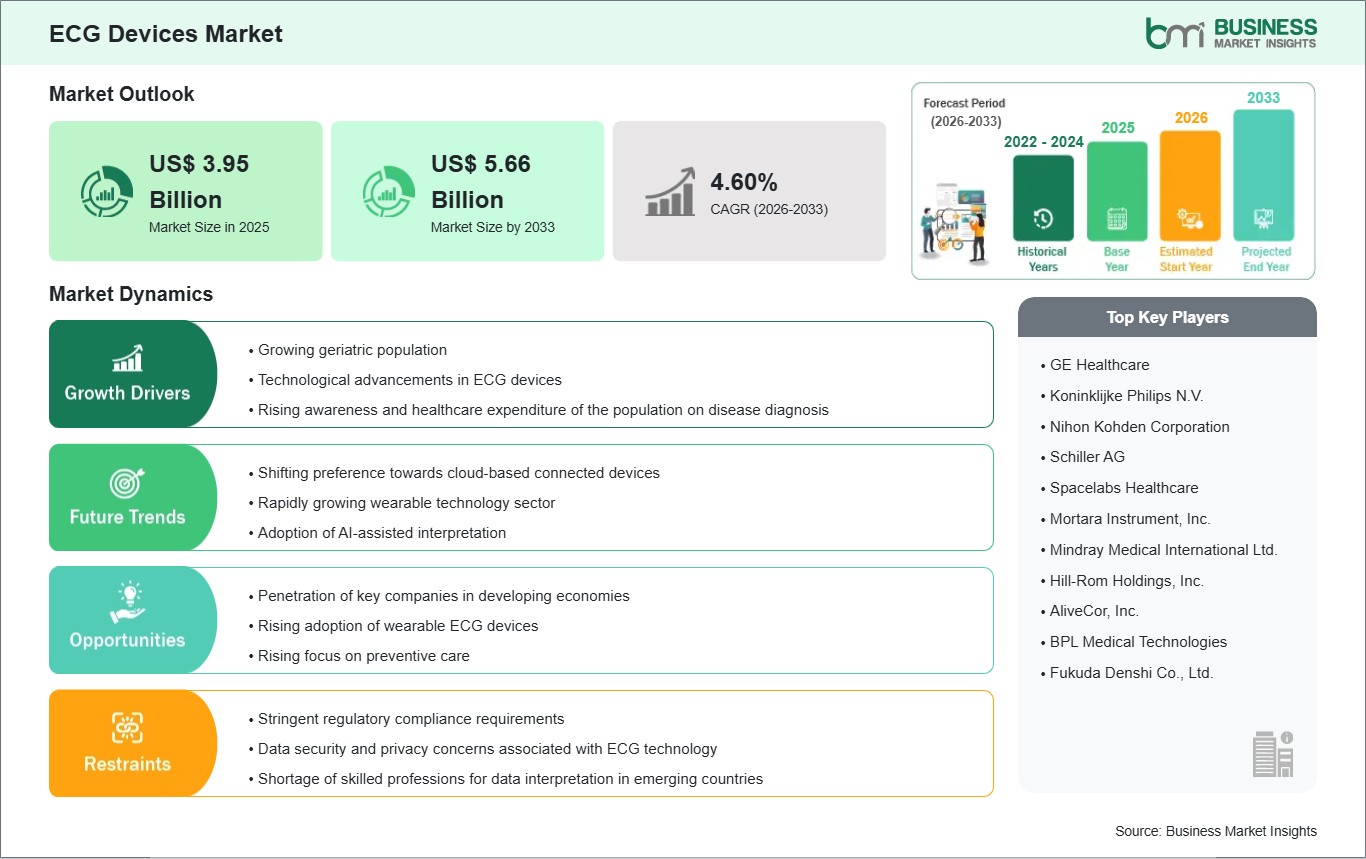
The ECG Devices market size is expected to reach US$ 5.66 Billion by 2033 from US$ 3.95 Billion in 2025. The market is estimated to record a CAGR of 4.6% from 2026 to 2033.
Electrocardiogram (ECG) is the most commonly used medical equipment in hospitals, emergency and urgent care units and ambulatory centers, thereafter, it reaches the home, care sector for the detection and monitoring of cardiac conditions. The growing prevalence of cardiovascular diseases such as arrhythmias, coronary artery disease, heart failure, and hypertension. Besides, the rising elderly population prone to cardiac disorders is further contributing to market growth. Active measures toward early diagnosis are taking place at a rapid pace since more and more people are becoming aware of the fact that the sooner a disease is detected, the higher are the chances for a safe and successful treatment. Besides, the emphasis on regular cardiac screening and continuous monitoring has been a reason for the increase in demand for ECG devices in acute and preventive care environments. In any case, the transition from inpatient to outpatient care and the remote monitoring of patients have led to a lively keen adoption of portable and wearable ECG solutions.
The prominent feature behind the rapid expansion of the market technologically is the creation of smart and wireless ECG devices that allow real, time data and remote interaction with the doctor, consequently, the patient will not have to go to the hospital. The capability of the device to be a part of the digital health platform, to keep the data on the cloud and to use Artificial Intelligence to automatically analyze the recorded ECG rhythm are the features that are solving most of the logistic and time constraints that accompany the diagnostic study while at the same time making the diagnosis more accurate. At the same time, by virtue of design simplicity and patient, friendliness, manufacturers are able to achieve plenty of innovation works for home healthcare settings, which in turn, lead to the extension and increase of the customer base in the market. As a result of energy, saving features, longer service life, and easy sterilization, the manufacturer's job has become even more complicated. Market players such as GE Healthcare, have been leading the innovation charge by promoting energy efficiency, device durability, and the incorporation of infection, control features in their product line, up

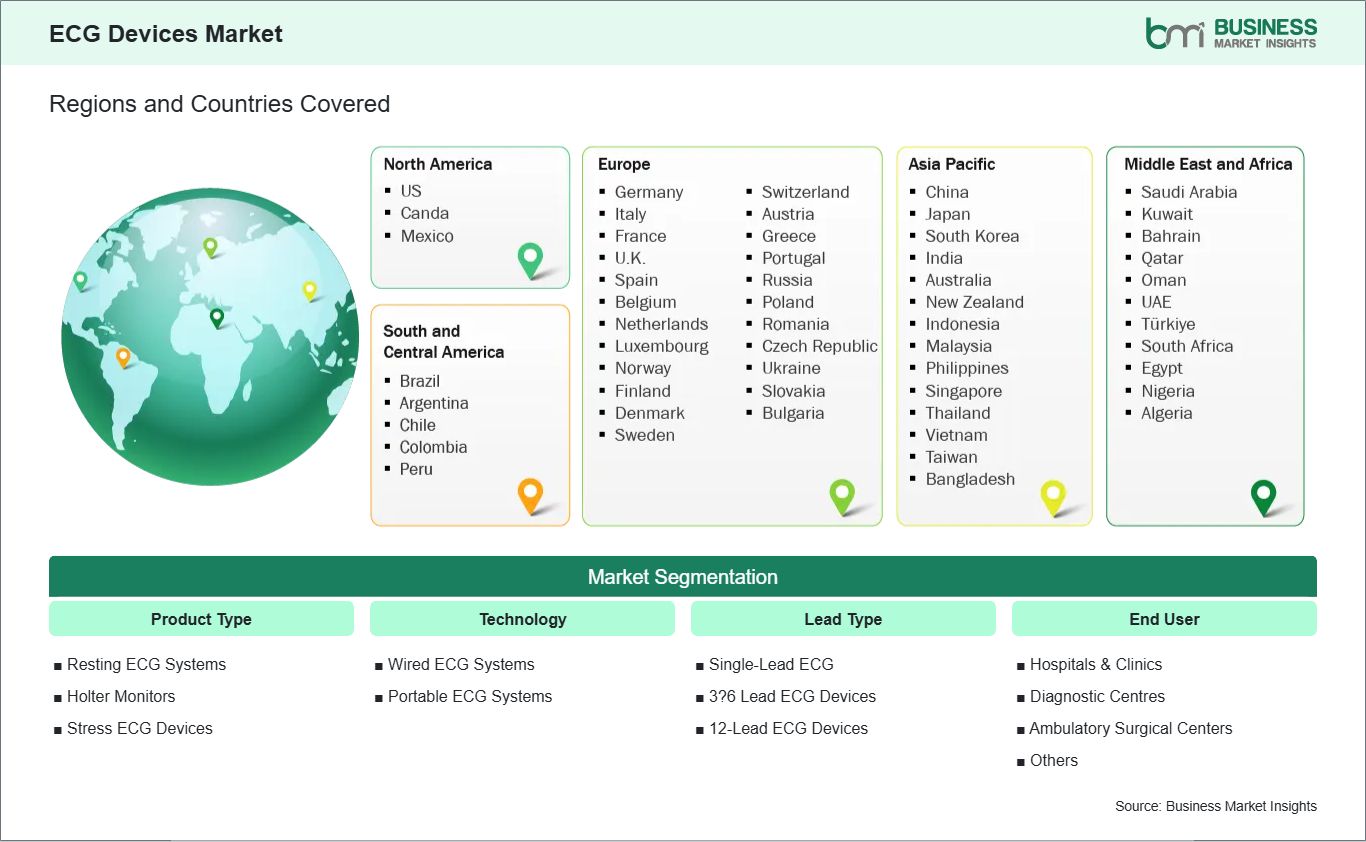
Key segments that contributed to the derivation of the ECG Devices market analysis are product type, technology, lead type, and end user.
The major factor driving the expansion of the diagnostic electrocardiograph (ECG) market is the global increase of cardiovascular diseases (CVDs) which, despite various efforts, continue to be the major cause of death globally. Some of the contributing factors to this are sedentary lifestyles, unhealthy diets, obesity, smoking, and increasing urbanization. The aforementioned conditions result in an increased incidence of arrhythmias, coronary artery disease, heart failure, and other cardiac disorders that require timely and accurate ECG monitoring for diagnosis and management.
Aging the global population rapidly is another factor creating the demand for ECG devices, as older adults are more vulnerable to cardiac issues and are thus more likely to require regular ECG examinations as a part of preventive care and management of chronic diseases. This population transition is especially noticeable in areas with a growing elderly population where healthcare systems need to reorganize their priorities to meet the demands of cardiac diagnostics.
Moreover, increasing concern among population about their heart health has led to an increase in the use of ECG equipment in the facilities of hospitals, outpatient clinics, and ambulatory care centers. This has been made possible by the collateral government initiatives that create awareness about the importance of early screening and preventive cardiology. To a considerable extent, technological improvements such as portable, wireless, and AI, influenced ECG systems have contributed to an increase in the demand for such devices by offering faster and more accurate diagnostics as well as remote monitoring possibilities. In the end, this leads to the avoidance of adverse cardiac events.
The market for ECG devices offers a lot of potential in developing countries in the Asia, Pacific region, Latin America, and Africa. The demand for diagnostic instruments is being propelled by rapid improvements in healthcare infrastructure, a rise in disposable income, and increased awareness of cardiovascular health. Medical care expansion through the construction of hospitals and clinics, especially in remote and less developed regions, requires affordable as well as portable ECG devices to satisfy this demand.
The move towards decentralized health care, which has been facilitated by the tele, health widespread use, has a wonderful sense for patients. They can now have an ECG recorded at home or checked remotely, and they do not have to come to the hospital on a regular basis. The ease of access to healthcare practitioners at the point, of, care facilities and home healthcare is improved by advances in wearable and wireless ECG gadgets that are smartphone compatible and AI, powered diagnostic tools.
Several countries have reimbursement regulations benefiting this trend, while patient and doctor willingness towards digital health solutions is the other side of the coin. Global manufacturers, local distributors; and a localized production strategy to cut down on cost are just a few of the ways through which the emerging markets have been turned into regions with a fast, growing rate in ECG devices, thus, creating an enormous opportunity for the market to expand and penetrate.
By product type, the ECG devices market is segmented into resting ECG Systems, holter monitors, stress ECG devices. The resting ECG systems segment dominated the market in 2025. Their dominance is largely driven by the general application in routine cardiac screening, diagnosis in case of emergency, and monitoring of the inpatient. Resting ECG systems are recognized as the first, line diagnostic tool of arrhythmias, myocardial infarction, and conduction abnormalities since these are the most accurate, easiest to use, and available in practically all healthcare settings.
By technology, the market is bifurcated into wired ECG systems and portable ECG systems. The portable ECG systems segment held the largest share of the market in 2025. The segment's expansion is attributed to the raised demand for point, of, care diagnostics, home healthcare, and remote patient monitoring. The portability, wireless connectivity, and smartphone integration make diagnosis quicker and patient facilitation better, which is why their adoption is supported outside the environment of a traditional hospital.
By lead type, the ECG devices market is segmented into single-lead ECG, 3–6 lead ECG devices, 12-lead ECG devices. The 12-lead ECG devices segment dominated the market in 2025. These devices are the clinical gold standard for comprehensive cardiac assessment, allowing detailed analysis of the electrical activity of the heart. The extensive use in emergency departments, ICUs, and cardiology units is what causes the strong demand..
By end user, the market is segmented into hospitals & clinics, diagnostic centres, ambulatory surgical centers, others. The hospitals & clinics segment held the largest share of the market in 2025. This growth is supported by the presence of an advanced diagnostic infrastructure, availability of skilled healthcare professionals, and high patient volumes which require continuous cardiac monitoring and emergency care.
| Report Attribute | Details |
|---|---|
| Market size in 2025 | US$ 3.95 Billion |
| Market Size by 2033 | US$ 5.66 Billion |
| Global CAGR (2026 - 2033) | 4.60% |
| Historical Data | 2022 - 2024 |
| Forecast period | 2026-2033 |
| Segments Covered | By Product Type
|
| Regions and Countries Covered | North America
|
| Market leaders and key company profiles |
|
The ECG Devices Market Size and Forecast (2025-2033) report provides a detailed analysis of the market covering below areas:
The geographical scope of the ECG Devices market report is divided into five regions: North America, Asia Pacific, Europe, Middle East & Africa, and South & Central America. The ECG Devices market in Asia Pacific is expected to grow significantly during the forecast period.
The Asia-Pacific ECG Devices market is segmented into China, Japan, South Korea, India, Australia, New Zealand, Indonesia, Malaysia, the Philippines, Singapore, Thailand, Vietnam, Taiwan, Bangladesh, and the Rest of Asia. The Asia Pacific market for ECG devices is undergoing a substantial expansion, mainly fueled by the increasing incidence of cardiovascular diseases, the rapid demographic changes, and the continuous enhancement of the healthcare infrastructure throughout the region. The trend of heart, related conditions is going up in such countries as China, India, Japan, South Korea, and Australia. The main reasons for that are aging populations, urbanization, sedentary lifestyles, and a higher occurrence of hypertension and diabetes. As a consequence, the demand for early diagnosis and continuous cardiac monitoring has risen dramatically, thus placing ECG devices as pivotal diagnostic tools.
The drive to adopt such devices is also fueled by the expanding healthcare services accessibility, especially in the developing countries, and the government initiatives aimed at strengthening primary care and preventive screening programs. Moreover, the region is witnessing the transition of demand for portable and wearable ECG devices. The trend is attributed to the increasing popularity of home healthcare and remote patient monitoring.
Technological innovations such as wireless connectivity, smartphone, based ECG systems, and AI, enabled interpretation, are making the diagnostics more accurate and user, friendly in both urban and semi, urban areas. Even though hospitals and diagnostic centers are the major users, home, care adoption is on the rise due to convenience and cost, and effectiveness. Furthermore, the local manufacturers' presence and collaborations with international players are contributing to product availability and affordability. In general, better healthcare access, technological innovation, and focus on preventive care are some of factors driving the market growth in Asia Pacific region.

The ECG Devices market is evaluated by gathering qualitative and quantitative data post primary and secondary research, which includes important corporate publications, association data, and databases. A few of the key developments in the ECG devices market are:
The ECG Devices Market is valued at US$ 3.95 Billion in 2025, it is projected to reach US$ 5.66 Billion by 2033.
As per our report ECG Devices Market, the market size is valued at US$ 3.95 Billion in 2025, projecting it to reach US$ 5.66 Billion by 2033. This translates to a CAGR of approximately 4.60% during the forecast period.
The ECG Devices Market report typically cover these key segments-
The historic period, base year, and forecast period can vary slightly depending on the specific market research report. However, for the ECG Devices Market report:
The ECG Devices Market is populated by several key players, each contributing to its growth and innovation. Some of the major players include:
The ECG Devices Market report is valuable for diverse stakeholders, including:
Essentially, anyone involved in or considering involvement in the ECG Devices Market value chain can benefit from the information contained in a comprehensive market report.
Please tell us your area of interest
(Market Segments/ Regions and Countries/ Companies)