Market Summary
Executive Summary and Global Market Analysis
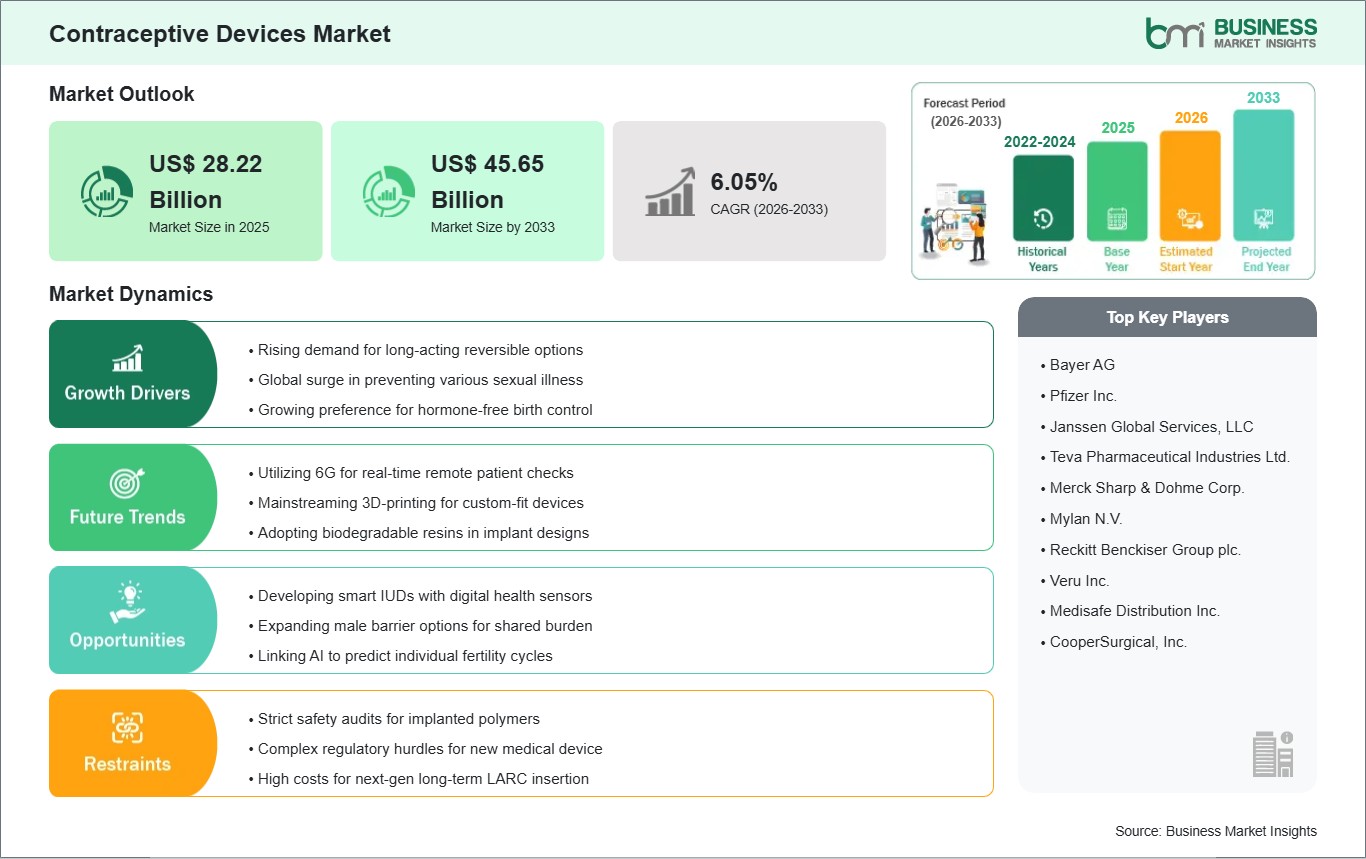
Contraceptive devices are specialized medical apparatuses and barrier tools designed to prevent pregnancy by interfering with the process of ovulation, fertilization, or implantation. Contraceptive options include Long-Acting Reversible Contraceptives (LARCs) like IUDs and implants, barrier methods such as condoms, diaphragms, and cervical caps, and permanent surgical implants for sterilization. There is an increased awareness of family planning, emphasis on women's empowerment and education, and government-supported policies that emphasize access to modern forms of contraception. Innovative LARCs, such as sleek, low-dose IUDs and biodegradable implants that dissolve on their own, are making contraception simpler and more accessible than ever.
However, several challenges can restrain market growth: high initial procurement costs for long-acting devices and specialized insertion procedures can limit adoption in resource-poor settings or areas with inadequate healthcare infrastructure. Stringent regulatory hurdles, including intensive safety monitoring and clinical trial requirements for hormonal systems, lengthen the time-to-market for innovative products. Moreover, the industry faces constraints due to social and cultural stigmas in certain regions, as well as concerns regarding hormonal side effects, such as mood changes or cycle irregularities, which remain a leading cause of device discontinuation among users.
Despite these hurdles, the market holds immense opportunities in the universal mandate for expanded reproductive rights and the accelerating deployment of non-hormonal, molecular-targeted technologies that minimize systemic side effects. The expansion of digital contraception (FDA-cleared apps) that utilize predictive algorithms for fertility tracking and the development of multipurpose prevention technologies (MPTs), which combine contraception with anti-retroviral protection, are expected to create significant opportunities for market growth.
Segment Analysis
Contraceptive Devices Market Segmentation
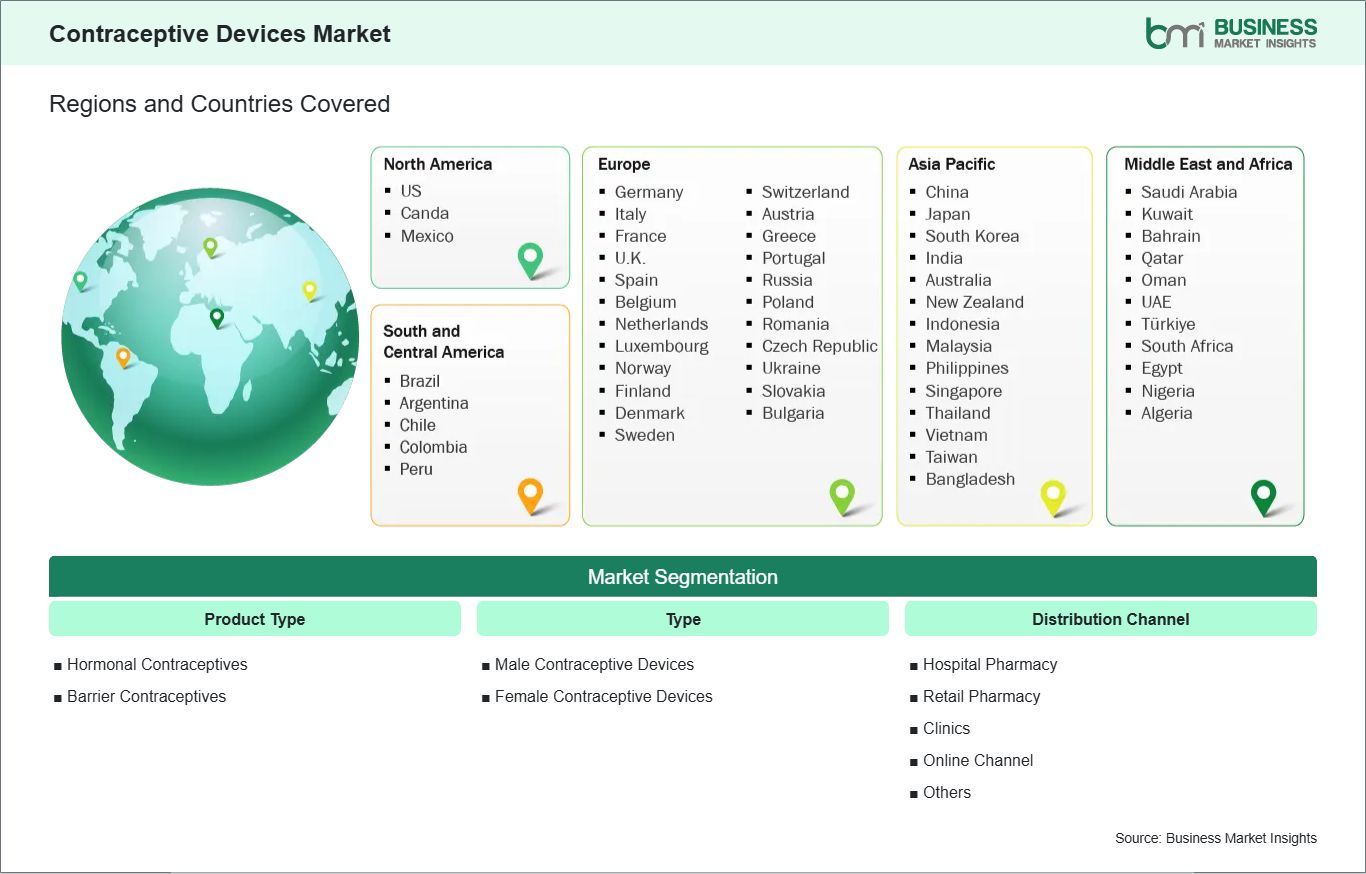
Key segments that contributed to the derivation of the Contraceptive Devices market analysis are product type, type, and distribution channel.
- By Product Type, the market is bifurcated into Hormonal Contraceptives and Barrier Contraceptives.
- By Type, the market is bifurcated into Male Contraceptive Devices and Female Contraceptive Devices.
- By Distribution Channel, the market is segmented into Hospital Pharmacy, Retail Pharmacy, Clinics, Online Channel, and Others.
Market Forces
Contraceptive Devices Market Drivers and Opportunities
Population Management and Growing Focus on Women’s Health
Governments and international health organizations are increasing reproductive health programs to help manage population growth and promote economic empowerment, especially in developing countries. Supportive regulations, better education, and more awareness about sexual health have helped reduce the stigma around contraception. The increasing prevalence of sexually transmitted diseases (STDs) has led to a greater adoption of barrier contraceptives, such as condoms, for the prevention of both pregnancy and disease. Furthermore, demographic trends, including a younger population and professionals postponing parenthood, continue to drive demand for reliable, long-term contraceptive methods. As healthcare infrastructure grows worldwide, easier access to these devices through pharmacies and public clinics supports steady market growth.
Long-Acting Reversibles and Digital Access
A high-value opportunity in the contraceptive market is the rapid uptake of Long-Acting reversible Contraceptives (LARCs), including intrauterine devices (IUDs), and sub-dermal devices. These devices are increasingly preferred for their greater efficacy compared to daily-adherence methods. Smaller, flexible, hormone-free copper systems are gaining popularity, particularly among adolescents. Digital tools, including e-pharmacies and subscription services, are improving access to contraception by increasing convenience and privacy. Additionally, there is significant potential for the development of new male contraceptives. As shared reproductive responsibility gains importance, non-surgical, reversible male devices like vas-occlusive gels represent a large, untapped market. Manufacturers that use eco-friendly materials, including biodegradable or non-latex options, are well-positioned to attract environmentally conscious consumers.
Size and Share Analysis
Contraceptive Devices Market Size and Share Analysis
The Contraceptive Devices market demonstrates steady growth, with size and share analysis revealing evolving trends and competitive positioning among key players. The report further examines subsegments categorized within product type, type, and distribution channel, offering insights into their contribution to overall market performance.
For instance, the Hormonal Contraceptives segment accounts for a significant portion of the market, fueled by the widespread adoption of Long-Acting Reversible Contraceptives (LARCs) such as intrauterine devices (IUDs) and subdermal implants. In 2025, a prominent trend is the shift toward "ultra-low-dose" and progestin-only formulations, which are favored by users seeking to minimize cardiovascular risks and estrogen-related side effects. Meanwhile, Barrier Contraceptives (product type) maintain a strong presence due to their critical role in preventing sexually transmitted infections (STIs), with innovations in non-latex materials and enhanced sensation designs broadening their appeal among consumers with sensitivities.
Report Coverage
Contraceptive Devices Market Report Coverage and Deliverables
The Contraceptive Devices Market Size and Forecast (2022–2033) report provides a detailed analysis of the market covering below areas:
- Contraceptive Devices market size and forecast at global, regional, and country levels for all the key market segments covered under the scope
- Contraceptive Devices market trends, as well as market dynamics such as drivers, restraints, and key opportunities
- Contraceptive Devices market analysis covering key market trends, global and regional framework, major players, regulations, and recent market developments
- Industry landscape and competition analysis covering market concentration, heat map analysis, prominent players, and recent developments for the Contraceptive Devices market
- Detailed company profiles, including SWOT analysis
Geographic Insights
Contraceptive Devices Market Geographic Insights
The geographical scope of the Contraceptive Devices market report is divided into five regions: North America, Asia Pacific, Europe, Middle East & Africa, and South & Central America.
The Asia-Pacific Contraceptive Devices Market is segmented into China, Japan, South Korea, India, Australia, New Zealand, Indonesia, Malaysia, the Philippines, Singapore, Thailand, Vietnam, Taiwan, Bangladesh, and the Rest of Asia. This region is witnessing significant growth in the market due to its massive population base and increasing focus on family planning. China and India lead the regional demand, fueled by government-led population control programs and rising healthcare investments. Japan and South Korea contribute through advanced healthcare infrastructure and high levels of awareness regarding reproductive rights.
Growth is supported by increased adoption of Long-Acting Reversible Contraceptives (LARCs), including intrauterine devices (IUDs) and implants, valued for their efficacy and convenience. The surge in e-commerce and online pharmacies is making these products more accessible than ever, particularly in bustling cities. With more women joining the workforce and societal attitudes shifting, the demand for discreet and dependable birth control is on the rise. These powerful trends are transforming Asia-Pacific into a vibrant hub for innovation and market expansion.
Industry Activity
Recent Developments
The Contraceptive Devices market is evaluated by gathering qualitative and quantitative data post primary and secondary research, which includes important corporate publications, association data, and databases. A few of the key developments in the Contraceptive Devices market are:
- In April 2024, Aspivix partnered with Bayer (Switzerland) AG to expand the adoption of its carevix® device, a suction-based cervical stabilizer that reduces pain and bleeding during IUD placement. The collaboration leverages Bayer’s marketing and educational outreach to gynecologists across Switzerland and aims to generate additional clinical evidence supporting the device’s patient-friendly design. The partnership addresses a major adoption barrier for IUDs, enhancing patient experience and supporting broader utilization in the contraceptive devices market.
- In September 2024, CooperSurgical, a global leader in women’s healthcare, announced the launch of a new inserter designed for single-hand placement of Paragard®, which was recently approved by the U.S. Food and Drug Administration (FDA). The new single-hand inserter simplifies the placement process for healthcare providers, making Paragard an even more accessible contraceptive choice for both providers and patients.
- In February 2025, Sebela Women’s Health announced FDA approval of MIUDELLA®, a next-generation, hormone-free copper intrauterine system (IUS) for pregnancy prevention for up to 3 years. MIUDELLA® features a small, flexible nitinol frame and a preloaded inserter for easier placement, using less than half the copper of existing copper IUDs. Clinical trials demonstrated 99% efficacy, low expulsion rates, and minimal discontinuations, making MIUDELLA® the first new hormone-free IUD approved in the U.S. in over 40 years. This launch expands contraceptive choices and addresses unmet demand for non-hormonal birth control options.
Trust & Transparency
Research Methodology
The market analysis combines proprietary research with secondary data from government agencies, company disclosures, regulatory filings, industry databases and expert interviews. Market estimates are validated through data triangulation, cross-market benchmarking and analyst
review.
View Full Research Methodology
Key Sources Referred:
World Bank – Global Trade IndicatorsWorld Trade Organization (WTO)International Monetary Fund (IMF)International Trade Administration (ITA)Company WebsitesCompany Annual ReportsCompany Investor Presentations