
Refractive Surgery Devices Market Outlook: Size, Share, Trends, Growth Analysis, Competitive Landscape & Forecast, 2026-2033

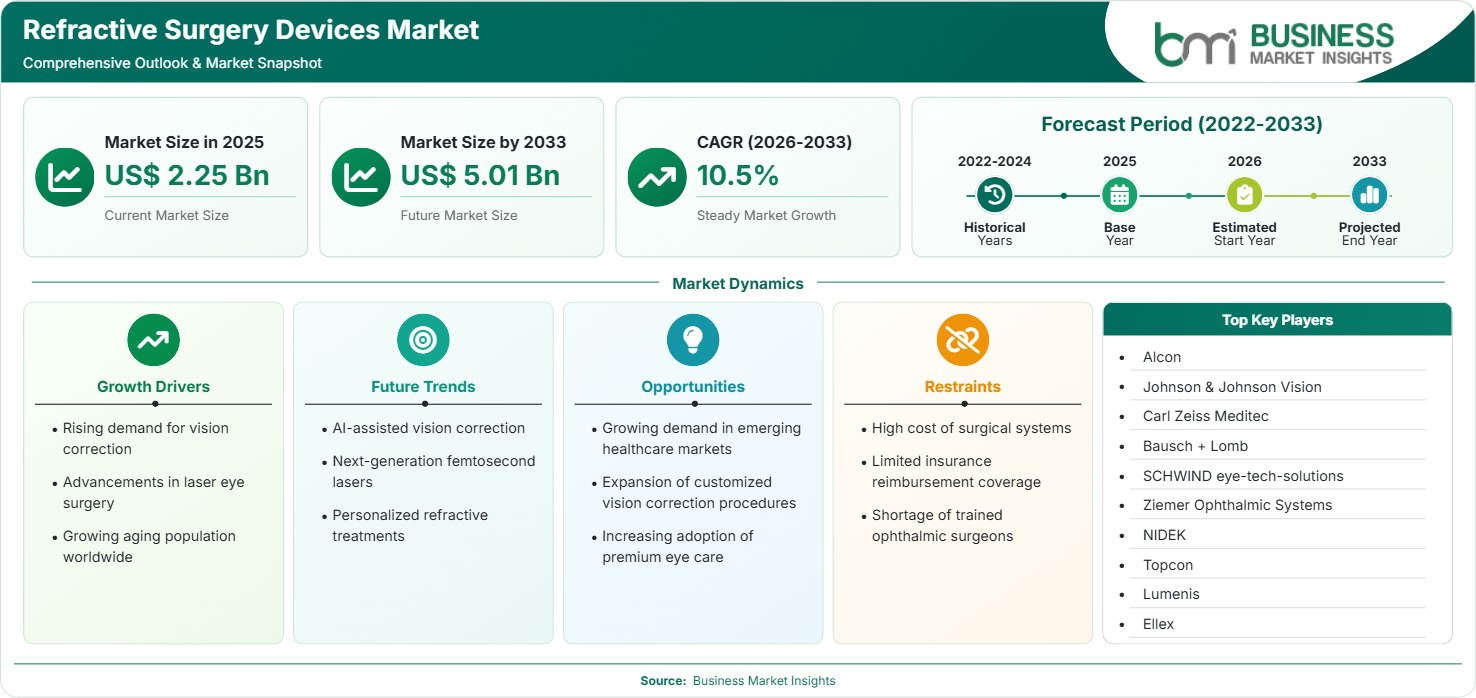
The Refractive Surgery Devices Market size was valued at US$ 2.25 billion in 2025 and is projected to reach US$ 5.01 billion by 2033, growing at a CAGR of 10.52% from 2026 to 2033, driven by increasing vision correction demand, laser surgery advancements, aging population growth, customized procedures, and rising adoption of premium ophthalmic care.

Report Coverage
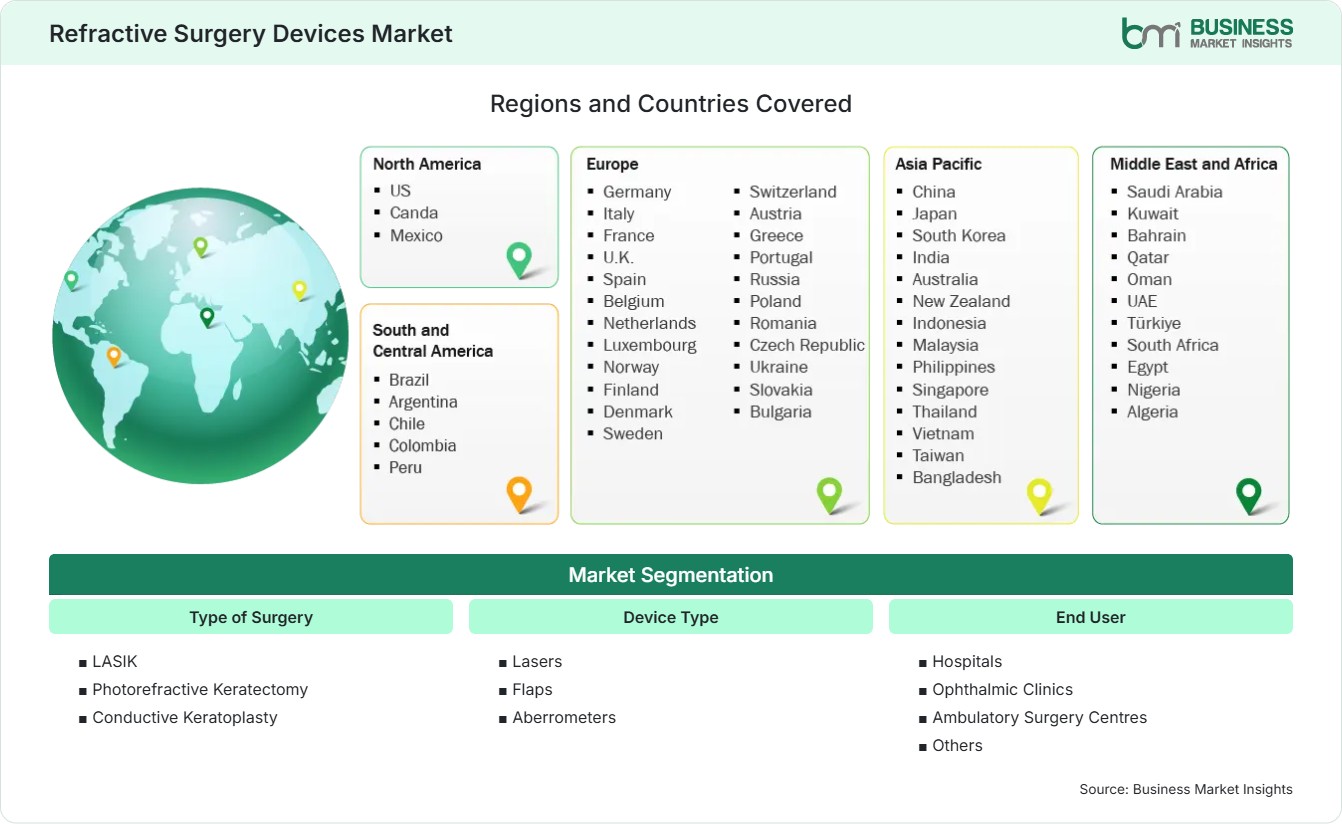
  • Type of Surgery: LASIK, Photorefractive Keratectomy, Conductive Keratoplasty
  • Device Type: Lasers, Flaps, Aberrometers
  • End User: Hospitals, Ophthalmic Clinics, Ambulatory Surgery Centres, Others
US$ 2.25 Bn Market size in 2025
US$ 5.01 Bn Market Size by 2033
10.5% CAGR, 2026 - 2033
2026-2033 Forecast Period

01 AI Overview

Refractive Surgery Devices Market Summary

  • North America Region: North America holds a market share of 38%–41% in 2025, growing with a CAGR of 9%–11%, influenced by advanced ophthalmic infrastructure, high procedure adoption, premium eye care demand, and technological innovation. The US market expands with a CAGR of 9%–11% during 2026–2033, supported by strong healthcare spending and advanced vision correction adoption.
  • Fastest Growing Region: Asia Pacific represents a share range of 25%–28% in 2025, expanding with a CAGR of 12%–14% driven by rising eye disorder prevalence, healthcare modernization, increasing disposable income, and expanding access to advanced ophthalmic procedures.
  • Leading Segment: LASIK represents the leading surgery type segment with a share range of 58%–61% in 2025, growing at a CAGR of 10%–12% due to high clinical adoption, improved outcomes, and strong patient preference for vision correction procedures.
  • High Growth Segment: Aberrometers demonstrate a share range of 15%–18% in 2025, expanding at a CAGR of 13%–15% due to increasing personalized treatments, wavefront analysis adoption, and precision ophthalmic diagnostics.
  • Key Market Opportunity: Opportunities are concentrated in emerging healthcare markets, customized refractive procedures, premium ophthalmic services, and advanced laser-based vision correction technologies.
  • Major Market Players: Alcon, Johnson & Johnson Vision, Carl Zeiss Meditec, Bausch + Lomb, SCHWIND eye-tech-solutions, Ziemer Ophthalmic Systems, NIDEK, Topcon, Lumenis, Ellex.
02 Strategic Insights

Refractive Surgery Devices Market: Strategic Insights

refractive-surgery-devices-market-market-strategic-framework
FREE PDF
Request your free sample
Request free sample
03 Stakeholder View

Key Takeaways

  • The ophthalmic device ecosystem is shifting toward precision-based procedures supported by advanced lasers, diagnostic technologies, and customized treatment planning systems.
  • Growth opportunities are concentrated in LASIK procedures, emerging healthcare markets, premium eye care services, and personalized refractive correction solutions.
  • Innovation is focused on improving laser accuracy, reducing recovery time, enhancing patient screening, and integrating digital diagnostic capabilities.
  • Asia Pacific offers strong investment potential due to rising vision correction demand, healthcare infrastructure development, and increasing ophthalmology service availability.
  • Strategic partnerships, technology upgrades, and product portfolio expansion are shaping competition among ophthalmic device manufacturers.
04 Geographic Outlook

Refractive Surgery Devices Market Regional Highlights

North America Refractive Surgery Devices Market

North America accounted for a share range of 38%–41% in 2025 and is projected to grow at a CAGR of 9%–11% during 2026–2033. The region maintains leadership due to advanced healthcare systems, high adoption of laser vision correction procedures, and a strong presence of ophthalmic technology companies. The Refractive Surgery Devices Market share in North America is supported by premium eye care demand and advanced surgical infrastructure.

  • The United States remains the largest contributor due to high LASIK adoption, advanced ophthalmology clinics, and strong healthcare technology investments.
  • Ophthalmic centers are increasingly adopting advanced laser platforms to improve treatment precision and patient satisfaction.
  • Premium vision correction procedures are gaining popularity among consumers seeking alternatives to corrective lenses.
  • Technology providers continue investing in advanced imaging, diagnostics, and customized treatment solutions.

US Refractive Surgery Devices Market

The US represented a share range of 33%–36% in 2025 and is expected to expand at a CAGR of 9%–11% between 2026 and 2033. The country remains a major market due to established ophthalmic facilities, strong physician expertise, and high demand for elective vision correction procedures. Growth is supported by technological advancements and increasing preference for personalized surgical outcomes.

  • Ophthalmic clinics are expanding the adoption of advanced laser systems for customized refractive procedures.
  • Consumer interest in reducing dependence on glasses and contact lenses continues to support procedure volumes.
  • Healthcare providers are integrating advanced diagnostic tools to improve surgical planning and patient selection.
  • Manufacturers are developing next-generation systems focused on accuracy, efficiency, and improved patient experience.

Europe Refractive Surgery Devices Market

Europe held a share range of 27%–30% in 2025, growing at a CAGR of 10%–12% during 2026–2033. The region benefits from established eye care infrastructure, advanced medical technology adoption, and increasing demand for vision correction procedures. Germany, the United Kingdom, and France represent leading markets, while Italy and Spain demonstrate growth opportunities through expanding ophthalmic services.

  • Germany supports market expansion through advanced healthcare facilities and strong medical technology adoption.
  • The United Kingdom is increasing investment in specialized ophthalmic procedures and advanced surgical equipment.
  • France demonstrates growing demand for premium vision correction and personalized treatment approaches.
  • European ophthalmology centers are adopting advanced diagnostic and laser technologies to improve outcomes.

Asia Pacific Refractive Surgery Devices Market

Asia Pacific accounted for a share range of 25%–28% in 2025 and is expanding at a CAGR of 12%–14% during 2026–2033. The region represents the fastest-growing market due to increasing vision impairment prevalence, healthcare modernization, rising disposable income, and expanding access to ophthalmic procedures. China, Japan, India, South Korea, and Southeast Asian countries are driving regional growth through investments in eye care infrastructure.

  • China is expanding the adoption of refractive surgery devices through growing ophthalmology networks, healthcare investment, and increasing patient awareness.
  • India is witnessing a rising demand for vision correction procedures due to expanding private eye care facilities and improving healthcare accessibility.
  • Japan and South Korea continue advancing ophthalmic technologies through strong medical research capabilities and advanced surgical adoption.
  • Southeast Asian countries are improving access to laser vision correction through healthcare infrastructure development and specialized clinics.

Rest of World Refractive Surgery Devices Market

The rest of the world represented a share range of 5%–8% in 2025, growing at a CAGR of 10%–12% during 2026–2033. Latin America, the Middle East, and Africa are gradually adopting refractive surgery technologies through healthcare expansion, medical tourism growth, and improved ophthalmic services. Brazil, Mexico, Saudi Arabia, and the UAE represent emerging markets supported by increasing eye care investments.

  • Brazil is expanding refractive procedure adoption through private ophthalmology clinics, medical technology investments, and growing patient awareness.
  • Mexico is developing specialized eye care services supported by healthcare modernization and increasing demand for corrective procedures.
  • Saudi Arabia and the UAE are investing in advanced ophthalmology centers as part of healthcare transformation programs.
  • African markets are improving access to vision care through healthcare partnerships and expanding medical infrastructure.
global-market-geography
FREE PDF
Request your free sample
Request free sample
05 Segment Analysis

Refractive Surgery Devices Market Segmentation

Type of Surgery

The type of surgery segment is driven by increasing patient preference for vision correction procedures, technological improvements, and demand for customized outcomes. LASIK represented the leading segment with a share range of 58%–61% in 2025 and a CAGR of 10%–12% between 2026 and 2034. The Refractive Surgery Devices Market scope is expanding through improved laser systems, broader clinical adoption, and increasing awareness of surgical alternatives.

  • LASIK: LASIK remains the dominant procedure due to established clinical outcomes, shorter recovery periods, high patient acceptance, and widespread availability across ophthalmic facilities.
  • Photorefractive Keratectomy: Photorefractive Keratectomy adoption continues through applications among patients requiring surface-based correction approaches and specific corneal treatment considerations.
  • Conductive Keratoplasty: Conductive Keratoplasty supports specialized vision correction applications through controlled thermal treatment methods and is suitable for selected patient groups.

Device Type

The device type segment reflects increasing adoption of advanced surgical platforms, diagnostic technologies, and precision treatment systems. Lasers represent the leading category due to their central role in refractive procedures and continuous technological improvements. The Refractive Surgery Devices Market trends indicate increasing demand for integrated systems combining diagnostics, treatment planning, and surgical execution capabilities.

  • Lasers: Laser systems drive market adoption through improved precision, faster procedures, enhanced customization, and widespread use in modern refractive surgery.
  • Flaps: Flap technologies support LASIK procedures by enabling controlled corneal access and improving surgical workflow efficiency.
  • Aberrometers: Aberrometers are increasingly used for wavefront analysis, customized treatment planning, and improved evaluation of optical imperfections.

End User

The end-user segment is influenced by healthcare delivery models, availability of ophthalmic expertise, and patient access to specialized procedures. Hospitals and ophthalmic clinics represent major adoption centers due to comprehensive facilities and skilled professionals. Ambulatory surgery centers are expanding due to efficient outpatient treatment models and growing demand for elective vision correction services.

  • Hospitals: Hospitals provide advanced ophthalmology departments, specialized surgical infrastructure, and comprehensive patient management capabilities for refractive procedures.
  • Ophthalmic Clinics: Ophthalmic clinics represent key providers due to focused expertise, specialized equipment availability, and increasing consumer preference for dedicated eye care services.
  • Ambulatory Surgery Centers: Ambulatory surgery centers support convenient outpatient procedures, reduced hospital dependency, and efficient delivery of refractive surgery services.
06 Market Forces

Refractive Surgery Devices Market Dynamics

Key Market Drivers

Rising Demand for Vision Correction

The increasing demand for vision correction procedures is a major driver of market expansion, as more individuals seek alternatives to glasses and contact lenses. The Refractive Surgery Devices Market growth is influenced by rising awareness of elective eye procedures, improving surgical outcomes, and expanding access to ophthalmic services. The rates of myopia, hyperopia, and astigmatism have been consistently rising across the world, hence the need for corrective methods. With advances in laser technology, procedures are becoming more accurate and safer. There has also been increased investment by health institutions in high-end equipment to satisfy the changing consumer demands. More so, people prefer living without glasses.

Advancements in Laser Eye Surgery

Technological advancements in laser eye surgery are improving precision, customization, and procedural efficiency across ophthalmic applications. The Refractive Surgery Devices Market trends reflect growing adoption of femtosecond lasers, wavefront-guided systems, and advanced imaging technologies. The technologies allow surgeons to create individual treatment plans based on patients' specific eye features. The companies that produce medical equipment have started to create integrated systems that can include diagnostic devices, software solutions, and surgical devices to increase the effectiveness of the operations. Increased automation helps to make procedures simpler and to achieve constant results. Research in ophthalmic technologies advances the development of new methods for performing refractive correction procedures.

Growing Aging Population Worldwide

The growing number of aged people in the world has led to an increased need for ophthalmic procedures. Various age-related eye disorders, such as presbyopia and refractive disorders, have provided scope for new surgical instruments. The increasing needs of the aging population have made ophthalmic procedures a key area of focus within the healthcare industry. Premium vision correction procedures are increasingly being adopted due to the growing need for a better standard of living and minimal reliance on vision correction. Technological advances by device makers cater to different vision problems across age groups. The aging population and increased health care penetration will continue driving the demand for refractive surgery devices.

Key Market Opportunities

Growing Demand in Emerging Healthcare Markets

Healthcare markets are developing in the region, providing opportunities owing to expanding ophthalmology infrastructure, rising disposable incomes, and growing awareness of advanced vision correction procedures. Countries in the Asia-Pacific region, Latin America, and the Middle East are establishing specialized eye care clinics and adopting new medical technologies. There is an increase in the establishment of ophthalmology clinics by private healthcare organizations owing to the increasing need for elective procedures. Manufacturers can create their presence in the market by partnering with regional clinics and offering affordable technology. These markets provide long-term growth potential as access to specialized eye care continues improving, supporting the refractive surgery devices market forecast.

Expansion of Customized Vision Correction Procedures

Tailored vision correction procedures are presenting opportunities by offering treatment methods tailored to the specific characteristics of the eye. With the help of modern diagnostics, wavefront techniques, and advanced laser systems, ophthalmologists can provide more accurate treatments. Patients become interested in procedures that will ensure higher-quality vision and meet their optical needs. Manufacturers of such equipment are concentrating on diagnostic technology combined with software and surgical systems to provide individualized care solutions. The increasing prevalence of premium ophthalmological services drives clinics to implement new-generation platforms providing unique solutions. Development in customized procedures will further increase the demand for refractive surgery equipment.

Increasing Adoption of Premium Eye Care

Premium eye care adoption is expanding as consumers prioritize advanced treatments, improved visual outcomes, and personalized healthcare experiences. Rising healthcare awareness and increasing willingness to invest in elective procedures are supporting demand for sophisticated refractive technologies. Ophthalmic clinics are introducing premium service models supported by advanced lasers, diagnostics, and customized treatment options. Manufacturers are developing innovative devices that enable providers to offer differentiated procedures with enhanced accuracy and efficiency. Growing private healthcare expenditure and increasing focus on quality-of-life improvements are encouraging the adoption of advanced vision correction solutions. Premium eye care trends are expected to create additional opportunities for technology providers and specialized clinics.

Market Restraints and Challenges

High Cost of Surgical Systems

Factor: Advanced refractive surgery systems require substantial capital investment due to sophisticated laser platforms, diagnostic technologies, software integration, and maintenance requirements.

Impact: High equipment costs can limit adoption among smaller ophthalmic clinics, hospitals, and healthcare providers in cost-sensitive regions. Although advanced systems improve surgical precision and efficiency, initial acquisition expenses remain a major consideration for healthcare organizations. Additional costs related to training, servicing, and technology upgrades can influence purchasing decisions.

Limited Insurance Reimbursement Coverage

Factor: Limited insurance coverage for elective refractive procedures creates affordability barriers because many vision correction surgeries are considered non-essential treatments.

Impact: Patients may delay procedures due to out-of-pocket expenses, restricting demand growth in markets with limited reimbursement support. Healthcare providers often rely on direct patient payments, which can influence procedure volumes and accessibility. Reimbursement policies vary significantly across countries, affecting adoption patterns and market expansion.

07 Company Analysis

Competitive Landscape

The Refractive Surgery Devices Market analysis highlights a competitive environment driven by ophthalmic technology innovation, laser platform development, diagnostic integration, and expanding premium eye care services. Leading companies are focusing on precision technologies, customized treatment solutions, strategic partnerships, and product advancements to strengthen their position in the global ophthalmology sector.

Company Name

Overview

Products and Services relevant to this market

Alcon

Global eye care company providing surgical and vision care solutions.

Refractive lasers, ophthalmic surgical systems, and vision correction technologies.

Johnson & Johnson Vision

An eye health company focused on vision correction and ophthalmic innovation.

Laser vision technologies, refractive solutions, and eye care products.

Carl Zeiss Meditec

Medical technology company specializing in ophthalmology systems.

Refractive lasers, diagnostic devices, and surgical visualization technologies.

Bausch + Lomb

Eye health company developing ophthalmic products and surgical solutions.

Refractive surgery technologies, ophthalmic equipment, vision care solutions.

SCHWIND eye-tech-solutions

Ophthalmic technology provider specializing in laser systems.

Excimer lasers, femtosecond lasers, customized refractive surgery platforms.

Ziemer Ophthalmic Systems

An ophthalmic device company focused on laser-based eye surgery solutions.

Femtosecond lasers, ophthalmic surgical systems, refractive platforms.

NIDEK

Medical technology company providing ophthalmic diagnostic and surgical equipment.

Excimer lasers, refractive devices, and eye examination systems.

Topcon

Healthcare technology company specializing in ophthalmic equipment.

Diagnostic imaging systems, ophthalmic devices, eye care technologies.

Lumenis

Medical technology company offering energy-based treatment systems.

Laser technologies, ophthalmic treatment systems, and surgical solutions.

Ellex

An ophthalmic technology company focused on laser eye care solutions.

Ophthalmic lasers, vision treatment technologies, and eye care systems.

08 Industry Activity

Recent Developments

May 2026

Carl Zeiss Meditec received FDA approval for a supplement to the VISUMAX Femtosecond Laser related to an in-process quality control parameter change, supporting continued manufacturing and quality management of its refractive surgery laser platform.

September 2025

Alcon launched Wavelight Plus in the U.S. and Canada, introducing a fully personalized LASIK treatment approach using ray-tracing technology to create individualized treatment plans based on each patient’s optical system. The launch strengthened Alcon’s refractive surgery technology portfolio.

August 2025

Carl Zeiss Meditec received FDA approval for a VISUMAX 800 Femtosecond Laser supplement covering a new supplier for a component of the laser system, supporting supply chain continuity for its refractive surgery device platform.

March 2025

Alcon received FDA approval for a supplement to the WaveLight EX500 Laser System, expanding the device’s approved use with INNOVEYES Sightmap for WaveLight Plus LASIK treatments for the correction of myopia and myopic astigmatism.

10 Trust & Transparency

Research Methodology

The market analysis combines proprietary research with secondary data from government agencies, company disclosures, regulatory filings, industry databases and expert interviews. Market estimates are validated through data triangulation, cross-market benchmarking and analyst review.

View Full Research Methodology

11 Questions Answered

Frequently Asked Questions

How does the Refractive Surgery Devices Market Report support industry stakeholders?

The market report provides insights into market trends, competitive strategies, regional opportunities, segment performance, and technology developments.

What challenges affect refractive surgery device adoption?

High equipment costs, limited reimbursement coverage, specialized training requirements, and affordability concerns can restrict adoption among some healthcare providers and patients.

How are customized treatments influencing ophthalmic care?

Customized treatments use advanced diagnostics and personalized planning methods to improve surgical precision, visual outcomes, and patient satisfaction.

Which procedure dominates the refractive surgery devices market?

LASIK remains a leading procedure due to strong clinical adoption, established outcomes, shorter recovery periods, and widespread availability among ophthalmic providers.

What factors are driving demand for refractive surgery devices?

Increasing demand for vision correction, technological improvements in laser procedures, aging population growth, and rising awareness of advanced ophthalmic treatments are supporting market expansion.

Access the Full Refractive Surgery Devices Market Report

Get segment-level forecasts, regional estimates, competitive benchmarking, company profiles and downloadable Excel datasets.

Access the full Refractive Surgery Devices Market Report
350 pages PDF & Excel | 2026-07-30