
Cosmetic Surgery Market Outlook: Size, Share, Trends, Growth Analysis, Competitive Landscape & Forecast, 2026-2033

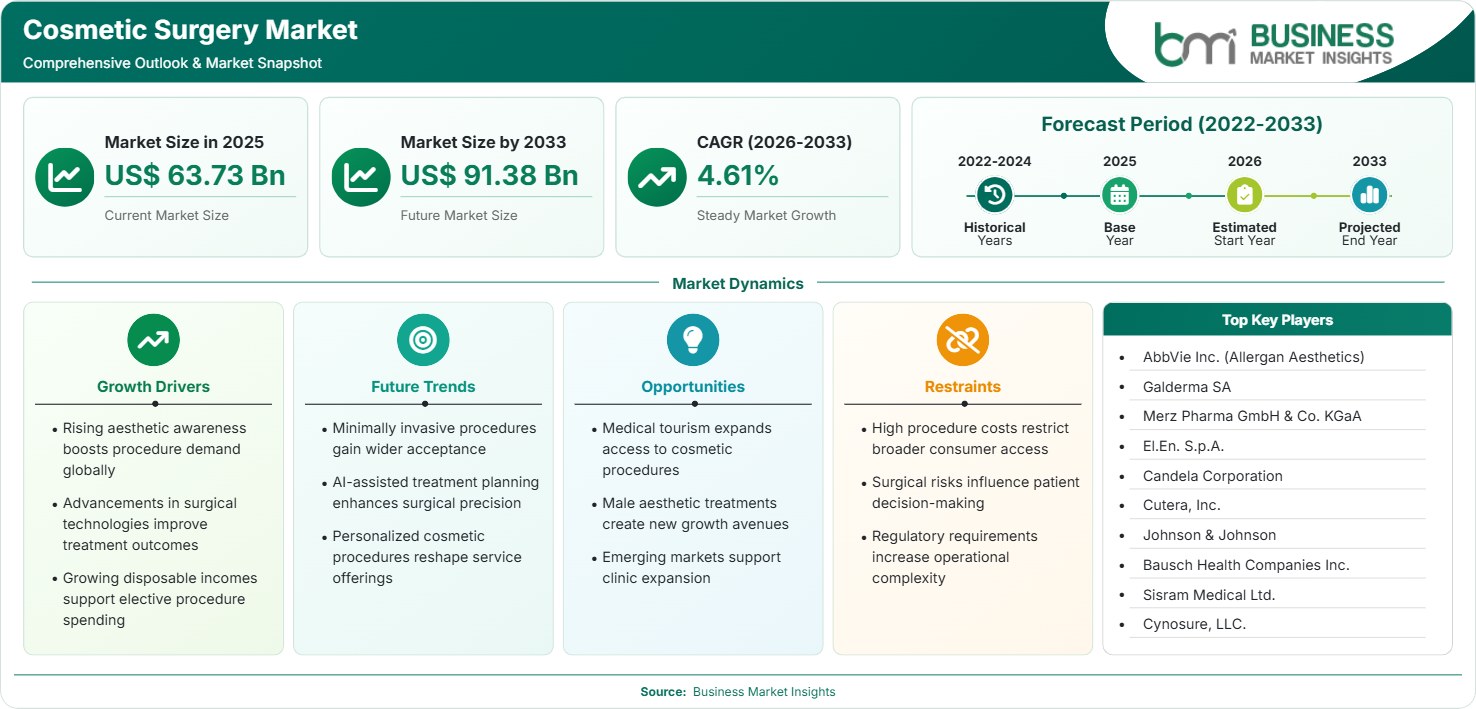
The Cosmetic Surgery Market size was valued at US$ 63.73 Billion in 2025 and is projected to reach US$ 91.38 Billion by 2033, growing at a CAGR of 4.61% during 2026–2033. Key drivers include rising aesthetic awareness, minimally invasive procedures, medical tourism expansion, advanced imaging technologies, growing male participation, and increasing demand for personalized aesthetic treatments globally.

Report Coverage
  • Procedure: Surgical Procedures, Non-Surgical Procedures
  • Gender: Female, Male
  • Age Group: 18 Years and Younger, 19 to 34 Years, 35 to 50 Years, 51 to 64 Years, 65 Years & Above
  • Provider: Hospitals, Specialty Clinics, Spas, Cosmetic Surgery Centers
US$ 63.73 Bn Market size in 2025
US$ 91.38 Bn Market Size by 2033
4.61% CAGR, 2026 - 2033
2026-2033 Forecast Period

AI Overview

Cosmetic Surgery Market Summary

  • North America Region: North America holds a market share of 36%–39% in 2025, growing at a CAGR of 3.8%–4.3% during 2026–2033. Key drivers include high disposable incomes, advanced aesthetic infrastructure, strong procedural volumes, technological innovation adoption, provider concentration, medical financing accessibility, expanding minimally invasive offerings, and celebrity influence on consumer demand. The U.S. dominates regional demand through procedure innovation and clinic density, advancing at a CAGR of 3.9%–4.4%.
  • Fastest Growing Region: Asia Pacific holds a market share of 24%–27% in 2025, growing at a CAGR of 5.8%–6.4% during 2026–2033. Key drivers include expanding middle-class populations, medical tourism, digital beauty culture, affordability advantages, increasing specialist availability, advanced clinics, rising self-image spending, and growing demand across younger demographics.
  • Leading Segment: Non-Surgical Procedures hold a market share of 54%–57% in 2025, growing at a CAGR of 5.0%–5.6% during 2026–2033. Key drivers include reduced recovery periods, lower procedural costs, repeat treatment demand, filler innovation, botulinum toxin adoption, clinic accessibility, personalized care, and enhanced patient convenience.
  • High Growth Segment: Male holds a market share of 20%–23% in 2025, growing at a CAGR of 6.0%–6.7% during 2026–2033. Key drivers include workplace appearance awareness, social media visibility, hair restoration demand, facial contouring uptake, reduced stigma, higher disposable income, wellness integration, and targeted aesthetic marketing.
  • Key Market Opportunity: Expansion of AI-enabled consultation platforms, regenerative aesthetics, personalized treatment planning, medical tourism ecosystems, and wellness-focused cosmetic programs creates scalable revenue streams while improving patient engagement and procedural conversion rates.
  • Major Market Players: AbbVie Inc. (Allergan Aesthetics), Galderma SA, Merz Pharma GmbH & Co. KGaA, El.En. S.p.A., Candela Corporation, Cutera, Inc., Johnson & Johnson, Bausch Health Companies Inc., Sisram Medical Ltd., and Cynosure, LLC.
Strategic Insights

Cosmetic Surgery Market: Strategic Insights

Cosmetic Surgery Market Strategic Framework
FREE PDF
Request your free sample
Request free sample
Stakeholder View

Key Takeaways

  • The market ecosystem increasingly integrates device manufacturers, injectable suppliers, specialty surgeons, dermatologists, medical spas, digital consultation providers, and financing platforms, creating a multilayered value chain focused on patient experience.
  • Non-invasive facial rejuvenation, skin tightening, body contouring, and male aesthetics represent the strongest revenue expansion opportunities due to shorter recovery periods and recurring treatment demand patterns.
  • AI-based facial mapping, 3D visualization, regenerative medicine, biostimulators, and personalized treatment protocols are redefining clinical workflows and patient decision-making processes.
  • Asia Pacific offers an attractive investment case, supported by medical tourism hubs in South Korea, Thailand, Singapore, and India, alongside expanding urban middle-class spending.
  • Clinic consolidation, private equity participation, and strategic acquisitions among aesthetic device and injectable manufacturers continue to strengthen competitive positioning and geographic reach.
  • Aging populations in developed economies are increasing demand for preventive and maintenance-focused aesthetic treatments, supporting repeat procedure volumes and patient lifetime value.
Geographic Outlook

Cosmetic Surgery Market Regional Highlights

North America Cosmetic Surgery

North America accounts for 36%–39% of global revenue in 2025 and is projected to register a CAGR of 3.8%–4.3% through 2033. Strong consumer spending, established provider networks, and high adoption of injectables support regional leadership. The Cosmetic Surgery Market share remains highest in the region due to advanced reimbursement financing models and broad procedure availability. Demand increasingly favors facial rejuvenation, body contouring, and minimally invasive procedures. Growth also benefits from physician specialization and continuous introduction of novel aesthetic technologies.

  • High concentration of board-certified surgeons strengthens procedural quality, patient confidence, innovation adoption, and premium treatment pricing across major metropolitan markets.
  • Injectable treatments remain dominant because repeat treatments create recurring revenue streams and encourage long-term patient engagement.
  • Demand among middle-aged consumers supports facial rejuvenation growth while younger consumers increasingly select preventative aesthetic procedures.
  • Medical spas and specialty aesthetics centers continue expanding treatment accessibility outside traditional hospital environments.
  • Social media influence and digital consultation tools are accelerating treatment awareness and conversion rates.

US Cosmetic Surgery

The United States represents 78%–82% of the North American Cosmetic Surgery Market demand and is expected to expand at a CAGR of 3.9%–4.4% through 2033. According to ISAPS, the country remains the largest aesthetic procedure market globally. Strong physician density, innovation leadership, and consumer acceptance support sustained expansion. Premium injectable brands, energy-based devices, and personalized aesthetic treatment pathways remain central growth pillars.

  • Advanced clinic networks support efficient patient management and broad procedure accessibility across states.
  • Facial procedures experience strong demand driven by aging demographics and preventive aesthetic care preferences.
  • Regulatory oversight enhances confidence in approved devices, injectables, and surgical procedures.
  • Growing male participation expands addressable demand across facial treatments, body contouring, and hair restoration.

Europe Cosmetic Surgery

Europe holds 27%–30% Cosmetic Surgery Market share in 2025 and is forecast to grow at a CAGR of 4.2%–4.8% through 2033. Germany, France, Italy, and the United Kingdom represent major procedure hubs. Demand is supported by aging populations, high awareness of minimally invasive treatments, and developed healthcare infrastructure. The region balances advanced technology adoption with strong clinical standards. Germany leads regional revenue generation, while Eastern European destinations demonstrate higher growth rates approaching 5.0%–5.5%.

  • Injectable aesthetics continue outperforming traditional surgery in procedure volume growth across major countries.
  • Cross-border medical tourism contributes to clinic utilization rates in several European markets.
  • Premium skincare integration increasingly complements procedure-based aesthetic treatment plans.
  • Energy-based technologies gain traction for skin tightening and body contouring applications.
  • Poland and Turkey show strong growth supported by medical tourism competitiveness and specialist availability.

Asia Pacific Cosmetic Surgery

Asia Pacific commands 24%–27% of global demand in 2025 and is projected to expand at a CAGR of 5.8%–6.4% through 2033. South Korea, China, Japan, and India drive regional momentum. Cosmetic Surgery Market growth is enhanced by rising disposable incomes, digital beauty influence, and strong medical tourism ecosystems. South Korea remains a regional innovation leader, while India and Southeast Asian markets deliver accelerated procedure adoption supported by affordability and expanding clinic networks.

  • Medical tourism significantly supports procedural volumes across Thailand, South Korea, and India.
  • Younger demographics create strong demand for facial contouring and preventive aesthetic procedures.
  • Local manufacturers increase access to cost-effective injectables and aesthetic devices.
  • Digital platforms improve patient education, consultation efficiency, and treatment engagement.
  • China and India exhibit high-growth trajectories, supported by urbanization and rising consumer spending.

Rest of World Cosmetic Surgery

Rest of World represents 8%–10% Cosmetic Surgery Market share in 2025 and is forecast to grow at a CAGR of 4.8%–5.4% through 2033. South and Central America maintain strong demand due to aesthetic culture and established practitioner communities. Brazil remains a leading market, while Mexico benefits from medical tourism.

Middle East and Africa demand is expanding through premium healthcare investments, specialist recruitment, and growing wellness tourism. The UAE demonstrates strong momentum, while Saudi Arabia increasingly invests in advanced aesthetic service infrastructure.

  • Brazil remains among the world's most active procedure markets, supporting substantial regional revenue generation.
  • Private healthcare expansion increases access to premium surgical and non-surgical treatments.
  • Gulf Cooperation Council countries are investing in advanced cosmetic healthcare facilities.
  • Medical tourism strengthens patient inflows for both surgical and minimally invasive procedures.
  • Urban consumer populations continue driving demand for appearance-focused wellness services.
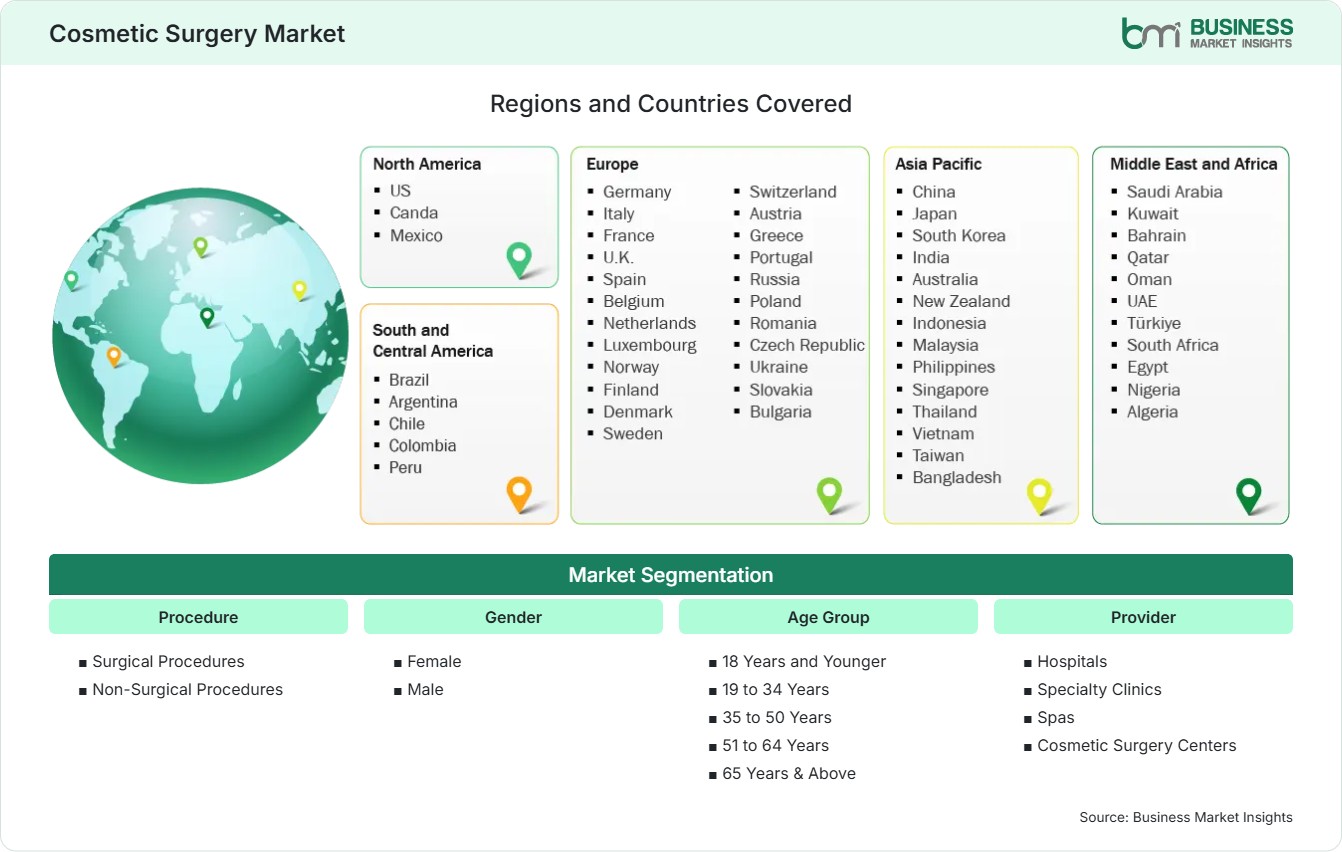
Global Market Geography
FREE PDF
Request your free sample
Request free sample
Segment Analysis

Cosmetic Surgery Market Segmentation

Procedure

Procedure remains the most influential segment, with Non-Surgical Procedures leading overall adoption. This segment contributes 54%–57% share in 2025 and is expected to grow at 5.0%–5.6% CAGR. The Cosmetic Surgery Market scope continues expanding as patients increasingly prioritize faster recovery, affordability, personalized treatment pathways, and maintenance-oriented aesthetic care supported by continuous technology innovation.

  • Surgical Procedures: Demand remains strong for rhinoplasty, liposuction, breast procedures, and facial reconstruction, supported by permanent outcome preferences, advanced surgical techniques, improved safety protocols, and specialist expertise.
  • Non-Surgical Procedures: Growth is driven by injectables, fillers, laser treatments, skin tightening, and body contouring technologies that provide convenience, repeat treatment opportunities, and shorter recovery durations.

Gender

Female consumers account for the majority of procedural demand, representing 77%–80% market share in 2025 with overall segment growth of 4.4%–5.0%. Rising participation from male consumers expands the addressable population. Cosmetic Surgery Market trends indicate increasing acceptance of appearance enhancement across genders, supported by changing social attitudes and workplace image considerations.

  • Female: Demand remains concentrated in facial rejuvenation, body contouring, breast procedures, and preventive aesthetic treatments supported by high awareness and established treatment familiarity.
  • Male: Expanding interest in facial aesthetics, hair restoration, body contouring, and minimally invasive procedures continues reducing historical adoption barriers across diverse age groups.

Age Group

The 35 to 50 Years category leads utilization, accounting for 31%–34% Cosmetic Surgery Market share in 2025 and advancing at 4.8%–5.3% CAGR. Patients within this cohort actively seek preventive and corrective aesthetic therapies. Demand patterns vary significantly by age, procedure type, treatment goals, and recovery expectations.

  • 18 Years and Younger: Limited utilization primarily focuses on corrective and reconstructive procedures, supported by clinical necessity and specialist recommendation.
  • 19 to 34 Years: Strong engagement with facial contouring, injectables, and appearance enhancement procedures influenced by digital media exposure.
  • 35 to 50 Years: Highest procedure activity reflects anti-aging priorities, career-related appearance considerations, and preventive treatment preferences.
  • 51 to 64 Years: Demand centers on facial rejuvenation, skin tightening, and maintenance-oriented aesthetic interventions with natural-looking outcomes.
  • 65 Years & Above: Growing interest reflects longevity trends, active lifestyles, and greater willingness to invest in appearance-focused wellness.

Provider

Hospitals & Specialty Clinics dominate with 68%–71% share in 2025 and CAGR of 4.2%–4.8%. Comprehensive clinical capabilities, surgeon availability, and procedural complexity support segment leadership. Provider diversification continues improving accessibility as specialized centers expand geographic coverage and consumer engagement.

  • Hospitals & Specialty Clinics: Preferred for complex procedures requiring advanced operating infrastructure, multidisciplinary support, comprehensive aftercare, and surgeon specialization.
  • Spas & Cosmetic Surgery Centers: Attract consumers seeking convenience, recurring aesthetic maintenance, personalized experiences, and broader access to minimally invasive treatments.
Market Forces

Cosmetic Surgery Market Dynamics

Key Market Drivers

Rising Global Demand for Minimally Invasive Aesthetic Treatments

ISAPS reported that over 20.5 million non-surgical treatments were performed worldwide in 2024, surpassing the number of surgeries and underscoring the ongoing trend towards minimal-intervention treatments. Patients prefer procedures that come with less risk, shorter recovery times, and predictable results. Injectable neuromodulators, dermal fillers, and energy-based skin rejuvenation technologies continue to broaden addressable patient populations. Providers benefit from recurring treatment cycles that enhance lifetime patient value. Cosmetic Surgery Market trends increasingly reflect preventive aesthetics rather than corrective intervention alone. Higher treatment accessibility through specialty clinics and medical spas further accelerates procedural adoption among younger demographics and working professionals seeking convenience.

Growing Influence of Social Media and Digital Image Awareness

The consumption of digital content has resulted in changes in the process of aesthetic decision-making among different age groups. High-definition images, video messaging apps, influencers, and beauty standards, along with the demands of the world of visual self-presentation, have led to increased awareness of cosmetic surgery. Surgeons utilize 3D visualization technologies to improve treatment planning and patient confidence. Demand growth extends beyond celebrities to mainstream consumers. Cosmetic Surgery Market growth also benefits from educational content that clarifies procedural outcomes, risks, recovery expectations, and available treatment alternatives across diverse demographic categories.

Advancements in Devices, Injectables, and Regenerative Technologies

Continuous innovation across botulinum toxins, dermal fillers, laser platforms, radiofrequency systems, ultrasound devices, and regenerative therapies enhances treatment efficacy. Manufacturers are prioritizing personalized outcomes, longer-lasting effects, and improved safety profiles. Facial analysis technology powered by artificial intelligence enhances clinical accuracy while promoting patient participation. Biostimulators and regenerative aesthetics help meet the consumer's desire for achieving a more natural look. Research in the clinical arena conducted by aesthetic industry leaders hastens the arrival of advanced products into the market. All this helps to boost industry growth in the future.

Key Market Opportunities

Expansion of Medical Tourism Hubs and Cross-Border Treatment Demand

Aesthetic surgery tourism remains lucrative, generating revenue for many destinations. Destinations such as Thailand, Turkey, South Korea, Mexico, and India have an edge due to their expertise, low cost of procedures, and hospitality facilities. There is growing government support for health care tourism through infrastructure development and international accreditation. Healthcare tourism is gaining government backing in terms of infrastructure development and international accreditation. Cosmetic Surgery Market Forecasts show that the patients will remain mobile as they compare the quality, cost, and recovery process of their procedure in other countries. Integrated care packages, multilingual communication, and pre-consultation through the internet make the market scalable. Service providers who have established their referral network internationally will have more patients.

AI-Enabled Consultation and Personalized Treatment Planning

Artificial intelligence introduces opportunities to improve consultation efficiency, predictive outcome modeling, and treatment customization. AI-enabled facial mapping technology helps physicians understand their outcomes and provides them with optimized recommendations for treatments. Better personalization leads to greater confidence in patients and results in improved conversion rates. Engagement through digital media reduces the hurdle of consultations while providing assessment even remotely. Combining AI analytics with patient history and imaging data results in better decision-making. By adopting advanced consultation technologies, providers can differentiate themselves and deliver higher treatment adherence.

Growing Male Aesthetics Market Across Global Economies

Male participation in aesthetic procedures is expanding faster than overall industry averages. Demand is strengthening across hair restoration, skin rejuvenation, jawline enhancement, body contouring, and wrinkle reduction categories. The social acceptance is steadily improving, as more people recognize well-being and the maintenance of a good physical appearance as important aspects of their lifestyle choices. There is an increasing trend to design targeted marketing and treatment procedures. Those providers who create a specific environment for consultations and treatment outcomes for men can utilize the opportunities of working with an untapped customer segment.

Market Restraints and Challenges

High Procedure Costs and Uneven Affordability

Factor: Premium surgical procedures and advanced injectable treatments often require significant out-of-pocket expenditures because cosmetic interventions are generally not covered by insurance systems.

Impact: Cost consciousness is a barrier to acceptance for lower income individuals and affects the frequency of procedures. Economic instability may cause a delay in making elective expenditure decisions, which will impact the utilization rates of clinics. The affordability gap based on geography is another factor that impacts accessibility. Premium pricing versus competitive pricing pressures providers to find a balance. However, financing is a way to offset these barriers to some extent.

Safety Concerns and Regulatory Compliance Requirements

Factor: Aesthetic medicine operates within complex regulatory frameworks governing devices, injectables, advertising practices, practitioner qualifications, and patient protection standards. Impact: Compliance creates increased expenses in terms of operations and delayed time for bringing products to market. Poor events relating to non-approved products and providers with no experience may impact consumers’ trust in the brand. There are regulatory differences among nations, which will make it difficult for a company to develop an international business plan. Training and safety monitoring will require significant investments by manufacturers and providers.

Company Analysis

Competitive Landscape

Cosmetic Surgery Market analysis indicates competition is shaped by injectable innovation, aesthetic devices, regenerative solutions, clinical training programs, and global distribution capabilities.

Company Name

Overview

Products and Services relevant to this market

AbbVie Inc. (Allergan Aesthetics)

Global aesthetics leader with extensive physician networks and strong brand recognition across facial aesthetics.

BOTOX Cosmetic, JUVÉDERM fillers, body contouring technologies, training, and aesthetic practice solutions.

Galderma SA

Dermatology-focused company expanding injectable aesthetics and skincare portfolios worldwide.

Restylane fillers, Sculptra biostimulator, aesthetic skincare products, and practitioner education programs.

Merz Pharma GmbH & Co. KGaA

Established aesthetic medicine provider with global clinical and commercial operations.

Xeomin, Radiesse, Ultherapy, facial rejuvenation products, and aesthetic treatment technologies.

El.En. S.p.A.

Medical laser technology specialist serving cosmetic and dermatology applications internationally.

Laser systems for skin resurfacing, hair removal, body contouring, and aesthetic treatments.

Candela Corporation

Leading energy-based medical aesthetics company with diversified technology offerings.

Laser, radiofrequency, vascular treatment, pigmentation management, and skin rejuvenation systems.

Cutera, Inc.

Device manufacturer focused on non-invasive and minimally invasive aesthetic procedures.

Body sculpting, laser platforms, skin revitalization, and aesthetic clinic technologies.

Johnson & Johnson

Diversified healthcare company with significant presence in aesthetic and reconstructive solutions.

Breast aesthetics products, surgical technologies, wound closure, and procedural support solutions.

Bausch Health Companies Inc.

Healthcare company participating in aesthetics through specialty pharmaceutical and device portfolios.

Facial aesthetic products, dermatology solutions, and physician-focused treatment platforms.

Sisram Medical Ltd.

Global provider of professional energy-based aesthetic technologies and services.

Alma laser systems, body contouring devices, skin tightening, and clinic workflow solutions.

Cynosure, LLC

Aesthetic technology developer serving dermatology and cosmetic procedure providers.

Laser treatments, body sculpting systems, hair removal technology, and skin enhancement devices.

Trust & Transparency

Research Methodology

The market analysis combines proprietary research with secondary data from government agencies, company disclosures, regulatory filings, industry databases and expert interviews. Market estimates are validated through data triangulation, cross-market benchmarking and analyst review.

View Full Research Methodology

Questions Answered

Frequently Asked Questions

Why are non-surgical treatments gaining popularity?

They provide effective aesthetic enhancement with shorter recovery periods, lower procedural burden, broader accessibility, and recurring patient engagement opportunities.

What does the Cosmetic Surgery Market Report typically evaluate?

The Cosmetic Surgery Market Report generally assesses procedure categories, provider models, demographic trends, competitive positioning, regional performance, innovations, and future demand patterns.

Which region offers the strongest long-term expansion potential?

Asia Pacific presents the strongest growth outlook due to rising incomes, medical tourism development, urbanization, and increasing awareness of aesthetic treatments.

What age group generates the highest procedure volume?

Individuals aged 35 to 50 years account for the largest procedural demand because they actively pursue preventive and corrective aesthetic treatments.

What factor is most strongly influencing treatment demand?

Growing preference for minimally invasive procedures offering lower downtime, repeat treatment flexibility, and personalized outcomes is driving patient adoption globally.

Access the Full Cosmetic Surgery Market Report

Get segment-level forecasts, regional estimates, competitive benchmarking, company profiles and downloadable Excel datasets.

Access the full Cosmetic Surgery Market Report
350 pages PDF & Excel | 2026-08-31