
Aesthetic Cosmetic Lasers Market Outlook: Size, Share, Trends, Growth Analysis, Competitive Landscape & Forecast, 2026-2033

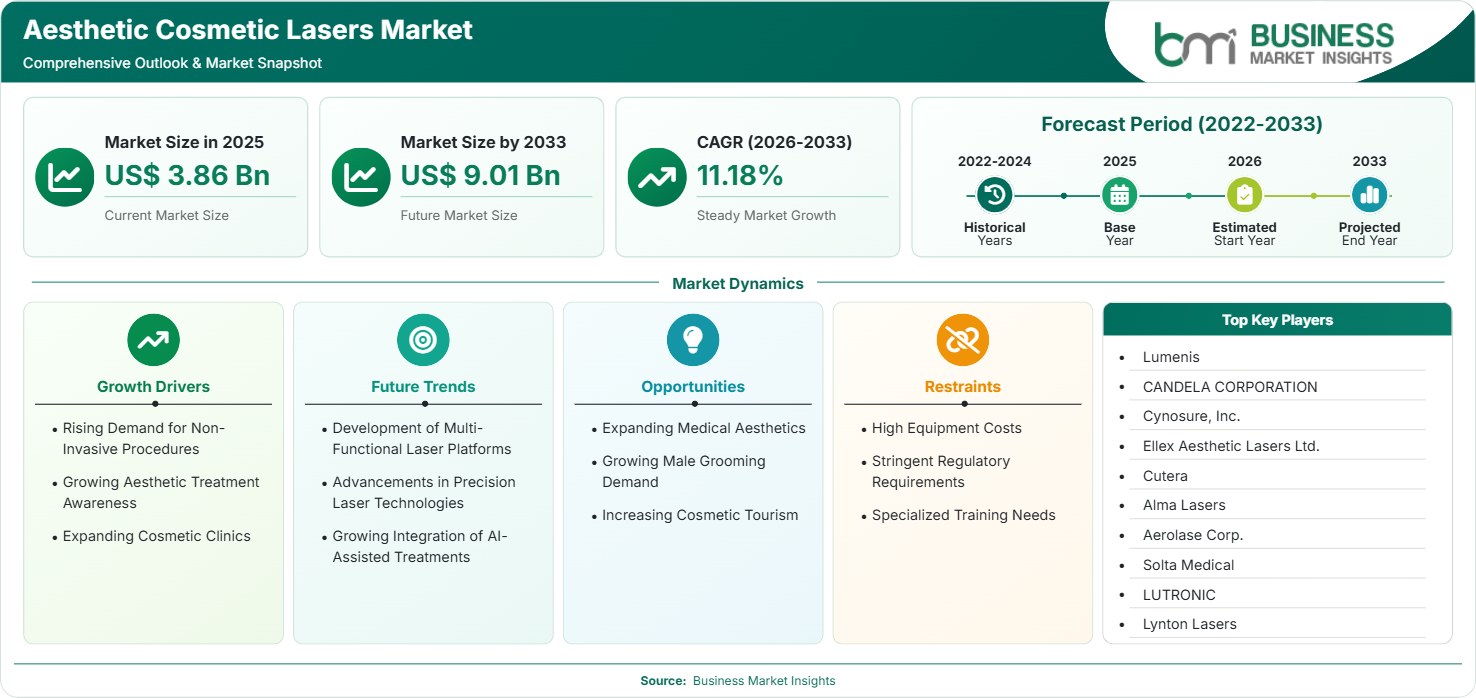
The Aesthetic Cosmetic Lasers Market size was valued at US$ 3.86 Billion in 2025 and is projected to reach US$ 9.01 Billion by 2033, growing at a CAGR of 11.18% during 2026–2033, supported by non-invasive treatment demand, clinic expansion, technology upgrades, personalized procedures, and cosmetic tourism opportunities.

Report Coverage
  • Application: Hair Removal, Pigmentation & Tattoo Removal, Body Shaping & Tightening, Skin Rejuvenation, Acne Reduction, Others
  • End User: Hospitals, Specialty Clinics
US$ 3.86 Bn Market size in 2025
US$ 9.01 Bn Market Size by 2033
11.18% CAGR, 2026 - 2033
2026-2033 Forecast Period

01 AI Overview

Aesthetic Cosmetic Lasers Market Summary

  • North America Region: North America holds an estimated 34%–38% share in 2025, growing at a 10.5%–11.5% CAGR during 2026–2033, supported by advanced dermatology infrastructure, high consumer acceptance, premium aesthetic procedures, replacement demand, and expanding specialty clinics. The U.S. market is projected to grow at approximately 10.8%–11.6% CAGR, supported by established aesthetic practices, technology adoption, and strong demand for minimally invasive treatments.
  • Fastest Growing Region: Asia Pacific represents approximately 24%–28% share in 2025 and is positioned for a 12.5%–14.0% CAGR during 2026–2033, driven by expanding medical aesthetics, rising disposable incomes, increasing urbanization, clinic modernization, technology accessibility, and growing interest in appearance-focused procedures across major economies.
  • Leading Segment: Application-led demand is concentrated in Hair Removal, representing approximately 28%–32% share in 2025 and advancing at a 10.5%–11.5% CAGR during 2026–2033, supported by recurring treatment cycles, broad demographic applicability, device versatility, and demand for durable aesthetic outcomes across specialty clinics.
  • High Growth Segment: Skin Rejuvenation represents approximately 18%–22% share in 2025 and is positioned for a 12.0%–13.5% CAGR during 2026–2033, supported by personalized treatment protocols, combination procedures, aging consumer populations, demand for minimally invasive solutions, and continuous improvements in laser precision.
  • Key Market Opportunity: Clinic modernization creates opportunities for modular platforms combining multiple wavelengths, treatment indications, cooling technologies, and software-assisted protocols, enabling providers to improve utilization while broadening procedure portfolios.
  • Major Market Players: Lumenis; CANDELA CORPORATION; Cynosure, Inc.; Ellex Aesthetic Lasers Ltd.; Cutera; Alma Lasers; Aerolase Corp.; Solta Medical; LUTRONIC; Lynton Lasers.
02 Strategic Insights

Aesthetic Cosmetic Lasers Market: Strategic Insights

Aesthetic Cosmetic Lasers Market Strategic Framework
FREE PDF
Request your free sample
Request free sample
03 Stakeholder View

Key Takeaways

  • The value chain extends from laser sources, optical components, energy-control systems, cooling assemblies, handpieces, software, and consumables to distributors, training providers, clinics, and service organizations. Suppliers capable of maintaining component quality and device consistency can strengthen relationships with platform manufacturers.
  • Hair removal provides a broad installed-base opportunity because procedures are recurring and applicable across numerous consumer groups. Skin rejuvenation and pigmentation-focused platforms provide additional upside because clinics can combine multiple indications within a single patient pathway.
  • Trends in product development will lead towards systems that are multifunctional with respect to treatment wavelengths, automation, cooling, and intuitive interfaces. Competitive edge in the market can be gained through enhanced consistency in treatment and reduced complexity in operation.
  • The Asia Pacific region offers an interesting scenario for growth since there is an expansion of dermatological and aesthetic clinics in urban centers. Growth can be achieved through local training, distribution, financing, and support networks.
  • Competitive positioning increasingly depends on broad technology portfolios rather than individual treatment devices. Strategic partnerships, distribution agreements, platform acquisitions, and technology integration can strengthen access to physicians and increase installed-base utilization.
04 Geographic Outlook

Aesthetic Cosmetic Lasers Market Regional Highlights

North America Aesthetic Cosmetic Lasers Market

North America holds a 34%–38% of the Aesthetic Cosmetic Lasers Market share in 2025, with a 10.5%–11.5% CAGR during 2026–2033. The region benefits from established dermatology practices, advanced outpatient infrastructure, strong physician familiarity, and consumer preference for minimally invasive procedures. The U.S. remains the principal demand center, while Canada contributes through specialized clinics and private aesthetic services.

  • Established specialty clinics continue upgrading older platforms toward multifunctional systems, improving utilization across hair removal, pigmentation, rejuvenation, and tightening procedures.
  • Premium device demand remains supported by physician preference for reliable energy delivery, ergonomic systems, and predictable treatment workflows.
  • Distribution and technical service networks remain important because downtime directly affects procedure scheduling, clinic revenue generation, and patient retention.
  • Manufacturers can strengthen regional penetration through training programs, financing structures, service contracts, and integrated software capabilities.

US Aesthetic Cosmetic Lasers Market

The U.S. Aesthetic Cosmetic Lasers Market represents approximately 80%–85% of North American demand in 2025 and is projected to advance at a 10.8%–11.6% CAGR during 2026–2033. Its position reflects a mature physician-led aesthetic ecosystem, broad private clinic participation, established medical device distribution, and high consumer familiarity with laser-based procedures. Replacement purchases are increasingly influenced by multifunctionality, treatment speed, operator ergonomics, and service support rather than basic device availability.

  • Large metropolitan aesthetic centers provide an important customer base for premium multifunctional systems, especially where several procedures are delivered from the same facility.
  • Independent specialty clinics increasingly evaluate equipment according to utilization potential, treatment versatility, maintenance requirements, and training burden.
  • Technology suppliers can improve competitiveness by pairing devices with clinical education, technical support, financing programs, and workflow-oriented software.

Europe Aesthetic Cosmetic Lasers Market

Europe Aesthetic Cosmetic Lasers Market accounts for approximately 27%–31% share in 2025, with a 9.8%–10.8% CAGR during 2026–2033. Germany, the United Kingdom, France, Italy, and Spain represent important established markets, while Poland and selected Central European economies provide comparatively faster expansion opportunities. Manufacturers must balance performance with regulatory documentation, training, safety controls, and post-sale support. Regional growth also favors versatile platforms serving several clinical indications.

  • Germany and France remain important equipment markets because established dermatology and aesthetic practices support replacement purchases and advanced procedure adoption.
  • The United Kingdom provides opportunities for private aesthetic clinics seeking multifunctional platforms and differentiated treatment protocols.
  • Spain and Italy benefit from strong aesthetic-service activity and consumer interest in appearance-focused procedures, supporting continued clinic investment.
  • Central and Eastern European markets offer higher expansion potential as modern private clinics broaden access to advanced devices.

Asia Pacific Aesthetic Cosmetic Lasers Market

Asia Pacific holds approximately 24%–28% of the Aesthetic Cosmetic Lasers Market share in 2025 and is expected to achieve a 12.5%–14.0% CAGR during 2026–2033. China, Japan, South Korea, India, and Australia form major demand centers, while Southeast Asian economies offer expanding opportunities. Rising private healthcare investment, urbanization, improving clinic infrastructure, and growing consumer awareness support adoption. South Korea and China remain important technology-oriented markets, while India and Southeast Asia provide opportunities for affordable multifunctional platforms, distributor expansion, clinical training, and localized service models.

  • China provides substantial potential for clinic modernization and adoption of multifunctional platforms, supported by expanding private aesthetic services.
  • South Korea remains an important innovation-oriented market where physicians frequently evaluate advanced energy-delivery and treatment-control capabilities.
  • India offers opportunities for compact systems and flexible financing as specialty clinics expand beyond major metropolitan centers.
  • Southeast Asian markets can support growth through medical tourism, private healthcare investment, distributor partnerships, and localized physician training.

Rest of World Aesthetic Cosmetic Lasers Market

Rest of World represents approximately 10%–14% share in 2025, with a 10.0%–11.5% CAGR during 2026–2033. South and Central America benefit from private dermatology expansion and medical tourism, while the Middle East and Africa offer opportunities through premium clinics and healthcare investment. Brazil and Mexico are important Latin American markets, while the United Arab Emirates and Saudi Arabia provide strong premium-service opportunities. Growth depends heavily on distributor capabilities, physician training, financing availability, service infrastructure, and regulatory navigation.

  • Brazil and Mexico provide important Latin American opportunities because established private aesthetic services can support broader laser adoption.
  • The United Arab Emirates offers premium-clinic opportunities where advanced technology, physician expertise, and patient experience influence purchasing decisions.
  • Saudi Arabia presents expanding potential as healthcare investment broadens specialty and private medical service capacity.
  • Distributor quality remains decisive because technical support, spare parts availability, and operator training directly influence device utilization.
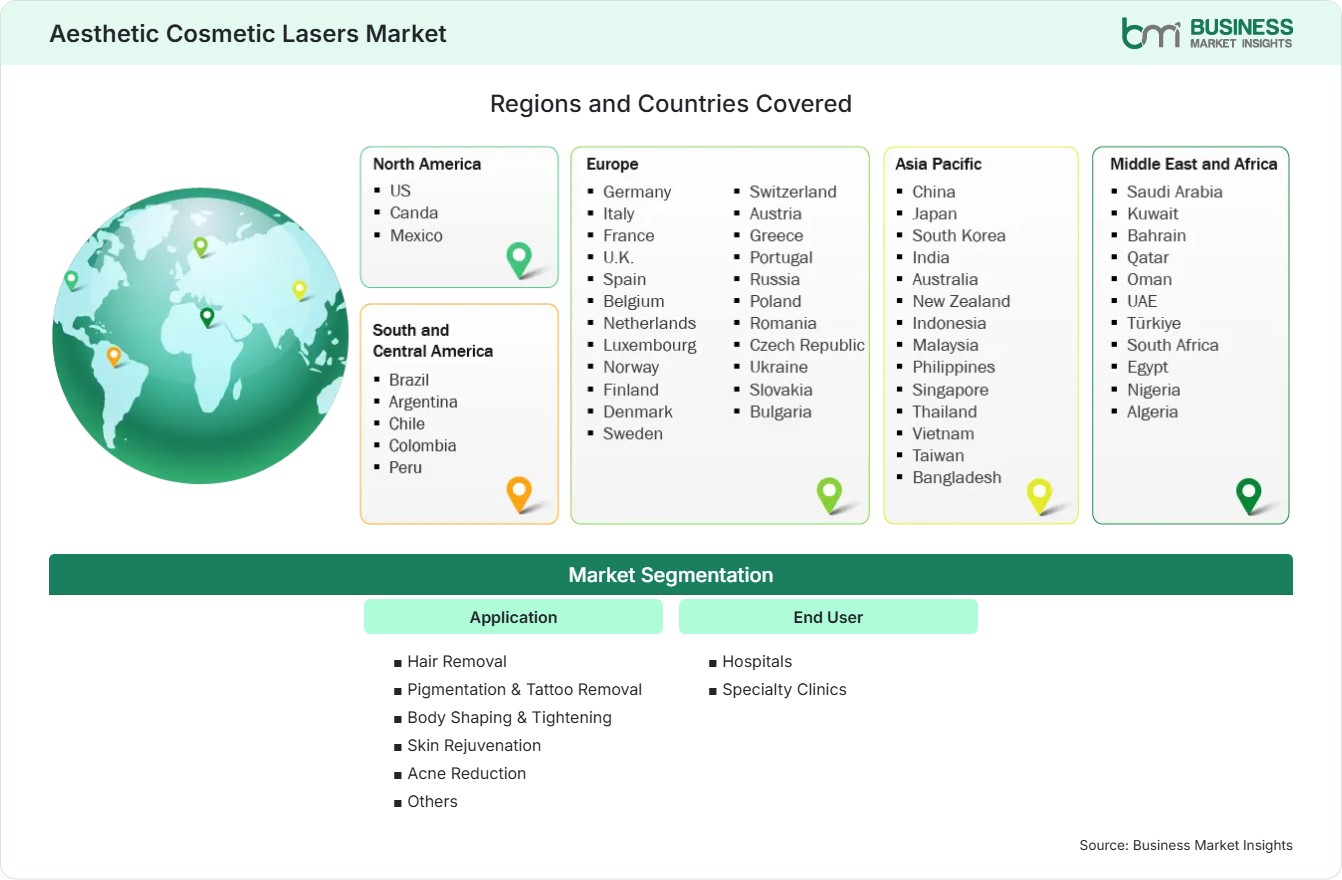
Global Market Geography
FREE PDF
Request your free sample
Request free sample
05 Segment Analysis

Aesthetic Cosmetic Lasers Market Segmentation

Application

Application demand is led by Hair Removal, estimated at 28%–32% share in 2025, with a 10.5%–11.5% CAGR during 2026–2034. Recurring procedures, broad consumer applicability, and platform versatility support adoption. Skin rejuvenation and pigmentation treatments provide additional expansion as clinics increasingly bundle multiple aesthetic indications into personalized treatment plans and integrated service offerings.

  • Hair Removal: High procedure frequency and recurring treatment schedules support strong equipment utilization, while adaptable systems help clinics serve diverse skin and hair characteristics efficiently.
  • Pigmentation & Tattoo Removal: Growing demand for targeted appearance correction supports specialized wavelength technologies, controlled energy delivery, and treatment protocols designed around pigment characteristics.
  • Body Shaping & Tightening: Clinics increasingly use energy-based systems for non-surgical contouring, creating opportunities for platforms emphasizing patient comfort, precision, and repeatable treatment outcomes.
  • Skin Rejuvenation: Consumer interest in texture, tone, and age-related appearance management supports multifunctional laser platforms and combination protocols within dermatology-focused practices.
  • Acne Reduction: Laser-based acne management provides clinics with an additional treatment pathway, particularly where systems can address inflammation, skin texture, and residual appearance concerns.

End User

Hospitals and Specialty Clinics collectively represent the primary purchasing environment, with Specialty Clinics holding an estimated 72%–78% share in 2025 and a 11.5%–12.5% CAGR during 2026–2034. Dedicated clinics prioritize utilization, treatment breadth, physician ergonomics, service responsiveness, and patient experience. Hospitals emphasize clinical governance, capital planning, safety documentation, and integration with broader outpatient services when selecting platforms.

  • Hospitals: Hospitals favor systems supported by standardized protocols, documented safety controls, technical service availability, and multidisciplinary utilization across dermatology and outpatient aesthetic services.
  • Specialty Clinics: Specialty clinics prioritize multifunctionality, treatment throughput, compact footprints, financing flexibility, and training support because equipment utilization directly influences commercial returns.
06 Market Forces

Aesthetic Cosmetic Lasers Market Dynamics

Key Market Drivers

Rising Demand for Non-Invasive Procedures

Non-invasive aesthetic procedure requests are dictating purchases in the equipment market, since patients more and more prefer procedures with noticeable effects that do not require post-surgery recovery periods. The use of lasers enables the provision of a platform for ambulatory treatment, which can be easily integrated in the clinic’s schedule. Consequently, the Aesthetic Cosmetic Lasers Market growth is highly dependent on frequency, convenience, and diversity of procedures. Equipment manufacturers are offering equipment with features such as control of energy output, cooling capabilities, ergonomically shaped handpieces, and fewer operation steps. It may also be possible to use multifunctional platform for the treatment of different indications without the need for acquisition of additional devices.

Growing Aesthetic Treatment Awareness

Consumer awareness is expanding the addressable patient base beyond traditional cosmetic users. Digital information channels, physician-led education, and greater familiarity with minimally invasive procedures encourage consumers to evaluate treatments for pigmentation, unwanted hair, acne-related appearance, skin texture, and age-associated changes. Clinics use equipment that caters to the varying needs of treatment rather than being limited to one mass market indication. Manufacturers with diversified product lines can cater to this need by offering equipment that allows handpieces to be changed, parameters adjusted, and applications configured. The commercial benefits range from developed to developing countries since awareness can drive new treatment procedures while persuading patients to undergo more treatments.

Expanding Cosmetic Clinics

The growth of aesthetic clinics is an additional direct driver of demand for equipment, as each clinic necessitates equipment, staffing, maintenance, and a unique range of procedures. The smaller clinics generally opt for more efficient multifunctional units because of capital costs and clinical considerations. The larger companies are capable of using better quality equipment which will ensure high efficiency and cover different areas of treatment. Aesthetic Cosmetic Lasers Market trends also impact the manufacturers, and distribution, technical services, financing, training, and installation become more important for them. With the development of clinics, there appears another source of demand for equipment as some of the equipment used in clinics needs to be replaced with more modern and more versatile platforms.

Key Market Opportunities

Expanding Medical Aesthetics

Medical aesthetics provides an opportunity to increase equipment utilization by combining dermatology, cosmetic treatment, skin health, and appearance-management services within coordinated clinic offerings. The economics can be improved by making one platform capable of addressing more than one need of patients as opposed to just handling a procedure on its own. This leaves space for manufacturers to design their products such that the product becomes modular and has interchangeable applicators, adaptable treatment environment, and workflow through the use of computer. The Aesthetic Cosmetic Lasers Market scope is an integrated platforms as opposed to specialized machines. The new facilities will be able to start off with these systems while existing facilities will upgrade towards more comprehensive treatment.

Growing Male Grooming Demand

Male participation in aesthetic treatments provides an additional patient segment for clinics seeking broader utilization. Demands can range from hair removal to pigmentation control, skin tightening, acne treatments, and select body contouring services. The manufacturers can capitalize on this opportunity by providing flexible environment features, effective treatment protocols, and communication focused on clinical results instead of gender-oriented devices. Clinics that utilize male-oriented consulting processes can enhance the use of available devices without necessitating the use of distinct platforms.

Increasing Cosmetic Tourism

Cosmetic Tourism provides an opportunity for clinics to operate in destination sites where patients combine their cosmetic procedures with tourism. Providers catering to the international market need platforms that are reliable, predictable workflow, multilingual training materials, reliable technical services, and quality treatment records. The Aesthetic Cosmetic Lasers Market Forecasts would thus gain by developing capabilities in clinics that meet the needs of the international market. Manufacturers would get involved through their distributors in regions, training centers, technical service centers, and high-end platform offerings. Cosmetic Tourism motivates clinics to create distinction in their offerings of procedure range, treatment experience, and brand recognition.

Market Restraints and Challenges

High Equipment Costs

Factor: Advanced laser systems require substantial investment in energy sources, optical components, cooling technologies, treatment handpieces, software, safety systems, installation, and professional training. Premium multifunctional platforms can therefore create significant capital requirements for independent clinics. Impact: Acquisition costs are expensive, which could delay buying decisions, especially in smaller facilities that do not have many patients or usage. Facilities can stretch out their replacement cycles and go for lower-cost solutions, putting pressure on high-end product manufacturers through pricing. Financing and leasing, the involvement of distributors, and a modular platform can help overcome this challenge; however, manufacturers need to show the economics of usage.

Stringent Regulatory Requirements

Factor: Aesthetic laser systems require compliance with applicable medical-device, electrical-safety, performance, labeling, operator-training, and clinical-use requirements, with obligations varying by jurisdiction. Impact: Regulatory challenges can result in longer times to introduce products into the market, higher documentation needs, and greater compliance costs for firms that have to deal with multiple markets. Appropriate competency of operators as well as safety procedures should be maintained by clinics, leading to training needs. Such compliance challenges may place smaller suppliers at a disadvantage due to their lack of regulatory processes or local presence.

07 Company Analysis

Competitive Landscape

The Aesthetic Cosmetic Lasers Market analysis indicates competition is shaped by platform breadth, energy-delivery precision, clinical usability, installed-base support, regulatory capabilities, training infrastructure, and distributor reach. Companies with multifunctional portfolios can serve several treatment categories, while specialized providers can differentiate through specific laser technologies, compact systems, or application-focused designs.

Company Name

Overview

Products and Services relevant to this market

Lumenis

Established aesthetic and medical technology company with a broad platform approach serving professional treatment environments.

Aesthetic laser platforms, energy-based systems, treatment technologies, clinical training, technical support, and related service capabilities.

CANDELA CORPORATION

Aesthetic technology provider focused on professional systems supporting dermatological and cosmetic treatment applications.

Laser and energy-based aesthetic systems covering hair removal, skin treatments, vascular applications, and clinical support.

Cynosure, Inc.

A specialist aesthetic technology company serving clinics with multiple laser and energy-based treatment platforms.

Aesthetic lasers and energy devices for hair removal, skin rejuvenation, body treatments, pigmentation, and related procedures.

Ellex Aesthetic Lasers Ltd.

Aesthetic laser business associated with specialized ophthalmic and laser technology capabilities.

Laser technology, treatment platforms, clinical applications, equipment support, and professional-use laser solutions.

Cutera

Developer of aesthetic systems serving dermatology and cosmetic practices through application-focused energy technologies.

Laser and light platforms for hair removal, skin rejuvenation, pigmentation, vascular treatment, and body-focused procedures.

Alma Lasers

Aesthetic technology provider emphasizing versatile platforms for professional clinics and treatment centers.

Laser, light, radiofrequency, and related aesthetic technologies for skin, hair, body, and rejuvenation procedures.

Aerolase Corp.

Specialist laser company recognized for compact technology and application-focused professional treatment systems.

Laser platforms supporting dermatological and aesthetic procedures, including hair, skin, pigmentation, and rejuvenation applications.

Solta Medical

A medical aesthetics technology company serving professional providers with energy-based treatment solutions.

Laser and energy-based systems supporting skin resurfacing, rejuvenation, tightening, and related aesthetic procedures.

LUTRONIC

Aesthetic technology provider focused on laser and energy-based systems for professional clinical environments.

Laser platforms for skin rejuvenation, pigmentation, hair removal, resurfacing, and related aesthetic applications.

Lynton Lasers

Professional laser and light technology supplier serving aesthetic and medical treatment providers.

Laser and IPL systems, treatment platforms, training, technical services, and professional aesthetic technology solutions.

10 Trust & Transparency

Research Methodology

The market analysis combines proprietary research with secondary data from government agencies, company disclosures, regulatory filings, industry databases and expert interviews. Market estimates are validated through data triangulation, cross-market benchmarking and analyst review.

View Full Research Methodology

11 Questions Answered

Frequently Asked Questions

How should manufacturers approach Aesthetic Cosmetic Lasers Market Forecasts?

Manufacturers should assess application diversification, regional clinic expansion, equipment replacement cycles, platform versatility, practitioner requirements, and evolving treatment preferences. A balanced forecast should consider both equipment demand and the broader service ecosystem influencing adoption, including training, maintenance, distribution, and application expansion.

Which application provides strong expansion potential for manufacturers?

Skin rejuvenation provides an attractive expansion pathway because it can encompass several treatment objectives and complement established procedures. Manufacturers can strengthen this opportunity through flexible platforms, differentiated treatment configurations, improved usability, and systems capable of supporting combination-oriented aesthetic workflows.

What is the role of multifunctional systems in the Aesthetic Cosmetic Lasers Market Report?

Multifunctional systems provide clinics with greater flexibility by supporting several aesthetic applications through one platform. They can simplify equipment planning, expand treatment portfolios, and support broader practitioner utilization. Their value depends on application performance, workflow compatibility, usability, and the ability to address diverse treatment requirements effectively.

How can clinics improve utilization of aesthetic laser equipment?

Clinics can improve utilization by selecting multifunctional platforms, expanding treatment indications, developing complementary procedure packages, training practitioners across applications, and maintaining reliable equipment availability. A broader application mix can reduce dependence on individual procedures and support more consistent use of installed systems.

What factors determine the selection of an aesthetic laser platform?

Selection depends on treatment indications, energy flexibility, practitioner usability, patient requirements, equipment utilization, maintenance needs, platform versatility, and the provider's intended procedure portfolio. Clinics increasingly evaluate whether one system can support several applications rather than considering a device only for one treatment category.

Access the Full Aesthetic Cosmetic Lasers Market Report

Get segment-level forecasts, regional estimates, competitive benchmarking, company profiles and downloadable Excel datasets.

Access the full Aesthetic Cosmetic Lasers Market Report
350 pages PDF & Excel | 2026-08-19