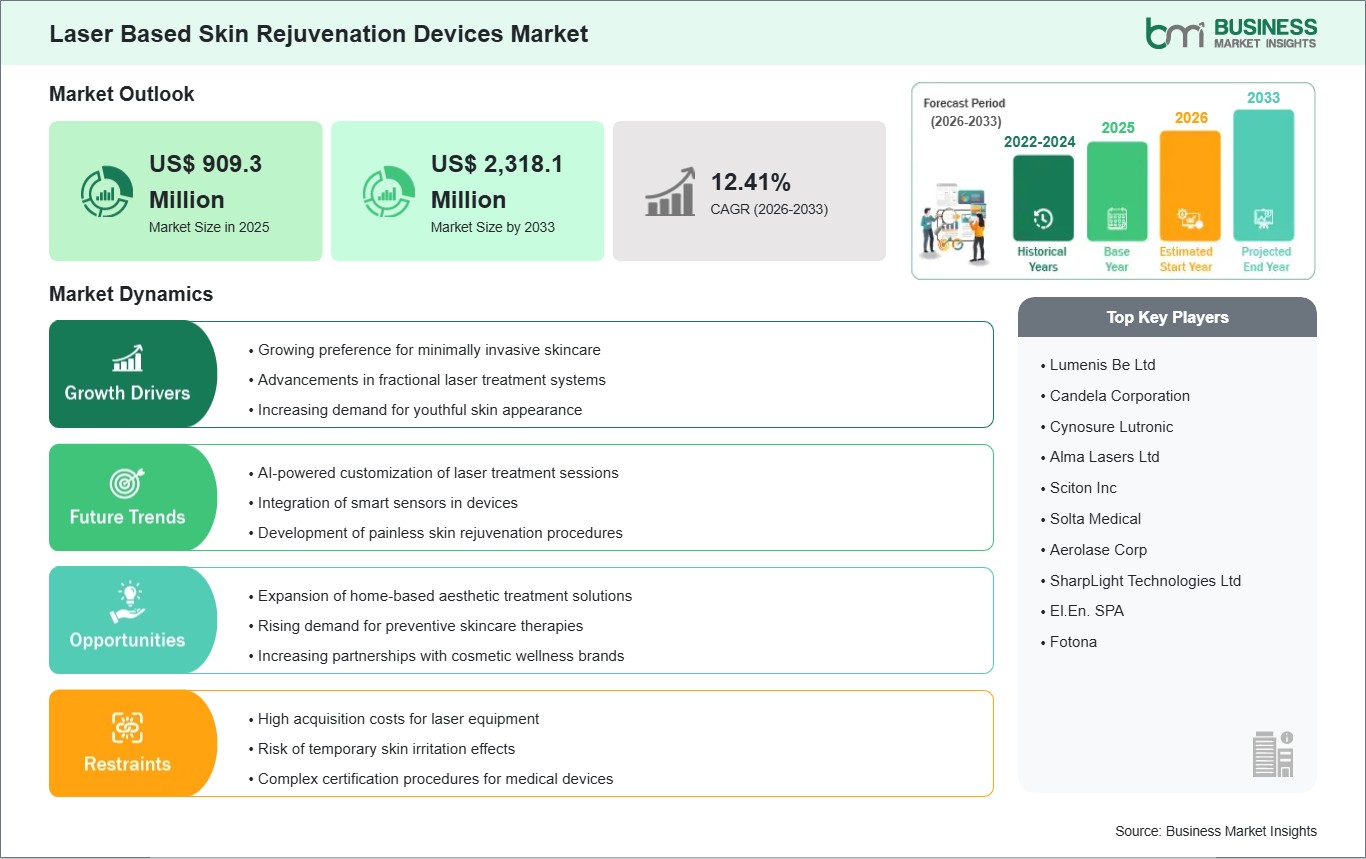
The laser based skin rejuvenation devices market size is expected to reach US$ 2,318.1 million by 2033 from US$ 909.3 million in 2025. The market is estimated to register a CAGR of 12.4% from 2026 to 2033.
The laser-based skin rejuvenation devices market is progressing through a phase of clinical sophistication, where demand is increasingly anchored in dermatology-led treatment protocols rather than purely cosmetic applications. One of the key developments is the increasing trend toward skin restoration strategies that are biology-based, using laser technology to induce carefully-controlled wound healing pathways, collagen remodeling, and keratinization processes. As a result, the use of laser systems has gained significance in addressing more complicated skin conditions such as post-inflammatory hyperpigmentation, atrophic scars, and abnormal vasculature. These systems have become critical instruments in holistic skin health care. Key drivers for innovation include the emphasis on precise energy delivery and customization of treatments.
Modern laser equipment is adopting various approaches, including modulated pulse generation, fractionated delivery to multiple layers of skin simultaneously, and wavelength stacking, which enables practitioners to affect multiple skin levels during one procedure, resulting in fewer treatments required and higher predictability of treatment outcomes. Business approaches are also changing, with companies focusing on developing an ecosystem model of interaction rather than selling devices once. They include subscription service agreements, hardware systems upgradable over time, and consumable systems that will provide a steady income stream. Consumer demand is also increasing as aesthetic dermatology becomes more widely accepted and skin rejuvenation is increasingly viewed as part of wellness care. However, regulatory standards, specialist training requirements, and reimbursement policies for aesthetic treatments vary significantly across countries.

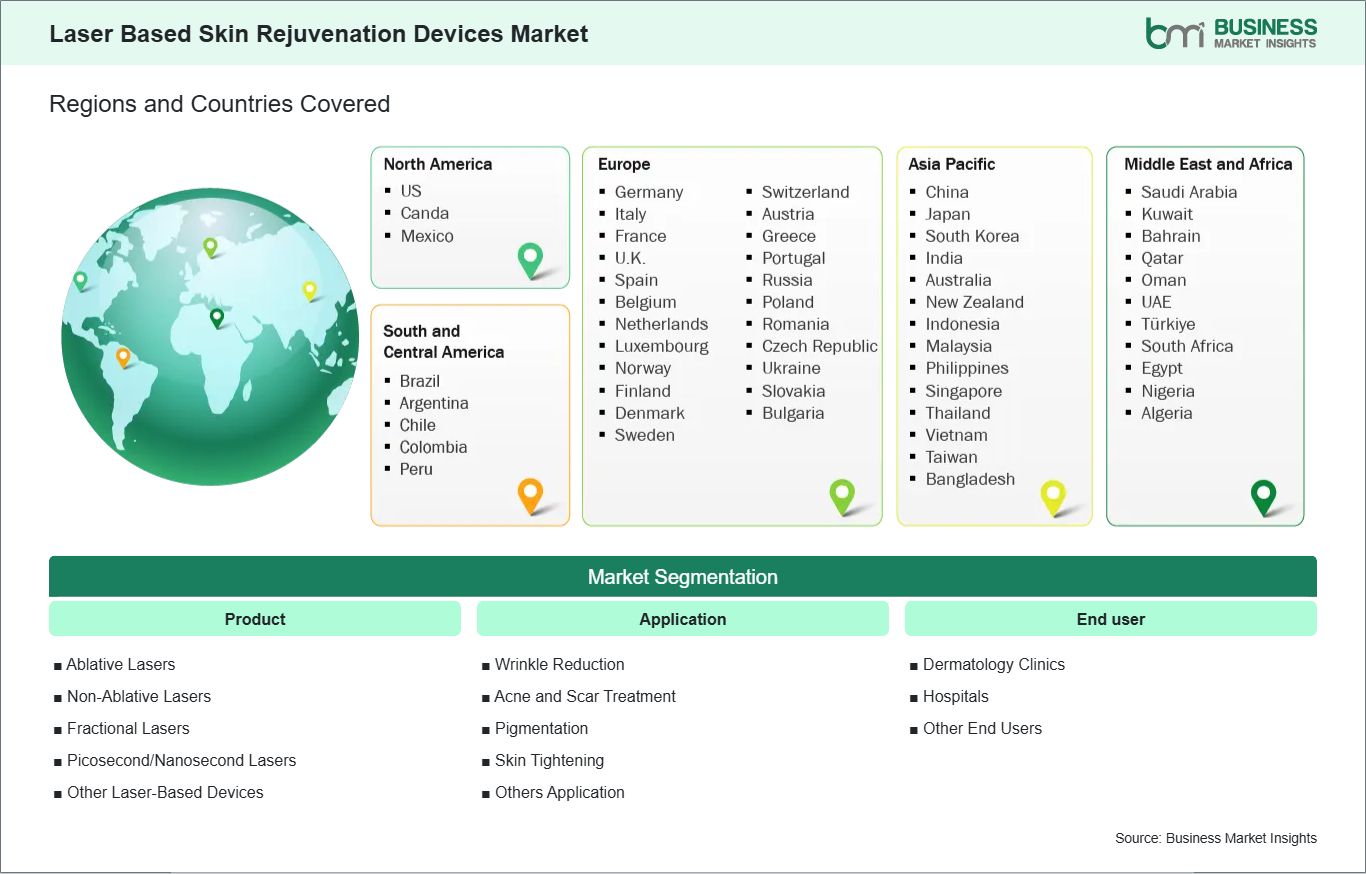
Key segments that contributed to the derivation of the laser based skin rejuvenation devices market analysis are product, application, and end user.
Patients in North America and Western Europe are increasingly shifting from surgical cosmetic procedures to laser-based treatments that offer lower risk, minimal downtime, and gradual, natural-looking results. This includes skin resurfacing with fractional lasers, skin pigmentation removals, and anti-wrinkle procedures using lasers, which are commonly used in dermatological practices and medispas.
In nations such as the USA, UK, Germany, and France, there has been an increase in the popularity of aesthetics treatments, especially the application of lasers to rejuvenate skin through clinics established in cities such as New York, London, Berlin, and Paris. This is especially true among younger patients who are using these procedures to treat their acne scars and even prevent aging problems, as opposed to older people whose main concern is the reduction of wrinkles.
Demand for laser treatments is on the rise in Asia Pacific and Latin America because of the presence of middle-class demographics that understand cosmetic dermatology. The popularity of laser treatments has gone up in countries such as China, South Korea, India, Brazil, and Mexico. In Brazil, there is an extensive application of aesthetic treatments in its beauty culture. South Korea continues to be at the forefront of cutting-edge skincare technology. Meanwhile, in Middle Eastern nations such as the UAE and Saudi Arabia, expenditure toward premium cosmetology treatment has been on the increase.
The adoption of laser-based skin rejuvenation devices is expanding in emerging healthcare markets due to improving medical infrastructure, rising disposable income, and increasing availability of dermatology services.
In Latin American nations—such as Brazil, Mexico, Colombia, and Argentina—the increasing focus on aesthetics within the culture, along with the presence of a middle-class population, is fueling the use of laser technology within beauty procedures. Some of the major cities—including São Paulo, Mexico City, and Bogota—are witnessing an influx in the number of clinics and rising demands for laser therapies among their patients. Additionally, the Middle Eastern nations are becoming a promising region for the industry, with the UAE and Saudi Arabia emerging as regional leaders.
Adoption in Southeast Asia and Africa is still at an early stage but is growing rapidly as awareness of noninvasive cosmetic procedures increases. International companies are expanding distribution and training programs to improve product access for smaller dermatology clinics and support proper device usage. The availability of lower-cost laser systems has also enabled more small clinics to enter the market. Rising healthcare spending and supportive regulatory frameworks are expected to strengthen the role of these regions in the industry.

The laser based skin rejuvenation devices market demonstrates steady growth, with size and share analysis highlighting evolving trends and competitive dynamics among key players. The report examines subsegments categorized within product, application, and end user, offering insights into their contribution to overall market performance.
By product, the non-ablative lasers segment dominated the market in 2025, driven by rising preference for minimally invasive aesthetic procedures that deliver effective skin rejuvenation with reduced downtime, high safety, and strong collagen stimulation outcomes.
Based on application, the wrinkle reduction segment dominated the market in 2025, driven by increasing global aging population, heightened aesthetic consciousness, and growing demand for nonsurgical treatments that improve fine lines and skin texture through collagen regeneration.
In terms of end user, the dermatology clinics segment dominated the market in 2025, driven by high patient preference for physician-supervised procedures and widespread adoption of advanced laser-based skin rejuvenation technologies in specialized clinical settings.
| Report Attribute | Details |
|---|---|
| Market size in 2025 | US$ 909.3 Million |
| Market Size by 2033 | US$ 2,318.1 Million |
| Global CAGR (2026 - 2033) | 12.41% |
| Historical Data | 2022-2024 |
| Forecast period | 2026-2033 |
| Segments Covered | By Product
|
|
Regions and Countries Covered
| |
| North America | US, Canada, Mexico |
| Europe | Germany, Italy, France, U.K., Spain, Belgium, Netherlands, Luxembourg, Norway, Finland, Denmark, Sweden, Switzerland, Austria, Greece, Portugal, Russia, Poland, Romania, Czech Republic, Ukraine, Slovakia, Bulgaria |
| Asia-Pacific | China, Japan, South Korea, India, Australia, New Zealand, Indonesia, Malaysia, Philippines, Singapore, Thailand, Vietnam, Taiwan, Bangladesh |
| South and Central America | Brazil, Argentina, Chile, Colombia, Peru |
| Middle East and Africa | Saudi Arabia, United Arab Emirates, Kuwait, Bahrain, Qatar, Oman, Turkiye, South Africa, Egypt, Nigeria, Algeria |
| Market leaders and key company profiles |
|
The "Laser Based Skin Rejuvenation Devices Market Size and Forecast (2022-2033)" report provides a detailed analysis of the market covering below areas:
The geographical scope of the laser based skin rejuvenation devices market report is divided into North America, Asia Pacific, Europe, Middle East & Africa, and South & Central America. North America held the largest share in 2025.
North America is a mature, innovation-driven market with strong adoption of advanced laser platforms across dermatology clinics and medical spas. Demand is supported by high consumer spending on elective procedures and preference for minimally invasive, low-downtime treatments. Clinics frequently use multifunctional systems combining resurfacing, pigmentation correction, and skin tightening. Private-pay models enable rapid technology upgrades, while physician training networks ensure consistent clinical adoption of new laser technologies. Asia Pacific is a fast-growing region driven by rising disposable incomes, urbanization, and strong beauty consciousness. Demand is concentrated on pigmentation correction, skin brightening, and anti-aging treatments. Clinics are rapidly adopting cost-efficient laser systems alongside premium devices in urban centers. Social media strongly accelerates procedure uptake, especially among younger consumers. Expansion of aesthetic clinics and increasing use of combination therapies are key growth drivers.
Europe is a highly regulated market focused on clinical safety and evidence-based dermatology. Laser use is increasingly integrated into medical dermatology for photoaging, vascular, and pigment disorders rather than purely cosmetic use. Procurement is driven by clinical validation and long-term outcomes, leading to steady but slower adoption. Fractional and wavelength-specific systems dominate due to emphasis on precision and controlled treatment delivery. In Middle East & Africa, the Gulf countries lead in premium aesthetic adoption. In the Middle East, high-income consumers drive demand for advanced laser treatments in luxury clinics and medspas, often combined with injectables and tightening procedures. Africa is gradually expanding access through private sector growth, but the adoption is limited by infrastructure gaps. South & Central America is a developing market with rising demand concentrated in urban private clinics. Adoption is driven by increasing awareness of noninvasive aesthetic treatments and growing focus on skin quality improvement. Laser systems are mainly used for acne scars, pigmentation, and sun damage. Growth is supported by expanding private healthcare services, though economic variability limits wider technology penetration outside major cities.

The laser based skin rejuvenation devices market is evaluated by gathering qualitative and quantitative data post primary and secondary research, which includes important corporate publications, association data, and databases. A few of the key developments in the laser based skin rejuvenation devices market are:
The Laser Based Skin Rejuvenation Devices Market is valued at US$ 909.3 Million in 2025, it is projected to reach US$ 2,318.1 Million by 2033.
As per our report Laser Based Skin Rejuvenation Devices Market, the market size is valued at US$ 909.3 Million in 2025, projecting it to reach US$ 2,318.1 Million by 2033. This translates to a CAGR of approximately 12.41% during the forecast period.
The Laser Based Skin Rejuvenation Devices Market report typically cover these key segments-
The historic period, base year, and forecast period can vary slightly depending on the specific market research report. However, for the Laser Based Skin Rejuvenation Devices Market report:
The Laser Based Skin Rejuvenation Devices Market is populated by several key players, each contributing to its growth and innovation. Some of the major players include:
The Laser Based Skin Rejuvenation Devices Market report is valuable for diverse stakeholders, including:
Essentially, anyone involved in or considering involvement in the Laser Based Skin Rejuvenation Devices Market value chain can benefit from the information contained in a comprehensive market report.
Please tell us your area of interest
(Market Segments/ Regions and Countries/ Companies)