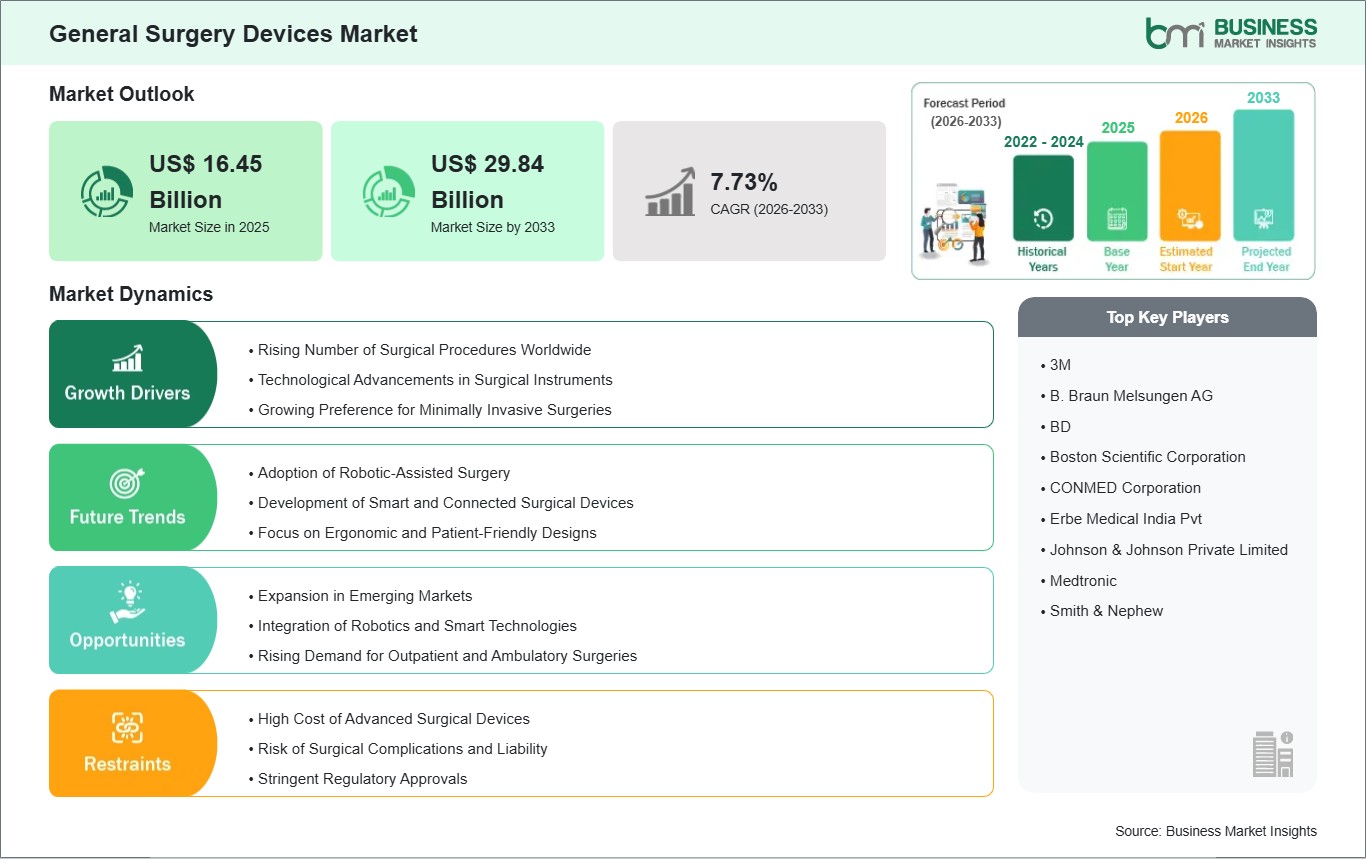
The general surgery devices market size is expected to reach US$ 29.84 billion by 2033 from US$ 16.45 billion in 2025. The market is estimated to record a CAGR of 7.73% from 2026 to 2033.
The market for general surgery devices is a huge and crucial part of medical devices industry, making available tools and technologies for different kinds of surgical operations, starting from open ones to minimally invasive techniques. Among those, the list goes on from laparoscopic instruments, energy-based tools like electrosurgical and ultrasonic devices, and staplers through to hemostats, sutures, and sophisticated systems like robotic-assisted platforms that give better control and precision to the surgery. On the other hand, the market is being pulled upward as people requiring surgery are becoming more and more due to chronic diseases such as cancer, heart problems, and obesity, all of which need operations, and follow-up care. Aging population and better healthcare infrastructure globally are also factors that are pushing the healthcare industry to use these devices in hospitals and outpatient surgery centers more and more.
The market is influenced by several key factors. One significant trend is the rise of the preference for minimally invasive surgery which results in less trauma, faster recovery, fewer complications, and cost savings. Hospitals are therefore increasingly going for advanced laparoscopic and robotic systems, which not only help in the conducting of complex surgeries through enhanced visualization but also provide user-friendly tools. The latest innovations, like artificial intelligence, improved imaging, and robotics, are gradually changing the surgical approach, enabling surgeons to perform even more precisely and efficiently, especially in cases of cancer, heart, and weight-loss surgeries. However, such technologies might restrict their uptake in the regions that are sensitive to pricing. Stringent regulatory requirements and lengthy procedures required for new devices can also adversely impact the commercialization through delays and projected higher costs. Moreover, the lack of proficient professionals who can handle high-technology procedures might be a geographical limitation to the market penetration.

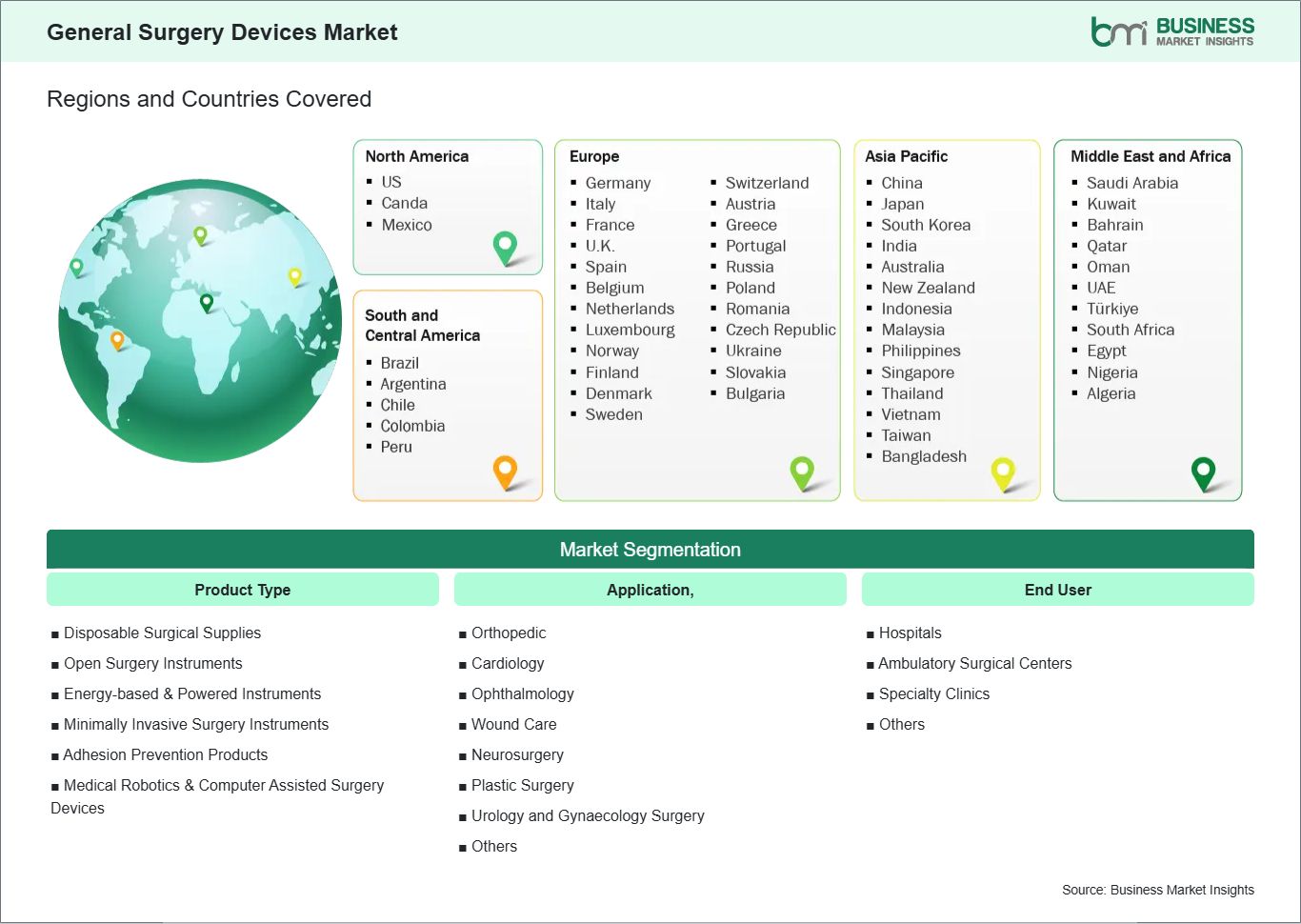
Key segments that contributed to the derivation of the general surgery devices market analysis are product, application, and end user.
The overall increase of surgical operations around the world is the main reason for the growth of the market for general surgery devices, as the rise in the number of operations lifts the demand directly for the supporting instruments, consumables, and advanced technologies needed for operative care. Every year, hundreds of millions of major surgical operations are performed worldwide, with an estimated 300 million surgeries taking place annually. Projections indicate that this number will continue to rise as the population grows and ages. As nations progress and the healthcare system becomes more accessible, there are more patients that have undergone necessary interventions for trauma, chronic diseases like cancer and cardiovascular conditions, and elective or cosmetic surgeries, all requiring a variety of general surgery devices. This increase in surgical procedures is seen in every specialty — from minimally invasive laparoscopic procedures to complex open surgeries — and the hospitals and surgical centers are therefore compelled to increase their inventories of staplers, energy-based devices, retractors, and other tools that not only assist but also improve precision and outcomes.
Furthermore, although the preference for minimally invasive surgeries is still growing, it is due to the advantages like less pain, faster recovery, and lower infection risks that eventually lead to a higher number of these types of procedures which in turn require specialized instruments suitable for their techniques. Meanwhile, the advanced technologies — such as robot-assisted systems and smart energy platforms — are being increasingly integrated into the operating room as they are the ones that can manage the rising number of patients in an efficient and safe way, thus leading to further device adoption.
The amalgamation of robots and intelligent technologies presents a powerful growth prospect in the surgical devices market, as it enhances precision, efficacy, and patient outcomes in a fundamental way. The introduction of robotic-assisted systems in hospitals has been increasing not only for general surgeries like cholecystomies and hernia repairs but also for complex cancer and heart surgeries. They enable surgeons to operate with accuracy down to a millimeter, with better skills, and excellent 3D vision, which surpasses that of traditional methods. Research indicates that the use of AI in robotics helps reduce operative time and complications during operations, thereby enhancing clinical safety and increasing throughput and efficiency in hospitals.
The real-life usage growth of the technology is a clear demonstration of this trend: in the UK's NHS, the number of surgeries that are robot-assisted is anticipated to skyrocket in the next decade, with the use of robots in laparoscopic surgeries planned to be the most common across many specialties. Likewise, the da Vinci system, for instance, has recorded a global rise in procedure volume of more than ten percent, which is indicative of the strong clinical demand and the confidence of surgeons and healthcare facilities.
The use of smart technologies such as AI, machine learning, and advanced imaging integration is paving the way for the next generation of surgical robots that can assist in surgical planning, provide real-time decision support, and even perform some semi-autonomous functions. This technology allows for the reduction of inter-operator variability and at the same time, it may improve the consistency while the connected data analytics further enhance the performance and provide support in training.

By product, the general surgery devices market is bifurcated into disposable surgical supplies [surgical non-woven, examination & surgical gloves, general surgery procedural kits, needles and syringes, venous access catheters], open surgery instruments [retractor, dilator, catheters, others], energy-based & powered instruments, minimally invasive surgery instruments, adhesion prevention products, medical robotics & computer assisted surgery devices. The disposable surgical supplies segment dominated the market in 2025. The surgical supplies segment, particularly disposable surgical supplies, is experiencing substantial growth, primarily driven by the increasing demand for hygiene and infection control during surgical procedures, as the use of disposables reduces the risk of cross-contamination.
By application, the market is segmented into orthopedic, cardiology, ophthalmology, wound care, neurosurgery, plastic surgery, urology and gynaecology surgery, other applications. The orthopedic segment held the largest share of the market in 2025. The growth of the orthopedic surgery segment is attributed to the rising cases of musculoskeletal disorders, sports-related injuries, and the aging population that requires joint replacements and other treatments. Moreover, advancements in surgical techniques, including minimally invasive and robotic surgery, have significantly enhanced the effectiveness and safety of orthopedic surgeries.
By end user, the market is segmented into hospitals, ambulatory surgical centers, specialty clinics, other end users. The hospitals segment held the largest share of the market in 2025. The hospital segment is benefiting from a combination of factors, including technological advancements that lead to safer and more effective surgeries, as well as an aging population that generates a need for more surgical interventions. As hospitals upgrade their skills and improve care, it is expected that the number of both elective and emergency surgeries will increase, creating further demand and prompting hospitals to invest in equipment, staff training, and infrastructure.
| Report Attribute | Details |
|---|---|
| Market size in 2025 | US$ 16.45 Billion |
| Market Size by 2033 | US$ 29.84 Billion |
| Global CAGR (2026 - 2033) | 7.73% |
| Historical Data | 2022 - 2024 |
| Forecast period | 2026-2033 |
| Segments Covered | By Product Type
|
|
Regions and Countries Covered
| |
| North America | US, Canada, Mexico |
| Europe | Belgium, Austria, Finland, Denmark, Greece, Poland, Romania, Russia, Ukraine, Czech Republic, Slovakia, Bulgaria, Italy, Luxembourg, Germany, Switzerland, France, Netherlands, Norway, Portugal, Spain, Sweden, United Kingdom |
| Asia-Pacific | Australia, China, India, Japan, South Korea, Indonesia, Malaysia, Philippines, Singapore, Thailand, Vietnam, Bangladesh, New Zealand, Taiwan |
| South and Central America | Brazil, Argentina, Peru, Chile, Colombia |
| Middle East and Africa | Bahrain, Kuwait, Oman, Qatar, Saudi Arabia, United Arab Emirates, Turkiye, South Africa, Egypt, Algeria, Nigeria |
| Market leaders and key company profiles |
|
The "General Surgery Devices Market Size and Forecast (2022–2033)" report provides a detailed analysis of the market covering below areas:
The geographical scope of the general surgery devices market report is divided into five regions: North America, Asia Pacific, Europe, Middle East & Africa, and South & Central America. The general surgery devices market in Asia Pacific is expected to grow significantly during the forecast period.
The Asia-Pacific general surgery devices market is segmented into China, Japan, South Korea, India, Australia, and the rest of Asia. The Asia-Pacific market for devices used in general surgery is experiencing rapid growth. The factors behind this growth include increased healthcare investments, a growing elderly population, and a higher incidence of chronic respiratory diseases. Among the leaders of this growth are China, India, and Japan, which are characterized by their use of modern medical technology and excellent medical care infrastructures. The market is likely to continue to grow as approval from FDA, TGA, and EMA has been secured by many healthcare facilities in the Asia-Pacific region.
The developing markets in the Asia-Pacific region are reflected in the general surgery devices sector in Japan, which is expected to see a significant increase on the aforementioned date. The medical device sector is becoming larger by the introduction of sophisticated devices and continuous new product launches. Manufacturers are allocating funds for research and development to create innovative tools that not only enhance but also ensure precision, efficiency, and patient safety. For instance, in September 2022, Olympus Corporation introduced the THUNDERBEAT Open Fine Jaw Type X, a surgical energy device designed for use in open surgical procedures, as well as delicate operations such as thyroidectomy.

The general surgery devices market is evaluated by gathering qualitative and quantitative data post primary and secondary research, which includes important corporate publications, association data, and databases. A few of the key developments in the general surgery devices market are:
The General Surgery Devices Market is valued at US$ 16.45 Billion in 2025, it is projected to reach US$ 29.84 Billion by 2033.
As per our report General Surgery Devices Market, the market size is valued at US$ 16.45 Billion in 2025, projecting it to reach US$ 29.84 Billion by 2033. This translates to a CAGR of approximately 7.73% during the forecast period.
The General Surgery Devices Market report typically cover these key segments-
The historic period, base year, and forecast period can vary slightly depending on the specific market research report. However, for the General Surgery Devices Market report:
The General Surgery Devices Market is populated by several key players, each contributing to its growth and innovation. Some of the major players include:
The General Surgery Devices Market report is valuable for diverse stakeholders, including:
Essentially, anyone involved in or considering involvement in the General Surgery Devices Market value chain can benefit from the information contained in a comprehensive market report.
Please tell us your area of interest
(Market Segments/ Regions and Countries/ Companies)