
Neurology Endoscopy Devices Market Outlook: Size, Share, Trends, Growth Analysis, Competitive Landscape & Forecast, 2026–2033

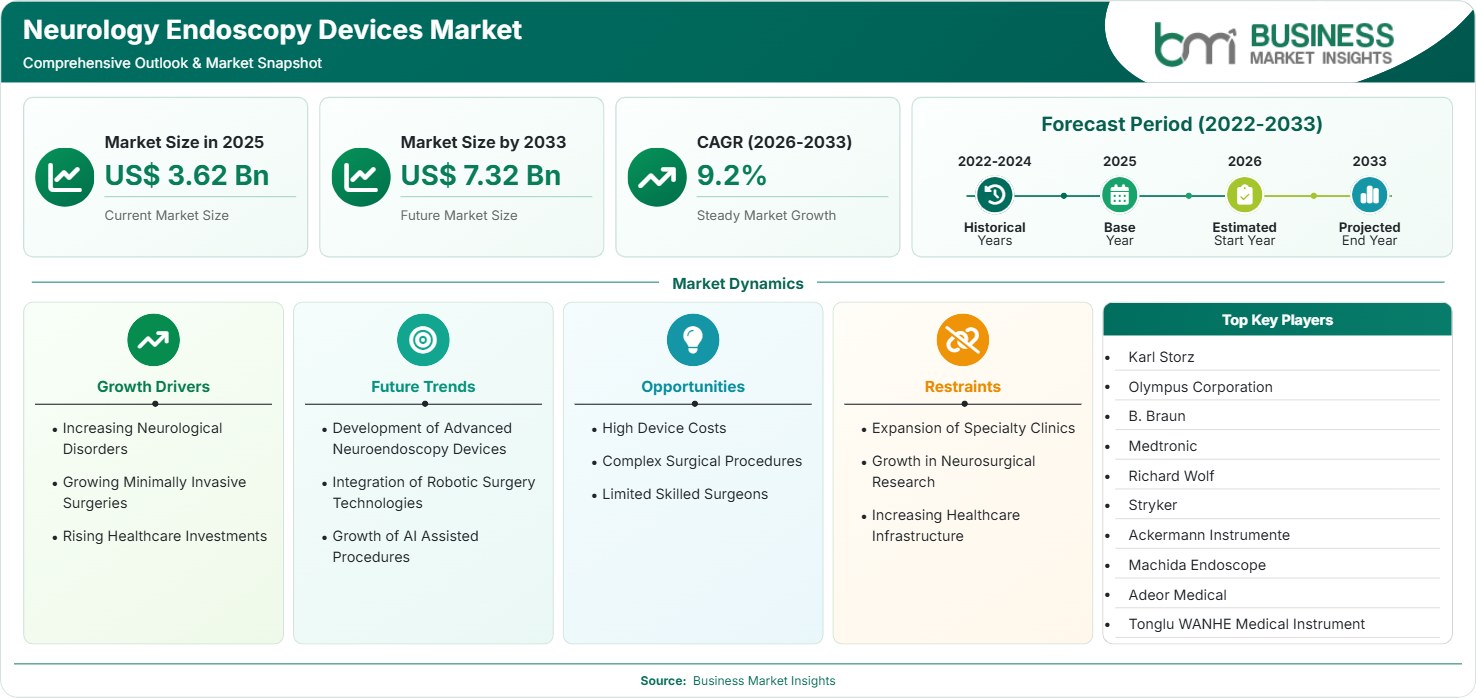
The Neurology Endoscopy Devices Market size was valued at US$ 3.62 billion in 2025 and is projected to reach US$ 7.32 billion by 2033, growing at a CAGR of 9.2% during 2026–2033. Rising neurological disease prevalence, increasing minimally invasive neurosurgical procedures, expanding healthcare infrastructure, and continuous advancements in endoscopic visualization technologies continue driving global market expansion.

Report Coverage
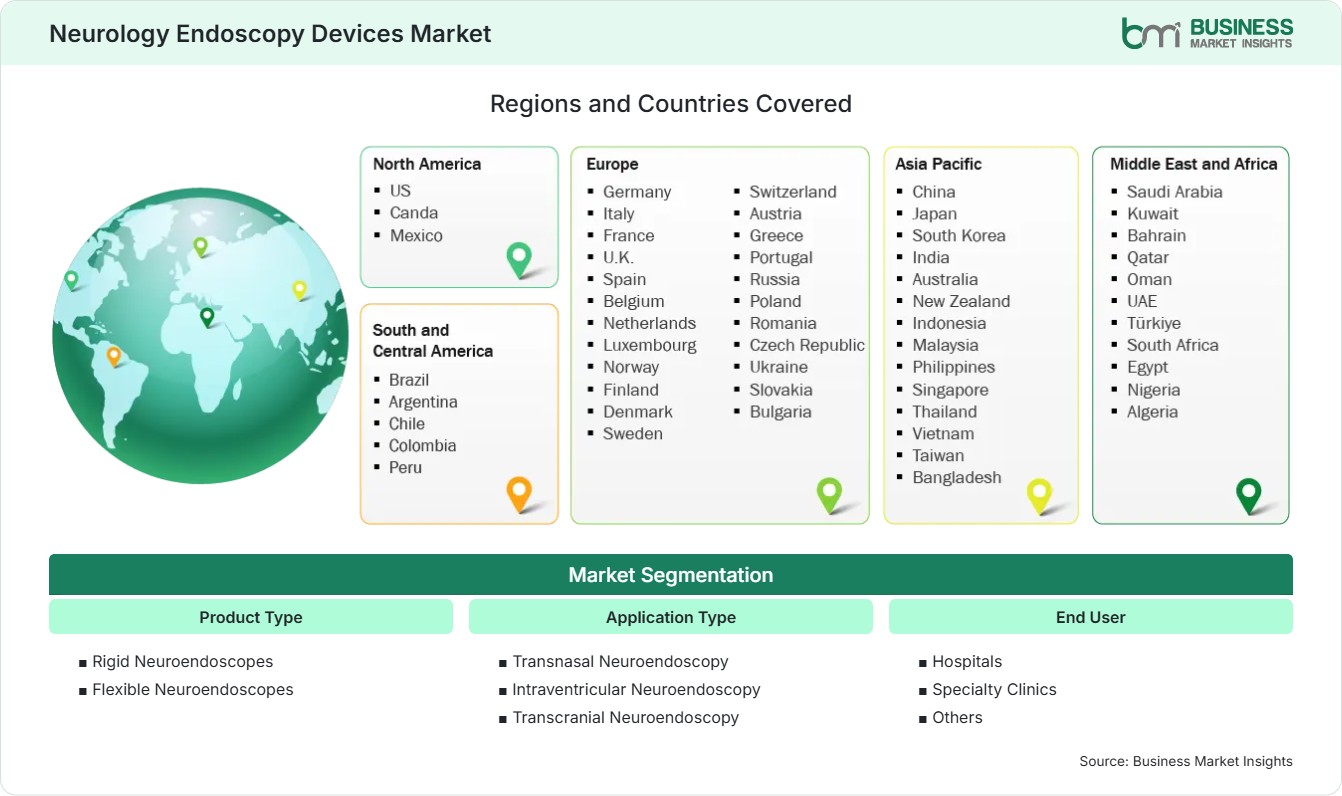
  • Product Type: Rigid Neuroendoscopes, Flexible Neuroendoscopes
  • Application Type: Transnasal Neuroendoscopy, Intraventricular Neuroendoscopy, Transcranial Neuroendoscopy
  • End User: Hospitals, Specialty Clinics, Others
US$ 3.62 Bn Market size in 2025
US$ 7.32 Bn Market Size by 2033
9.2% CAGR, 2026 - 2033
2026-2033 Forecast Period

AI Overview

Neurology Endoscopy Devices Market Summary

  • North America Region: North America holds 38%–40% share in 2025 and is projected to grow at a CAGR of 8.7%–9.3% during 2026–2033, supported by advanced neurosurgical infrastructure, high healthcare expenditure, and increasing adoption of minimally invasive neurological procedures. The U.S. market benefits from robust medical technology adoption and specialized neurosurgical centers, growing at a 9.0% CAGR through 2033.
  • Fastest Growing Region: Asia Pacific accounts for 27%–29% share in 2025 and is anticipated to register a 10.2%–10.8% CAGR during 2026–2033, driven by expanding healthcare infrastructure, rising neurological disease burden, increasing healthcare investments, and growing availability of specialized neurosurgical services.
  • Leading Segment: Rigid Neuroendoscopes account for 61%–63% share in 2025 and are projected to grow at a 9.3%–9.9% CAGR during 2026–2033, supported by superior visualization quality, precision, and widespread adoption in intraventricular and skull base surgeries.
  • High Growth Segment: Hospitals account for 63%–65% share in 2025 and are expected to expand at a 9.4%–10.0% CAGR during 2026–2033, driven by increasing neurosurgical volumes, investments in operating room technologies, and multidisciplinary neurological care.
  • Key Market Opportunity: Expanding neurosurgical centers, increasing investments in minimally invasive technologies, and rising healthcare infrastructure development create substantial opportunities for advanced neuroendoscopy system manufacturers worldwide.
  • Major Market Players: Karl Storz, Olympus Corporation, B. Braun SE, Medtronic plc, Richard Wolf GmbH, Stryker Corporation, Ackermann Instrumente GmbH, Machida Endoscope Co., Ltd., Adeor Medical AG, and Tonglu WANHE Medical Instrument Co., Ltd.
Strategic Insights

Neurology Endoscopy Devices Market: Strategic Insights

Neurology Endoscopy Devices Market Strategic Framework
FREE PDF
Request your free sample
Request free sample
Stakeholder View

Key Takeaways

  • The market ecosystem integrates device manufacturers, imaging technology providers, hospitals, neurosurgical centers, and research institutions to improve procedural precision and patient outcomes.
  • Hospitals remain the largest end-user segment owing to high neurosurgical procedure volumes, advanced surgical infrastructure, and increasing investments in minimally invasive technologies.
  • Product innovation increasingly focuses on high-definition optics, 3D visualization, image-guided surgery, ergonomic instruments, and digital integration to enhance surgical performance.
  • Asia Pacific presents the strongest long-term investment opportunity due to expanding healthcare infrastructure, growing neurological disease prevalence, and increasing government healthcare expenditure.
  • Strategic collaborations between medical device manufacturers and healthcare institutions continue accelerating technology development and clinical adoption worldwide.
  • Increasing physician training initiatives and simulation-based education programs continue supporting broader adoption of neuroendoscopy procedures across emerging healthcare markets.
Geographic Outlook

Neurology Endoscopy Devices Market Regional Highlights

North America Neurology Endoscopy Devices Market

North America accounted for 38%–40% of the Neurology Endoscopy Devices Market share in 2025 and is projected to expand at a 8.7%–9.3% CAGR through 2033. Strong healthcare infrastructure, widespread availability of specialized neurosurgical centers, and continuous adoption of advanced medical technologies continue supporting regional market growth. Favorable reimbursement policies further encourage minimally invasive neurological procedures.

  • Hospitals increasingly invest in high-definition neuroendoscopy systems to improve surgical precision and patient recovery outcomes.
  • Academic medical centers continue expanding neurosurgical research and physician training programs supporting technology adoption.
  • Medical device companies strengthen regional innovation through continuous product development and clinical collaborations.
  • Growing prevalence of neurological disorders supports sustained procedural demand across specialized healthcare institutions.

US Neurology Endoscopy Devices Market

The United States represented 32%–34% of global revenue in 2025 and is projected to grow at a 9.0% CAGR during the Neurology Endoscopy Devices Market Forecasts. Increasing neurological procedure volumes, strong healthcare investments, and advanced hospital infrastructure continue supporting equipment demand. Ongoing innovation in minimally invasive neurosurgery further strengthens long-term market expansion.

  • Advanced neurosurgical hospitals continue adopting integrated visualization technologies for improved surgical outcomes.
  • Growing physician training programs strengthen clinical expertise in minimally invasive neurological procedures.
  • Continuous medical technology innovation improves imaging quality, surgical navigation, and procedural efficiency.
  • Increasing healthcare expenditure supports procurement of advanced neuroendoscopy platforms nationwide.

Europe Neurology Endoscopy Devices Market

Europe accounted for 27%–29% of global revenue in 2025 and is expected to register a 8.8%–9.4% CAGR through 2033. Rising neurological disease incidence, expanding healthcare modernization, and increasing adoption of minimally invasive surgery continue supporting regional growth. Germany remains the leading regional market, while Spain is projected to register the fastest growth at a 9.6% CAGR during the forecast period.

  • Healthcare providers increasingly adopt advanced neuroendoscopy systems to improve neurosurgical precision and patient safety.
  • Growing investments in digital operating rooms strengthen adoption of integrated visualization technologies.
  • Academic collaborations continue supporting innovation in minimally invasive neurosurgical techniques.
  • Favorable regulatory support accelerates commercialization of advanced medical imaging solutions.

Asia Pacific Neurology Endoscopy Devices Market

Asia Pacific accounted for 27%–29% of global revenue in 2025 and is projected to register the fastest Neurology Endoscopy Devices Market growth at 10.2%–10.8% CAGR through 2033. Expanding healthcare infrastructure, increasing neurological disease diagnosis, and rising government healthcare expenditure continue strengthening regional demand. China remains the leading regional market, while India is projected to record the fastest growth with an estimated 11.1% CAGR during the forecast period.

  • Governments continue investing in specialized neurological hospitals and advanced surgical infrastructure.
  • Growing access to minimally invasive neurosurgical procedures improves treatment availability across emerging healthcare systems.
  • Medical device manufacturers continue expanding regional distribution and localized production capabilities.
  • Increasing physician training programs strengthen adoption of advanced neuroendoscopy technologies.

Rest of World Neurology Endoscopy Devices Market

The Rest of World region, comprising South & Central America and the Middle East & Africa, accounted for 6%–8% of global Neurology Endoscopy Devices Market revenue in 2025 and is projected to expand at a 9.0%–9.6% CAGR through 2033. Brazil leads regional demand through expanding neurological care infrastructure, while Saudi Arabia is expected to register the fastest regional growth with a 9.9% CAGR, supported by healthcare modernization and increasing investments in specialized medical services.

Across the Middle East and Africa, healthcare infrastructure expansion, growing neurosurgical capabilities, and increasing investments in advanced medical technologies continue strengthening market demand. Government healthcare reforms further support long-term adoption of minimally invasive neurosurgical equipment.

  • Brazil continues expanding tertiary care hospitals equipped with advanced neurosurgical technologies.
  • Gulf countries invest significantly in specialized neuroscience centers and modern operating room infrastructure.
  • International medical device companies strengthen regional partnerships to improve technology accessibility.
  • Rising awareness of minimally invasive neurological procedures continues supporting equipment adoption across emerging healthcare markets.
Global Market Geography
FREE PDF
Request your free sample
Request free sample
Segment Analysis

Neurology Endoscopy Devices Market Segmentation

Product Type

Product Type represents the largest segment of the market as hospitals and neurosurgical centers increasingly adopt advanced visualization technologies for minimally invasive brain procedures. This segment accounted for 57%–59% market share in 2025 and is projected to grow at a 9.3%–9.9% CAGR during 2026–2033. The Neurology Endoscopy Devices Market scope continues expanding with technological advancements in high-definition imaging, improved illumination systems, and growing preference for minimally invasive neurosurgical interventions.

  • Rigid Neuroendoscopes: Rigid neuroendoscopes dominate clinical procedures owing to superior image quality, structural stability, and widespread use in intraventricular surgeries and skull base interventions.
  • Flexible Neuroendoscopes: Flexible neuroendoscopes are gaining wider adoption for complex anatomical access, offering enhanced maneuverability and improved visualization during minimally invasive neurological procedures.

Application Type

Application Type remains a critical segment as neuroendoscopic techniques continue replacing conventional open neurosurgical procedures across multiple neurological conditions. This segment accounted for 35%–37% market share in 2025 and is expected to register a 9.4%–10.0% CAGR through 2026–2033. The Neurology Endoscopy Devices Market trends highlight increasing clinical adoption of advanced neuroendoscopy across hospitals and specialized neurosurgical centers worldwide.

  • Transnasal Neuroendoscopy: Transnasal neuroendoscopy continues expanding for pituitary tumor removal and skull base surgeries owing to reduced surgical trauma and faster patient recovery.
  • Intraventricular Neuroendoscopy: Intraventricular neuroendoscopy remains the leading application for hydrocephalus treatment, cyst removal, tumor biopsy, and cerebrospinal fluid pathway restoration.
  • Transcranial Neuroendoscopy: Transcranial neuroendoscopy supports minimally invasive management of intracranial lesions requiring enhanced visualization while minimizing disruption to surrounding brain tissue.

End User

End User demand is primarily driven by expanding neurosurgical capabilities, rising neurological disease prevalence, and increasing investments in advanced surgical infrastructure. This segment accounted for 63%–65% of the Neurology Endoscopy Devices market share in 2025 and is projected to grow at a 9.1%–9.7% CAGR during 2026–2033. Hospitals continue investing in advanced neuroendoscopy platforms to improve surgical precision, patient outcomes, and procedural efficiency.

  • Hospitals: Hospitals remain the primary users owing to high surgical volumes, availability of specialized neurosurgical teams, and continuous investments in advanced operating room technologies.
  • Specialty Clinics: Specialty clinics continue expanding adoption of neuroendoscopy systems by offering focused neurological care, minimally invasive procedures, and shorter patient recovery times.
Market Forces

Neurology Endoscopy Devices Market Dynamics

Key Market Drivers

Increasing Neurological Disorders

The global rise in neurological disorders, including hydrocephalus, brain tumors, intracranial cysts, and neurovascular diseases, continues driving demand for advanced neuroendoscopy procedures. Aging populations and improved diagnostic capabilities contribute to higher procedural volumes worldwide. The Neurology Endoscopy Devices Market growth is supported by increasing demand for precise visualization technologies that improve surgical outcomes while reducing patient trauma and hospitalization periods.

Growing Minimally Invasive Surgeries

Healthcare providers increasingly prefer minimally invasive neurosurgical techniques because they reduce surgical complications, shorten recovery periods, minimize blood loss, and improve clinical outcomes. Neuroendoscopy enables surgeons to access complex anatomical structures with enhanced visualization while preserving healthy tissue. Continuous advancements in optics, camera systems, and surgical instrumentation further accelerate adoption across hospitals and specialized neurosurgical centers.

Rising Healthcare Investments

Governments and private healthcare organizations continue investing in advanced surgical infrastructure, neurosurgical training, and modern operating room technologies. Increasing healthcare expenditure supports procurement of high-definition neuroendoscopy platforms and integrated surgical visualization systems. Growing reimbursement support for minimally invasive procedures also encourages healthcare providers to expand neuroendoscopy capabilities across developed and emerging healthcare markets.

Key Market Opportunities

Expansion of Specialty Clinics

The increasing establishment of specialized neurology and neurosurgery clinics creates significant opportunities for manufacturers supplying compact, high-performance neuroendoscopy systems. Specialty centers have been continuously acquiring sophisticated surgery equipment in order to enhance patient experiences and procedure effectiveness. This helps in expanding the practice of minimally invasive neurosurgery beyond the walls of major tertiary centers.

Growth in Neurosurgical Research

Expanding research in neuro-oncology, cerebrovascular disorders, pediatric neurosurgery, and image-guided interventions continues creating opportunities for technological innovation. Many academic and medical device companies have now come together to develop next-generation neuroendoscopic techniques that use robotics, artificial intelligence, and advanced imaging technology to improve surgical accuracy and outcomes.

Increasing Healthcare Infrastructure

Rapid healthcare infrastructure development across emerging economies creates favorable opportunities for neuroendoscopy equipment manufacturers. As new hospitals, neurosurgical centers, and neuroscience institutes make greater use of visualization technology for their ever-growing range of neurology services, there is increased spending on such equipment in public and private healthcare organizations.

Market Restraints and Challenges

High Device Costs

Factor: Advanced neuroendoscopy systems incorporate high-definition optics, precision surgical instruments, sophisticated imaging technologies, and integrated visualization platforms that substantially increase acquisition costs.

Impact: High cost of capital can lead to the postponement of the procurement process, especially among small hospitals or other healthcare organizations operating on limited budgets. Nowadays, manufacturers offer more modular systems, financing options, and long-term services to make it more affordable. Besides that, technological standardization and increased market adoption will make it cheaper in the future.

Complex Surgical Procedures

Factor: Neuroendoscopic procedures require highly specialized surgical expertise, extensive training, and comprehensive understanding of complex intracranial anatomy to ensure safe clinical outcomes.

Impact: The shortage of skilled neurosurgeons and training programs may act as barriers to the uptake and use of highly sophisticated neuroendoscopy systems. Medical device companies are still providing medical practitioners with training programs in simulation, surgery workshops, and other forms of collaboration. Such training will promote safe procedures and increase the uptake of minimally invasive neurosurgery around the world.

Company Analysis

Competitive Landscape

The market is characterized by strong competition among global medical device manufacturers focusing on high-definition imaging, advanced optics, minimally invasive surgical technologies, and integrated visualization systems. The Neurology Endoscopy Devices Market analysis indicates that companies are strengthening their market positions through continuous product innovation, strategic collaborations with healthcare institutions, and expansion of specialized neurosurgical portfolios.

Company Name

Overview

Products and Services Relevant to this Market

Karl Storz

Global leader in endoscopic technologies with extensive expertise in minimally invasive surgical solutions.

Neuroendoscopes, endoscopic imaging systems, visualization platforms, surgical instruments, and operating room integration solutions.

Olympus Corporation

Leading medical technology company specializing in advanced endoscopy and imaging systems.

Endoscopic visualization systems, neuroendoscopes, surgical imaging solutions, endoscopic instruments, and medical visualization technologies.

B. Braun SE

International healthcare company offering comprehensive surgical and neurosurgical technology solutions.

Neuroendoscopy instruments, surgical devices, minimally invasive equipment, operating room technologies, and neurosurgical accessories.

Medtronic plc

Global medical device manufacturer with broad neurosurgical and neurological treatment portfolios.

Neuroendoscopy systems, surgical navigation technologies, neurosurgical instruments, imaging integration, and operating room solutions.

Richard Wolf GmbH

Medical technology company specializing in advanced endoscopic systems and surgical visualization equipment.

Neuroendoscopes, camera systems, light sources, visualization platforms, and minimally invasive surgical instruments.

Stryker Corporation

Global healthcare technology company providing innovative surgical equipment and visualization systems.

Endoscopic visualization platforms, surgical cameras, neurosurgical instruments, operating room technologies, and imaging solutions.

Ackermann Instrumente GmbH

German manufacturer specializing in precision endoscopic technologies for surgical applications.

Neuroendoscopes, visualization systems, surgical instruments, camera systems, and minimally invasive medical equipment.

Machida Endoscope Co., Ltd.

Specialized manufacturer of medical endoscopy systems serving hospitals and surgical centers globally.

Flexible endoscopes, rigid endoscopes, imaging systems, endoscopic accessories, and diagnostic visualization equipment.

Adeor Medical AG

Medical technology company focused on minimally invasive surgical instrumentation and visualization solutions.

Neuroendoscopy devices, surgical instruments, visualization systems, operating room equipment, and neurosurgical accessories.

Tonglu WANHE Medical Instrument Co., Ltd.

Medical device manufacturer supplying endoscopic equipment and surgical instruments worldwide.

Neuroendoscopy systems, rigid endoscopes, surgical visualization equipment, endoscopic instruments, and medical accessories.

Industry Activity

Recent Developments

June 2026

Stryker partnered with professional golfer Shane Lowry as a sponsored brand ambassador for its Joint Replacement division to raise awareness of the vital role caregivers play throughout the joint replacement journey.

May 2026

Stryker completed the acquisition of Amplitude Vascular Systems (AVS), a privately held medical technology company developing a next-generation intravascular lithotripsy (IVL) platform for the treatment of complex peripheral arterial disease (PAD).

August 2024

KARL STORZ completed the acquisition of Asensus Surgical, strengthening its portfolio in robot-assisted minimally invasive surgery. The acquisition combines KARL STORZ's expertise in endoscopy and visualization with Asensus' digital laparoscopy and Performance-Guided Surgery technologies.

April 2024

Medtronic plc unveiled the latest advancements for its GI Genius intelligent endoscopy system at Genius Summit 2024, including the launch of ColonPRO software.

Trust & Transparency

Research Methodology

The market analysis combines proprietary research with secondary data from government agencies, company disclosures, regulatory filings, industry databases and expert interviews. Market estimates are validated through data triangulation, cross-market benchmarking and analyst review.

View Full Research Methodology

Questions Answered

Frequently Asked Questions

What does the Neurology Endoscopy Devices Market Report include?

The Neurology Endoscopy Devices Report provides comprehensive market forecasts, competitive analysis, regional insights, segmentation, company profiles, technology trends, recent developments, and strategic growth opportunities.

Which end-user segment offers the highest market opportunity?

Hospitals remain the leading end-user segment due to higher neurosurgical procedure volumes, advanced surgical infrastructure, multidisciplinary neurological care, and continuous investments in modern operating room technologies.

Why is Asia Pacific expected to witness the fastest growth?

Asia Pacific benefits from expanding healthcare infrastructure, rising neurological disease diagnosis, increasing government healthcare expenditure, improving access to specialized neurosurgical care, and growing investments in advanced medical technologies.

Which product segment dominates the market?

Rigid Neuroendoscopes account for the largest market share because they provide superior image quality, procedural precision, structural stability, and widespread application across neurosurgical interventions.

What factors are driving the Neurology Endoscopy Devices Market?

Increasing prevalence of neurological disorders, growing adoption of minimally invasive neurosurgery, expanding healthcare investments, and continuous technological advancements in endoscopic visualization systems continue driving market growth.

Access the Full Neurology Endoscopy Devices Market Report

Get segment-level forecasts, regional estimates, competitive benchmarking, company profiles and downloadable Excel datasets.

Access the full Neurology Endoscopy Devices Market Report
350 pages PDF & Excel | 2026-08-04