
Gas Engines Market Outlook: Size, Share, Trends, Growth Analysis, Competitive Landscape & Forecast, 2026-2033

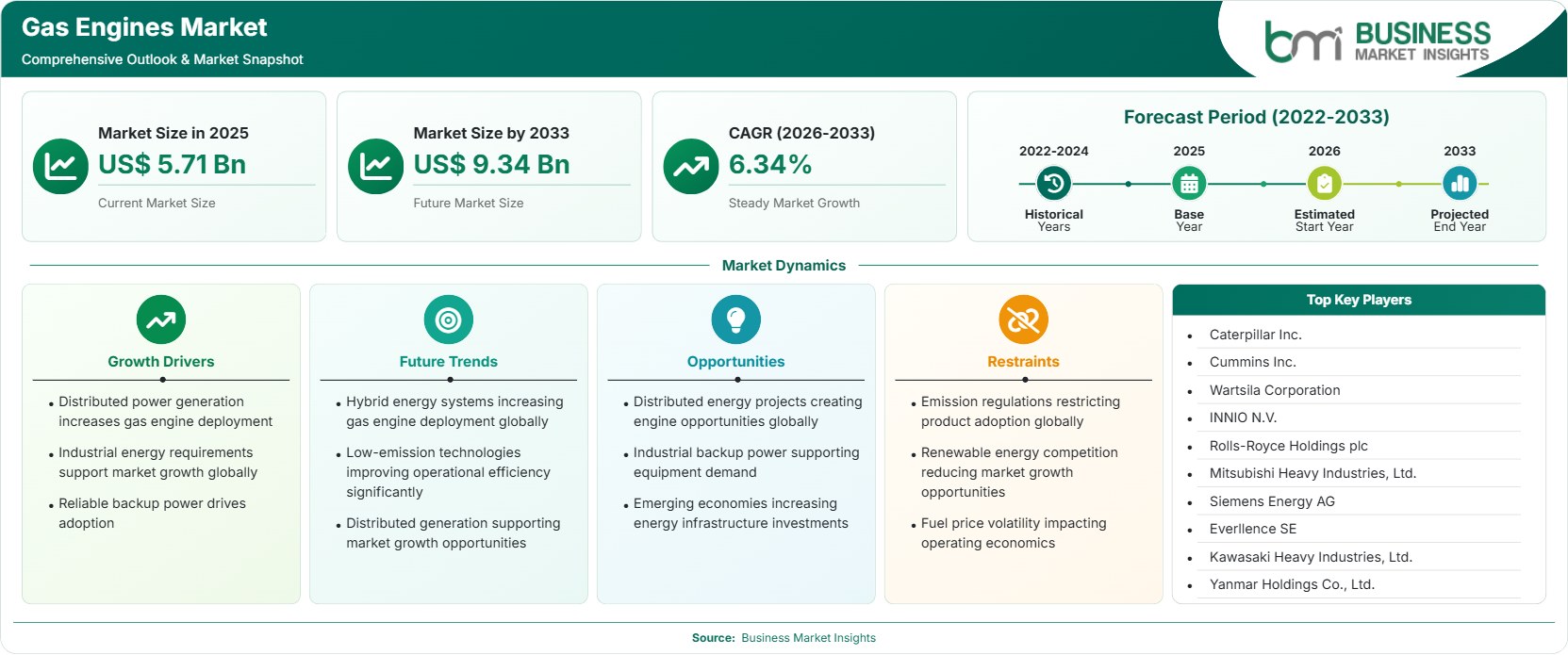
The Gas Engines Market size was valued at US$ 5.71 Billion in 2025 and is projected to reach US$ 9.34 Billion by 2033, growing at a CAGR of 6.34% during 2026–2033, driven by distributed generation, flexible power demand, cogeneration, fuel diversification, and data-center expansion.

Report Coverage
  • Product Type: Natural Gas, Special Gas, Other
  • Power Output: 0.5-1 MW, 1-2 MW, 2-5 MW, 5-10 MW, 10-20 MW
  • Application: Power Generation, Mechanical Drive, Cogeneration, Others
US$ 5.71 Bn Market size in 2025
US$ 9.34 Bn Market Size by 2033
6.34% CAGR, 2026 - 2033
2026-2033 Forecast Period

AI Overview

Gas Engines Market Summary

  • North America Region: North America holds a 29%–33% share in 2025, growing with a 5.8%–6.3% CAGR, influenced by data centers, grid constraints, distributed generation, replacement demand, industrial resilience, and flexible power requirements. US investment increasingly targets fast-start generation, CHP systems, and modular engines supporting constrained grid connections.
  • Fastest Growing Region: Asia Pacific holds a 31%–35% Gas Engines Market share in 2025, expanding at a 6.8%–7.4% CAGR, supported by industrialization, distributed generation, gas infrastructure, electrification, urban development, and rising demand for reliable decentralized power across manufacturing-intensive economies.
  • Leading Segment: Natural Gas holds a 58%–63% share in 2025, advancing at a 6.0%–6.5% CAGR, supported by broad fuel availability, established infrastructure, efficient combustion, lower local pollutants, flexible dispatch, and expanding distributed-generation applications.
  • High Growth Segment: The 5-10 MW segment holds a 17%–21% share in 2025, expanding at a 7.1%–7.8% CAGR, supported by data centers, industrial facilities, microgrids, utilities, cogeneration projects, and modular generation requirements.
  • Key Market Opportunity: Rising electricity demand, constrained grid capacity, data-center development, renewable intermittency, and hydrogen-ready platforms create opportunities for modular engines combining rapid deployment, high efficiency, fuel flexibility, digital monitoring, and long-term service contracts.
  • Major Market Players: Caterpillar Inc., Cummins Inc., Wärtsilä Corporation, INNIO N.V., Rolls-Royce Holdings plc, Mitsubishi Heavy Industries, Ltd., Siemens Energy AG, Everllence SE, Kawasaki Heavy Industries, Ltd., and Yanmar Holdings Co., Ltd.
Strategic Insights

Gas Engines Market: Strategic Insights

Gas Engines Market Strategic Framework
FREE PDF
Request your free sample
Request free sample
Stakeholder View

Key Takeaways

  • The ecosystem for supply is becoming more integrated, with the manufacturers of engines combining their combustion technology, generator packages, controls, remote monitoring, engineering services, commissioning, spare parts, and long-term maintenance into wider energy-system offerings.
  • The greatest potential benefit is to be found in distributed power, cogeneration, and in larger modular installations that serve data centers, industrial campuses, utilities, and microgrids, since greater grid delays make the quick deployment of such systems more valuable.
  • The development of products is heading in the direction of hydrogen-ready combustion, greater power density, better thermal efficiency, reduced emissions, predictive maintenance, digital controls, and the creation of engines that can operate with a variety of gaseous fuels.
  • The strongest opportunity for geographic expansion is offered by the Asia Pacific since the growth of industrial demand, urbanization, the inconsistent reliability of the grid, and the growing investment in flexible generation all lead to a need for a range of different engine sizes.
  • More of the investment is now being directed towards manufacturing capacity, testing infrastructure, service networks, and technology partnerships rather than towards the expansion of standalone equipment, which shows that lifecycle revenue and application-specific engineering are becoming more important.
  • The demand for fast-starting gas engines among data centers is growing since customers are placing greater value on dispatchability, reliability, modularity, and the ability to operate before the permanent grid capacity is available.
Geographic Outlook

Gas Engines Market Regional Highlights

North America Gas Engines Market

North America accounts for a 29%–33% Gas Engines Market share in 2025 and is projected to expand at a 5.8%–6.3% CAGR during 2026–2033. The regional opportunity is centered on data centers, industrial facilities, grid congestion, replacement of aging generation assets, and flexible distributed power.

  • The demand for reliable on-site generation in data centers is growing, especially in cases where the time needed to connect to the utility supply is longer than the timeline for developing the project. Flexible gas engines can thus fill the gap in infrastructure.
  • Increasingly, industrial customers are combining their engines with renewable generation and storage in order to improve their resilience, manage peak demand, and keep production going when there are grid disturbances or transmission constraints.
  • The demand for replacement is driving a preference for premium equipment since operators are now more inclined to focus on fuel efficiency, emissions performance, remote monitoring, and longer service intervals rather than on reducing the initial cost of the equipment.
  • Distributed generation is still attractive in cases where transmission upgrades would require a large amount of capital or involve a long permitting process. Modular engine systems can be introduced bit by bit as electricity demand increases on commercial and industrial premises.

US Gas Engines Market

The US represents 68%–72% of the North American Gas Engines Market demand in 2025 and is projected to grow at a 5.7%–6.2% CAGR through 2033. The country combines extensive gas infrastructure with substantial investment in data centers, manufacturing, healthcare, logistics, and critical infrastructure.

  • Data centers are now a major factor in increasing demand as developers look for generation that can handle the operations during delays associated with grid-interconnection and, at the same time, keep ahead of broader energy strategies.
  • The process of industrial reshoring is increasing the demand for a reliable supply of electricity in sectors such as semiconductors, the automotive industry, chemicals, metals, and advanced manufacturing, since production interruptions in these areas can lead to substantial economic losses.
  • Utilities and independent power producers are looking at modular engines for use in providing peak support, carrying out balancing tasks, and enabling distributed generation since these engines can operate flexibly without the long construction periods that are associated with some of the larger generation assets.

Europe Gas Engines Market

Europe holds a 24%–28% Gas Engines Market share in 2025 and is projected to advance at a 5.6%–6.1% CAGR through 2033. Germany remains a leading market, while the United Kingdom, Italy, and the Netherlands provide substantial opportunities across industrial CHP and flexible generation.

  • Germany is still a leading market since industrial CHP installations are able to improve fuel efficiency and offer a steady supply of both thermal and electrical power for energy-intensive operations.
  • The industrial base in Italy is suitable for cogeneration, especially in cases where the production of both heat and power results in a reduction of the amount of electricity that has to be purchased and leads to more efficient use of the existing thermal loads.
  • Because renewable energy is becoming more widespread in the United Kingdom, there is potential for growth in flexible generation, and the electricity system operators need more dispatchable resources that can quickly respond to changes in demand.
  • Because developers want to keep the useful capabilities of their gas-engine assets while preparing for changes in fuel availability and meeting decarbonization requirements, there is now greater attention being paid to hydrogen-ready technologies.

Asia Pacific Gas Engines Market

Asia Pacific represents a 31%–35% Gas Engines Market share in 2025 and is projected to grow at a 6.8%–7.4% CAGR through 2033, making it the fastest-growing regional market. China and Japan provide substantial installed industrial and utility demand, while India, Indonesia, Vietnam, and Australia offer strong expansion opportunities. India is supported by industrialization and distributed power requirements.

  • China continues to be a leading market since it has large industrial facilities, a number of distributed energy projects, and localization of equipment, all of which support demand for gas engines in various power-output categories.
  • India is a high-growth country since the demand for reliable electricity and power at local sites is increasing due to the expansion of industrial corridors, commercial infrastructure, data centers, and distributed generation projects.
  • In Southeast Asia, there are great opportunities since manufacturing investment is progressing more rapidly than the grid infrastructure, leading to a demand for modular engines to be used in factories, industrial parks, and commercial buildings.
  • Australia offers scope for flexible generation since engines can be used to complement renewable energy sources, help to stabilize the local supply, and support remote mining and industrial activities that require a reliable supply of electricity.

Rest of World Gas Engines Market

South and Central America account for an estimated 6%–9% Gas Engines Market share within the global market in 2025, with a 5.9%–6.6% CAGR through 2033. Brazil leads regional demand through industrial, agricultural, utility, and distributed-generation applications.

  • The variety of industries in Brazil, together with the country's access to energy resources, enables the use of gas engines in a range of applications such as distributed generation, in industrial establishments, and in cogeneration projects that have varying electricity demands.
  • Chile offers the possibility of flexible generation since its renewable capacity is growing and the operating authorities need dispatchable resources in order to ensure reliability during times of variable renewable output.
  • Saudi Arabia and the United Arab Emirates are establishing advanced industrial and infrastructure systems in which reliable distributed generation can support important facilities and new industrial initiatives.
  • In South Africa and Nigeria, there are opportunities since the problem of grid reliability leads industrial customers, commercial establishments, and operators of infrastructure to consider generating power on-site and using hybrid energy arrangements.
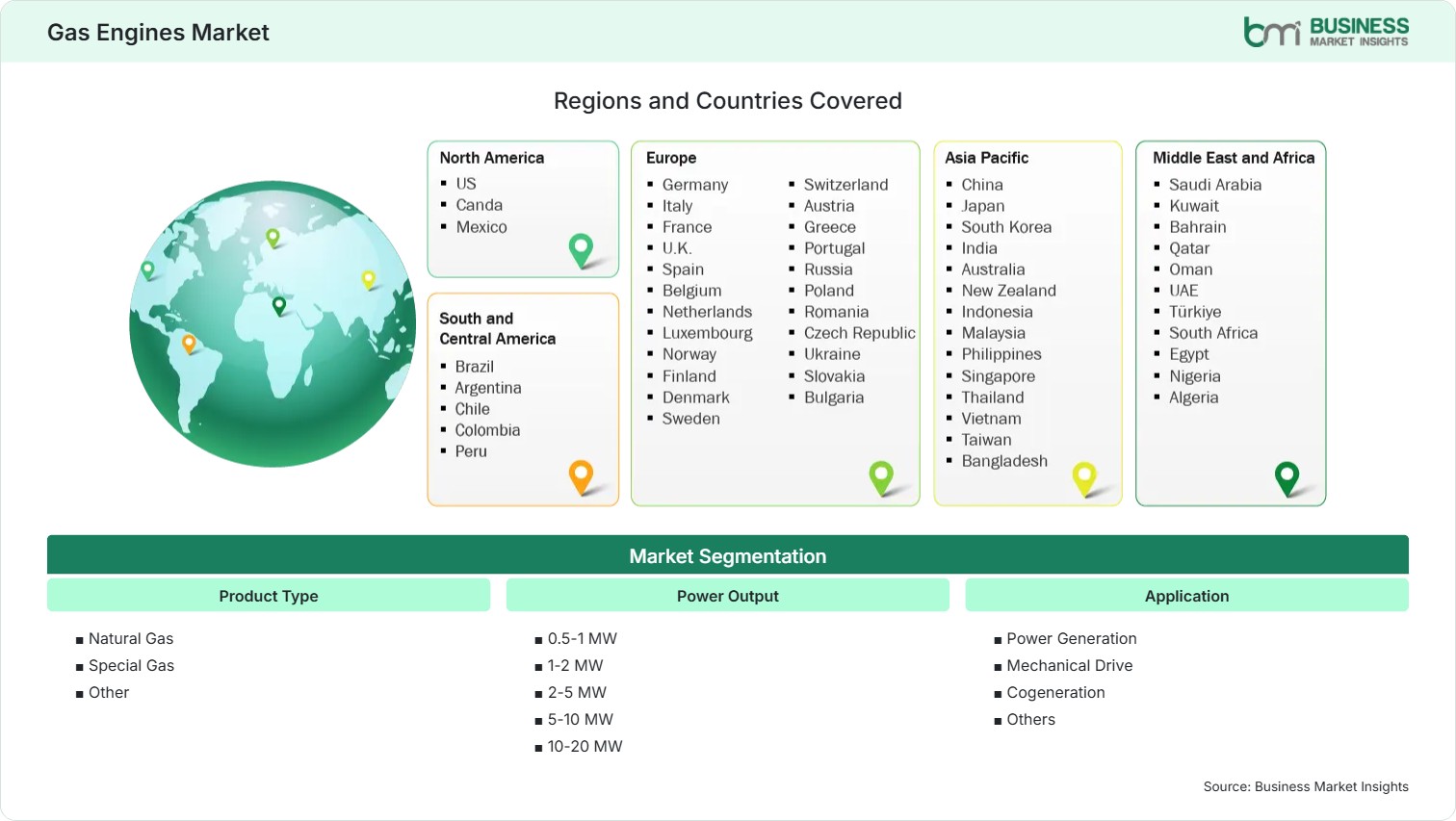
Global Market Geography
FREE PDF
Request your free sample
Request free sample
Segment Analysis

Gas Engines Market Segmentation

Product Type

Natural Gas represents a 58%–63% Gas Engines Market share in 2025 and is projected to expand at a 6.0%–6.5% CAGR during 2026–2034. Established infrastructure, operating familiarity, competitive fuel economics, and lower local emissions support adoption. Special Gas serves biogas, landfill gas, sewage gas, and industrial gas applications where fuel availability supports decentralized generation. Other fuels remain niche, with interest linked to fuel diversification and emerging low-carbon combustion pathways.

  • Natural Gas: Established pipeline infrastructure, proven combustion technology, broad OEM support, and dependable fuel quality make natural gas the preferred option for utilities, industries, data centers, and cogeneration facilities.
  • Special Gas: Biogas, landfill gas, sewage gas, and industrial gases create opportunities for engines capable of handling variable fuel composition while converting locally available waste streams into useful energy.

Power Output

The 5-10 MW category represents a 17%–21% Gas Engines Market share in 2025 and is projected to grow at a 7.1%–7.8% CAGR during 2026–2034. This range benefits from modular plant configurations, data centers, industrial campuses, utilities, and microgrids. Smaller units remain relevant for commercial and decentralized applications, while larger units address industrial and utility-scale requirements. Power-output selection increasingly reflects load profile, grid access, expansion plans, and operating flexibility.

  • 0.5-1 MW: Compact systems support commercial facilities, smaller industrial sites, agricultural operations, and distributed microgrids where moderate loads require dependable generation without large infrastructure commitments.
  • 1-2 MW: This range fits medium-sized commercial and industrial installations, providing scalable capacity for facilities seeking onsite power, backup capability, or improved energy cost management.
  • 2-5 MW: Larger industrial facilities and decentralized power plants favor this range because modular units can match growing demand while maintaining operational redundancy and maintenance flexibility.
  • 5-10 MW: Data centers, industrial campuses, utilities, and microgrids increasingly favor this range because modular blocks provide rapid deployment, dependable output, and flexible expansion.
  • 10-20 MW: Large industrial and utility applications use these systems where continuous generation, cogeneration, and grid-support requirements justify higher-capacity engine installations and dedicated plant infrastructure.

Application

Power Generation remains the dominant application, while cogeneration provides attractive economics where electricity and useful heat are simultaneously required. Mechanical Drive serves compression and process applications, particularly in oil and gas. Other applications remain specialized. Adoption increasingly depends on load profile, fuel availability, emissions requirements, operating hours, and integration with renewables or storage. The Gas Engines Market scope, therefore, extends beyond conventional electricity generation toward integrated energy systems.

  • Power Generation: Utilities, industrial operators, commercial facilities, and data centers use engines for prime power, distributed generation, standby capacity, peak support, and microgrid applications requiring dependable dispatch.
  • Mechanical Drive: Gas engines provide direct mechanical power for compressors, pumps, and process equipment, particularly where continuous operation and local fuel availability improve lifecycle economics.
  • Cogeneration: Combined heat and power systems improve overall fuel utilization by producing electricity and useful thermal energy, making them attractive for manufacturing, hospitals, district heating, and commercial facilities.
Market Forces

Gas Engines Market Dynamics

Key Market Drivers

Rising Data-Center Electricity Requirements

Data-center electricity consumption is becoming a major catalyst for flexible generation investment. Rapid computing expansion increases requirements for reliable power, while grid interconnection can remain constrained by transmission capacity and permitting. Engine-based generation provides modular capacity that can be installed in stages and operated alongside grid supply, renewable generation, and storage. Recent industry orders demonstrate the scale of this demand, including a 429 MW engine project announced for a US data-center application. The Gas Engines Market growth, therefore, increasingly reflects digital infrastructure rather than traditional industrial demand alone.

Expansion of Flexible Distributed Power Systems

Electricity systems with growing renewable penetration require dispatchable resources that can respond to changing demand and renewable variability. Gas engines can start quickly, operate efficiently across variable loads, and be deployed in modular configurations, making them suitable for balancing and distributed generation. Their application is expanding across industrial facilities, utilities, microgrids, commercial campuses, and critical infrastructure. The Gas Engines Market trends increasingly favor systems capable of integration with batteries, solar, wind, and digital energy-management platforms rather than isolated generation.

Fuel Flexibility and Hydrogen-Ready Technology

Fuel flexibility is becoming an important differentiator as operators manage changing gas quality, local fuel availability, and decarbonization requirements. Modern platforms increasingly support natural gas, biogas, landfill gas, sewage gas, syngas, and hydrogen blends, depending on engine architecture. Hydrogen-ready designs allow customers to preserve equipment utility as fuel strategies evolve without immediately replacing installed assets. Kawasaki's commercial launch of a large gas-engine system capable of 30% hydrogen co-firing in 2025 demonstrates the direction of technology development. Such engineering supports the Gas Engines Market growth by expanding applications while reducing technology obsolescence concerns.

Key Market Opportunities

Data-Center and Grid-Constraint Power Infrastructure

Data-center expansion creates an opportunity for suppliers able to package engines, generators, controls, switchgear, cooling, emissions systems, and service contracts into rapidly deployable power blocks. Developers increasingly face long grid-connection schedules while computing capacity must be commissioned quickly. Engine-based systems can provide interim generation and remain valuable as permanent grid capacity becomes available. Gas Engines Market Forecasts increasingly need to account for this structural change in electricity demand because computing infrastructure can require concentrated power capacity rather than gradual load growth.

Hybrid Generation and Renewable Balancing

Hybrid projects combining engines with renewable generation and battery storage offer an attractive opportunity for developers seeking reliability without excessive dependence on any single technology. Engines can provide dispatchable capacity when renewable output declines, while batteries manage rapid fluctuations and short-duration balancing. Solar and wind resources can reduce fuel consumption during favorable operating periods, improving overall system economics. Industrial customers can also use integrated systems to manage demand charges, improve resilience, and reduce exposure to grid interruptions.

Special-Gas and Low-Carbon Fuel Applications

Special-gas applications represent an attractive expansion pathway because waste gases can become locally available energy resources. Biogas from wastewater treatment, landfill operations, agriculture, and anaerobic digestion can support decentralized generation while reducing dependence on conventional fuels. Industrial facilities can similarly use process gases that would otherwise require treatment or disposal. Engine platforms designed for variable methane concentration, contaminants, and changing calorific value can capture these opportunities. Hydrogen blending creates another pathway, particularly in regions developing dedicated hydrogen infrastructure.

Market Restraints and Challenges

Gas Price Volatility and Fuel-Supply Exposure

Factor: Natural-gas pricing can fluctuate because of regional supply conditions, pipeline constraints, weather, geopolitical disruptions, and LNG-market dynamics. Impact: Higher fuel costs can weaken the operating-cost advantage of gas engines against alternative generation technologies, particularly for customers with high annual utilization. Project developers may therefore demand flexible operating strategies, indexed energy contracts, dual-fuel capability, or diversified generation portfolios.

Permitting, Emissions Compliance, and Project Complexity

Factor: Gas-engine projects must comply with increasingly stringent emissions, noise, permitting, grid-connection, and environmental requirements that vary substantially by jurisdiction. Impact: Compliance can increase engineering costs, extend project schedules, and require additional emissions-control equipment or monitoring infrastructure. Customers may face complex approval processes when installing multiple engines at industrial or urban sites. Methane leakage concerns and broader lifecycle-emissions scrutiny can also influence project assessments even when local combustion emissions are lower than conventional alternatives.

Company Analysis

Competitive Landscape

The competitive environment is characterized by multinational engine manufacturers competing through efficiency, power density, fuel flexibility, controls, service networks, and application engineering. Gas Engines Market analysis indicates that competitive advantage increasingly depends on lifecycle capabilities because customers evaluate availability, maintenance costs, emissions compliance, digital monitoring, and financing alongside equipment performance.

Company Name

Overview

Products and Services relevant to this market

Caterpillar Inc.

Major global power-equipment manufacturer with extensive gas-engine capabilities and established industrial, utility, and energy-sector distribution.

Gas generator sets, gas engines, distributed generation systems, CHP solutions, mechanical-drive systems, controls, parts, and lifecycle support.

Cummins Inc.

Global powertrain and energy-technology company serving distributed generation, industrial, commercial, and critical-power customers across multiple regions.

Natural-gas engines, generator sets, power systems, controls, emissions solutions, service programs, and integrated distributed-energy technologies.

Wärtsilä Corporation

Energy-technology company with strong medium-speed engine capabilities serving utilities, independent power producers, and flexible power-system developers.

Gas engine power plants, generator sets, flexible generation, balancing systems, lifecycle services, controls, and power-system integration.

INNIO N.V.

Distributed-energy specialist operating major Jenbacher and Waukesha engine platforms for industrial and decentralized energy applications.

Gas engines, generator sets, CHP systems, hydrogen-ready technologies, digital services, maintenance programs, and distributed-energy solutions.

Rolls-Royce Holdings plc

Diversified engineering group with Power Systems operations serving stationary power, critical infrastructure, and industrial customers globally.

MTU gas and power systems, generator sets, power modules, microgrids, controls, digital monitoring, service, and lifecycle support.

Mitsubishi Heavy Industries, Ltd.

Japanese industrial group providing large-scale machinery and energy technologies for utility and industrial applications.

Gas engines, power-generation systems, distributed energy equipment, engineering, maintenance, controls, and integrated power solutions.

Siemens Energy AG

Energy-technology provider participating across generation, grid, industrial energy, and related infrastructure markets.

Gas-engine ecosystem technologies, power-generation integration, controls, grid solutions, energy systems, service, and project engineering.

Everllence SE

Formerly known as MAN Energy Solutions, the company develops large engines and energy technologies focused increasingly on efficiency and decarbonization.

Gas engines, power-generation systems, engine services, efficiency technologies, future-fuel solutions, and lifecycle support.

Kawasaki Heavy Industries, Ltd.

Japanese engineering company with specialized gas-engine technology and increasing emphasis on hydrogen-capable power generation.

Gas engines, hydrogen co-firing systems, power-generation equipment, engineering, maintenance, and energy-system integration.

Yanmar Holdings Co., Ltd.

Japanese manufacturer with extensive engine expertise serving distributed energy, industrial, commercial, and decentralized power applications.

Gas engines, cogeneration systems, generator sets, micro-CHP equipment, controls, maintenance, and energy-management solutions.

Trust & Transparency

Research Methodology

The market analysis combines proprietary research with secondary data from government agencies, company disclosures, regulatory filings, industry databases and expert interviews. Market estimates are validated through data triangulation, cross-market benchmarking and analyst review.

View Full Research Methodology

Questions Answered

Frequently Asked Questions

How important are service contracts to engine buyers?

Service agreements can protect availability, stabilize maintenance expenditure, improve parts planning, and provide access to remote diagnostics. For critical-power installations, long-term service arrangements increasingly form part of project evaluation because equipment downtime can impose costs substantially greater than routine maintenance expenses.

Which industries can benefit most from cogeneration systems?

Industries with simultaneous electricity and thermal-energy requirements can achieve the strongest economics. Chemicals, food processing, pharmaceuticals, paper, textiles, hospitals, district-energy facilities, and other continuous-process operations can use recovered heat or steam alongside generated electricity.

Why are hydrogen-ready gas engines gaining attention?

Hydrogen-ready engines allow customers to prepare for future fuel changes without immediately replacing existing generation assets. The technology can support progressive hydrogen blending as supply infrastructure, economics, combustion technology, and regulatory frameworks develop.

How can gas engines complement renewable power generation?

Gas engines can provide dispatchable capacity when solar or wind output declines, while batteries handle rapid fluctuations. This combination allows operators to increase renewable penetration without sacrificing reliability, particularly in industrial microgrids, remote facilities, and constrained electricity systems.

What factors determine the optimal gas-engine power output for an industrial facility?

Load profile, operating hours, redundancy requirements, grid availability, expansion plans, fuel costs, and heat-recovery requirements determine the appropriate engine configuration. Modular systems can provide additional flexibility because operators can match installed capacity with demand growth rather than installing a single oversized unit.

Access the Full Gas Engines Market Report

Get segment-level forecasts, regional estimates, competitive benchmarking, company profiles and downloadable Excel datasets.

Access the full Gas Engines Market Report
350 pages PDF & Excel | 2026-11-03
Similar Research

Related Market Reports