Food Robotics Market Outlook (2022-2033)

Historic Data: 2022-2024   |   Base Year: 2025   |   Forecast Period: 2026-2033
Report Content: Market Scope, Market Segmentation, Market Dynamics, and Competitive Analysis

Report Coverage:
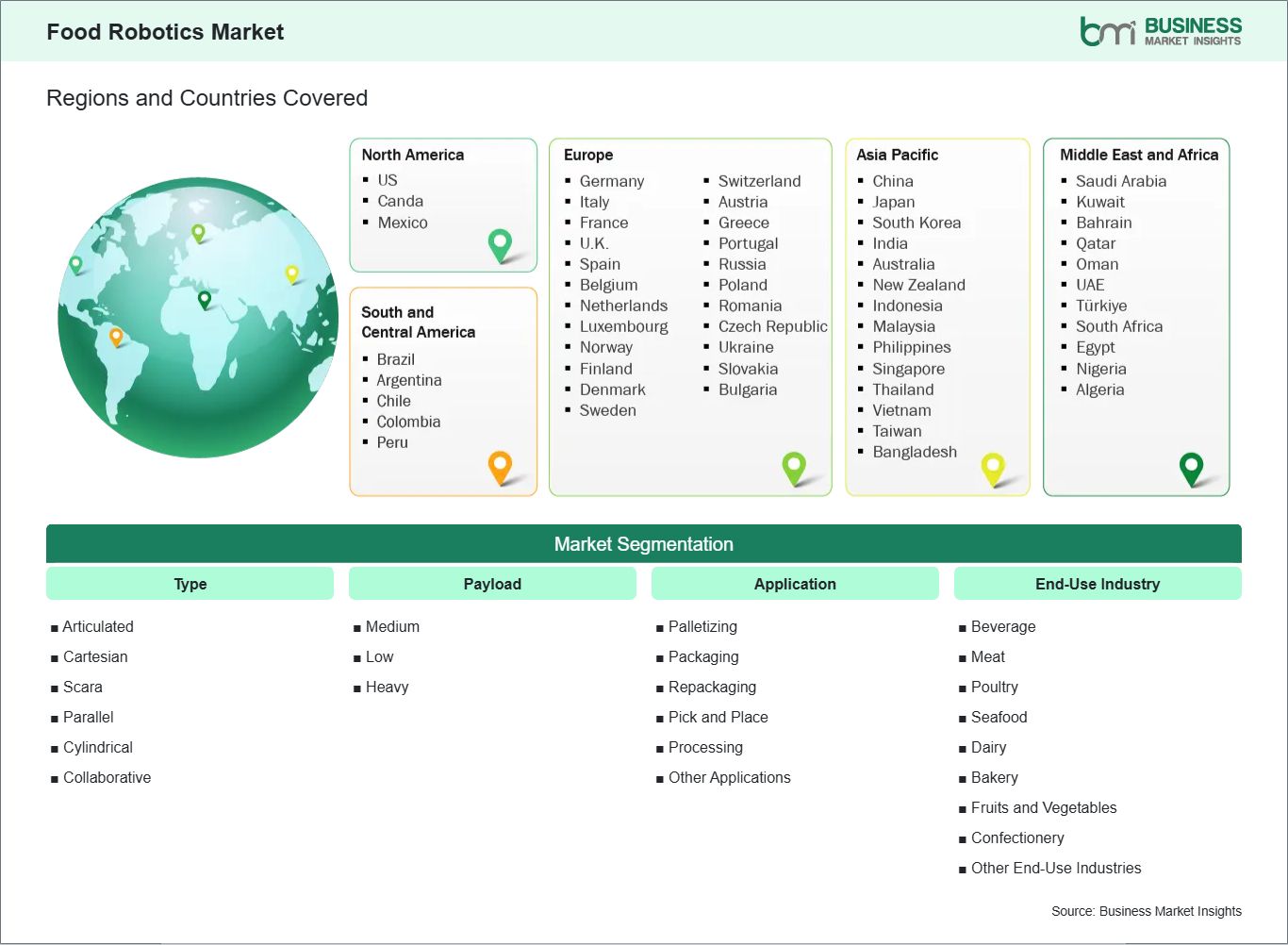
  • Type (Articulated, Cartesian, Scara, Parallel, Cylindrical, and Collaborative)
  • Payload (Medium, Low, and Heavy)
  • Application(Palletizing, Packaging, Repackaging, Pick and Place, Processing, and Other Applications)
  • End-Use Industry (Beverage, Meat, Poultry, Seafood, Dairy, Bakery, Fruits and Vegetables, Confectionery, and Other End-Use Industries)

No. of Pages: 400
Report Code: BMIPUB00035122
Category: Electronics and Semiconductor
Food Robotics Market

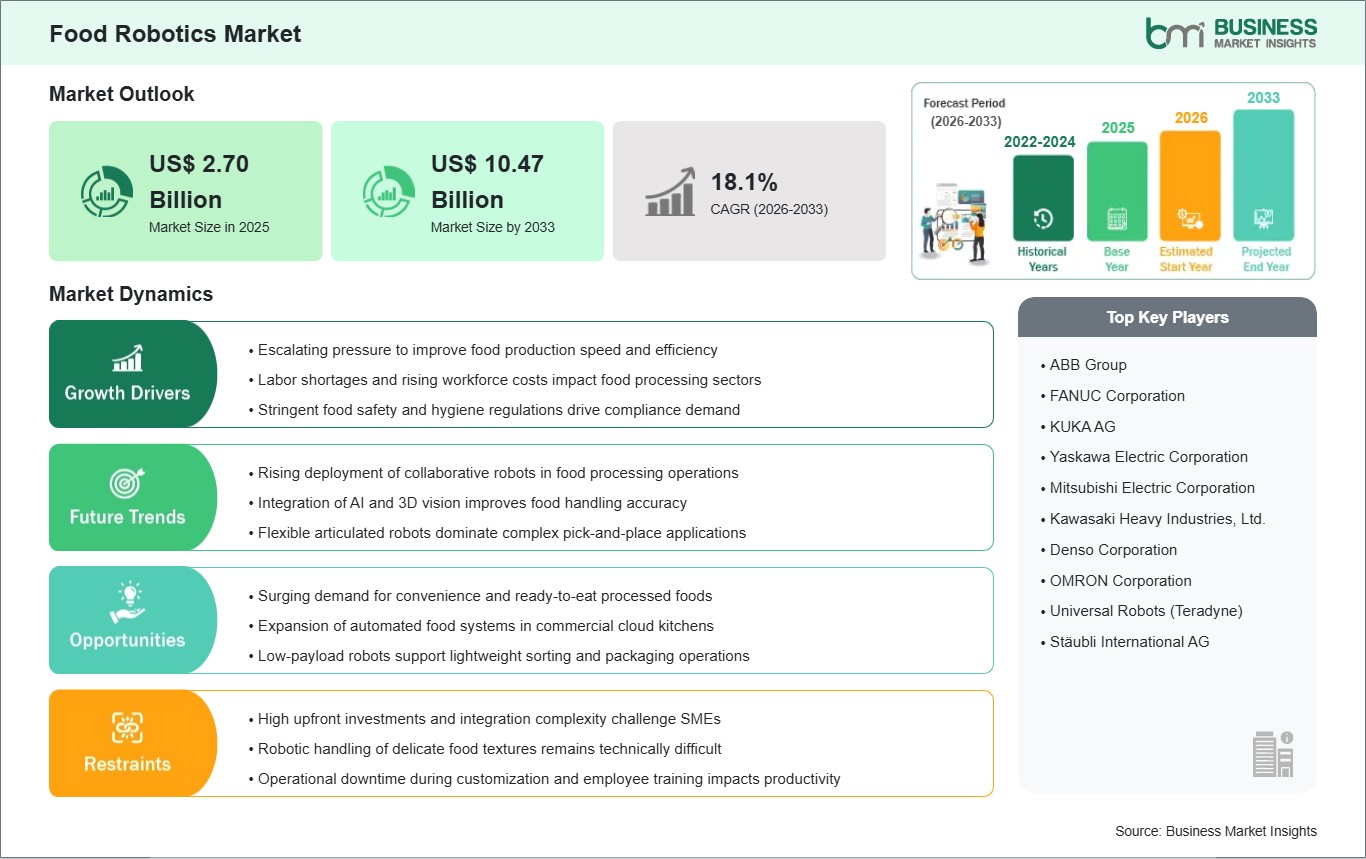
The Food Robotics market size is expected to reach US$ 10.47 billion by 2033 from US$ 2.70 billion in 2025. The market is estimated to record a CAGR of 18.13% from 2026 to 2033.

Executive Summary and Global Market Analysis:

Food robotics refer to the integrated application of automated mechanical systems and computational intelligence engineered to handle, process, and package food products within a sterile and high-throughput environment. By utilizing specialized hardware, including articulated arms, delta robots for high-speed picking, and collaborative robots (cobots), these systems execute complex tasks such as precision cutting, delicate sorting, and automated palletizing. This technology is fundamental to the operational architecture of large-scale meat and poultry processing, industrial bakeries, and the rapidly expanding cloud kitchen sector. Market expansion is being propelled by acute global labor shortages in the food and beverage industry, the rising institutional requirement for contactless production to ensure food safety, and the increasing integration of AI-powered vision systems for real-time quality inspection and defect removal.

However, several factors may restrain market progression. The high capital intensity associated with the procurement and customization of robotic cells, which must often be engineered with washdown-capable materials and food-grade lubricants, remains a primary hurdle for small and mid-sized food manufacturers. The industry also faces persistent technical challenges regarding the handling of biological variability, as designing end-effectors that can manipulate irregular and fragile items like fresh produce or raw protein without damage requires expensive, bespoke engineering. Additionally, the proliferation of automated lines has intensified the technical skills gap, as the maintenance and programming of these sophisticated systems require a workforce proficient in both robotics and strict hygiene protocols. These hurdles, compounded by the complexity of integrating new robotics into legacy factory layouts and the strategic risks of semiconductor supply chain volatility, increase the total cost of ownership and may prolong the time-to-value for enterprise-level automation projects.

Despite these hurdles, the market outlook remains highly favorable as the sector transitions toward intelligent and adaptive automation. Opportunities are emerging through the adoption of Collaborative Robots (cobots); the market is witnessing a surge in lightweight systems that work alongside human staff in assembly and decoration tasks, particularly in the bakery and confectionery segments. The expansion of AI-powered vision and sorting is gaining significant traction, with next-generation sensors now capable of identifying microscopic surface contaminants and ripeness levels at high speeds. Furthermore, the growth of robotic kitchen assistants for the food service industry aligns with global goals for operational consistency and 24/7 service in quick-service restaurants. Collectively, these innovations position the food robotics industry for sustained long-term development as a cornerstone of the modern, resilient, and hyper-efficient global food supply chain.

Food Robotics Market - Strategic Insights:

global-market-strategic-framework
Get more information on this report

Food Robotics Market Segmentation Analysis:

Key segments that contributed to the derivation of the Food Robotics market analysis are type, payload, application, and end-use industry.

  • By Type, the market is segmented into Articulated, Cartesian, Scara, Parallel, Cylindrical, and Collaborative.
  • By Payload, the market is divided into Medium, Low, and Heavy.
  • By Application, the market is categorized into Palletizing, Packaging, Repackaging, Pick and Place, Processing, and Other Applications.
  • By End-Use Industry, the market is segmented into Beverage, Meat, Poultry, Seafood, Dairy, Bakery, Fruits and Vegetables, Confectionery, and Other End-Use Industries.

Food Robotics Market Drivers and Opportunities:

Rising Demand for Automation, Efficiency, and Food Safety

The food robotics market is being driven by the growing need for automation, operational efficiency, and food safety across processing, packaging, and service industries. Robotics are increasingly adopted to handle repetitive, labor‑intensive, and hazardous tasks, reducing reliance on manual labor while improving consistency and productivity. Rising demand for packaged and processed foods is amplifying adoption, as robots streamline cutting, sorting, and packaging operations. In food service, robots are being deployed for cooking, serving, and delivery, enhancing customer experience and reducing wait times. Labor shortages and rising wages in many regions are reinforcing growth, as food robotics help address workforce challenges. Additionally, strict food safety regulations are propelling investment in robotic systems that minimize contamination risks and ensure compliance. The expansion of e‑commerce and quick‑service restaurants is driving demand for robotics that support high‑volume, fast‑paced operations. Collectively, automation needs, efficiency priorities, and safety requirements are fueling sustained growth in the global food robotics market.

Rising Integration of AI, IoT, and Emerging Applications

Opportunities in the food robotics market are expanding through the integration of artificial intelligence, IoT connectivity, and emerging cross‑industry applications. AI‑enabled robots are opening lucrative opportunities by delivering adaptive learning, predictive analytics, and precision control for complex food processing tasks. IoT‑driven platforms are gaining traction, enabling real‑time monitoring of robotic performance, predictive maintenance, and seamless integration with smart factories. The growing emphasis on digital transformation is fueling demand for interoperable robotic solutions that connect with ERP, supply chain, and quality management systems. Emerging applications in agriculture are driving innovation, as food robotics support harvesting, sorting, and packaging of fresh produce. Food service and hospitality sectors are also reinforcing opportunities, where robots enhance customer engagement, automate repetitive tasks, and support personalized dining experiences. Additionally, sustainability trends are encouraging deployment of eco‑friendly, energy‑efficient robotic systems that align with global environmental goals. The expansion of 3D food printing, collaborative robots (cobots), and autonomous delivery systems is creating new pathways for adoption. Vendors who focus on AI‑driven, IoT‑ready, and industry‑specific food robotics solutions are well‑positioned to capture growth. The convergence of AI, IoT, and smart automation underscores a transformative trajectory for the global food robotics market.

Food Robotics Market Size and Share Analysis:

The Food Robotics market demonstrates steady growth, with size and share analysis revealing evolving trends and competitive positioning among key players. The report examines subsegments categorized within type, payload, application, and end-use industry, offering insights into their contribution to overall market performance.

Based on Type, the Articulated Robots subsegment holds a strong presence, as multi‑jointed arms are widely used for packaging, palletizing, and processing tasks requiring flexibility and precision. The Cartesian Robots subsegment is essential for linear movements in pick‑and‑place and assembly operations, offering simplicity and accuracy. The SCARA Robots subsegment anchors demand in high‑speed packaging and sorting, particularly in beverage and bakery industries. The Parallel Robots subsegment is critical for lightweight, high‑speed applications such as confectionery and fruit handling. The Cylindrical Robots subsegment supports niche applications requiring vertical and rotational movements. The Collaborative Robots (Cobots) subsegment is indispensable for safe human‑robot interaction, enhancing productivity in SMEs and food processing plants.

Food Robotics Market Report Highlights:

Report Attribute Details
Market size in 2025 US$ 2.70 Billion
Market Size by 2033 US$ 10.47 Billion
Global CAGR (2026 - 2033)18.1%
Historical Data 2022-2024
Forecast period 2026-2033
Segments Covered By Type
  • Articulated
  • Cartesian
  • Scara
  • Parallel
  • Cylindrical
  • Collaborative
By Payload
  • Medium
  • Low
  • Heavy
By Application
  • Palletizing
  • Packaging
  • Repackaging
  • Pick and Place
  • Processing
  • Other Applications
By End-Use Industry
  • Beverage
  • Meat
  • Poultry
  • Seafood
  • Dairy
  • Bakery
  • Fruits and Vegetables
  • Confectionery
  • Other End-Use Industries
Regions and Countries Covered
North America US, Canada, Mexico
Europe Belgium, Austria, Finland, Denmark, Greece, Poland, Romania, Russia, Ukraine, Czech Republic, Slovakia, Bulgaria, Italy, Luxembourg, Germany, Switzerland, France, Netherlands, Norway, Portugal, Spain, Sweden, United Kingdom
Asia-Pacific Australia, China, India, Japan, South Korea, Indonesia, Malaysia, Philippines, Singapore, Thailand, Vietnam, Bangladesh, New Zealand, Taiwan
South and Central America Brazil, Argentina, Peru, Chile, Colombia
Middle East and Africa Bahrain, Kuwait, Oman, Qatar, Saudi Arabia, United Arab Emirates, Turkiye, South Africa, Egypt, Algeria, Nigeria
Market leaders and key company profiles
  • ABB Group
  • FANUC Corporation
  • KUKA AG
  • Yaskawa Electric Corporation
  • Mitsubishi Electric Corporation
  • Kawasaki Heavy Industries, Ltd.
  • Denso Corporation
  • OMRON Corporation
  • Universal Robots (Teradyne)
  • Stäubli International AG
Get more information on this report

Food Robotics Market Report Coverage and Deliverables:

The “Food Robotics Market Size and Forecast (2022–2033)” report provides a detailed analysis of the market covering below areas:

  • Market size and forecast at global, regional, and country levels for all market segments covered under the scope
  • Market trends, as well as drivers, restraints, and opportunities
  • Market analysis covering key trends, global and regional framework, major players, and recent developments
  • Market concentration, heat map analysis, prominent players, and recent developments
  • Detailed company profiles, including SWOT analysis

Food Robotics Market Geographic Insights:

The geographical scope of the Food Robotics market report is divided into five regions: North America, Asia Pacific, Europe, Middle East & Africa, and South & Central America.

North America maintains a preeminent position within the global industry, a status reinforced by the region's advanced manufacturing infrastructure and the rapid adoption of automated solutions to address persistent labor shortages. The regional landscape is characterized by significant investments in the United States and Canada, where the transition toward high-speed, hygienic, and autonomous food processing has become a strategic priority. This market leadership is supported by a robust ecosystem of technology pioneers, including Rockwell Automation, Bastian Solutions, and Teradyne (Universal Robots), who drive the commercialization of sophisticated robotic arms and delta robots designed for precision handling.

Industrial and enterprise trends in the region reflect a decisive shift toward Collaborative Robotics (Cobots) and AI-Integrated Vision Systems. Food manufacturers are increasingly moving away from traditional, caged industrial robots to adopt cobots that can work safely alongside human operators in packing and sorting lines. Furthermore, the region is witnessing an escalating demand for Autonomous Mobile Robots (AMRs) within temperature-controlled warehouses and distribution centers. This focus on Intelligent Automation allows for real-time quality inspection and defect removal, enabling North American firms to maintain high throughput while ensuring consistent product quality across diverse Stock Keeping Units (SKUs). 

global-market-geography
Get more information on this report

Food Robotics Market Research Report Guidance:

  • The report includes qualitative and quantitative data in the Food Robotics market across type, payload, application, end-use industry, and geography.
  • The report starts with the key takeaways (chapter 2), highlighting the key trends and outlook of the market.
  • Chapter 3 focuses on the research methodology of the study.
  • Chapter 4 includes ecosystem analysis.
  • Chapter 5 highlights the major industry dynamics in the market, including factors that are driving the market, prevailing deterrents, potential opportunities, as well as future trends. Impact analysis of these drivers and restraints is also covered in this section.
  • Chapter 6 discusses the market scenario, in terms of historical market revenues, and forecast till the year 2033.
  • Chapters 7 to 11 cover market segments by type, payload, application, end-use industry, and geography across North America, Europe, Asia Pacific, Middle East and Africa, and South and Central America. They cover the market revenue, forecast, and factors driving the market.
  • Chapter 11 describes the competitive analysis along with the heat map analysis for the key players operating in the market.
  • Chapter 12 describes the industry landscape analysis. It provides detailed descriptions of business activities such as market initiatives, new developments, mergers, and joint ventures globally, along with a competitive landscape.
  • Chapter 13 provides detailed profiles of the major companies operating in the market. Companies have been profiled on the basis of their key facts, business descriptions, products and services, financial overview, SWOT analysis, and key developments.
  • Chapter 14, i.e., the appendix, is inclusive of a brief overview of the company, list of abbreviations, and disclaimer.

Food Robotics Market News and Key Development:

The Food Robotics market is evaluated by gathering qualitative and quantitative data post primary and secondary research, which includes important corporate publications, association data, and databases. A few of the key developments in the Food Robotics market are:

  • In October 2025, Chef Robotics partnered with ILPRA to deliver an integrated solution for robotic meal assembly and automated packaging. The combined system enables food manufacturers to automate high-mix production lines using AI-driven portioning robots and advanced tray sealing technologies. This solution addresses key industry challenges such as labor shortages, efficiency, and consistency in ready-to-eat and ready-to-heat meal production. This development supports the growth of the food robotics market by advancing end-to-end automation and increasing the adoption of scalable, intelligent food processing solutions.
  • In October 2025, Circus SE launched its CA-1 autonomous cooking robot in partnership with REWE Group, enabling in-store meal production under the Fresh & Smart concept. The system allows supermarkets to offer freshly prepared meals using fully autonomous AI-powered robotics integrated directly into retail environments. This deployment introduces a new application area by combining food robotics with brick-and-mortar retail, enhancing customer experience and operational efficiency. This development supports market growth by expanding food robotics adoption into retail and enabling scalable, autonomous food production systems.

Key Sources Referred:

  • World Bank & Global Trade Indicators
  • World Trade Organization (WTO)
  • International Monetary Fund (IMF)
  • International Trade Administration (ITA)
  • Company Websites
  • Company Annual Reports
  • Company Investor Presentations
The List of Companies - Food Robotics Market
  • ABB Group
  • FANUC Corporation
  • KUKA AG
  • Yaskawa Electric Corporation
  • Mitsubishi Electric Corporation
  • Kawasaki Heavy Industries, Ltd.
  • Denso Corporation
  • OMRON Corporation
  • Universal Robots (Teradyne)
  • Stäubli International AG
Frequently Asked Questions
How big is the Food Robotics Market?

The Food Robotics Market is valued at US$ 2.70 Billion in 2025, it is projected to reach US$ 10.47 Billion by 2033.

What is the CAGR for Food Robotics Market by (2026 - 2033)?

As per our report Food Robotics Market, the market size is valued at US$ 2.70 Billion in 2025, projecting it to reach US$ 10.47 Billion by 2033. This translates to a CAGR of approximately 18.1% during the forecast period.

What segments are covered in this report?

The Food Robotics Market report typically cover these key segments-

  • Type (Articulated, Cartesian, Scara, Parallel, Cylindrical, and Collaborative)
  • Payload (Medium, Low, and Heavy)
  • Application(Palletizing, Packaging, Repackaging, Pick and Place, Processing, and Other Applications)
  • End-Use Industry (Beverage, Meat, Poultry, Seafood, Dairy, Bakery, Fruits and Vegetables, Confectionery, and Other End-Use Industries)

What is the historic period, base year, and forecast period taken for Food Robotics Market?

The historic period, base year, and forecast period can vary slightly depending on the specific market research report. However, for the Food Robotics Market report:

  • Historic Period : 2022-2024
  • Base Year : 2025
  • Forecast Period : 2026-2033
  • Who are the major players in Food Robotics Market?

    The Food Robotics Market is populated by several key players, each contributing to its growth and innovation. Some of the major players include:

  • ABB Group
  • FANUC Corporation
  • KUKA AG
  • Yaskawa Electric Corporation
  • Mitsubishi Electric Corporation
  • Kawasaki Heavy Industries, Ltd.
  • Denso Corporation
  • OMRON Corporation
  • Universal Robots (Teradyne)
  • Stäubli International AG
  • Who should buy this report?

    The Food Robotics Market report is valuable for diverse stakeholders, including:

    • Investors: Provides insights for investment decisions pertaining to market growth, companies, or industry insights. Helps assess market attractiveness and potential returns.
    • Industry Players: Offers competitive intelligence, market sizing, and trend analysis to inform strategic planning, product development, and sales strategies.
    • Suppliers and Manufacturers: Helps understand market demand for components, materials, and services related to concerned industry.
    • Researchers and Consultants: Provides data and analysis for academic research, consulting projects, and market studies.
    • Financial Institutions: Helps assess risks and opportunities associated with financing or investing in the concerned market.

    Essentially, anyone involved in or considering involvement in the Food Robotics Market value chain can benefit from the information contained in a comprehensive market report.

    Available Report Formats

    pdf-format excel-format pptx-format
    Buy Now
    Sales Assistance
    +1 646 791 7070 (US & UK)
    Customization Form

    Please tell us your area of interest
    (Market Segments/ Regions and Countries/ Companies)