Market Summary
Executive Summary and Global Market Analysis
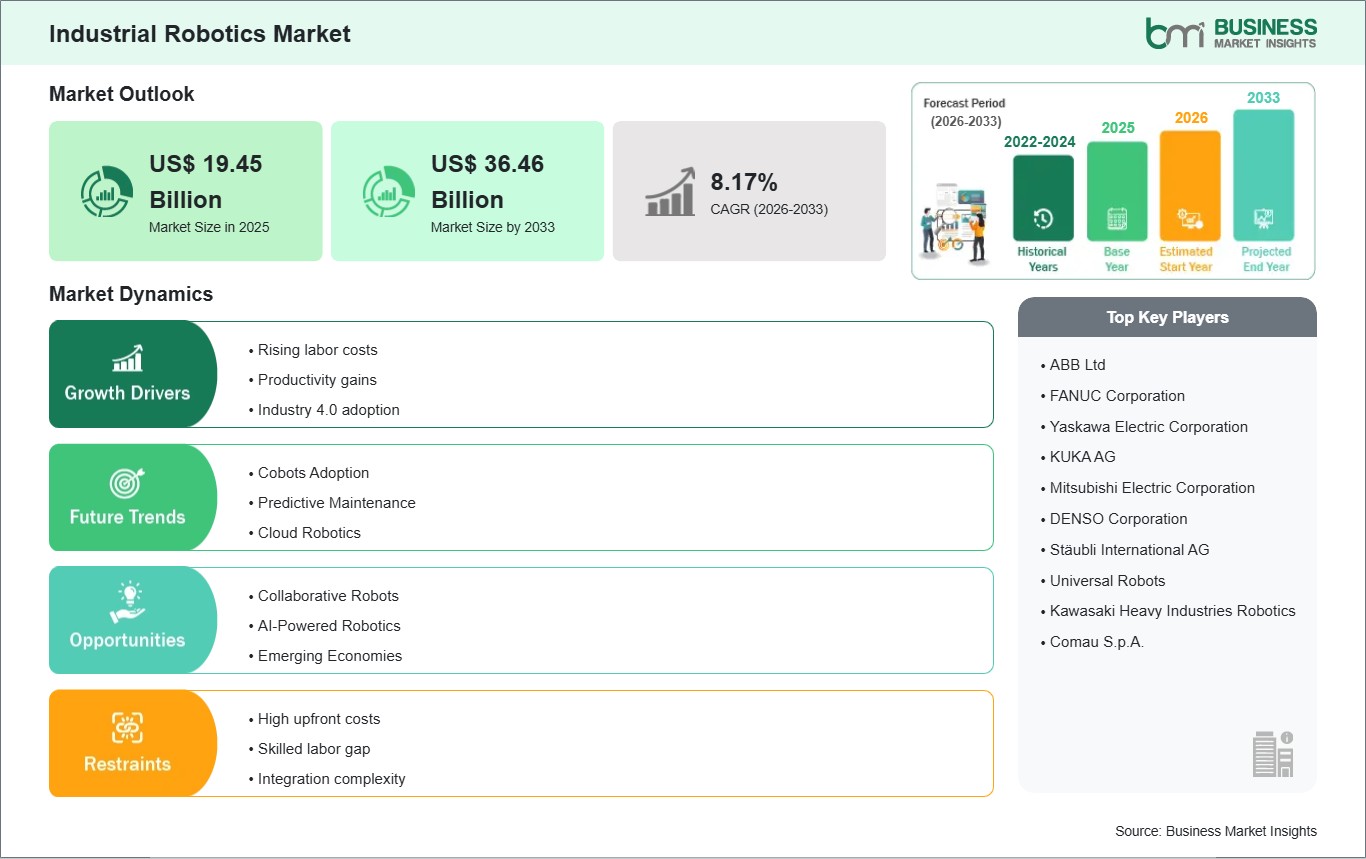
Industrial Robotics involves the use of specialized robotic systems to automate manufacturing and industrial tasks, including assembly, welding, painting, and material handling. Such systems are the important building blocks of Industry 4.0 and Smart Factories, conceived to undertake repetitive tasks, often requiring accuracy while ensuring the safety of workers.
The Industrial Robotics market is growing rapidly due to general labor shortages throughout the world, high labor costs in both developed and emerging economies, and growing needs for higher production efficiency and quality control. Advanced technologies such as Artificial Intelligence, Machine Learning, and sophisticated vision are developing smarter, flexible, and easier robots to be integrated into a wide range of manufacturing workflows.
Segment Analysis
Industrial Robotics Market Segmentation
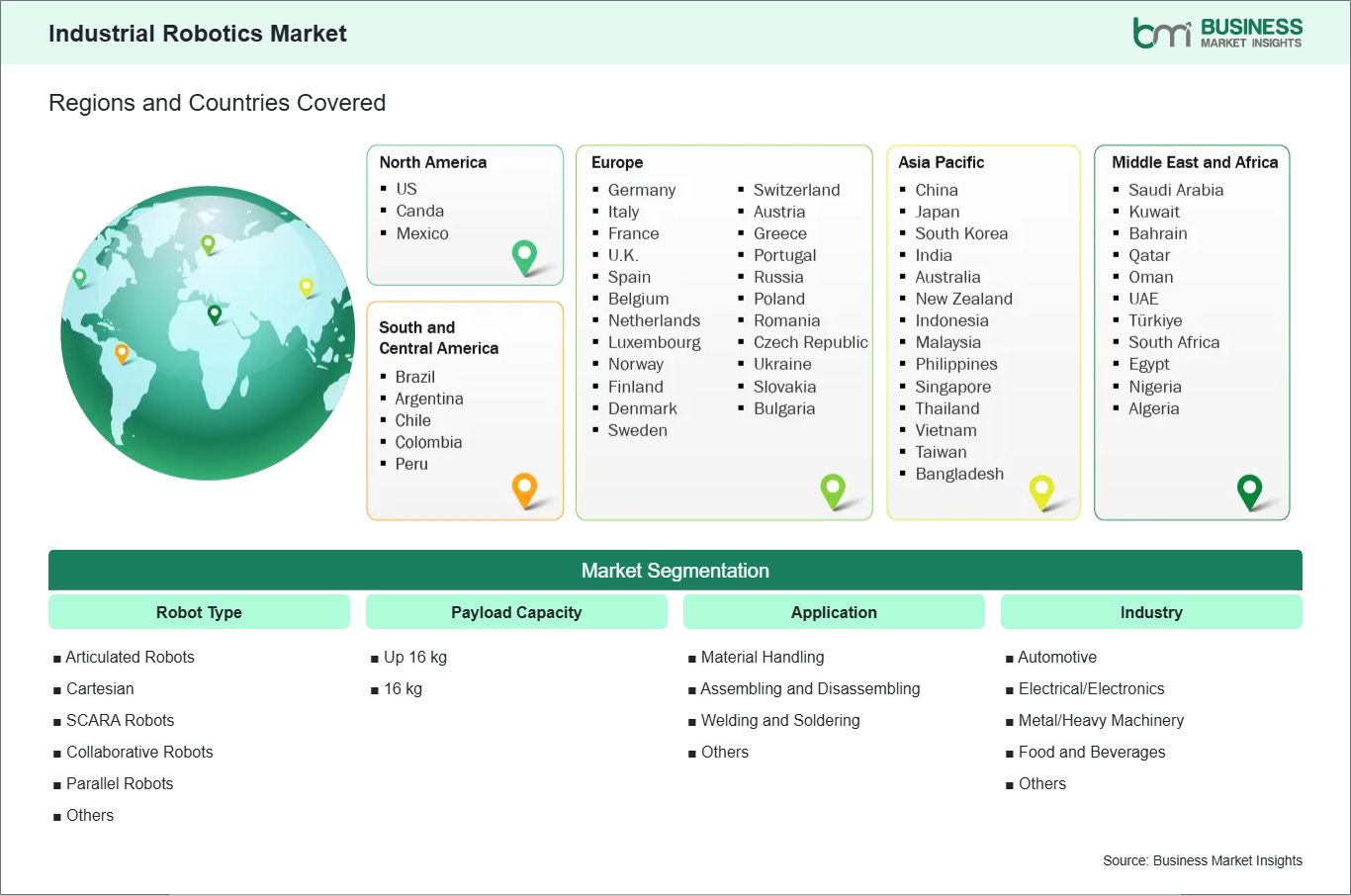
Key segments that contributed to the derivation of the Industrial Robotics Market analysis are robot type, payload capacity, application, and industry.
- By Robot Type, the market is segmented into Articulated Robots, Cartesian, SCARA Robots, Collaborative Robots, Parallel Robots, and Others.
- By Payload Capacity, the market is divided into Up 16 kg, 16–60 kg, 60–225 kg, and Above 225 kg.
- By Application, the market is categorized into Material Handling, Assembling and Disassembling, Welding and Soldering, and Others.
- By Industry, the market is segmented into Automotive, Electrical/Electronics, Metal/Heavy Machinery, Food and Beverages, and Others.
Market Forces
Industrial Robotics Market Drivers and Opportunities
Shortage of Skilled Labor and Rising Operational Costs
The manufacturing sector globally faces a significant and deepening shortage of skilled workers capable of performing complex or tedious tasks. Simultaneously, labor costs, particularly in mature economies, continue to rise, putting pressure on manufacturers to maintain profitability and remain competitive. Industrial robots offer a critical, long-term solution to this structural challenge. Robots can operate continuously with high precision, dramatically reducing reliance on human labor for monotonous or physically demanding work, which can lead to higher employee turnover and increased error rates.
For instance, in the Automotive and Electronics sectors, high-volume production lines require consistently high levels of quality that are best achieved through automation. By substituting human labor with robotic systems for tasks like spot welding, painting, or PCB assembly, companies not only reduce direct labor costs but also achieve superior repeatability and throughput. This economic and operational imperative, driven by both the inability to find human workers and the need to control rising wages, serves as the single most powerful driver for the mass adoption of industrial robotics across all major manufacturing regions.
Rise of Collaborative Robots (Cobots) and Robotics-as-a-Service (RaaS)
The emergence of Collaborative Robots (Cobots) presents a substantial opportunity to democratize automation, particularly for Small and Medium-sized Enterprises (SMEs) that have traditionally been deterred by the high upfront cost and complexity of traditional industrial robots. Cobots are designed with safety features that allow them to work alongside human operators without safety caging, making them easier and faster to deploy. They are smaller, more affordable, and simpler to program, often using intuitive, hand-guided teaching methods.
This opportunity is further amplified by the development of the Robotics-as-a-Service (RaaS) business model. RaaS allows companies to lease robotic hardware and software on a subscription basis, shifting the capital expenditure (CapEx) from a massive initial investment to a manageable operating expense (OpEx). By lowering the financial barrier to entry and simplifying maintenance/upgrades, RaaS, coupled with the flexibility of Cobots, opens up vast new markets in non-traditional robotics sectors like logistics, e-commerce fulfillment, food processing, and smaller-scale manufacturing, accelerating the market's overall growth potential.
Size and Share Analysis
Industrial Robotics Market Size and Share Analysis
The industrial robotics market demonstrates steady growth, with size and share analysis revealing evolving trends and competitive positioning among key players. The report further examines subsegments categorized within robot type, payload capacity, application, and industry, offering insights into their contribution to overall market performance.
For instance, articulated robots continue to grow the market, due to their versatility in complex assembly and welding tasks. However, collaborative robots (cobots) are witnessing the fastest growth as they can safely operate alongside humans.
In the payload segment, robots with a capacity of up to 16 kg hold a significant market share, widely utilized in the electronics sector for pick-and-place and light assembly. Conversely, heavy-duty robots with capacities above 225 kg are essential in the automotive industry for chassis handling and spot welding.
The Electrical/Electronics industry has emerged as a leading industry segment, particularly in the Asia-Pacific region, due to the rapid demand for high-speed automated handling of miniature components. Material handling remains the most dominant application area, driven by the need for efficient logistics and palletizing in smart warehouses.
Report Coverage
Industrial Robotics Market Report Coverage and Deliverables
The "Industrial Robotics Market Size and Forecast (2022 - 2033)" report provides a detailed analysis of the market covering below areas:
- Industrial Robotics Market size and forecast at global, regional, and country levels for all the key market segments covered under the scope
- Industrial Robotics Market trends, as well as market dynamics such as drivers, restraints, and key opportunities
- Industrial Robotics Market analysis covering key market trends, global and regional framework, major players, regulations, and recent market developments
- Industry landscape and competition analysis covering market concentration, heat map analysis, prominent players, and recent developments for the Industrial Robotics Market
- Detailed company profiles, including SWOT analysis
Geographic Insights
Industrial Robotics Market Geographic Insights
The geographical scope of the Industrial Robotics Market report is divided into five regions: North America, Asia Pacific, Europe, Middle East & Africa, and South & Central America.
Asia Pacific holds a significant market share. This is largely driven by massive automation investments in China, South Korea, and Japan. The region is anticipated to record the fastest growth during the forecast period. Europe is the second-largest market, with key adoption centered in Germany and Italy, where the emphasis is on high-value, complex manufacturing and modernization initiatives like Industry 4.0. The North American market is also showing robust growth, fueled by rising labor costs, reshoring/nearshoring efforts, and increasing demand from non-automotive sectors like electronics and logistics. Countries in the Middle East & Africa and South & Central America represent emerging markets, with high long-term growth potential due to new industrialization and government support for manufacturing automation.
Industry Activity
Recent Developments
The Industrial Robotics Market is evaluated by gathering qualitative and quantitative data post primary and secondary research, which includes important corporate publications, association data, and databases. A few of the key developments in the Industrial Robotics Market are:
- In December 2025, Yaskawa Electric Corporation and SoftBank Corp. announced a partnership to advance the social deployment of Physical AI. The two companies, combining Yaskawa’s AI robotics expertise with SoftBank’s AI?RAN initiative, signed a memorandum of understanding (MOU) to formalize their collaboration. Through this collaboration, the two companies aim to realize a future in which robots can perform their abilities in more diverse environments and work together safely and flexibly in the same space as humans by fusing AI and communication technology with robotics and expanding the work areas in which robots can operate.
- In June 2025, ABB Robotics expanded its large robot portfolio with the launch of the IRB 6730S, IRB 6750S, and IRB 6760. The introduction of these new robots, alongside the wider portfolio of next-generation robots launched since 2022, now means the company can offer its customers the most comprehensive lineup of industrial robots and variants on the market. The lineup of 11 next-generation robot families comprising 60 variants offers customers new levels of flexibility and choice as well as class-leading performance and sustainability benefits.
Trust & Transparency
Research Methodology
The market analysis combines proprietary research with secondary data from government agencies, company disclosures, regulatory filings, industry databases and expert interviews. Market estimates are validated through data triangulation, cross-market benchmarking and analyst
review.
View Full Research Methodology
Key Sources Referred:
World Bank - Global Trade IndicatorsWorld Trade Organization (WTO)International Monetary Fund (IMF)International Trade Administration (ITA)Company WebsitesCompany Annual ReportsCompany Investor Presentations