Market Summary
Executive Summary and Global Market Analysis
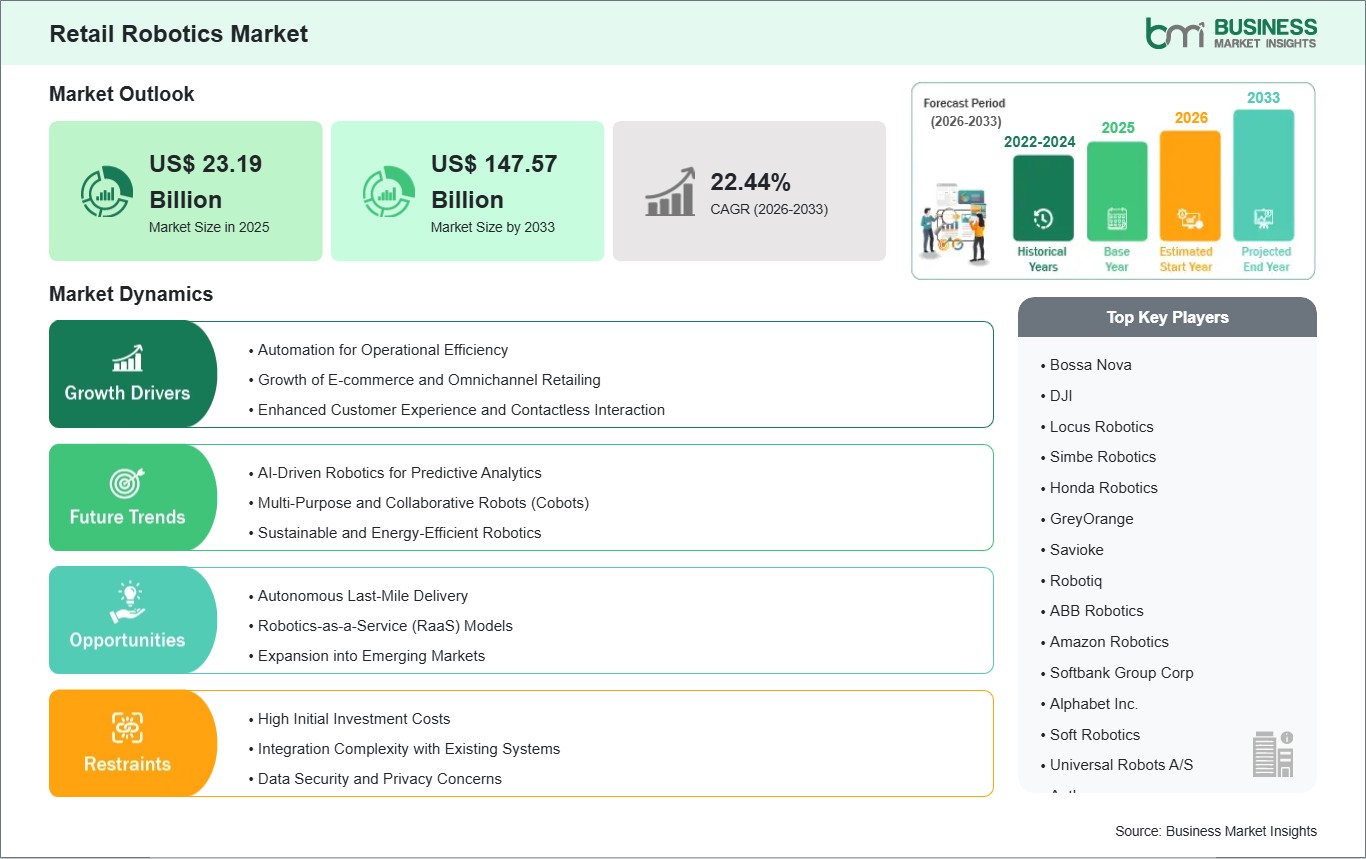
The retail robotics market refers to the segment of robotics technology focused on automating and enhancing operational and customer‑facing tasks within the retail industry. Retail robots include a wide range of systems such as autonomous mobile robots (AMRs) for inventory tracking, humanoid and service robots for customer engagement, checkout and payment automation systems, and delivery robots for last‑mile fulfillment. These robots bring multiple benefits to retailers, including improved operational efficiency, real‑time inventory accuracy, reduced labor costs, better customer experience, and faster order fulfillment. Integrating AI, IoT, machine vision, and cloud robotics enables robots to navigate stores, recognize products, assist customers, and streamline fulfilment processes across physical stores, warehouses, and e‑commerce environments.
In terms of market dynamics, the Retail Robotics market is being propelled by several key drivers and opportunities as well as challenges that influence adoption. Major growth drivers include the rising need for automation due to labor shortages and high operational costs, the surge in omnichannel retailing and e‑commerce, and the push for contactless and personalized shopping experiences. Retailers increasingly invest in AI‑driven robotics to achieve higher order accuracy, better customer service, and efficient inventory and delivery operations. Emerging opportunities lie in autonomous last‑mile delivery, robotics‑as‑a‑service (RaaS) models that lower entry barriers, expansion into emerging markets with growing urban retail infrastructures, and the integration of sustainable robotic solutions that enhance energy efficiency and hygiene standards.
Segment Analysis
Retail Robotics Market Segmentation
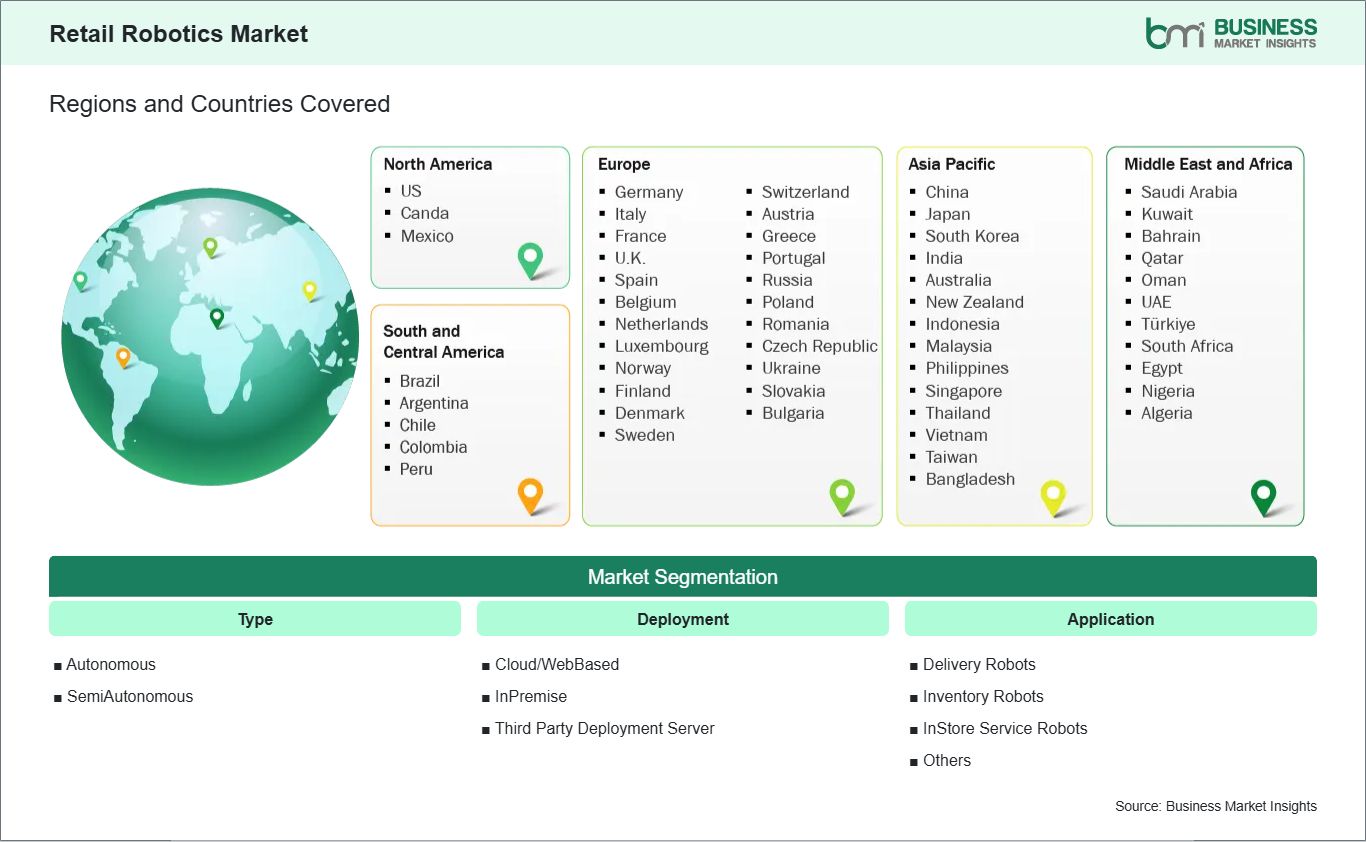
Key segments that contributed to the derivation of the Retail robotics market analysis are Type, Deployment, and Application.
- By Type, the Retail robotics market is segmented into Autonomous, Semi-Autonomous. The Autonomous segment dominated the market in 2024.
- By Deployment, the Retail robotics market is segmented into Cloud/Web-Based, In-Premise, and Third-Party Deployment and Servers. The Cloud/Web‑Based segment dominated the market in 2024.
- By Application, the Retail robotics market is segmented into Delivery Robots, Inventory Robots, In-Store Service Robots, and Others. The Inventory Robots segment dominated the market in 2024.
- By Deployment, the virtual private network market is segmented into Cloud, On-premise. The Cloud segment dominated the market in 2024.
- By End-use, the virtual private network market is segmented into Commercial, Individual, and Service providers. The Commercial segment dominated the market in 2024.
Market Forces
Retail Robotics Market Drivers and Opportunities
Automation for Operational Efficiency
Retailers are increasingly adopting robotics to automate repetitive and labor-intensive tasks such as inventory management, shelf scanning, and checkout. This shift reduces dependency on manual labor, minimizes human error, and speeds up store operations. Autonomous robots can work 24/7 without fatigue, ensuring continuous productivity. Rising labor costs and workforce shortages in retail sectors across North America, Europe, and Asia-Pacific further drive adoption. As retailers strive for operational efficiency and cost savings, robots become essential tools in streamlining processes, maintaining stock accuracy, and enhancing overall store performance.
Robotics-as-a-Service (RaaS) Models
RaaS provides retailers access to advanced robotics without heavy upfront investments. Subscription-based models allow companies to lease robots, software, and support services, reducing cost barriers and accelerating adoption. Retailers can scale solutions according to seasonal demand or business growth. This model also enables regular software updates, predictive maintenance, and data analytics without managing complex in-house infrastructure. RaaS opens opportunities for small and medium retailers to compete with larger players in automation adoption. As cloud-based platforms and AI integration improve, RaaS is poised to expand, offering flexible, cost-efficient, and technologically advanced retail automation solutions globally.
Size and Share Analysis
Retail Robotics Market Size and Share Analysis
By Type, the market is segmented into Autonomous, Semi-Autonomous. The Autonomous segment dominated the market in 2024. The Autonomous segment in the Retail Robotics market includes self-operating robots such as autonomous mobile robots (AMRs) and delivery robots that perform tasks without human intervention. These robots enhance inventory management, in-store navigation, and fulfillment efficiency, reducing labor costs, improving accuracy, and enabling 24/7 operations in retail environments.
By Deployment, the market is segmented into Cloud/Web-Based, In-Premise, and Third-Party Deployment Server. The Cloud/Web‑Based segment held the largest share of the market in 2024. The Cloud/Web‑Based segment in the Retail Robotics market enables robots to operate through remote servers and cloud platforms, allowing real-time data access, software updates, and centralized management. This deployment model offers scalability, lower upfront costs, seamless integration, and enhanced flexibility, making it ideal for retailers adopting AI-driven automation and digital transformation strategies.
By Application, the market is segmented into Delivery Robots, Inventory Robots, In-Store Service Robots, and Others. The Inventory Robots segment held the largest share of the market in 2024. The Inventory Robots segment in the Retail Robotics market focuses on autonomous robots that manage stock levels, perform shelf scanning, and track inventory in real time. These robots improve accuracy, reduce human errors, optimize supply chains, and enhance operational efficiency, making them essential for modern retail stores and warehouse management.
Report Coverage
Retail Robotics Market Report Coverage and Deliverables
The Retail Robotics Market Size and Forecast (2022–2033) report provides a detailed analysis of the market covering below areas:
- Retail Robotics market size and forecast at global, regional, and country levels for all the key market segments covered under the scope
- Retail Robotics market trends, as well as market dynamics such as drivers, restraints, and key opportunities
- Retail Robotics market analysis covering key market trends, global and regional framework, major players, regulations, and recent market developments
- Industry landscape and competition analysis covering market concentration, heat map analysis, prominent players, and recent developments for the Retail Robotics market
- Detailed company profiles, including SWOT analysis
Geographic Insights
Retail Robotics Market Geographic Insights
The geographical scope of the Retail robotics market report is divided into five regions: North America, Asia Pacific, Europe, Middle East & Africa, and South & Central America. The Retail robotics market in Asia Pacific is expected to grow significantly during the forecast period.
The Asia-Pacific Retail robotics market is segmented into China, Japan, South Korea, India, Australia, New Zealand, Indonesia, Malaysia, the Philippines, Singapore, Thailand, Vietnam, Taiwan, Bangladesh, and the Rest of Asia. The Asia-Pacific Retail robotics market is experiencing robust growth, driven by rapid urbanization, rising e-commerce adoption, increasing retail automation investments, and supportive government initiatives. Countries like China, Japan, South Korea, and India are rapidly deploying AI-powered robots for inventory management, in-store assistance, and last-mile delivery, boosting market expansion.
Additionally, the region benefits from technological advancements, a growing middle-class consumer base, and rising demand for contactless and efficient retail experiences. These factors collectively accelerate the adoption of autonomous and cloud-based retail robotics solutions.
Industry Activity
Recent Developments
The Retail robotics market is evaluated by gathering qualitative and quantitative data post primary and secondary research, which includes important corporate publications, association data, and databases. A few of the key developments in the Retail robotics market are:
- In June 2025, Amazon reached a major milestone in warehouse automation by deploying its one millionth robot worldwide. Alongside this achievement, the company unveiled a new generative AI foundation model aimed at boosting the efficiency of its robot fleet by 10%, with the goal of speeding up deliveries and lowering operational costs.
- In August 2025, Robotiq (USA) introduced its latest palletizing solution at Pack Expo 2025, highlighting innovations in robotic automation for material handling applications.
Trust & Transparency
Research Methodology
The market analysis combines proprietary research with secondary data from government agencies, company disclosures, regulatory filings, industry databases and expert interviews. Market estimates are validated through data triangulation, cross-market benchmarking and analyst
review.
View Full Research Methodology
Key Sources Referred:
World Bank – Global Trade Indicators
World Trade Organization (WTO)
(International Monetary Fund )IMF
International Trade Administration (ITA)
Company website
Company annual reports
Company investor presentations