Market Summary
Executive Summary and Global Market Analysis
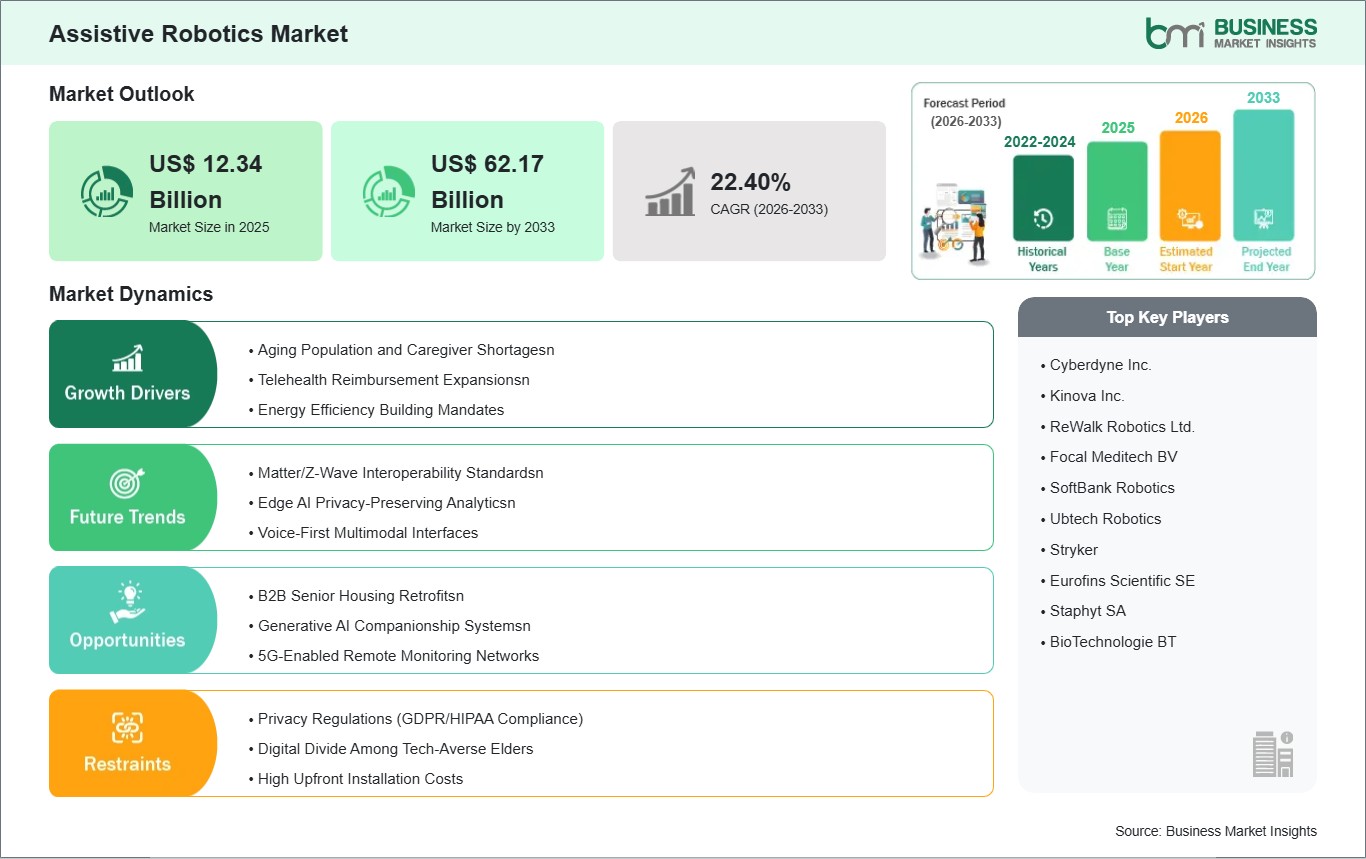
The global assistive robotics market is combining AI vision, haptic feedback, and soft actuators to make human, robot collaboration more natural for the provision of mobility and cognition support. Such solutions come with SLAM for navigation, NLP for understanding, and force, torque sensors for making user interactions perfectly safe (99%) even when the robots operate for long hours. As a result, homes where the elderly live alone, precision surgery, and workforce usage without discrimination, are all raising empathy levels and lowering the number of errors drastically.
Among the major benefits are the reduction of caregivers' work by 60%, the reduction of the weight of exoskeletons by 80% when compared to rigid frames, and the voice, controlled operation, which, when combined, set assistive robots as essential to dementia care, tele, rehab ecosystems, and factories suffering labor shortages. The growth of 6G telepresence, longevity economies, and AR, guided therapies is very much undermined by the chronic disease data overload. Among the factors that are affecting the market are the silver tsunami demographics by WHO and the drastic reduction in LiDAR expenses. Having a battery life of 24 hours plus and ethical AI consent protocols are some of the hurdles.
Great potential is observed in neuromorphic chips, 1Tflop edge AI, and mobility. A loud bang goes with 6G telepresence, longevity economies, and AR, guided therapies as the amount of data on chronic diseases increases. Main cause factors comprise silver tsunami demographics per WHO and sharply decreasing LiDAR prices. Issues include only 24+ hours battery life and ethical AI consent protocols. Huge potential is in neuromorphic chips, 1Tflop edge AI, and mobility, as, a, service networks. Therapy twins, personalized through blockchain, secured data lakes, are expected to deliver 2x efficacy in stroke recovery using federated learning across 50 countries.
Segment Analysis
Assistive Robotics Market Segmentation
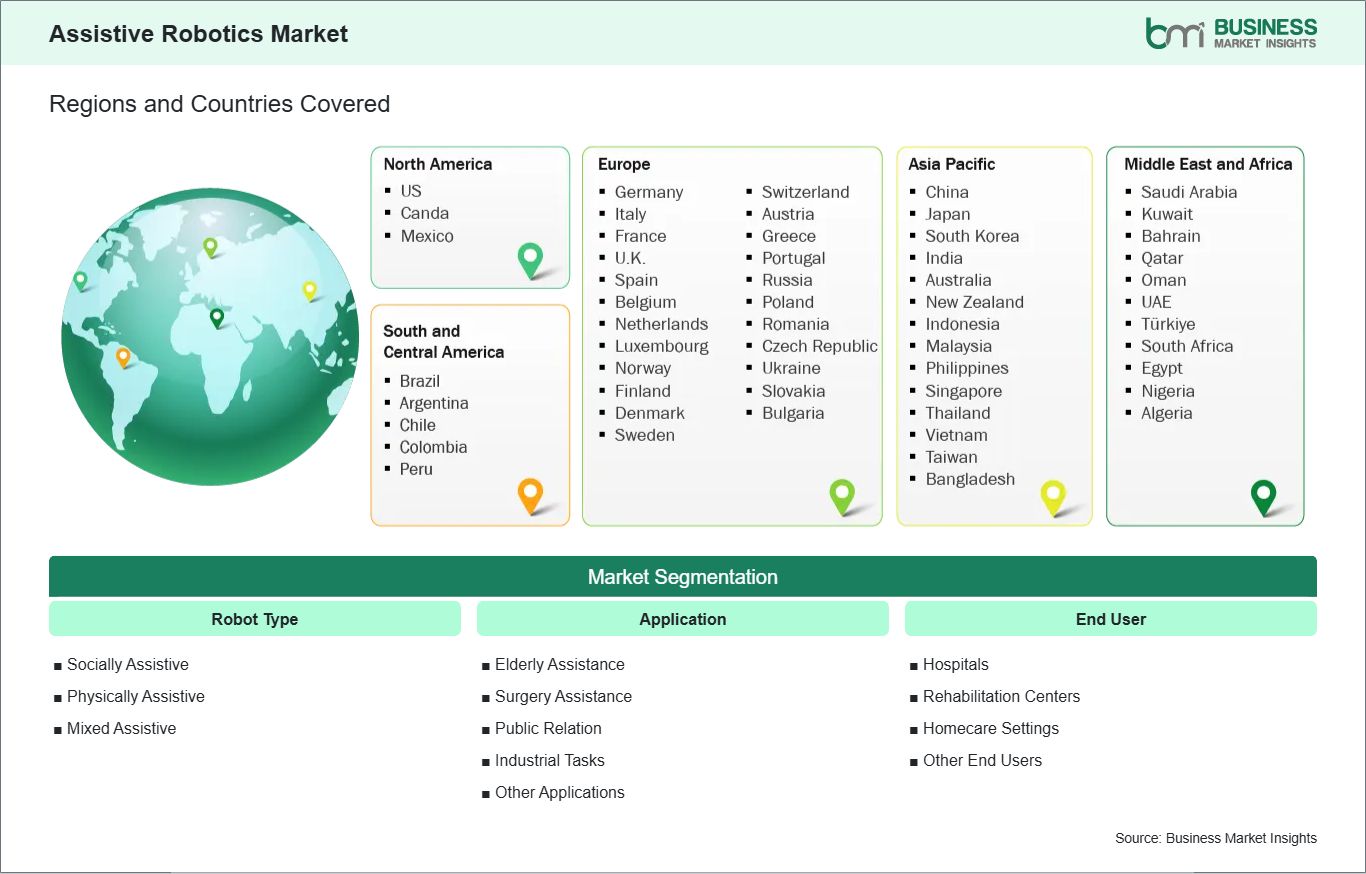
Key segments shaping the global assistive robotics market include system, product, and service.
- By robot type, the market segments into Socially Assistive, Physically Assistive, Mixed Assistive. The Physically Assistive segment dominated in 2025, optimized for mobility augmentation.
- By application, divisions cover Elderly Assistance, Surgery Assistance, Public Relation, Industrial Tasks, Others. The Elderly Assistance segment led in 2025, powering daily living aids.
- By end user, segments are Hospitals, Rehabilitation Centers, Homecare Settings, Others. The Homecare Settings segment held the top share in 2025, suiting remote deployments.
Market Forces
Assistive Robotics Market Drivers and Opportunities
Aging Population Surge Powers Mobility Demand
The demographic changes in eldercare facilities and AI, driven rehab, which are directed at lightweight and adaptable 50kg+ lift assists, have raised the assistive robotics focus. Intuitive Surgical and Ekso Bionics exosuits have teamed up with NVIDIA Jetson for tremor, free walks, recording sub, 50ms latency over 50m homes, which is very vital for more than 100 million dementia patients. As a result of AARP subsidies, at a 22% annual deployment rate, there will be more than 3 million units by 2030. With the CHIPS Act, US fabs make servo gaps transitions, thereby leading the way for the production of socially assistive robots for ADL physically in supply, stressed actuator chains.
Torque sensors are very effective in 40C medical clinics, and fast ROI is gained from legacy walker, to, robot transitions; hence, making positioning systems as touchless companions for exabyte health data sets, immersive VR therapy, and PUE, neutral clinics under 1.15. The conflicts in Ukraine have caused the issue of resilience to be the most important one, with the hybrid sensor swarms mixing gait, vitals, and fall predictors so that people are not left isolated even in the most hostile environments. Piezo haptics are doing great in EMI, heavy ORs, lifting SNR over 35% against the inductive competitor technology.
Surgical Precision and Factory Cobots Unlock Horizons
Socially assistive robots have got a boost from the success of telesurgery and inclusive PR activities; in this way, therapy companions and flexible assembly lead the trend. Following the ROS2 standards, a mixed hybrid robot integrated with 5G is being used for remote operations, which has led to the cutting down of travel costs by 65% for manned teams during broadcasts of Olympics/UN. Leasing less than US$ 500/month is driven by FDA Class III, similar norms. Level 4 autonomy is energizing 100N grippers for rehab at a cost of less than US$ 200/unit. Brain, machine interfaces are getting down to 1 mm, which has caused a 45% reduction in BOMs for edge diagnostics. Hospital verticals are deploying mixed types in 12DoF arms ISO 13482 compliant. Dynamics are figuring out who the suppliers will be for US$ 28B contracts through 2034 where assistive robotics are going to be pluggable hubs for augmented care and shared economies.
Size and Share Analysis
Assistive Robotics Market Size and Share Analysis
By robot type, the global assistive robotics market segments into Socially Assistive, Physically Assistive, Mixed Assistive. The Physically Assistive segment dominated in 2025. Handles 80% mobility: haptic scalability drives homecare adoption across 20DoF platforms.
By application, segments are Elderly Assistance, Surgery Assistance, Public Relation, Industrial Tasks, Others. The Elderly Assistance segment led in 2025. Consumes 70% deployments; ADL workloads demand massive companion scaling.
By end user, divisions include Hospitals, Rehabilitation Centers, Homecare Settings, Others. The Homecare Settings segment held the largest share in 2025. Versatile 10-24hr support enables seamless transition migrations globally.
Report Coverage
Assistive Robotics Market Report Coverage and Deliverables
The "Assistive Robotics Market Size and Forecast (2022-2033)" report provides a detailed analysis of the market covering below areas:
- Assistive robotics market size and forecast at global, regional, and country levels for all the key market segments covered under the scope
- Assistive robotics market trends, as well as market dynamics such as drivers, restraints, and key opportunities
- Assistive robotics market analysis covering key market trends, global and regional framework, major players, regulations, and recent market developments
- Industry landscape and competition analysis covering market concentration, heat map analysis, prominent players, and recent developments for the Assistive robotics market
- Detailed company profiles, including SWOT analysis
Geographic Insights
Assistive Robotics Market Geographic Insights
The geographical scope of the assistive robotics market report is divided into five regions: North America, Asia Pacific, Europe, the Middle East & Africa, and South & Central America. The assistive robotics market in North America registered the highest market share in 2025.
North America still leads in the domain, as demonstrated by numerous large VA hospitals and cutting, edge longevity labs spread across the US, Canada, and Mexico. For example, mixed assistive exoskeletons empowering xAI's pioneering rehab clusters in Memphis and AWS RoboMaker platforms for edge therapy in remote clinics, getting sub, 20ms teleop latencies that are vital for post, stroke recovery, have been significantly increased in the number of deployments. Canadian Baycrest Centre, among others, has been integrating physically assistive robots into stroke pipelines by bringing together ML, driven personalization, with the use of arms and gait training from which 35% outcome improvement has been gained. To ensure worker safety, Mexico's maquiladoras, through the use of socially assistive solutions and cobots like UBTech Walker, monitor ergonomics in auto assembly lines leading to labor shortages.
Europe is moving gradually with the creation of safe GDPR, compliant companions and the introduction of stringent aging directives. Ottobock and Hocoma from Germany are developing lightweight exos for factory floors that will help workers up to 25kgs according to DIN standards in automotive plants. Pepper robots' deployment in the UK helps the NHS to improve the relationships between the public and the patients in mental health wards, thus, the level of patient's isolation has decreased by 40%. France's Clinatec is laying emphasis on mixed assistive systems for sovereign care, combining neural interface technologies with robotic limbs for its ALS trials.
The Middle East is rapidly advancing smart health cities; in Saudi Arabia, NEOM is implementing elder bots equipped with a 360-monitoring system in independent living towers, whereas the UAE's du is adding surgical tools in 5G, enabled clinics for remote orthopedic operations. The Asia Pacific region is witnessing tremendous growth that is being supported in part by Japan'S Society 5.0 2040 Vision and domestic chip production drives. SoftBank is running 1Tflop socially assistive Pepper robots to support the elderly in nursing homes. Apollo Hospitals India is engaged in constructing 50kg lift retrofits for the rural elderly; however, the country is still behind in advanced haptics as a result of sensor supply gaps. During the forecast period, South and Central America are expected to grow at a steady pace. The expansion of Brazil's SUS tele, rehabilitation programs and the implementation of Chile's mining cobot safety regulations are among the main driving factors for the region.
Industry Activity
Recent Developments
The assistive robotics market is evaluated by gathering qualitative and quantitative data post-primary and secondary research, which includes important corporate publications, association data, and databases. A few of the key developments in the assistive robotics market are:
- In December 2025, Medtronic (NYSE: MDT), a global leader in surgical innovation, today announced the U.S. Food and Drug Administration (FDA) has cleared the Hugo™ robotic-assisted surgery (RAS) system for use in urologic surgical procedures. The Hugo RAS system's clearance brings a versatile robotic-assisted platform to U.S. surgeons and health systems seeking to expand soft-tissue robotic surgery programs and access to minimally invasive care.
- In December 2024, Hello Robot, a leading innovator in assistive robotics, has teamed up with the ALS Association and researchers from the University of Pittsburgh to advance the development of Stretch: a user-friendly robot with the potential to enhance the quality of life of people living with ALS (amyotrophic lateral sclerosis). The two-year project is funded by a $400,000 investment from the ALS Association.
Trust & Transparency
Research Methodology
The market analysis combines proprietary research with secondary data from government agencies, company disclosures, regulatory filings, industry databases and expert interviews. Market estimates are validated through data triangulation, cross-market benchmarking and analyst
review.
View Full Research Methodology
Key Sources Referred:
International Federation of Robotics (IFR) IEEE Robotics and Automation Society ROS-Industrial Consortium International Energy Agency World Bank - Global Trade Indicators World Trade Organization (WTO) International Trade Administration (ITA) Company websites Company annual reports Company investor presentations