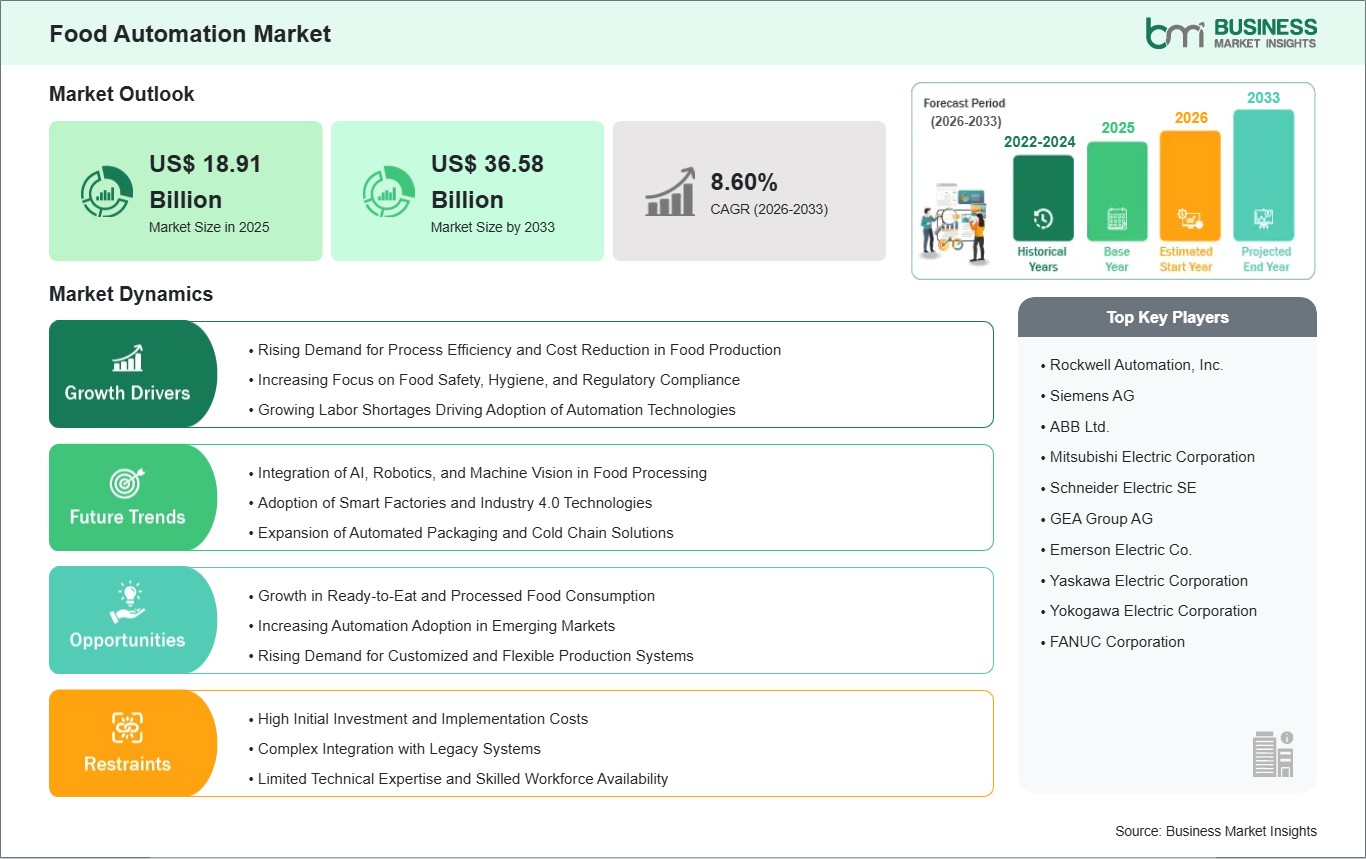
The Food Automation Market size is expected to reach US$ 36.58 Billion by 2033 from US$ 18.91 Billion in 2025. The market is estimated to record a CAGR of 8.60% from 2026 to 2033.
Food automation refers to the integrated application of control systems, robotics, and artificial intelligence (AI) engineered to operate food processing, packaging, and distribution machinery with minimal human intervention. By utilizing specialized hardware, such as hygienic robotic arms, vision-guided sorting systems, and automated storage and retrieval systems (AS/RS), these platforms ensure consistent product quality, high-speed throughput, and stringent adherence to safety protocols. This technology is fundamental to the modernization of large-scale bakeries, meat processing facilities, and ghost kitchens that require high-volume, contamination-free production. Market expansion is being propelled by acute global labor shortages, rising wage pressures, and the increasing institutional requirement for digital traceability to comply with transparent safety mandates.
However, several factors may restrain market progression. The high capital intensity associated with high-end robotics, NPU-integrated sensors, and the necessary infrastructure for lights-out manufacturing remains a primary hurdle, particularly for small and medium-sized enterprises (SMEs). The industry also faces technical challenges regarding the handling of irregular shapes, as delicate or non-uniform food items like fresh produce or artisanal breads require advanced soft-touch grippers that are often more expensive than standard vacuum alternatives. Additionally, the requirement for frequent wash-downs with harsh chemicals necessitates the use of specialized, corrosion-resistant materials that further escalate initial investment costs. These hurdles, compounded by a persistent global scarcity of specialized engineers proficient in the convergence of operational technology (OT) and IT, increase the complexity of system integration and total lifecycle maintenance.
Despite these hurdles, the market outlook remains highly favorable as the sector moves toward hyper-intelligent autonomy. Opportunities are emerging through the adoption of agentic AI and digital twins; the market is witnessing a surge in systems capable of making independent process optimizations and performing predictive maintenance to reduce downtime by identifying anomalies before failure. The expansion of the cold chain automation sector is gaining significant traction, with high-density automated warehouses now utilizing sub-zero robotics to maximize vertical space and reduce energy consumption by up to 30%. Furthermore, the growth of AI-powered quality inspection, which can achieve up to 99% defect detection accuracy, aligns with global goals for zero-waste production and enhanced consumer trust. Collectively, these innovations position the food automation industry for sustained long-term development as a cornerstone of the resilient, efficient, and technologically-empowered global food supply chain.

Key segments that contributed to the derivation of the Food Automation market analysis are implementation, technology, and application.
The food automation market is being driven by the growing need for efficiency, safety, and consistency across food processing, packaging, and distribution. Rising global food demand and pressure to optimize production are amplifying adoption of automation technologies such as robotics, AI, and IoT-enabled systems. Food manufacturers are increasingly investing in automation to reduce labor costs, minimize human error, and ensure compliance with stringent food safety regulations. The expansion of packaged and processed food consumption is reinforcing demand, as automation enables faster throughput, standardized quality, and greater scalability. Additionally, the pandemic accelerated the shift toward automation, highlighting the importance of resilient supply chains and reduced reliance on manual labor.
Rising concerns about hygiene, contamination, and sustainability are further propelling investment in automated handling, inspection, and energy-efficient systems. The integration of smart sensors, predictive analytics, and cloud-based platforms is also transforming operations, enabling real-time monitoring and adaptive control. Collectively, efficiency goals, safety priorities, and consumer demand for consistent quality are fueling sustained growth in the global food automation market.
Opportunities in the food automation market are expanding through the integration of IoT connectivity, artificial intelligence, and smart manufacturing practices. IoT‑enabled automation systems are opening lucrative opportunities by offering real‑time monitoring, predictive analytics, and seamless integration with enterprise resource planning (ERP) platforms. AI‑driven solutions are gaining traction, enabling automated quality control, adaptive production scheduling, and predictive maintenance. The growing emphasis on smart factories and digital transformation is fueling demand for interoperable automation solutions that enhance efficiency and reduce waste. Emerging applications in e‑commerce and food delivery are also driving innovation, as automation supports rapid packaging, inventory management, and logistics.
Additionally, sustainability trends are encouraging deployment of eco‑friendly, energy‑efficient automation systems that align with global environmental goals. The expansion of personalized nutrition and functional foods is creating new pathways for adoption, where automation supports customized production at scale. Vendors who focus on cost‑effective, AI‑enabled, and IoT‑ready solutions are well‑positioned to capture growth. The convergence of IoT, AI, and smart manufacturing underscores a transformative trajectory for the global food automation market.

The Food Automation market demonstrates steady growth, with size and share analysis revealing evolving trends and competitive positioning among key players. The report examines subsegments categorized within implementation, technology, and application, offering insights into their contribution to overall market performance.
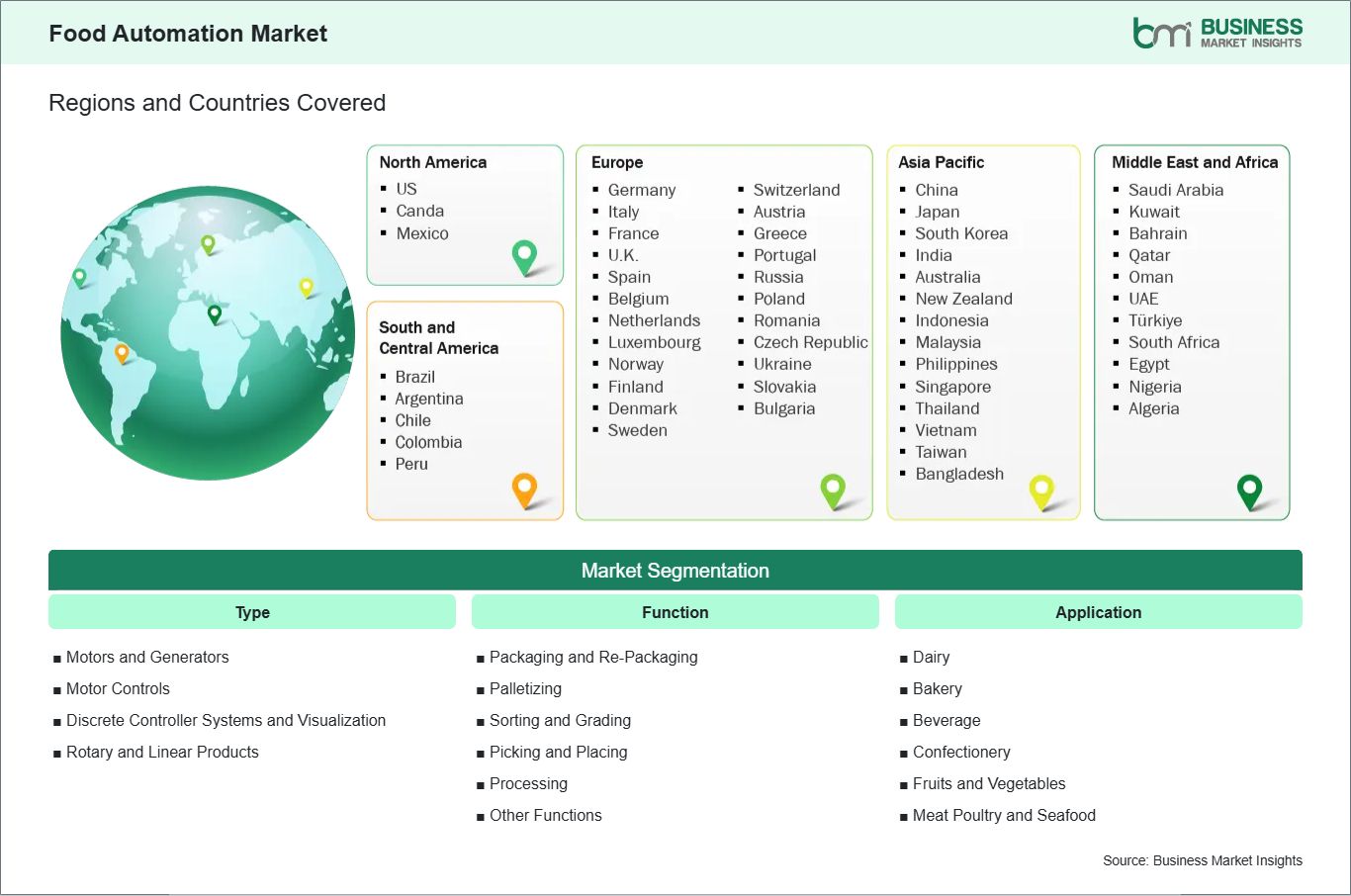
Based on Type, the Motors and Generators subsegment holds the primary market presence, as they are indispensable for powering automated machinery across food processing and packaging lines. The Motor Controls subsegment is essential for regulating speed, torque, and efficiency, ensuring precision in operations. The Discrete Controller Systems and Visualization subsegment anchors demand by enabling monitoring, control, and visualization of automated processes, improving productivity and reducing downtime. The Rotary and Linear Products subsegment is critical for motion control in conveyor systems, robotic arms, and packaging equipment. Together, these components form the backbone of food automation, driving efficiency, consistency, and scalability.
| Report Attribute | Details |
|---|---|
| Market size in 2025 | US$ 18.91 Billion |
| Market Size by 2033 | US$ 36.58 Billion |
| Global CAGR (2026 - 2033) | 8.60% |
| Historical Data | 2022-2024 |
| Forecast period | 2026-2033 |
| Segments Covered | By Type
|
|
Regions and Countries Covered
| |
| North America | US, Canada, Mexico |
| Europe | Belgium, Austria, Finland, Denmark, Greece, Poland, Romania, Russia, Ukraine, Czech Republic, Slovakia, Bulgaria, Italy, Luxembourg, Germany, Switzerland, France, Netherlands, Norway, Portugal, Spain, Sweden, United Kingdom |
| Asia-Pacific | Australia, China, India, Japan, South Korea, Indonesia, Malaysia, Philippines, Singapore, Thailand, Vietnam, Bangladesh, New Zealand, Taiwan |
| South and Central America | Brazil, Argentina, Peru, Chile, Colombia |
| Middle East and Africa | Bahrain, Kuwait, Oman, Qatar, Saudi Arabia, United Arab Emirates, Turkiye, South Africa, Egypt, Algeria, Nigeria |
| Market leaders and key company profiles |
|
The "Food Automation Market Size and Forecast (2022 - 2033)" report provides a detailed analysis of the market covering below areas:
The geographical scope of the Food Automation market report is divided into five regions: North America, Asia Pacific, Europe, Middle East & Africa, and South & Central America.
North America maintains a preeminent position within the global industry, a status reinforced by the region's advanced manufacturing infrastructure and a decisive transition toward integrated smart factory solutions. The regional landscape is characterized by high-density investments in the United States and Canada, where the adoption of fully automated production lines has become a strategic priority to mitigate persistent labor shortages and rising operational costs. This market leadership is supported by a robust corporate ecosystem that increasingly prioritizes digital transformation, utilizing artificial intelligence and the Internet of Things to enhance production outcomes and maintain a competitive edge.
Local consumer trends reflect a growing demand for processed, packaged, and ready-to-eat food products, driven by urbanization and busy lifestyles. To satisfy these preferences while ensuring product integrity, manufacturers are increasingly deploying adaptive robotics and vision systems capable of handling delicate items, such as soft fruits and raw proteins, with human-like precision. Furthermore, there is a rising focus on Information Transparency, with consumers prioritizing quality and safety, which encourages the use of automated systems to provide detailed digital records of ingredients and processing history.

The Food Automation market is evaluated by gathering qualitative and quantitative data post primary and secondary research, which includes important corporate publications, association data, and databases. A few of the key developments in the Food Automation market are:
The Food Automation Market is valued at US$ 18.91 Billion in 2025, it is projected to reach US$ 36.58 Billion by 2033.
As per our report Food Automation Market, the market size is valued at US$ 18.91 Billion in 2025, projecting it to reach US$ 36.58 Billion by 2033. This translates to a CAGR of approximately 8.60% during the forecast period.
The Food Automation Market report typically cover these key segments-
The historic period, base year, and forecast period can vary slightly depending on the specific market research report. However, for the Food Automation Market report:
The Food Automation Market is populated by several key players, each contributing to its growth and innovation. Some of the major players include:
The Food Automation Market report is valuable for diverse stakeholders, including:
Essentially, anyone involved in or considering involvement in the Food Automation Market value chain can benefit from the information contained in a comprehensive market report.
Please tell us your area of interest
(Market Segments/ Regions and Countries/ Companies)