Market Summary
Executive Summary and Global Market Analysis
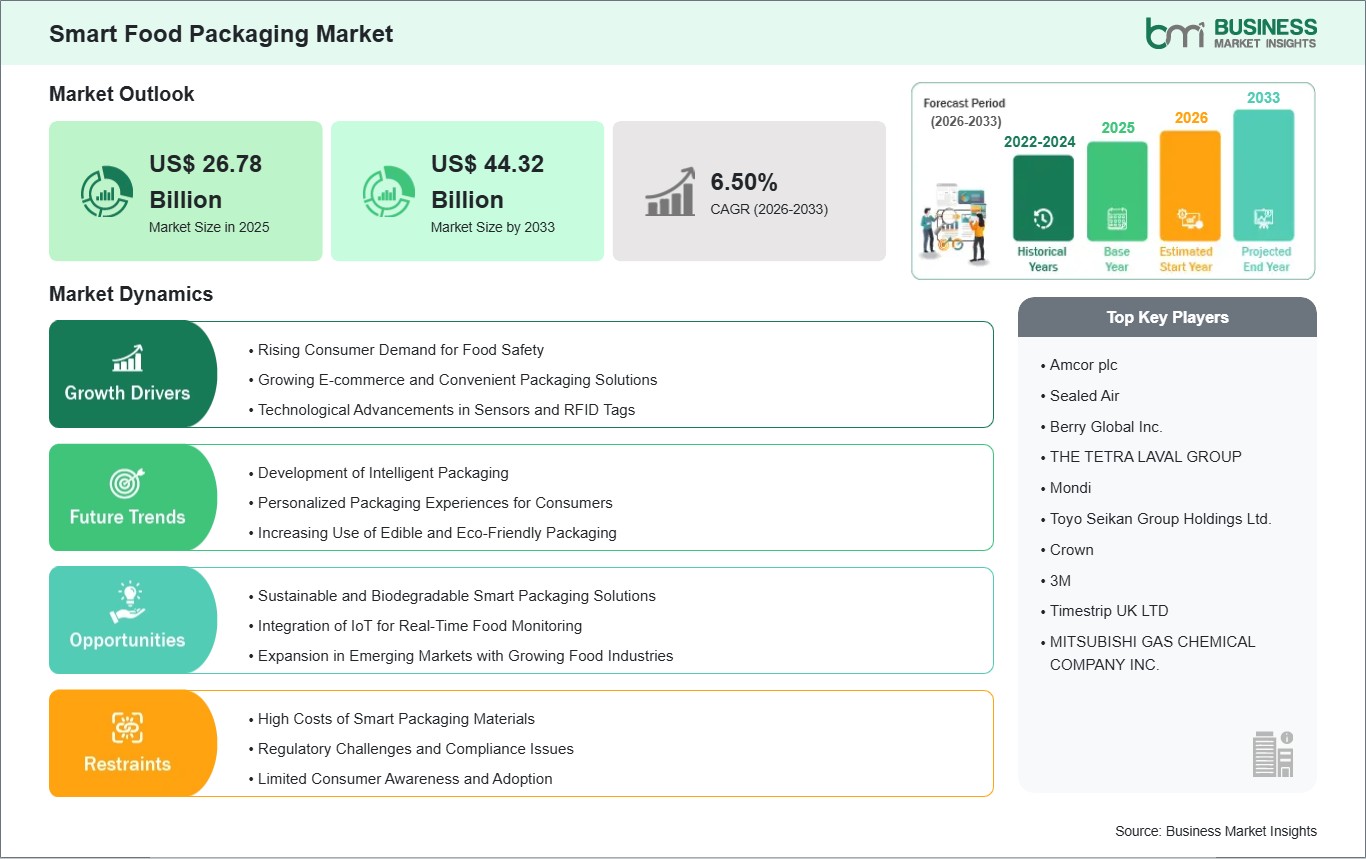
The global market for smart food packaging is at the crossroads of technological advancements and the increasing need to ensure food safety, freshness, and sustainability. Smart food packaging can include various packaging solutions that can monitor, communicate, and protect the freshness of food during its entire lifecycle, including production, consumption, and other associated activities. There are several key factors that are contributing to the global market for smart food packaging. Firstly, consumers are becoming more and more inclined towards food products that have longer shelf lives and are safer to use.
Furthermore, consumers are becoming increasingly concerned about the need to track food, and the use of IoT technology in packaging materials is increasing. In addition, there is a need to ensure that food waste is being minimized, and for that purpose, several smart packaging materials are being developed. There are several challenges that need to be considered in the global market for smart food packaging. Firstly, the cost factor associated with the implementation of smart packaging technology in food packaging is one of the key challenges.
Segment Analysis
Smart Food Packaging Market Segmentation
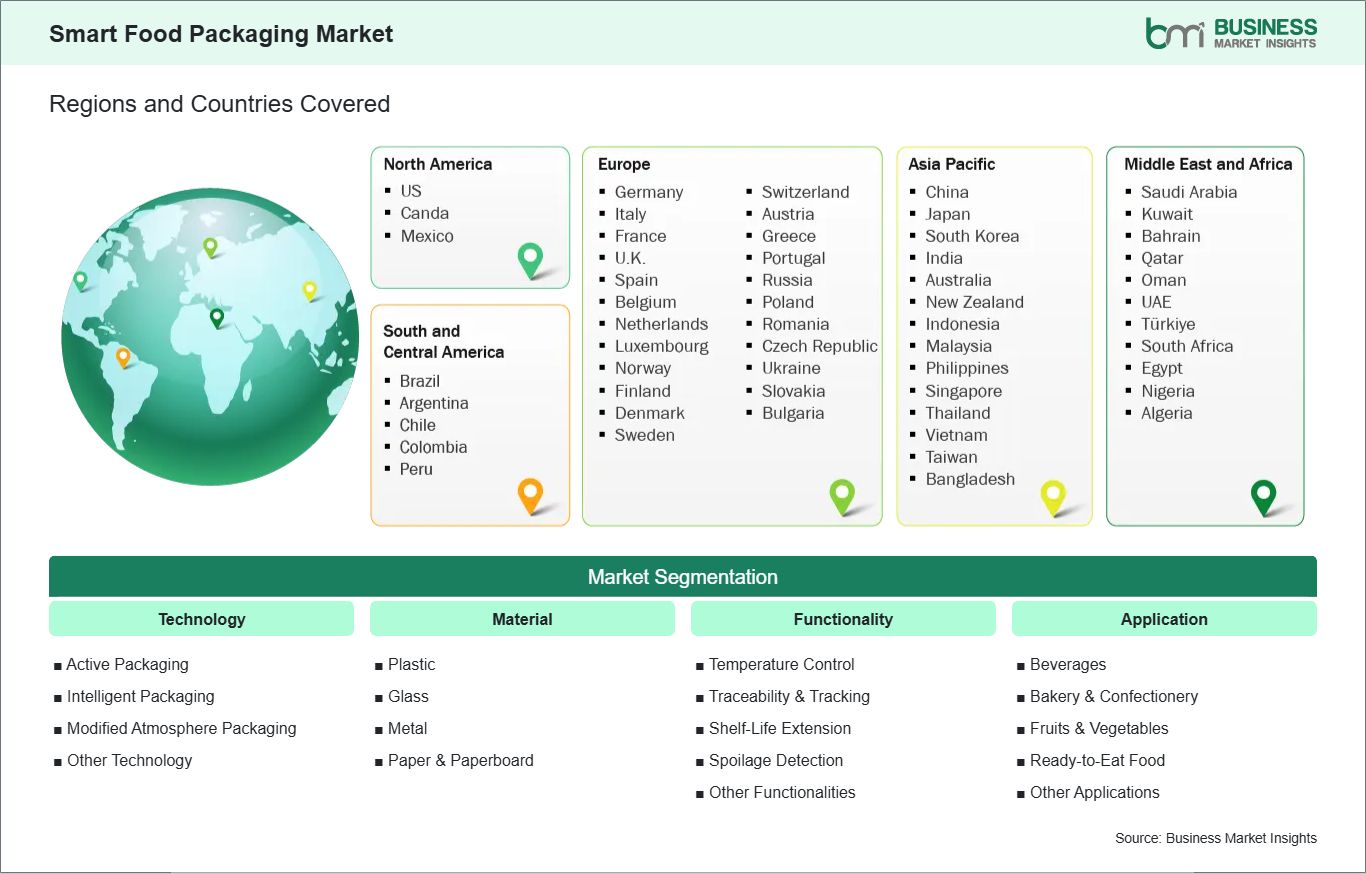
Key segments that contributed to the derivation of the smart food packaging market analysis are technology, material, functionality, and application.
- On the basis of technology, the Smart Food Packaging market is categorized into active packaging, intelligent packaging, modified atmosphere packaging (MAP), and other technology. The active packaging segment dominated the market in 2025.
- By material, the Smart Food Packaging market is segmented into plastic, glass, metal, and paper & paperboard. The plastic segment dominated the market in 2025.
- Based on functionality, the Smart Food Packaging market is classified into temperature control, traceability & tracking, shelf‑life extension, spoilage detection, and other functionalities. The shelf‑life extension segment dominated the market in 2025.
- In terms of application, the Smart Food Packaging market is categorized into beverages, bakery & confectionery, fruits & vegetables, ready‑to‑eat food, and other applications. The beverages segment dominated the market in 2025.
Market Forces
Smart Food Packaging Market Drivers and Opportunities
Rising Consumer Demand for Food Safety
The smart food packaging market is growing at a fast pace due to increased awareness about food safety and quality. Consumers are becoming increasingly concerned about the freshness and authenticity of the products they buy, thereby creating a demand for packaging solutions that can provide real-time information about the product. Solutions such as freshness sensors, time-temperature indicators, and traceability solutions are becoming more prevalent, allowing companies to convey important information about the safety of the product throughout the supply chain. This is directly meeting the demands of consumers who want products that are safe and reliable.
The regulatory environment is also providing impetus to the development and use of smart packaging by encouraging greater transparency and accountability in food handling. Stringent food safety and traceability regulations are prompting food producers to opt for advanced packaging solutions that can enhance food safety, thus providing greater impetus to the market.
Changes in consumer behavior are also providing greater impetus to the market, with growing demand for food products that can assure greater authenticity, freshness, and safety. Retailers and distribution channels are increasingly relying on sensor technology and intelligent packaging to deliver high-quality food products to their customers, thus ensuring greater satisfaction.
Sustainable and Biodegradable Smart Packaging Solutions
Sustainability is becoming a central driver of innovation in smart food packaging, as consumers and brands prioritize environmentally responsible options. Traditional plastic packaging is under increasing scrutiny due to its long-term ecological impact, leading to the development of biodegradable and eco-friendly alternatives. Manufacturers are exploring materials that preserve the functionality of smart packaging such as embedded sensors or freshness indicatorswhile minimizing environmental footprints. These solutions meet both ecological goals and rising consumer preference for greener products.
Policy initiatives are encouraging the transition to sustainable packaging by incentivizing environmentally friendly solutions and discouraging single-use plastics. Collaborations between packaging companies and material science innovators are enabling the creation of plant-based films, compostable polymers, and hybrid materials that maintain performance while being more sustainable. This opens new opportunities for companies to provide packaging that meets both functional and environmental standards.
Leading food and beverage brands are increasingly integrating sustainability into their packaging strategies, designing smart packaging to be recyclable, reusable, or fully biodegradable. These initiatives promote consistency in supply chains and drive the development of innovative materials, such as bioplastics with freshness-monitoring features or fully recyclable intelligent cartons. By combining advanced functionality with eco-conscious design, companies can meet consumer expectations while contributing to long-term environmental stewardship.
Size and Share Analysis
Smart Food Packaging Market Size and Share Analysis
The smart food packaging market is experiencing steady growth, with market size and share analysis reflecting evolving treatment preferences and competitive dynamics among key players. The report evaluates important subsegments categorized within technology, material, functionality, and application, highlighting their respective contributions to overall market performance.
On the basis of technology, the active packaging subsegment dominated the Smart Food Packaging market in 2025. This leadership is driven by the growing demand for packaging that interacts directly with food products to maintain or improve quality, extend shelf life, and minimize spoilage through components such as oxygen scavengers, moisture absorbers, and antimicrobial agents. The ability of active packaging to preserve freshness and safety across various food categories reinforces its strong adoption among manufacturers and retailers.
By material, the plastic subsegment dominated the Smart Food Packaging market in 2025. The prominence of plastics is attributed to their versatility, cost‑effectiveness, and strong barrier properties that help protect food products, coupled with innovations in bio‑based plastics that support sustainability efforts and regulatory compliance in food safety.
Based on functionality, the shelf‑life extension subsegment dominated the Smart Food Packaging market in 2025. The focus on extending shelf life is increasingly important for reducing food waste, improving supply chain efficiency, and meeting consumer demand for safer and longer‑lasting food products, making this functionality central to smart packaging adoption.
In terms of application, the beverages subsegment dominated the Smart Food Packaging market in 2025. Beverage packaging requires advanced solutions to maintain freshness, prevent contamination, and ensure quality throughout the supply chain. The use of smart packaging in this subsegment supports extended shelf life, traceability, and improved consumer safety, driving strong adoption among manufacturers and retailers.
Report Coverage
Smart Food Packaging Market Report Coverage and Deliverables
The "Smart Food Packaging Market Size and Forecast (2022 - 2033)" report provides a detailed analysis of the market covering below areas:
- Smart Food Packaging market size and forecast at global, regional, and country levels for all the key market segments covered under the scope
- Smart Food Packaging market trends, as well as drivers, restraints, and opportunities
- Smart Food Packaging market analysis covering key trends, regional framework, major players, regulations, and recent developments
- Industry landscape and competition analysis covering market concentration, heat map analysis, prominent players, and recent developments for the Smart Food Packaging market
- Detailed company profiles, including SWOT analysis
Geographic Insights
Smart Food Packaging Market Geographic Insights
The geographical scope of the Smart Food Packaging market report is divided into five regions: North America, Asia Pacific, Europe, Middle East & Africa, and South & Central America. The Smart Food Packaging market in North America is expected to grow during the forecast period.
North America currently leads the smart food packaging market worldwide, thanks to its well-developed food industry and culture of embracing technology. The region enjoys state-of-the-art research facilities, strict regulatory frameworks, and a food-savvy population that demands quality, safety, and traceability of food. This has led to the widespread adoption of smart packaging solutions such as real-time condition monitoring, interactive labels, and digital tracking systems. Food and beverage manufacturers in the region are heavily investing in these technologies to improve product differentiation, accountability, and meet the rising demands of consumers for more transparency.
The high costs of adoption may be a challenge in implementing the technology, especially for smaller food manufacturers, and the integration of the new technology with existing supply chain systems is also a consideration. Cybersecurity threats associated with connected packaging are also a major concern. North America remains the pace-setter in the industry, shaping global trends and cementing its position as the most advanced and leading regional market for smart food packaging.
Industry Activity
Recent Developments
The smart food packaging market is evaluated by gathering qualitative and quantitative data post primary and secondary research, which includes important corporate publications, association data, and databases. A few of the key developments in the smart food packaging market are:
- In July 2025, Nestlé announced that it collaborated with IBM Research to develop an AI tool for designing innovative, sustainable high‑barrier packaging materials aimed at enhancing food protection and reducing waste in smart food packaging solutions.
- In June 2025, UFlex announced that it introduced a novel FSSAI‑compliant single‑pellet solution blending virgin PET with recycled PET for food and beverage packaging to simplify production and improve sustainability.
Trust & Transparency
Research Methodology
The market analysis combines proprietary research with secondary data from government agencies, company disclosures, regulatory filings, industry databases and expert interviews. Market estimates are validated through data triangulation, cross-market benchmarking and analyst
review.
View Full Research Methodology
Key Sources Referred:
Food and Agriculture Organization (FAO) World Bank World Health Organization (WHO) Organisation for Economic Co-operation and Development (OECD) S. Food and Drug Administration (FDA) European Food Safety Authority (EFSA) Centers for Disease Control and Prevention (CDC) Company Websites Company Annual Reports Company Investor Presentations