Market Summary
Executive Summary and Global Market Analysis
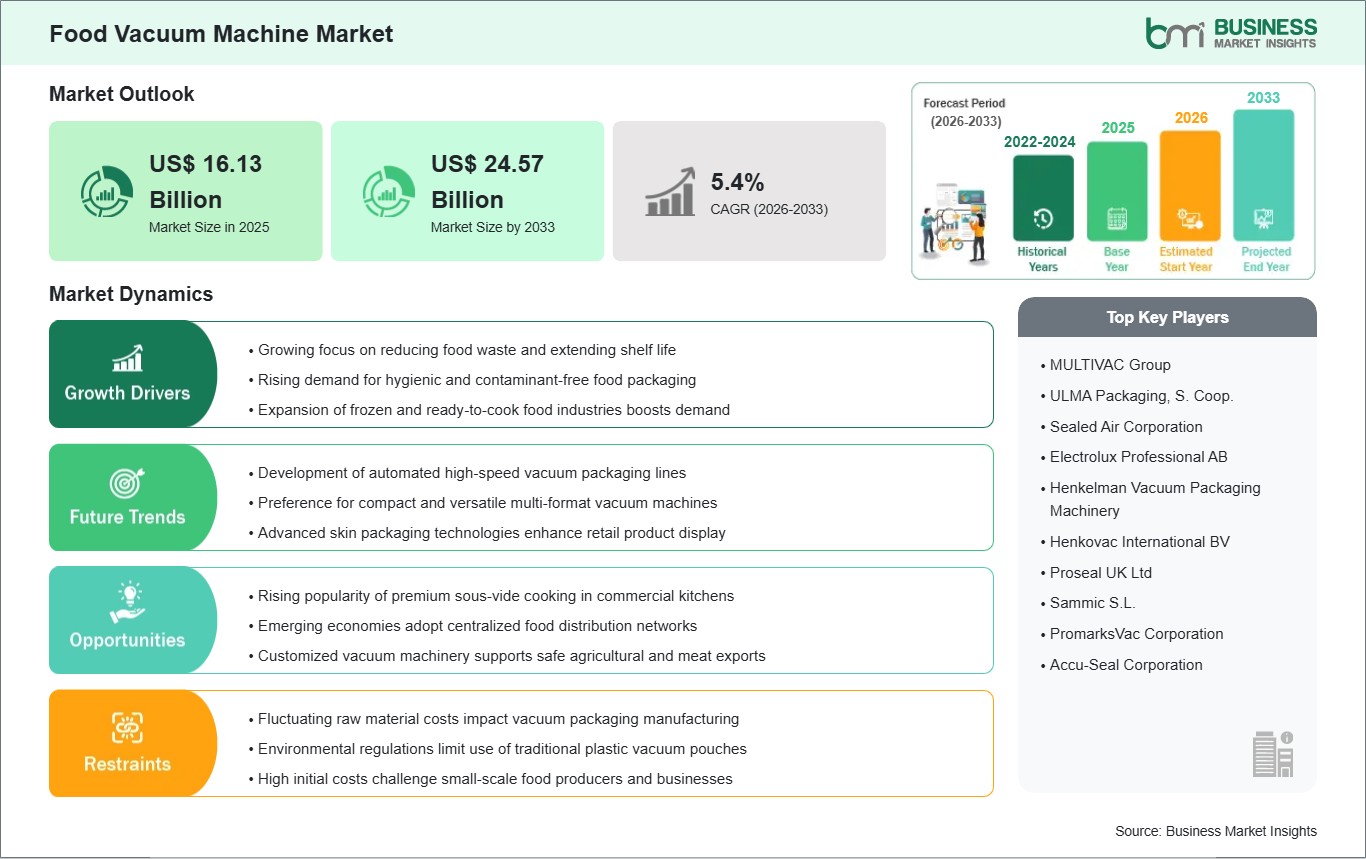
Food vacuum machines refer to the integrated application of packaging hardware engineered to remove atmospheric oxygen from a container prior to sealing, thereby inhibiting the growth of aerobic bacteria and fungi. By utilizing diverse mechanical configurations, including chamber vacuum machines, external suction sealers, and tray-sealing assemblies, these systems preserve the moisture, nutritional integrity, and sensory profiles of perishable goods. This technology is fundamental to the operational architecture of high-volume food processing facilities, the hospitality sector, and the sous-vide culinary industry. Market expansion is being propelled by the rapid global transition toward ready-to-eat (RTE) convenience meals, the rising requirement for extended shelf-life in cross-border food logistics, and the increasing institutional integration of smart sealing sensors to minimize material waste and enhance food safety compliance.
However, several factors may restrain market progression. The high capital intensity associated with high-throughput, double-chamber, and automatic thermoforming systems remains a primary hurdle for small-scale food processors and independent retailers. The industry also faces persistent technical challenges regarding material compatibility, as the transition toward compostable or recyclable mono-material films often requires precise recalibration of sealing temperatures and pressure cycles to ensure hermetic integrity. Additionally, the proliferation of portless and compact domestic sealers has intensified competition in the consumer segment, where price sensitivity can limit the adoption of professional-grade features. These hurdles, compounded by the strategic risks of fluctuating raw material costs for stainless steel and specialized heating elements, increase the total cost of ownership and may lengthen the return on investment for enterprise-level packaging line upgrades.
Despite these hurdles, the market outlook remains highly favorable as the sector moves toward automation and circularity. Opportunities are emerging through the adoption of Magnetic Auto-Sealing technology; as of March 2026, the market is witnessing a surge in hands-free machines that eliminate manual lid closure, significantly improving operational throughput for commercial kitchens. The expansion of IoT-enabled vacuum systems is gaining significant traction, allowing facilities to monitor vacuum pressure and seal quality in real-time to meet stringent global hygiene standards. Furthermore, the growth of Skin Packaging (VSP) processes aligns with global goals for enhanced product visibility and reduced plastic usage in premium meat and seafood segments. Collectively, these innovations position the food vacuum machine industry for sustained long-term development as a cornerstone of the modern, waste-conscious, and safety-oriented global food supply chain.
Segment Analysis
Food Vacuum Machine Market Segmentation
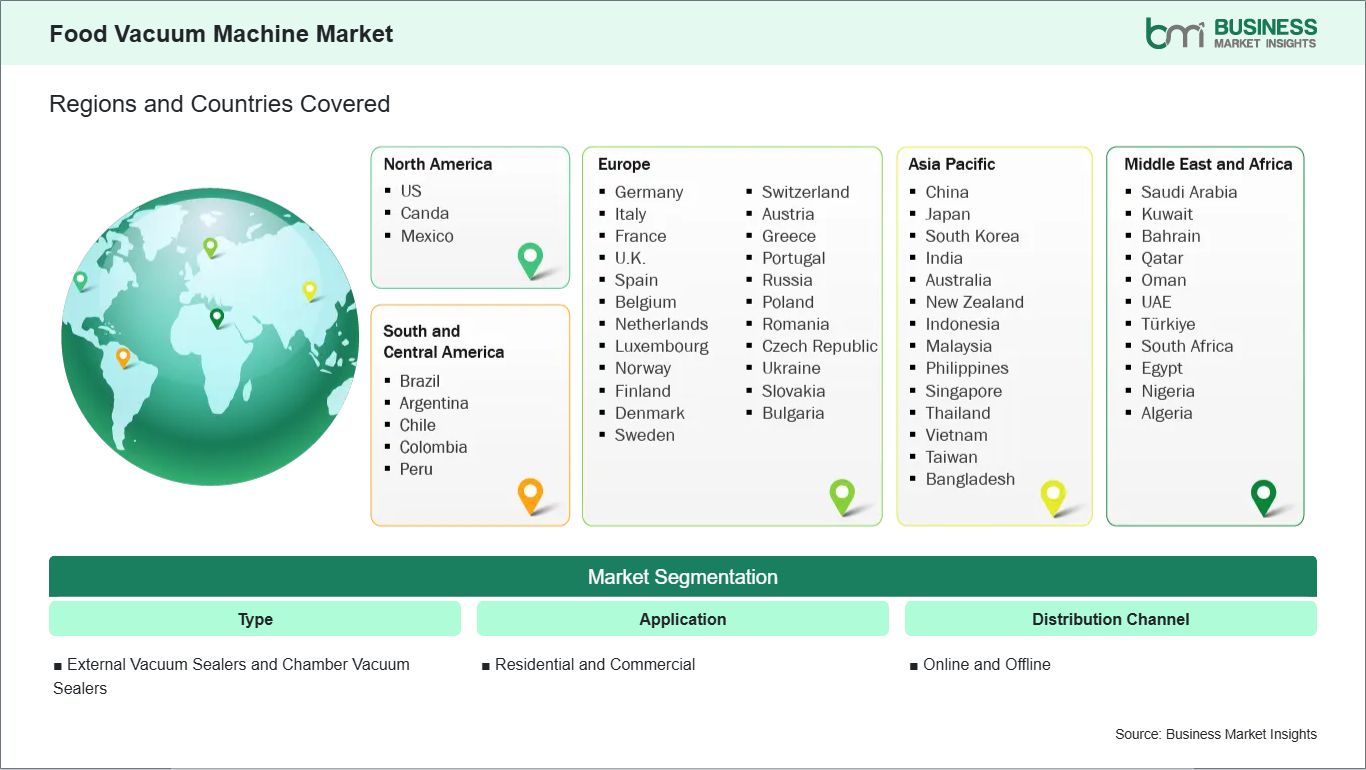
Key segments that contributed to the derivation of the Food Vacuum Machine market analysis are type, application, and distribution channel.
- By Type, the market is segmented into External Vacuum Sealers and Chamber Vacuum Sealers.
- By Application, the market is divided into Residential and Commercial.
- By Distribution Channel, the market is categorized into Online and Offline.
Market Forces
Food Vacuum Machine Market Drivers and Opportunities
Rising Demand for Shelf Life Extension, Hygiene, and Convenience
The food vacuum machine market is being driven by the growing need for extended shelf life, improved hygiene, and consumer convenience across households, food processing, and hospitality sectors. Vacuum machines remove air from packaging, slowing down oxidation and bacterial growth, thereby preserving freshness and nutritional value. Rising demand for packaged and ready‑to‑eat foods is amplifying adoption, as manufacturers and retailers seek reliable solutions to reduce spoilage and food waste. In households, increasing awareness of food safety and storage efficiency is reinforcing growth, with consumers adopting compact vacuum machines for everyday use. The hospitality industry is also leveraging vacuum machines for portion control, sous‑vide cooking, and inventory management. Additionally, regulatory mandates for food safety and hygiene are propelling investment in vacuum packaging technologies. The expansion of e‑commerce and global food trade is driving demand for durable, tamper‑proof packaging solutions. Collectively, shelf life priorities, hygiene requirements, and convenience trends are fueling sustained growth in the global food vacuum machine market.
Rising Integration of Smart Technology, Sustainability, and Emerging Applications
Opportunities in the food vacuum machine market are expanding through the integration of smart technology, sustainability initiatives, and emerging cross‑industry applications. IoT‑enabled vacuum machines are opening lucrative opportunities by offering real‑time monitoring, automated sealing, and adaptive storage solutions. Smart kitchen ecosystems are gaining traction, enabling vacuum machines to connect seamlessly with appliances, apps, and inventory management systems. The growing emphasis on sustainability is fueling demand for eco‑friendly packaging materials and energy‑efficient vacuum machines that align with global environmental goals. Emerging applications in food delivery and meal kits are driving innovation, as vacuum packaging ensures freshness and safety during transit. Healthcare and nutraceutical industries are also reinforcing opportunities, where vacuum machines support sterile packaging of supplements and medical foods. Additionally, the expansion of commercial kitchens and catering services is creating new pathways for adoption, offering scalability and efficiency. Vendors who focus on smart, sustainable, and industry‑specific vacuum machine solutions are well‑positioned to capture growth. The convergence of IoT, sustainability, and convenience underscores a transformative trajectory for the global food vacuum machine market.
Size and Share Analysis
Food Vacuum Machine Market Size and Share Analysis
The Food Vacuum Machine market demonstrates steady growth, with size and share analysis revealing evolving trends and competitive positioning among key players. The report examines subsegments categorized within type, application, and distribution channel, offering insights into their contribution to overall market performance.
Based on Type, the External Vacuum Sealers subsegment holds a strong presence, as they are widely adopted in residential kitchens for their affordability, compact design, and ease of use. These machines are indispensable for preserving food freshness, reducing waste, and supporting small‑scale packaging needs. The Chamber Vacuum Sealers subsegment is essential for commercial applications, offering higher efficiency, durability, and the ability to seal liquids and bulk products. Chamber sealers anchor demand in restaurants, food processing plants, and catering services, where large‑volume packaging is critical. Together, external sealers dominate household use, while chamber sealers ensure professional‑grade performance in commercial settings.
Report Coverage
Food Vacuum Machine Market Report Coverage and Deliverables
The “Food Vacuum Machine Market Size and Forecast (2022–2033)” report provides a detailed analysis of the market covering below areas:
- Market size and forecast at global, regional, and country levels for all market segments covered under the scope
- Market trends, as well as drivers, restraints, and opportunities
- Market analysis covering key trends, global and regional framework, major players, and recent developments
- Market concentration, heat map analysis, prominent players, and recent developments
- Detailed company profiles, including SWOT analysis
Geographic Insights
Food Vacuum Machine Market Geographic Insights
The geographical scope of the Food Vacuum Machine market report is divided into five regions: North America, Asia Pacific, Europe, Middle East & Africa, and South & Central America.
North America maintains a preeminent position within the global industry, a status reinforced by high consumer purchasing power and a sophisticated retail environment that prioritizes food safety and shelf-life extension. The regional landscape is characterized by significant investments in the United States and Canada, where the transition toward high-efficiency preservation has become a strategic priority for both residential and commercial users. This market leadership is supported by a robust ecosystem of industry pioneers, including Newell Brands (FoodSaver), Henkelman, and MULTIVAC, who drive the commercialization of advanced external and chamber vacuum systems.
Industrial and consumer trends in the region reflect a decisive shift toward Smart Preservation and Household Automation. There is an escalating demand for intelligent vacuum sealers equipped with moisture-sensing technology and automated sealing cycles, which optimize the preservation of varied food textures. Furthermore, the region is witnessing a rapid expansion of the Sous-Vide Cooking and Bulk-Buying movements. This focus on Culinary Precision is accelerated by the integration of mobile app connectivity and Wi-Fi-enabled controls, allowing tech-savvy consumers to monitor sealing progress and manage food inventory through digital platforms.
Industry Activity
Recent Developments
The Food Vacuum Machine market is evaluated by gathering qualitative and quantitative data post primary and secondary research, which includes important corporate publications, association data, and databases. A few of the key developments in the Food Vacuum Machine market are:
- In March 2025, ULMA Packaging launched the TFX range of thermoforming machines designed for advanced food packaging applications. The new systems enhance vacuum packaging efficiency through faster cycle times, improved productivity, and high-quality sealing performance. The machines also incorporate sustainability features and smart digital tools for optimized production and resource monitoring. This development supports the food vacuum machine market by advancing efficient, sustainable, and intelligent packaging technologies, driving wider industry adoption.
- In May 2025, Hoshizaki Corporation launched its first floor-standing vacuum packaging machines, expanding its product portfolio beyond tabletop models. The new systems enable large-scale vacuum sealing with significantly increased sealing width, allowing efficient packaging of larger and multiple food items. The machines address industry needs such as reducing food waste, improving preservation, and enhancing operational efficiency in food processing and sales. This development supports the food vacuum machine market by expanding capacity-driven solutions and accelerating adoption of advanced vacuum packaging technologies.
Trust & Transparency
Research Methodology
The market analysis combines proprietary research with secondary data from government agencies, company disclosures, regulatory filings, industry databases and expert interviews. Market estimates are validated through data triangulation, cross-market benchmarking and analyst
review.
View Full Research Methodology
Key Sources Referred:
World Bank & Global Trade Indicators World Trade Organization (WTO) International Monetary Fund (IMF) International Trade Administration (ITA) Company Websites Company Annual Reports Company Investor Presentations