Market Summary
Executive Summary and Global Market Analysis
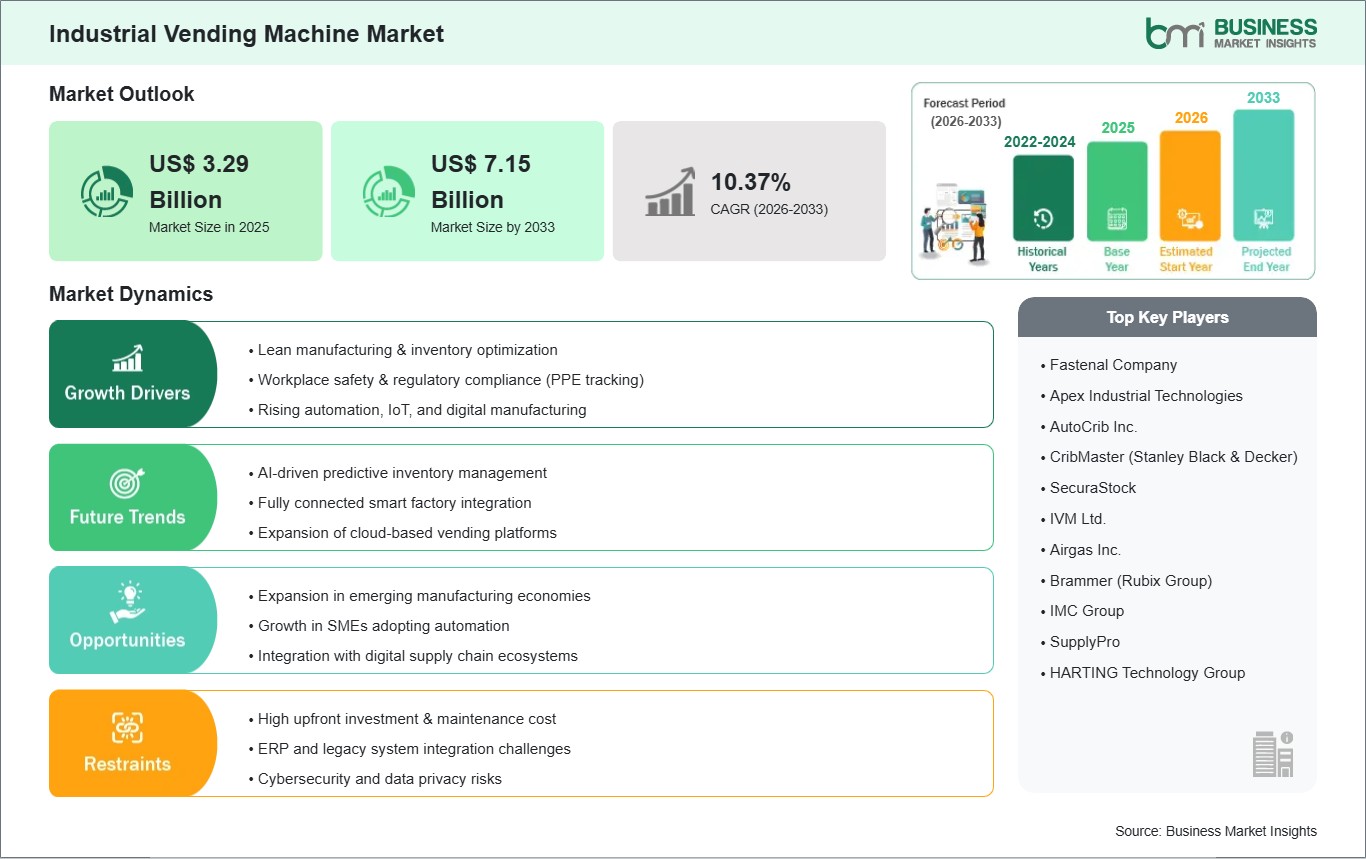
Industrial vending machines refer to the integrated application of automated dispensing systems engineered to manage the distribution and tracking of industrial supplies, tools, and personal protective equipment (PPE) directly at the point of use. By utilizing a coordinated network of hardware, including carousel, coil, and vertical lift machines, integrated with cloud-based management software, these systems facilitate real-time inventory visibility and automated replenishment. This technology is fundamental to the operational architecture of high-intensity manufacturing plants, aerospace facilities, and oil and gas maintenance operations. Market expansion is being propelled by the rapid global transition toward lean manufacturing, the rising institutional requirement for stringent workplace safety compliance, and the increasing integration of Internet of Things (IoT) sensors to eliminate manual stock counting and reduce material waste.
However, several factors may restrain market progression. The high capital intensity associated with the initial procurement of smart, sensor-enabled hardware remains a primary hurdle for small and medium-sized enterprises (SMEs) with limited automation budgets. The industry also faces persistent technical challenges regarding connectivity and synchronization, as maintaining real-time data flow across geographically distributed machines in remote industrial environments requires stable network infrastructure. Additionally, the proliferation of diverse inventory types has intensified concerns regarding system flexibility, as predefined storage configurations may struggle to accommodate irregularly shaped tools or high-volume items without significant customization. These hurdles, compounded by the strategic risks of global semiconductor shortages for touchscreen interfaces and the logistical complexity of integrating vending software with legacy enterprise resource planning (ERP) systems, increase the total cost of ownership and may lengthen the ROI period for traditional supply chain managers.
Despite these hurdles, the market outlook remains highly favorable as the sector transitions toward Intelligent and Predictive inventory ecosystems. Opportunities are emerging through the adoption of AI-Driven Demand Forecasting; the market is witnessing a surge in systems that utilize machine learning algorithms to analyze historical usage patterns and autonomously adjust reorder points to prevent both stockouts and overstocking. The personal protective equipment segment is gaining significant traction, with a rising requirement for Contactless PPE Dispensing units that provide an auditable trail for safety compliance while reducing employee walk-and-wait time. Furthermore, the growth of Modular and Scalable Designs, allowing for the seamless addition of locker units and satellite cabinets, aligns with global goals for flexible, future-proof industrial infrastructure.
Segment Analysis
Industrial Vending Machine Market Segmentation
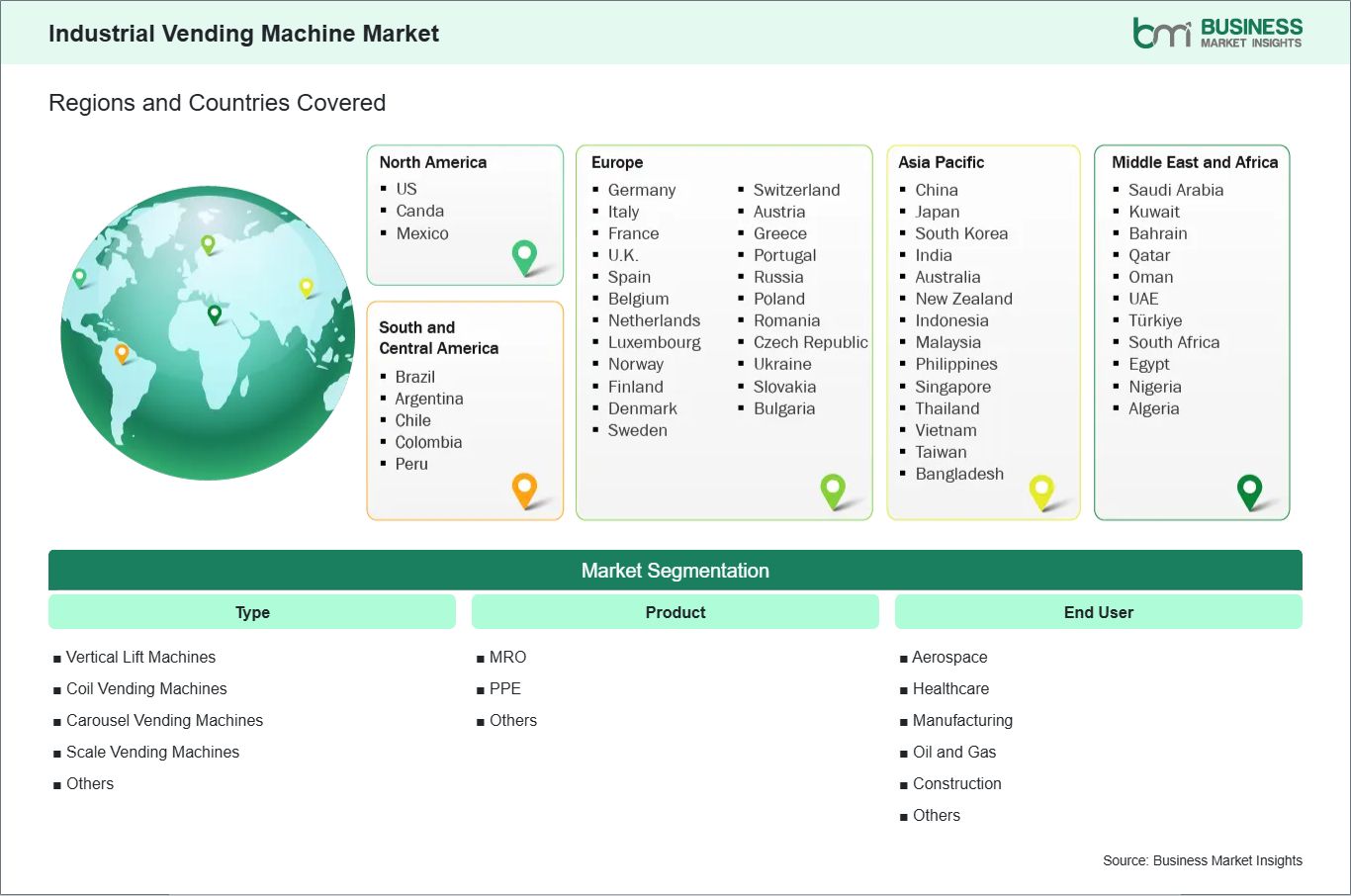
Key segments that contributed to the derivation of the Industrial Vending Machine market analysis are type, product, and end-user industry.
- By Type, the market is segmented into Vertical Lift Machines, Coil Vending Machines, Carousel Vending Machines, Scale Vending Machines, and Others.
- By Product, the market is divided into MRO, PPE, and Others.
- By End-user Industry, the market is categorized into Aerospace, Healthcare, Manufacturing, Oil and Gas, Construction, and Others.
Market Forces
Industrial Vending Machine Market Drivers and Opportunities
Rising Demand for Inventory Control, Cost Efficiency, and Workplace Safety
The industrial vending machine market is being driven by the growing need for inventory control, cost efficiency, and workplace safety across manufacturing, construction, oil & gas, and mining sectors. Industrial vending machines provide automated access to tools, personal protective equipment (PPE), and consumables, ensuring that employees have the right resources at the right time. Rising demand for lean manufacturing and just‑in‑time inventory practices is amplifying adoption, as vending machines reduce waste, minimize stockouts, and lower procurement costs. Workplace safety regulations are reinforcing growth, with vending machines ensuring controlled distribution of PPE and compliance with safety standards. Construction and mining industries are fueling demand, as vending solutions improve accountability and reduce downtime in remote or high‑risk environments. Additionally, stricter corporate mandates for efficiency and transparency are propelling investment in automated inventory systems. Collectively, inventory control priorities, cost reduction goals, and safety requirements are sustaining momentum in the global industrial vending machine market.
Rising Integration of IoT, Data Analytics, and Emerging Applications
Opportunities in the industrial vending machine market are expanding through the integration of IoT ecosystems, data analytics, and emerging cross‑industry applications. IoT‑enabled vending machines are opening lucrative opportunities by offering real‑time monitoring, automated replenishment, and predictive analytics for inventory management. AI‑driven platforms are gaining traction, enabling usage tracking, demand forecasting, and adaptive stocking strategies. The growing emphasis on digital transformation is fueling demand for interoperable vending solutions that integrate seamlessly with enterprise resource planning (ERP) and supply chain management systems. Emerging applications in healthcare and laboratories are driving innovation, as vending machines provide controlled access to medical supplies and specialized equipment. Defense and aerospace industries are reinforcing opportunities, where vending solutions improve accountability and reduce logistical complexity. Additionally, sustainability trends are encouraging deployment of energy‑efficient vending machines that reduce waste and align with global environmental goals. The expansion of smart factories, remote worksites, and Industry 4.0 initiatives is creating new pathways for adoption. Vendors who focus on IoT‑ready, AI‑driven, and industry‑specific vending solutions are well‑positioned to capture growth. The convergence of IoT, analytics, and smart automation underscores a transformative trajectory for the global industrial vending machine market.
Size and Share Analysis
Industrial Vending Machine Market Size and Share Analysis
The Industrial Vending Machine market demonstrates steady growth, with size and share analysis revealing evolving trends and competitive positioning among key players. The report examines subsegments categorized within type, product, and end-user industry, offering insights into their contribution to overall market performance.
Based on Type, the Vertical Lift Machines subsegment holds a strong presence, as they are indispensable for storing and dispensing large, bulky items with high efficiency and space optimization. The Coil Vending Machines subsegment is essential for smaller consumables such as tools, PPE, and maintenance supplies, offering quick access and easy replenishment. The Carousel Vending Machines subsegment anchors demand in industries requiring organized storage and retrieval of multiple SKUs, ensuring accuracy and reduced downtime. The Scale Vending Machines subsegment is critical for monitoring inventory weight and usage, enhancing accountability. The Others category includes hybrid and customized vending solutions, showcasing adaptability across diverse industrial needs.
Report Coverage
Industrial Vending Machine Market Report Coverage and Deliverables
The “Industrial Vending Machine Market Size and Forecast (2022–2033)” report provides a detailed analysis of the market covering below areas:
- Market size and forecast at global, regional, and country levels for all market segments covered under the scope
- Market trends, as well as drivers, restraints, and opportunities
- Market analysis covering key trends, global and regional framework, major players, and recent developments
- Market concentration, heat map analysis, prominent players, and recent developments
- Detailed company profiles, including SWOT analysis
Geographic Insights
Industrial Vending Machine Market Geographic Insights
The geographical scope of the Industrial Vending Machine market report is divided into five regions: North America, Asia Pacific, Europe, Middle East & Africa, and South & Central America.
North America maintains a preeminent position within the global industry, a status reinforced by the region's advanced manufacturing infrastructure and the rapid adoption of automated inventory management protocols. The regional landscape is characterized by a mature innovation ecosystem in the United States and Canada, where the transition toward connected dispensing units has become a strategic priority for enhancing workplace efficiency. This market leadership is supported by a robust presence of technology pioneers, including Fastenal Company, AutoCrib, Inc., SupplyPro, Inc., and CribMaster, who drive the commercialization of sophisticated carousel, coil, and large-scale cabinet vending systems.
Industrial and enterprise trends in the region reflect a decisive shift toward IIoT-Enabled Inventory Control and Automated MRO Procurement. Organizations are increasingly moving away from manual tool-crib management to adopt intelligent vending machines that provide real-time tracking of high-value tools, spare parts, and consumables. Furthermore, the region is witnessing an escalating demand for Point-of-Use Personal Protective Equipment (PPE) Dispensing. This focus on Safety Compliance is accelerated by the integration of biometric and badge authentication, which creates immutable audit trails and ensures that employees have immediate access to necessary safety gear while minimizing unauthorized usage and waste.
Industry Activity
Recent Developments
The Industrial Vending Machine market is evaluated by gathering qualitative and quantitative data post primary and secondary research, which includes important corporate publications, association data, and databases. A few of the key developments in the Industrial Vending Machine market are:
- In November 2025, TOMRA launched the S2 Rugged Plus, an all-weather outdoor reverse vending machine designed for high-volume drink container recycling. This development strengthens the industrial vending machine market by offering durable, modular, and scalable solutions that streamline operations and improve user convenience, supporting the expansion of deposit return schemes in retail and public locations.
- In December 2025, IMT launched VendingOS, the industry’s first AI-powered backend management system for vending machines, offering real-time monitoring, smart pricing, automated inventory control, and intelligent data insights. This development strengthens the industrial vending machine market by enabling more efficient, scalable, and data-driven operations, accelerating the adoption of smart vending solutions across retail and commercial applications.
Trust & Transparency
Research Methodology
The market analysis combines proprietary research with secondary data from government agencies, company disclosures, regulatory filings, industry databases and expert interviews. Market estimates are validated through data triangulation, cross-market benchmarking and analyst
review.
View Full Research Methodology
Key Sources Referred:
World Trade Organization (WTO) International Monetary Fund (IMF) International Trade Administration (ITA) Company Websites Company Annual Reports Company Investor Presentations