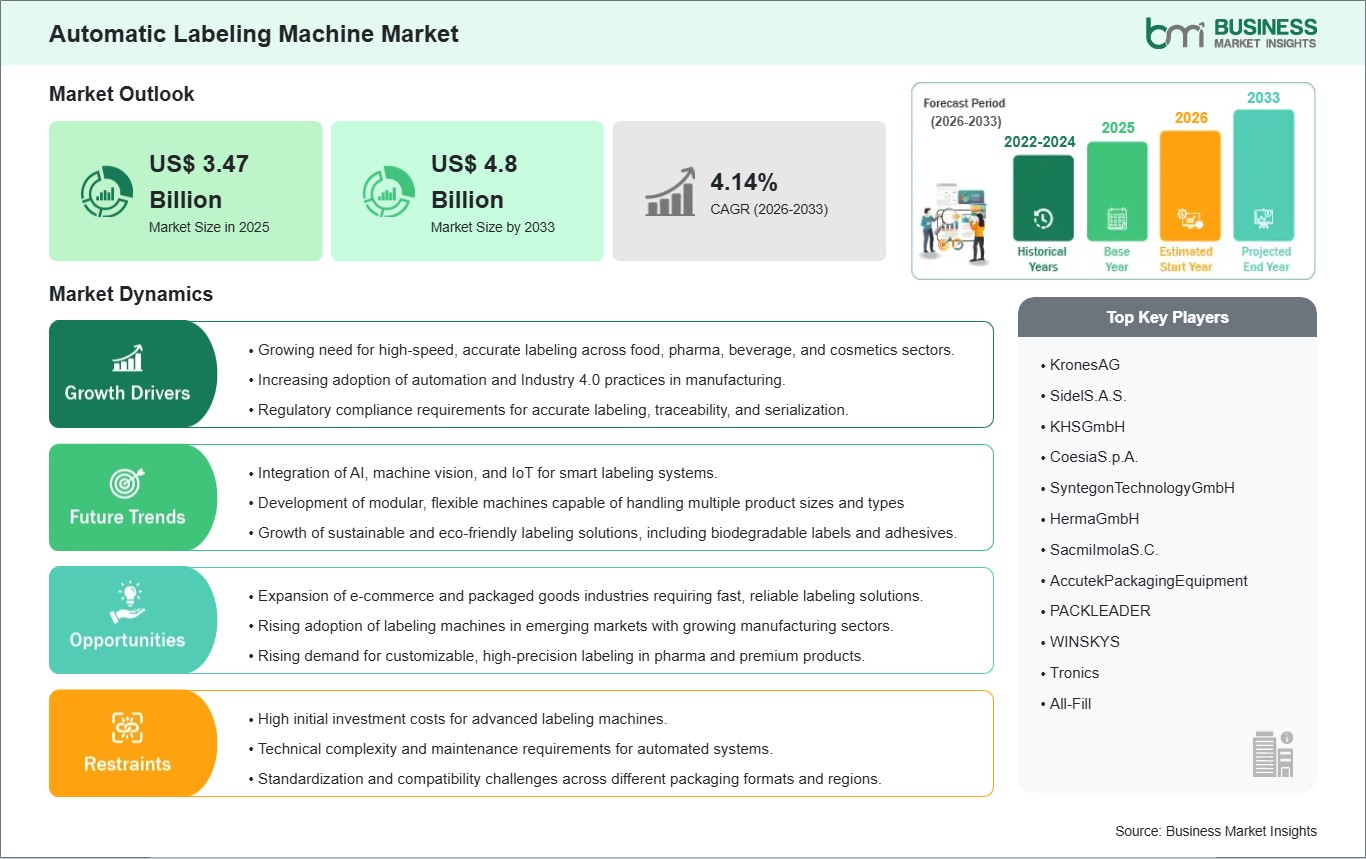
The Automatic Labeling Machine Market size is expected to reach US$ 4.8 Billion by 2033 from US$ 3.47 Billion in 2025. The market is estimated to record a CAGR of 4.14% from 2026 to 2033.
Automatic labeling machines are steadily gaining importance in the packaging process of the modern world. They present an exact, rapid, and dependable method of label application across various fields including food and beverage, pharmaceuticals, cosmetics, and transportation. Their demand increases with the need for greater operational efficiency, minimizing errors, and sticking to the rules of rigorous regulatory and traceability requirements, especially in the pharmaceutical and packaged goods industries.
Technology upgrades such as AI, powered vision systems, IoT connectivity, and modular, flexible platforms enable machines not only to spot misalignments but also to correct themselves instantaneously and manage different container shapes and label types without an issue. Moreover, machine innovations support the use of eco, friendly and recyclable labeling materials, thus accommodating the trend towards sustainability. Growth in the sectors of packed consumer goods, e-commerce, and logistics also leads to a rise in demand since issues like product tracking, brand consistency, and customer satisfaction heavily rely on proper labeling.

Key segments that contributed to the derivation of the Automatic Labeling Machine market analysis are technology, propulsion type, and vehicle type.
Automatic labeling machines have become vital elements of packaging lines in industries such as food and beverage, pharmaceuticals, cosmetics, and logistics. Globally, their usage is being accelerated by increasing production volumes, higher quality standards, and regulatory compliances. To give an example, in the pharmaceutical industry, automatic labeling plays a major role in the proper placement of barcodes, batch numbers, and ingredient lists, thus ensuring product traceability and meeting global regulatory requirements. Besides that, the food and beverage industry benefits from the deployment of high, speed labeling systems that make operations more efficient, reduce errors made by humans, and maintain brand consistency. At the same time, automating labeling in the logistics and e, commerce sectors facilitates faster order preparation and product tracking.
The growth of the manufacturing sector together with the advent of Industry 4.0 and industrial automation has escalated the need for labeling machines which are not only flexible and precise but also can be integrated with smart factory systems. Such machines help manufacturers reduce waste, increase throughput, and meet the ever, growing demands of the modern supply chains..
Thanks to the Industry 4.0 revolution and smart automated factories, the manufacturers are looking for labeling machines that can apply labels accurately and at the same time communicate with the production line monitoring systems, keep track of the real, time data, identify errors, and automatically adjust for different container shapes and label types. AI, powered cameras and IoT, enabled features are a great combination that can result into very efficient machines with less waste, increased productivity, and most importantly, great quality control based on measurable and evidence, based data.
This creates an opening for machine, makers to come up with innovative, modular labeling systems that can operate at high speeds, handle multi, product formats, comply with regulations, and at the same time provide real, time analytics. The companies that put their money in smart, connected labeling machines will be at a good place to take advantage of the increasing demand in the pharmaceutical, food & beverage, cosmetics, and the e, commerce industries, especially in the regions where the implementation of the advanced manufacturing technologies is fastest such as Asia Pacific, North America, and Europe.

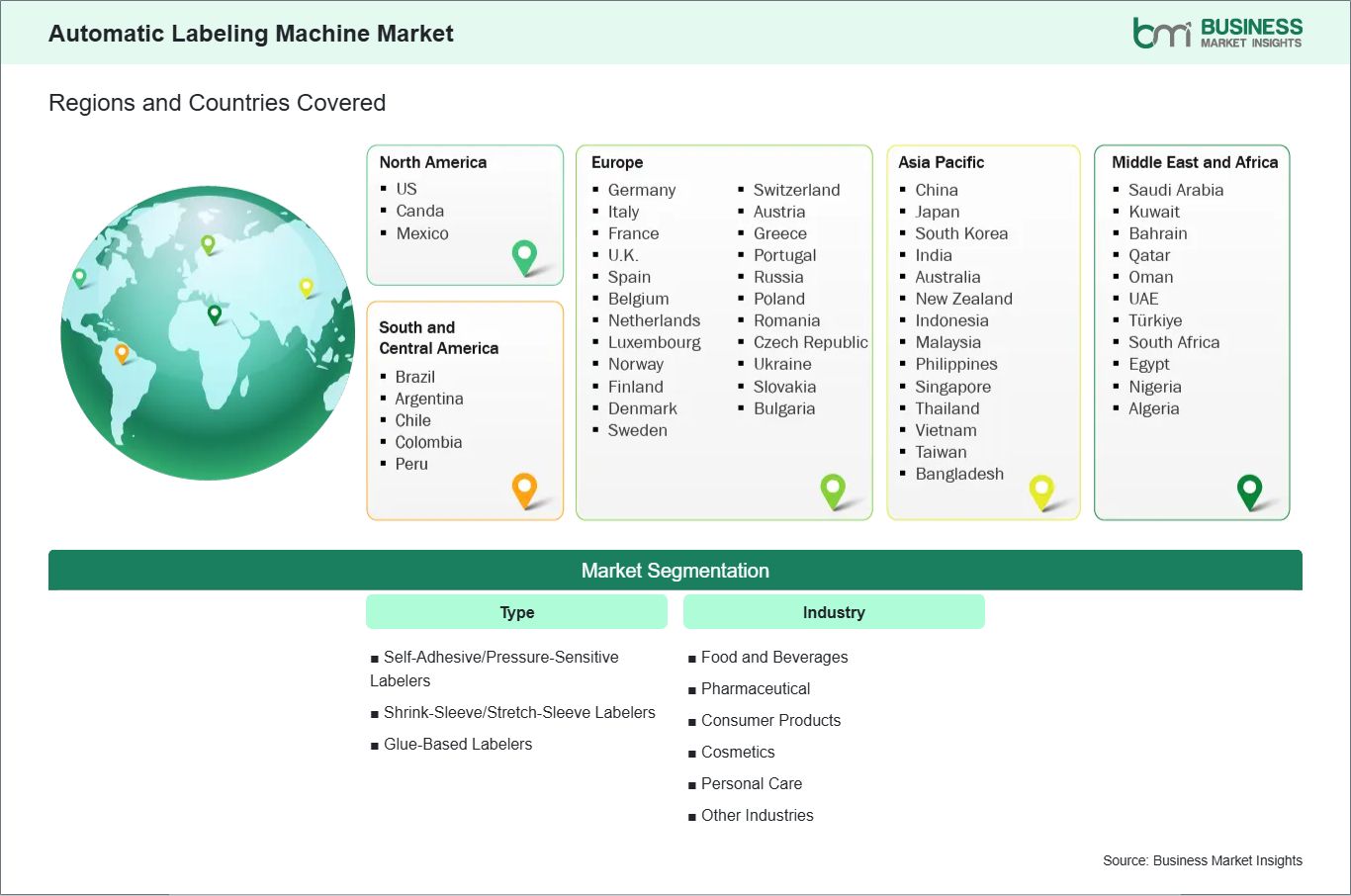
By type, the market is segmented into self-adhesive/pressure-sensitive labelers, shrink-sleeve/stretch-sleeve labelers, glue-based labelers. Pressure, sensitive or self, adhesive labelers represented the biggest market share in 2024. The main reason is their versatility, ease of use, and being suitable for high, speed production lines in industries, such as food and beverage, pharmaceuticals, and cosmetics. These labelers have been adopted widely since they offer pinpoint label placement, accommodate different container shapes, and reduce downtime to a minimum during operations. Shrink, sleeve and stretch, sleeve labelers are getting more attention, especially in the premium packaging and beverage industries, as they enable full, body branding, intricate designs, and better tamper, evident features. Although glue, based labelers have traditionally been slower, they are getting the benefit of technological enhancements such as automated glue application, integrated sensors, and modular designs that make them more efficient and thus capable of handling specialized packaging formats. The introduction of advanced control systems, the incorporation of machine vision, and AI, powered real, time adjustment in these machines continue to improve accuracy, cut down on errors, and raise throughput, thus leading to their more widespread use in high, volume and regulated production settings..
By Industry, the market is segmented into food and beverages, pharmaceutical, consumer products, cosmetics, and personal care, others. The food and beverage sector occupied the highest share of the market in 2024. The reasons behind this include the operation of high, volume production lines, extremely strict regulatory requirements, and the constant need for branding and traceability. Accurate labeling not only ensures that the information on ingredients and nutrition complies with the standard but also minimizes the occurrence of errors and increases overall efficiency. The pharmaceutical industry is one of the fastest, growing segments. This growth is supported by the tightening of serialization and traceability regulations which make it necessary to apply very precise batch numbers, barcodes, and expiration dates. Consumer products get benefits from automated labeling systems in the form of increased packaging speed and the ability to maintain brand consistency across a very diverse product line. The cosmetics and personal care industry is witnessing increasing adoption due to the demand for premium packaging, tamper, evident features, and complex label designs.
| Report Attribute | Details |
|---|---|
| Market size in 2025 | US$ 3.47 Billion |
| Market Size by 2033 | US$ 4.8 Billion |
| Global CAGR (2026 - 2033) | 4.14% |
| Historical Data | 2022-2024 |
| Forecast period | 2026-2033 |
| Segments Covered | By Type
|
|
Regions and Countries Covered
| |
| North America | US, Canada, Mexico |
| Europe | Belgium, Austria, Finland, Denmark, Greece, Poland, Romania, Russia, Ukraine, Czech Republic, Slovakia, Bulgaria, Italy, Luxembourg, Germany, Switzerland, France, Netherlands, Norway, Portugal, Spain, Sweden, United Kingdom |
| Asia-Pacific | Australia, China, India, Japan, South Korea, Indonesia, Malaysia, Philippines, Singapore, Thailand, Vietnam, Bangladesh, New Zealand, Taiwan |
| South and Central America | Brazil, Argentina, Peru, Chile, Colombia |
| Middle East and Africa | Bahrain, Kuwait, Oman, Qatar, Saudi Arabia, United Arab Emirates, Turkiye, South Africa, Egypt, Algeria, Nigeria |
| Market leaders and key company profiles |
|
The "Automatic Labeling Machine Market Size and Forecast (2022-2033)" report provides a detailed analysis of the market covering below areas:
The geographical scope of the Automatic Labeling Machine market report is divided into five regions: North America, Asia Pacific, Europe, the Middle East & Africa, and South & Central America. The Automatic Labeling Machine market in the Asia Pacific is expected to grow significantly during the forecast period.
Different regions reveal different degrees of adoption and growth potentials of the automatic labeling machine market. At present, Asia Pacific leads as the fastest, growing region mainly due to rapid industrialization, massive expansion of packaged goods production, increased adoption of automation in manufacturing, and government support through initiatives in China, India, Japan, and South Korea. The rise of the e, commerce sector in the region, coupled with the upsurge of demand for high, speed and efficient labeling systems in the food and beverage, pharmaceutical, and consumer products sectors, is leading to further market growth.
North America, although it has a slightly slower growth rate than Asia Pacific, continues to be a significant market which is mainly attributed to advanced manufacturing infrastructure, strict regulatory requirements, and extensive use of smart, automated labeling solutions in the pharmaceuticals, consumer goods, and logistics sectors. Robust funding for automation technology, in combination with the presence of major labeling machine manufacturers, is a great support for the continuation of market dominance there.
Europe holds the second position in terms of market size, with the major factors contributing to its support being stringently enforced compliance standards, the implementation of Industry 4.0 practices, and having well, established food, beverage, and pharmaceutical sectors. Slightly low growth rate is seen in Latin America and the Middle East & Africa, where the main drivers of adoption are the emergence of packaged goods industries, the expansion of healthcare infrastructures, and the increase in industrial automation. These tendencies point towards a steady but gradual global rise in various industries' usage of automatic labeling machines.

The Automatic Labeling Machine market is evaluated by gathering qualitative and quantitative data post-primary and secondary research, which includes important corporate publications, association data, and databases. A few of the key developments in the Automatic Labeling Machine market are:
The Automatic Labeling Machine Market is valued at US$ 3.47 Billion in 2025, it is projected to reach US$ 4.8 Billion by 2033.
As per our report Automatic Labeling Machine Market, the market size is valued at US$ 3.47 Billion in 2025, projecting it to reach US$ 4.8 Billion by 2033. This translates to a CAGR of approximately 4.14% during the forecast period.
The Automatic Labeling Machine Market report typically cover these key segments-
The historic period, base year, and forecast period can vary slightly depending on the specific market research report. However, for the Automatic Labeling Machine Market report:
The Automatic Labeling Machine Market is populated by several key players, each contributing to its growth and innovation. Some of the major players include:
The Automatic Labeling Machine Market report is valuable for diverse stakeholders, including:
Essentially, anyone involved in or considering involvement in the Automatic Labeling Machine Market value chain can benefit from the information contained in a comprehensive market report.
Please tell us your area of interest
(Market Segments/ Regions and Countries/ Companies)