Market Summary
Executive Summary and Global Market Analysis
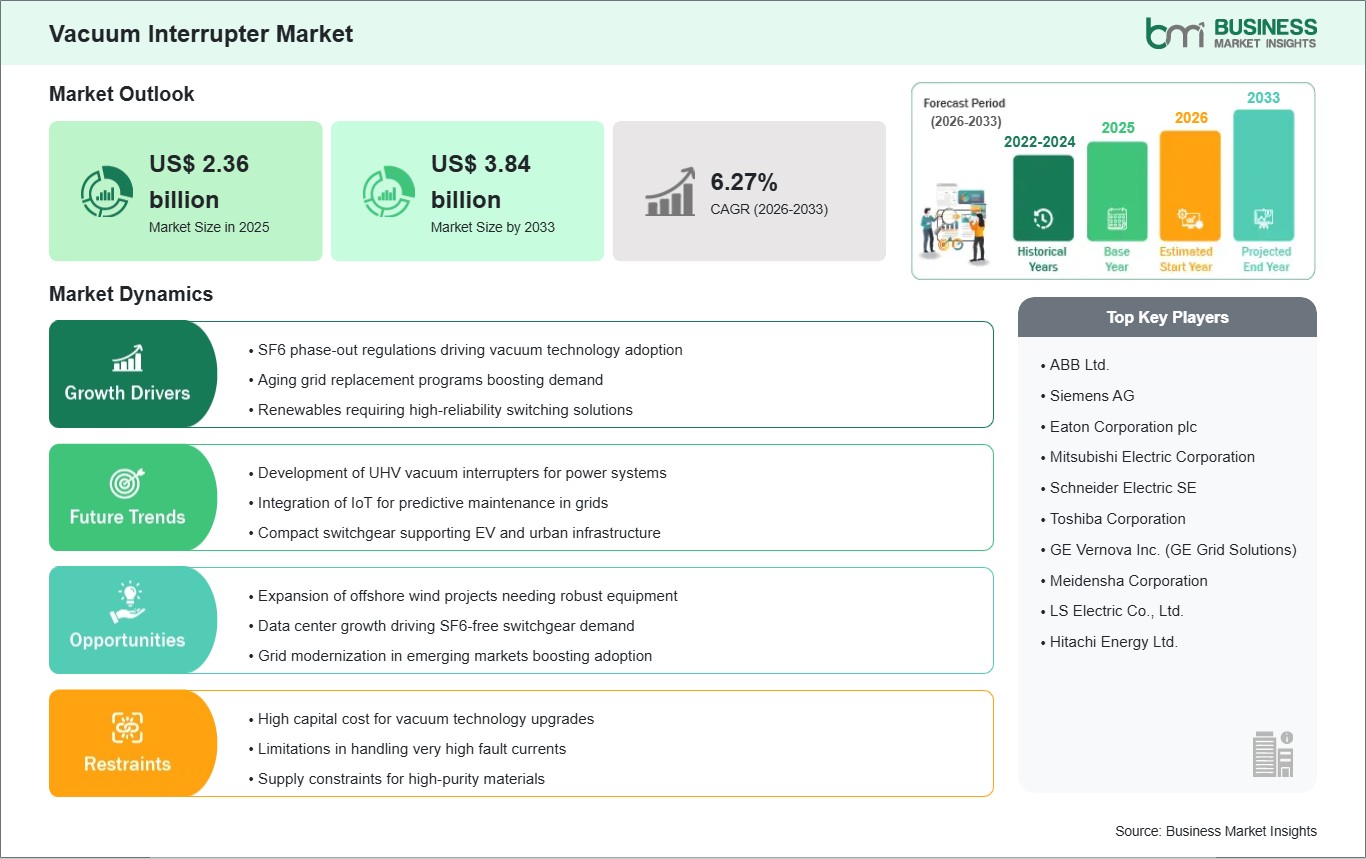
A vacuum interrupter is a hermetically sealed electrical component that serves as the "heart" of modern medium-to-high voltage switchgear, utilizing a high-vacuum environment to extinguish electrical arcs rapidly when contacts are separated. By leveraging the superior dielectric strength of a vacuum, these devices enable safe, compact, and maintenance-free current interruption for critical systems like circuit breakers and reclosers.
Despite their technical superiority, the market is confronted with significant challenges, most notably the high initial capital investment required for precision manufacturing and specialized cleanroom environments. Additionally, extending vacuum technology to ultra-high voltage transmission (above 145 kV) remains a complex engineering hurdle, as maintaining vacuum integrity across larger physical gaps necessitates advanced ceramic-to-metal bonding and specialized contact alloys.
Nevertheless, the industry is entering a phase of lucrative opportunities driven by the global " SF6-free " movement. Stricter environmental mandates, particularly in Europe and North America, are forcing a transition away from sulfur hexafluoride gas, positioning vacuum interrupters as the primary eco-friendly alternative for sustainable grid infrastructure. The surging demand for renewable energy integration and the modernization of aging electrical grids in developed nations provide a stable growth trajectory.
Segment Analysis
Vacuum Interrupter Market Segmentation
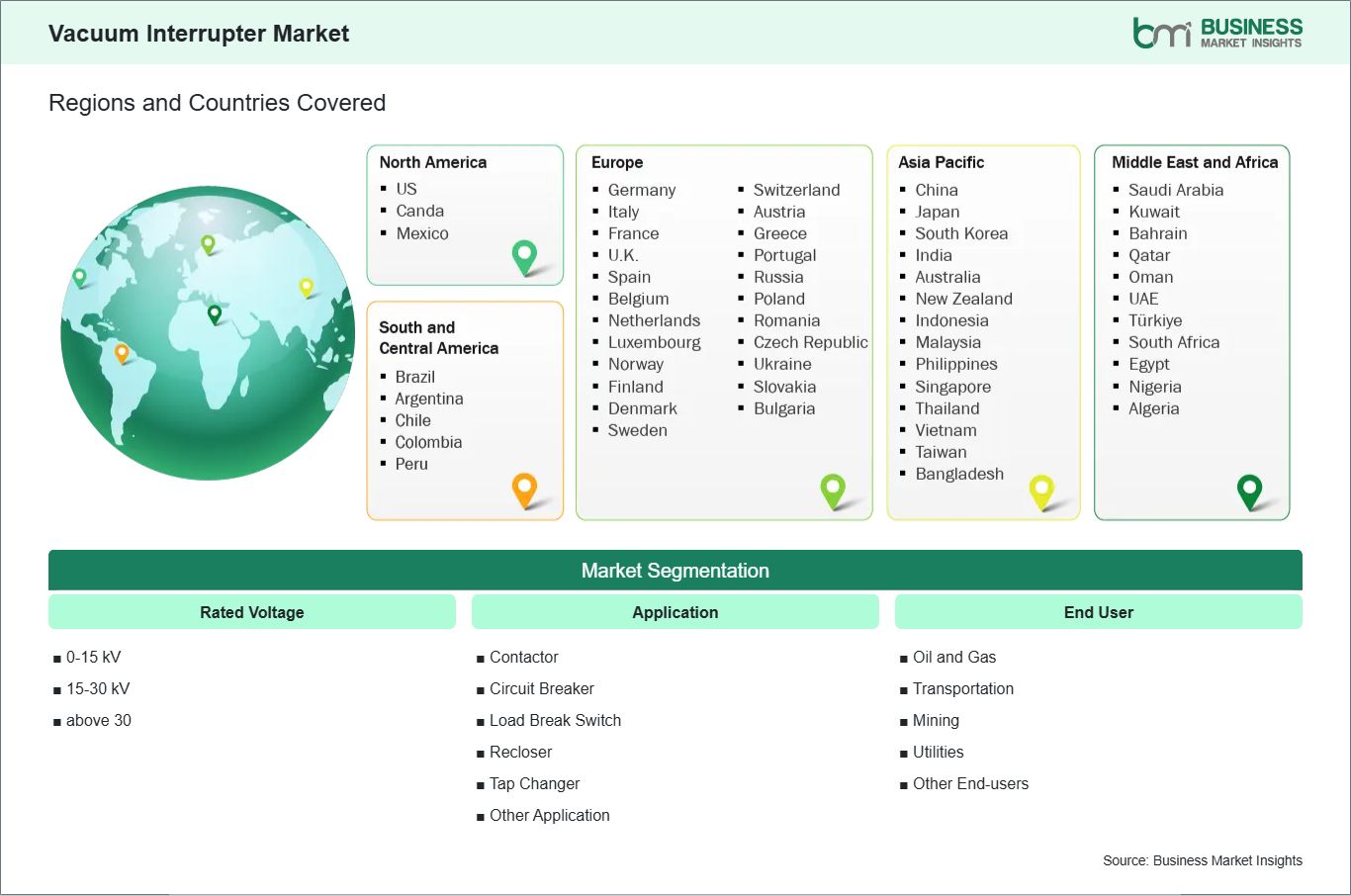
Key segments that contributed to the derivation of the Vacuum Interrupter market analysis are rated voltage , application , and end user .
- By Rated Voltage, the market is segmented into 0-15 kV , 15-30 kV , and above 30 kV .
- By Application, the market is categorized into Contactor , Circuit Breaker , Load Break Switch , Recloser , Tap Changer , and Others .
- By End User, the market is divided into Oil and Gas , Transportation , Mining , Utilities , and Others .
Market Forces
Vacuum Interrupter Market Drivers and Opportunities
Integration of Renewable Energy and Grid Modernization
The primary catalyst propelling the vacuum interrupter market is the global shift toward a decentralized energy landscape dominated by renewable sources. As solar and wind farms are integrated into existing power grids, the nature of electrical distribution changes from a predictable, steady flow to one that is highly variable and intermittent. This transition necessitates advanced switching devices that can manage frequent operations without physical degradation. Vacuum interrupters are uniquely engineered for this environment, as their hermetically sealed chambers allow for the rapid quenching of electrical arcs with minimal contact wear. Unlike traditional power plants that operate with consistent loads, renewable energy systems require "reclosers" and "circuit breakers" that can withstand thousands of switching cycles to maintain grid stability during fluctuating power generation.
Moreover, aging electrical infrastructure in industrialized nations is undergoing a massive modernization effort to become "Smart Grids." These modern networks utilize automated systems to detect faults and reroute power instantaneously, reducing downtime for end-users. Vacuum interrupters are the preferred core component for these automated systems due to their long operational lifespan and reliability. As governments invest in upgrading the backbone of their energy networks to support increased electrification and the rising demand from electric vehicle charging stations, the reliance on high-performance vacuum-based technology becomes indispensable. This ongoing grid transformation ensures a steady and rising demand for vacuum interrupters as the standard for safe and efficient power management in a modern, green economy.
Transition to SF6-Free and Eco-Friendly Switchgear
A transformative opportunity within the market is the regulatory and environmental movement to eliminate Sulfur Hexafluoride (SF6) gas from electrical infrastructure. For decades, SF6 has been the industry standard for insulation and arc quenching due to its excellent dielectric properties; however, it is now recognized as the most potent greenhouse gas in existence, with a global warming potential tens of thousands of times higher than carbon dioxide. International climate agreements and regional mandates, such as the European Union's F-gas regulations, are setting strict deadlines to phase out the use of SF6 in new medium-voltage installations. This legislative shift creates a massive void in the market that vacuum interrupters are perfectly positioned to fill, offering a zero-emission alternative that requires no gas handling or leak monitoring.
Beyond mere compliance, the move toward SF6-free technology allows manufacturers to innovate with "Clean Air" or solid-insulated vacuum switchgear. These hybrid solutions combine the vacuum's superior arc-extinguishing capability with environmentally harmless insulation mediums, resulting in a product that is safer for maintenance personnel and easier to decommission at the end of its life. As corporate sustainability goals become a priority for major utilities and industrial giants, the transition to vacuum-based, eco-friendly hardware is no longer just a technical choice but a strategic one. This shift represents a significant long-term growth avenue, as the entire global installed base of gas-insulated switchgear will eventually require replacement or retrofitting with sustainable, vacuum-interrupter-based technologies to meet net-zero carbon targets.
Size and Share Analysis
Vacuum Interrupter Market Size and Share Analysis
The Vacuum Interrupter market demonstrates steady growth , with size and share analysis revealing evolving trends and competitive positioning among key players. The report further examines subsegments categorized within voltage, application, and end user, offering insights into their contribution to overall market performance.
Across its voltage category, the 15-30 kV sub-segment is currently capturing a substantial share due to its widespread use in secondary distribution and industrial networks. Within applications, the Circuit Breaker sub-segment remains the dominant revenue contributor as the standard for fault protection. While in the end-user, Utilities segment leads the market share, driven by massive public investments in aging grid refurbishment.
Report Coverage
Vacuum Interrupter Market Report Coverage and Deliverables
The "Vacuum Interrupter Market Size and Forecast (2022–2033)" report provides a detailed analysis of the market covering:
- Vacuum Interrupter market size and forecast at global, regional, and country levels for all the key market segments covered under the scope
- Market trends, dynamics such as drivers, restraints, and key opportunities
- Industry landscape and competition analysis covering market concentration, heat map analysis, prominent players, and recent developments
- Detailed company profiles, including SWOT analysis
Geographic Insights
Vacuum Interrupter Market Geographic Insights
The geographical scope of the Vacuum Interrupter market report is divided into five regions: North America, Asia Pacific, Europe, Middle East & Africa, and South & Central America .
North America is primarily characterized by the intensive modernization of aging electrical grids, where utilities are aggressively replacing legacy infrastructure with smart-grid-compatible vacuum switching solutions. Europe serves as the global regulatory vanguard, with stringent mandates to phase out SF6 gas, directly accelerating the adoption of "green" vacuum-interrupter-based switchgear. The Asia-Pacific region acts as the primary growth engine and a major manufacturing hub, fueled by rapid urbanization and massive industrialization.
Industry Activity
Recent Developments
The Vacuum Interrupter market is evaluated by gathering qualitative and quantitative data post primary and secondary research. Key developments:
- August 2025: Siemens Energy successfully developed and tested a prototype 420 kV SF₆-free circuit breaker, which was scheduled for pilot testing in Norway and France as part of the EU's MISSION project. This breakthrough demonstrated the technical feasibility of utilizing a high-voltage Vacuum Interrupter for extra-high voltage applications.
- August 2024: Mitsubishi Electric Corporation and Siemens Energy finalized a significant agreement to co-develop requirement specifications for Direct Current (DC) Switching Stations and DC Circuit Breakers, integrating specialized Vacuum Interrupter technology.
Trust & Transparency
Research Methodology
The market analysis combines proprietary research with secondary data from government agencies, company disclosures, regulatory filings, industry databases and expert interviews. Market estimates are validated through data triangulation, cross-market benchmarking and analyst
review.
View Full Research Methodology
Key Sources Referred:
World Bank - Global Trade IndicatorsWorld Trade Organization (WTO)International Monetary Fund (IMF)International Trade Administration (ITA)Company websiteCompany annual reportsCompany investor presentations