
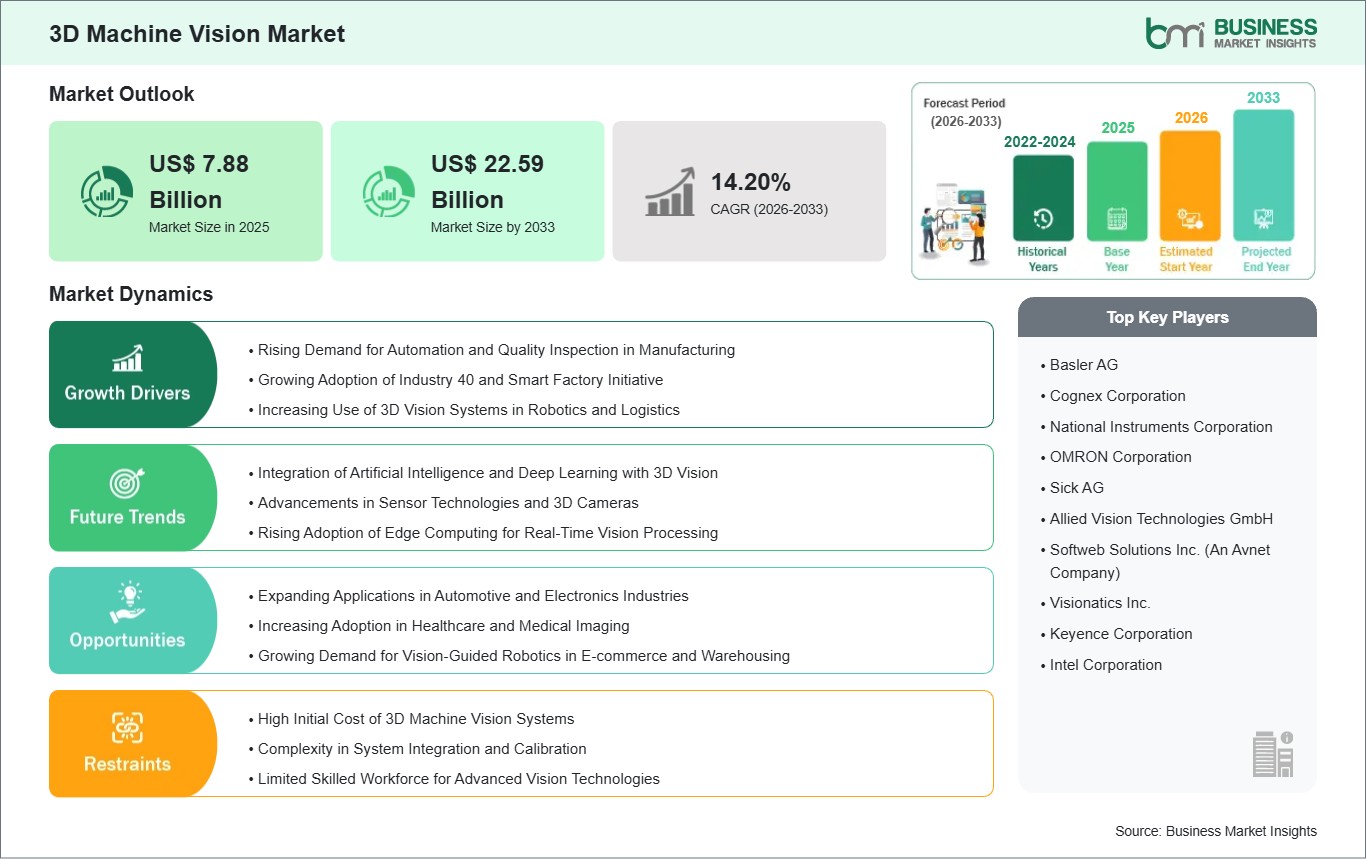
The 3D Machine Vision market size is expected to reach US$ 22.59 billion by 2033 from US$ 7.88 billion in 2025. The market is estimated to record a CAGR of 14.2% from 2026 to 2033.
The global 3D machine vision market is experiencing strong momentum as manufacturers increasingly adopt advanced imaging technologies to enhance automation, precision, and operational efficiency across industrial environments. Unlike traditional 2D systems, 3D machine vision enables accurate depth perception, volumetric measurement, and spatial analysis, making it critical for complex inspection, guidance, and measurement tasks. The market is driven by the growing need for high-speed quality control, reduced error rates, and real-time decision-making in production lines. Advancements in hardware components such as high-resolution cameras, optics, processors, LED lighting, and frame grabbers, combined with powerful software platforms including application-specific and deep learning-based solutions, are significantly improving system performance. The integration of artificial intelligence and machine learning is further expanding the capabilities of 3D vision systems, enabling predictive analytics, adaptive learning, and improved defect detection in dynamic environments.

Key segments that contributed to the derivation of the 3D Machine Vision market analysis are offering, hardware type, product type, application, and end-use.
The rapid adoption of automation and Industry 4.0 initiatives is a primary driver fueling the growth of the 3D machine vision market. Manufacturers across automotive, electronics, pharmaceuticals, and food & beverage industries are investing heavily in smart factories to enhance production efficiency, reduce operational errors, and improve product quality. 3D machine vision systems play a critical role in this transformation by enabling precise inspection, measurement, and positioning of components, which traditional 2D imaging cannot achieve. Unlike conventional methods, 3D vision provides volumetric and spatial data, facilitating accurate quality control, robotic guidance, and automated assembly processes.
The surge in automation adoption is particularly evident in high-volume production environments, where small errors can result in significant financial losses. 3D machine vision systems help mitigate these risks by providing real-time, high-precision feedback that enables manufacturers to identify defects, misalignments, or dimensional inconsistencies at early stages. Furthermore, the integration of machine vision with robotics and AI-based analytics allows for predictive maintenance, adaptive learning, and intelligent process optimization, which further drives market demand. As organizations continue to prioritize digitalization and smart manufacturing solutions, 3D machine vision is becoming an indispensable component of modern production lines. The combination of operational efficiency, improved product quality, and cost savings positions 3D machine vision as a crucial enabler of Industry 4.0, reinforcing its sustained adoption across industrial sectors.
Technological advancements in hardware components and AI-enabled software are a significant factor driving the expansion of the 3D machine vision market. Innovations in high-resolution cameras, frame grabbers, optics, LED lighting, and processors have substantially improved the speed, accuracy, and reliability of 3D imaging systems. Modern cameras and sensors can capture detailed depth information and complex geometries in real-time, which enhances performance in applications such as dimensional inspection, defect detection, and robotic guidance. These improvements make 3D machine vision systems more efficient and versatile, allowing adoption across a broader range of industries.
Simultaneously, the integration of deep learning and AI-based software solutions is transforming the capabilities of 3D vision systems. AI algorithms enable advanced image processing, pattern recognition, and predictive analytics, allowing machines to learn from previous data and improve inspection accuracy over time. This is particularly valuable in dynamic or unstructured environments where traditional systems struggle to maintain precision. The combination of sophisticated hardware and intelligent software expands the application scope of 3D machine vision to complex tasks, including automated quality assurance, real-time measurement, and adaptive guidance for robotics. As a result, organizations are increasingly investing in AI-enhanced 3D vision solutions to optimize productivity, reduce manual intervention, and achieve higher quality standards, which continues to drive robust market growth globally.
By component, the market is segmented into hardware, software, and services. The hardware segment held the largest share of the market in 2025. The segment in the navigation system market is driven by increasing demand for accurate positioning, growth in automotive and aerospace industries, rising adoption of advanced driver assistance systems, expansion of smart infrastructure, technological advancements in sensors and chips, and the need for reliable, real-time navigation performance across diverse applications.
By system type, the market is segmented into GPS, GNSS, inertial navigation system (INS), LORAN, and others. The GNSS segment held the largest share of the market in 2025. The GNSS segment drives the navigation system market due to its global coverage, high positioning accuracy, and continuous signal availability. Growing demand for smartphones, autonomous vehicles, aviation, maritime navigation, and precision agriculture, along with declining receiver costs and integration with IoT and AI technologies, further accelerate adoption worldwide today globally.
By end-users, the market is segmented into automotive & transportation, aerospace & defense, marine & shipping, consumer electronics, logistics & supply chain, government & public safety, and others. The aerospace & defense segment held the largest share of the market in 2025. Rising demand for navigation systems in aerospace and defense is driven by increased air traffic, modernization of military platforms, need for precise positioning, surveillance, and targeting, growth of unmanned systems, GPS-denied operations, and emphasis on safety, interoperability, and mission efficiency in complex, contested operational environments worldwide strategic and commercial expansion.
| Report Attribute | Details |
|---|---|
| Market size in 2025 | US$ 7.88 Billion |
| Market Size by 2033 | US$ 22.59 Billion |
| Global CAGR (2026 - 2033) | 14.20% |
| Historical Data | 2022-2024 |
| Forecast period | 2026-2033 |
| Segments Covered | By Offering
|
|
Regions and Countries Covered
| |
| North America | US, Canada, Mexico |
| Europe | Belgium, Austria, Finland, Denmark, Greece, Poland, Romania, Russia, Ukraine, Czech Republic, Slovakia, Bulgaria, Italy, Luxembourg, Germany, Switzerland, France, Netherlands, Norway, Portugal, Spain, Sweden, United Kingdom |
| Asia-Pacific | Australia, China, India, Japan, South Korea, Indonesia, Malaysia, Philippines, Singapore, Thailand, Vietnam, Bangladesh, New Zealand, Taiwan |
| South and Central America | Brazil, Argentina, Peru, Chile, Colombia |
| Middle East and Africa | Bahrain, Kuwait, Oman, Qatar, Saudi Arabia, United Arab Emirates, Turkiye, South Africa, Egypt, Algeria, Nigeria |
| Market leaders and key company profiles |
|
The "3D Machine Vision Market Size and Forecast (2022–2033)" report provides a detailed analysis of the market covering below areas:
The geographical scope of the 3D Machine Vision market report is divided into five regions: North America, Asia Pacific, Europe, Middle East & Africa, and South & Central America. The 3D Machine Vision market in Asia Pacific is expected to grow significantly during the forecast period.
North America holds a significant share of the market, supported by heavy investments in smart manufacturing, robotics, and quality assurance technologies across automotive, electronics, and aerospace sectors. The presence of major technology developers and solutions providers in the United States and Canada fosters rapid deployment of cutting‑edge 3D vision systems, particularly in high‑precision inspection and automated guidance tasks. Europe also demonstrates robust growth, driven by industrial modernization in countries such as Germany, France, and the UK. The region’s strong automotive and machinery manufacturing base increasingly leverages 3D vision technologies to achieve higher production standards and comply with stringent quality norms. Government incentives promoting Industry 4.0 adoption, along with high investments in research and development, further stimulate market expansion across the continent. In addition, Europe’s focus on sustainable manufacturing and efficiency improvements amplifies demand for intelligent imaging solutions.
The Asia Pacific region is poised to witness the fastest growth over the forecast period, propelled by rapid industrialization in China, Japan, South Korea, and India. These economies are increasingly integrating automation in electronics, automotive, logistics, and consumer goods sectors to remain competitive globally. China’s burgeoning production landscape, coupled with significant capital expenditure on smart factory infrastructures, positions Asia Pacific as a key growth engine for the 3D machine vision market. Furthermore, expanding mid‑sized manufacturing firms in Southeast Asia and India are adopting cost‑effective smart camera‑based solutions to improve yield and reduce defects. Emerging regions in Latin America and the Middle East & Africa are also beginning to invest in machine vision technologies, although at a relatively nascent stage. As digital transformation initiatives expand and local manufacturing capabilities mature, these markets are expected to contribute incremental growth, strengthening the global footprint of 3D machine vision adoption.

The 3D Machine Vision market is evaluated by gathering qualitative and quantitative data post primary and secondary research, which includes important corporate publications, association data, and databases. A few of the key developments in the 3D Machine Vision market are:
The 3D Machine Vision Market is valued at US$ 7.88 Billion in 2025, it is projected to reach US$ 22.59 Billion by 2033.
As per our report 3D Machine Vision Market, the market size is valued at US$ 7.88 Billion in 2025, projecting it to reach US$ 22.59 Billion by 2033. This translates to a CAGR of approximately 14.20% during the forecast period.
The 3D Machine Vision Market report typically cover these key segments-
The historic period, base year, and forecast period can vary slightly depending on the specific market research report. However, for the 3D Machine Vision Market report:
The 3D Machine Vision Market is populated by several key players, each contributing to its growth and innovation. Some of the major players include:
The 3D Machine Vision Market report is valuable for diverse stakeholders, including:
Essentially, anyone involved in or considering involvement in the 3D Machine Vision Market value chain can benefit from the information contained in a comprehensive market report.
Please tell us your area of interest
(Market Segments/ Regions and Countries/ Companies)