Vision Transformers Market Outlook (2022-2033)

Historic Data: 2022-2024   |   Base Year: 2025   |   Forecast Period: 2026-2033
Report Content: Market Scope, Market Segmentation, Market Dynamics, and Competitive Analysis

Report Coverage:
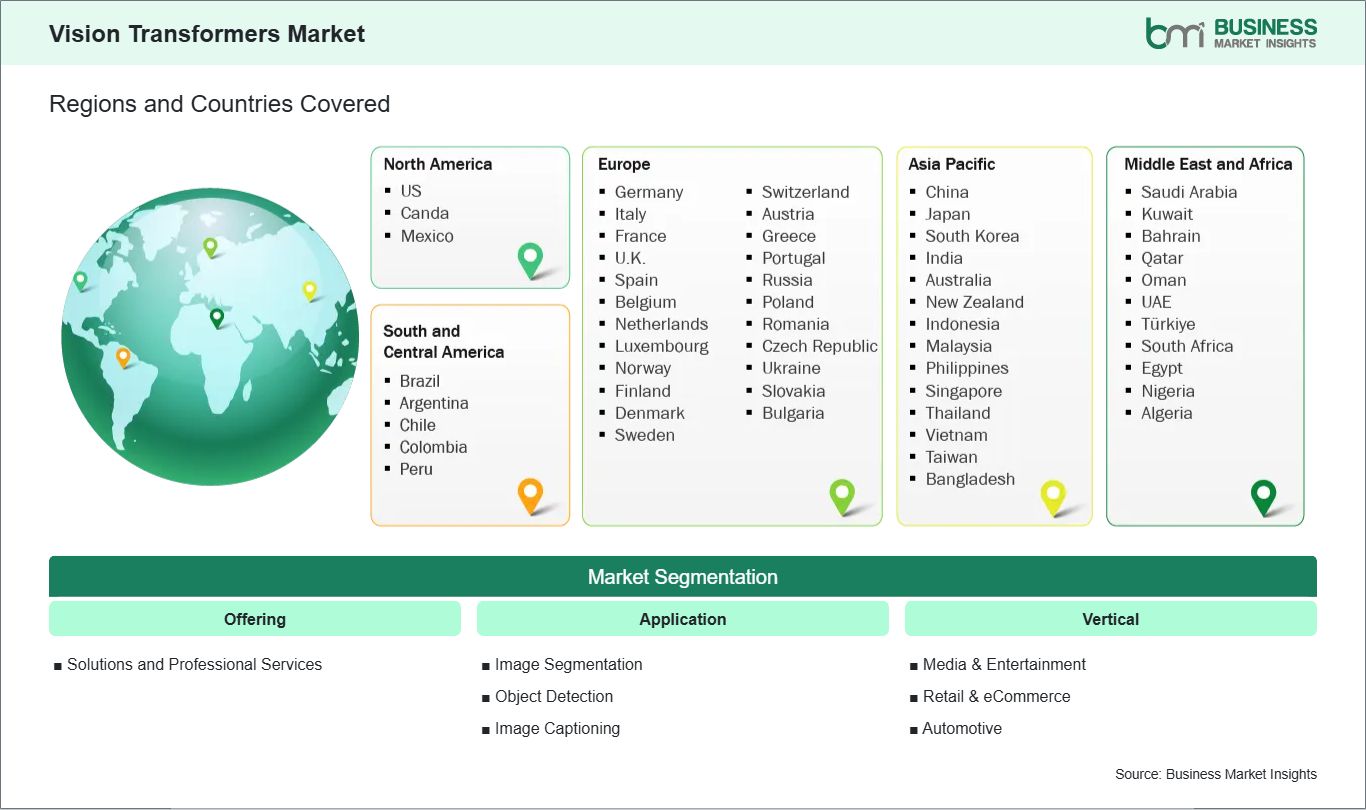
  • Offering (Solutions and Professional Services)
  • Application (Image Segmentation, Object Detection, and Image Captioning)
  • Vertical (Media & Entertainment, Retail & eCommerce, and Automotive)

No. of Pages: 383
Report Code: BMIPUB00034609
Category: Electronics and Semiconductor
Vision Transformers Market

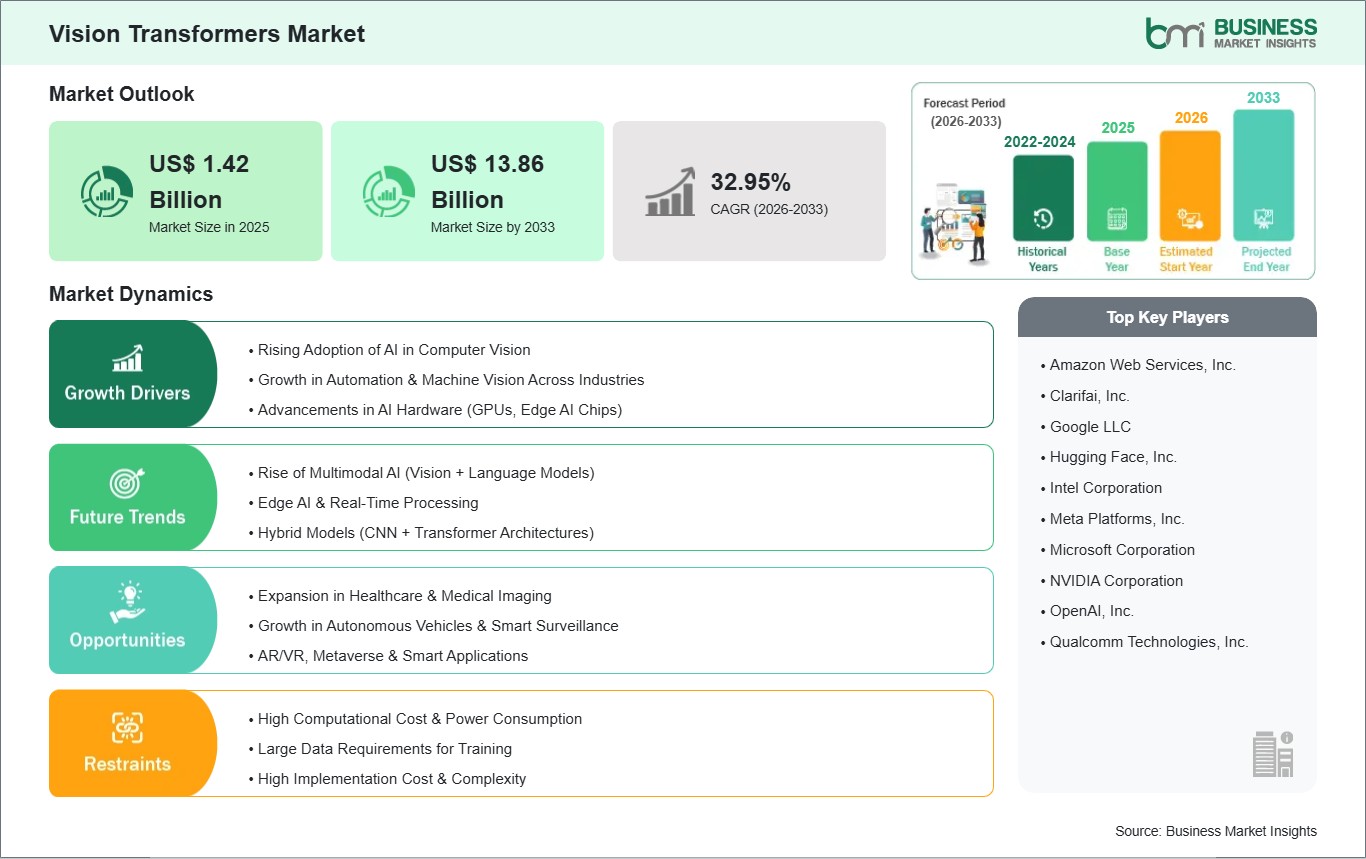
The Vision Transformers Market size is expected to reach US$ 13.86 billion by 2033 from US$ 1.42 billion in 2025. The market is estimated to record a CAGR of 32.95% from 2026 to 2033.

Executive Summary and Global Market Analysis:

Vision transformers (ViTs) refer to a transformative class of deep learning architectures engineered to apply the self-attention mechanisms of natural language processing to visual data analysis. By partitioning an image into a sequence of fixed-size patches and processing them as token embeddings, these models capture long-range dependencies and global context that traditional convolutional neural networks (CNNs) often overlook. This technology is fundamental to the advancement of high-precision image classification, object detection, and semantic segmentation across the healthcare, automotive, and retail sectors. Market expansion is being propelled by the rapid transition toward spatial computing, the rising institutional demand for autonomous systems with real-time perception, and a decisive shift toward multimodal AI frameworks that integrate vision and language processing.

However, several factors may restrain market progression. The high capital intensity associated with the significant computational requirements of ViTs, necessitating high-end graphics processing units (GPUs) and specialized accelerators, remains a substantial hurdle for small and medium-sized enterprises (SMEs). The industry also faces technical challenges regarding the data-intensive nature of these models, which often require extensive pre-training on massive datasets to achieve optimal generalization, making deployment difficult in data-restricted or niche industrial environments. Additionally, the increasing complexity of transformer architectures can lead to higher power consumption and latency at the edge, posing challenges for portable and battery-operated devices. These hurdles, compounded by the presence of established and computationally efficient CNN-based alternatives for simpler use cases, increase the total cost of ownership and require a strategic focus on model pruning and quantization.

Despite these hurdles, the market outlook remains favorable. Opportunities are emerging through the adoption of hierarchical and lightweight architectures, such as Shifted Windows (Swin) transformers, which optimize processing efficiency without sacrificing global insight. The expansion into the medical imaging field is gaining significant traction, with ViTs enabling superior accuracy in the detection of anomalies in high-resolution scans and pathology slides. Furthermore, the rise of self-supervised learning for vision transformers aligns with global goals for reducing dependence on expensive, manually labeled datasets. Collectively, these innovations position the vision transformer industry for sustained long-term development as a cornerstone of the next-generation, hyper-perceptive artificial intelligence landscape.

Vision Transformers Market - Strategic Insights:

global-market-strategic-framework
Get more information on this report

Vision Transformers Market Segmentation Analysis:

Key segments that contributed to the derivation of the Vision Transformers market analysis are offering, application, and vertical.

  • By Offering, the market is segmented into Solutions and Professional Services.
  • By Application, the market is divided into Image Segmentation, Object Detection, and Image Captioning.
  • By Vertical, the market is categorized into Media & Entertainment, Retail & eCommerce, and Automotive.

Vision Transformers Market Drivers and Opportunities:

Rising Demand for Advanced AI and Computer Vision

The vision transformers (ViTs) market is being driven by the growing need for advanced deep learning models capable of handling complex computer vision tasks across industries such as healthcare, automotive, retail, and security. Unlike traditional convolutional neural networks (CNNs), vision transformers leverage self‑attention mechanisms to capture global image features, enabling superior performance in image classification, object detection, and segmentation. The expansion of AI‑powered applications such as autonomous vehicles, medical imaging, and smart surveillance is amplifying adoption, as ViTs deliver higher accuracy and scalability. Enterprises are increasingly investing in vision transformers to enhance automation, reduce errors, and improve decision‑making in real time. The rising demand for edge AI and low‑latency processing is also reinforcing adoption, particularly in IoT ecosystems and smart devices. Additionally, the growing emphasis on digital transformation and AI‑driven innovation across industries is fueling demand for vision transformers as a next‑generation solution. Collectively, AI advancement, automation, and industry modernization are propelling sustained growth in the global vision transformers market.

Rising Integration of Multimodal AI and Emerging Applications

Opportunities in the vision transformers market are expanding through the integration of multimodal AI, edge computing, and cross‑industry applications. Multimodal vision transformers, which combine visual data with text, audio, or sensor inputs, are opening lucrative opportunities in healthcare diagnostics, robotics, and smart manufacturing, where contextual understanding is critical. Edge AI deployment is gaining traction, enabling vision transformers to process data locally in autonomous vehicles, drones, and wearable devices, reducing reliance on cloud infrastructure and improving response times.

The growing emphasis on AR/VR and metaverse platforms is fueling demand for ViTs that support immersive experiences and real‑time rendering. Emerging applications in retail, such as personalized shopping and inventory management, are also driving innovation, as vision transformers enhance customer engagement and operational efficiency. Additionally, the expansion of smart cities and environmental monitoring projects is creating demand for advanced vision models that support safety, sustainability, and infrastructure optimization. Vendors who focus on cost‑effective, multimodal, and edge‑ready vision transformer solutions are well‑positioned to capture growth. The convergence of multimodal AI, edge computing, and immersive technologies underscores a transformative trajectory for the global vision transformers market.

Vision Transformers Market Size and Share Analysis:

The Vision Transformers market demonstrates steady growth, with size and share analysis revealing evolving trends and competitive positioning among key players. The report examines subsegments categorized within offering, application, and vertical, offering insights into their contribution to overall market performance.

Based on Application, the Image Segmentation subsegment holds a strong presence in the market. Vision Transformers here are indispensable for medical imaging, autonomous driving, and industrial inspection, where precise segmentation is critical. The Object Detection subsegment is essential for surveillance, retail analytics, and robotics, enabling real‑time identification and tracking of objects. The Image Captioning subsegment anchors demand in media, e‑commerce, and accessibility applications, where Vision Transformers generate descriptive text for images, enhancing user experience and content management.

Vision Transformers Market Report Highlights:

Report Attribute Details
Market size in 2025 US$ 1.42 Billion
Market Size by 2033 US$ 13.86 Billion
Global CAGR (2026 - 2033)32.95%
Historical Data 2022-2024
Forecast period 2026-2033
Segments Covered By Offering
  • Solutions and Professional Services
By Application
  • Image Segmentation
  • Object Detection
  • Image Captioning
By Vertical
  • Media & Entertainment
  • Retail & eCommerce
  • Automotive
Regions and Countries Covered
North America US, Canada, Mexico
Europe Belgium, Austria, Finland, Denmark, Greece, Poland, Romania, Russia, Ukraine, Czech Republic, Slovakia, Bulgaria, Italy, Luxembourg, Germany, Switzerland, France, Netherlands, Norway, Portugal, Spain, Sweden, United Kingdom
Asia-Pacific Australia, China, India, Japan, South Korea, Indonesia, Malaysia, Philippines, Singapore, Thailand, Vietnam, Bangladesh, New Zealand, Taiwan
South and Central America Brazil, Argentina, Peru, Chile, Colombia
Middle East and Africa Bahrain, Kuwait, Oman, Qatar, Saudi Arabia, United Arab Emirates, Turkiye, South Africa, Egypt, Algeria, Nigeria
Market leaders and key company profiles
  • Amazon Web Services, Inc.
  • Clarifai, Inc.
  • Google LLC
  • Hugging Face, Inc.
  • Intel Corporation
  • Meta Platforms, Inc.
  • Microsoft Corporation
  • NVIDIA Corporation
  • OpenAI, Inc.
  • Qualcomm Technologies, Inc.
Get more information on this report

Vision Transformers Market Report Coverage and Deliverables:

The "Vision Transformers Market Size and Forecast (2022 - 2033)" report provides a detailed analysis of the market covering below areas:

  • Vision Transformers market size and forecast at global, regional, and country levels for all market segments covered under the scope
  • Vision Transformers market trends, as well as drivers, restraints, and opportunities
  • Vision Transformers market analysis covering key trends, global and regional framework, major players, regulations, and recent developments
  • Industry landscape and competition analysis covering market concentration, heat map analysis, prominent players, and recent developments for the Vision Transformers market
  • Detailed company profiles, including SWOT analysis

Vision Transformers Market Geographic Insights:

The geographical scope of the Vision Transformers market report is divided into five regions: North America, Asia Pacific, Europe, Middle East & Africa, and South & Central America.

North America maintains a preeminent position within the global industry, a status reinforced by the region's advanced artificial intelligence infrastructure and the concentration of primary technology pioneers. The regional landscape is characterized by high-stakes investments in the United States and Canada, where the transition toward Transformer-Based Neural Architectures has become a strategic priority for healthcare, automotive, and defense sectors. This market leadership is further supported by robust federal funding for AI research and a mature semiconductor ecosystem that facilitates the development of specialized hardware accelerators designed to optimize the performance of attention-centric models.

Technological progression in the United States and Canada is largely driven by a decisive shift toward Foundational Model Scaling and Hybrid Architectures. These advanced systems utilize global context modeling to outperform traditional convolutional networks in complex tasks such as high-resolution medical imaging and multi-object detection for autonomous navigation. Furthermore, the region is witnessing an increasing utilization of Cloud-Based AI Platforms, as enterprises seek to leverage pre-trained vision transformers for content moderation, retail analytics, and legal document processing. This focus on Intelligent Visual Perception allows North American operators to maintain a competitive advantage by automating highly specialized visual analysis tasks with superior accuracy.

global-market-geography
Get more information on this report

Vision Transformers Market Research Report Guidance:

  • The report includes qualitative and quantitative data in the Vision Transformers market across offering, application, vertical, and geography.
  • The report starts with the key takeaways (chapter 2), highlighting the key trends and outlook of the Vision Transformers market.
  • Chapter 3 focuses on the research methodology of the study.
  • Chapter 4 includes ecosystem analysis.
  • Chapter 5 highlights the major industry dynamics in the Vision Transformers market, including factors that are driving the market, prevailing deterrents, potential opportunities, as well as future trends. Impact analysis of these drivers and restraints is also covered in this section.
  • Chapter 6 discusses the Vision Transformers market scenario, in terms of historical market revenues, and forecast till the year 2033.
  • Chapters 7 to 10 cover Vision Transformers market segments by offering, application, vertical, and geography across North America, Europe, Asia Pacific, Middle East and Africa, and South and Central America. They cover the market revenue, forecast, and factors driving the market.
  • Chapter 11 describes the competitive analysis along with the heat map analysis for the key players operating in the market.
  • Chapter 12 describes the industry landscape analysis. It provides detailed descriptions of business activities such as market initiatives, new developments, mergers, and joint ventures globally, along with a competitive landscape.
  • Chapter 13 provides detailed profiles of the major companies operating in the Vision Transformers market. Companies have been profiled on the basis of their key facts, business descriptions, products and services, financial overview, SWOT analysis, and key developments.
  • Chapter 14, i.e., the appendix, is inclusive of a brief overview of the company, list of abbreviations, and disclaimer.

Vision Transformers Market News and Key Development:

The Vision Transformers market is evaluated by gathering qualitative and quantitative data post primary and secondary research, which includes important corporate publications, association data, and databases. A few of the key developments in the Vision Transformers market are:

  • In November 2025, Syntiant Corp. introduced a vision transformer (ViT) designed for edge AI and national security applications, enabling real-time image analysis, target detection, and classification in resource-constrained environments such as drones, maritime systems, and sensor networks. The development highlights the growing adoption of transformer-based architectures for computer vision at the edge and supports the expansion of Vision Transformer technologies across defense and intelligence applications.
  • In July 2024, Ambarella, Inc. and Plus announced the availability of PlusVision™, a transformer-based autonomous driving perception software stack, on Ambarella’s CV3-AD AI domain controller SoCs. The solution enables high-performance multi-camera perception processing for L2+/L3 autonomous driving systems, improving real-time object detection and scene understanding. This collaboration highlights the growing adoption of transformer architectures for computer vision and perception in automotive AI systems, supporting advancements in the Vision Transformers market.

Key Sources Referred:

  • World Bank - Global Trade Indicators
  • World Trade Organization (WTO)
  • International Monetary Fund (IMF)
  • International Trade Administration (ITA)
  • Company Websites
  • Company Annual Reports
  • Company Investor Presentations
The List of Companies - Vision Transformers Market
  • Amazon Web Services, Inc.
  • Clarifai, Inc.
  • Google LLC
  • Hugging Face, Inc.
  • Intel Corporation
  • Meta Platforms, Inc.
  • Microsoft Corporation
  • NVIDIA Corporation
  • OpenAI, Inc.
  • Qualcomm Technologies, Inc.
Frequently Asked Questions
How big is the Vision Transformers Market?

The Vision Transformers Market is valued at US$ 1.42 Billion in 2025, it is projected to reach US$ 13.86 Billion by 2033.

What is the CAGR for Vision Transformers Market by (2026 - 2033)?

As per our report Vision Transformers Market, the market size is valued at US$ 1.42 Billion in 2025, projecting it to reach US$ 13.86 Billion by 2033. This translates to a CAGR of approximately 32.95% during the forecast period.

What segments are covered in this report?

The Vision Transformers Market report typically cover these key segments-

  • Offering (Solutions and Professional Services)
  • Application (Image Segmentation, Object Detection, and Image Captioning)
  • Vertical (Media & Entertainment, Retail & eCommerce, and Automotive)

What is the historic period, base year, and forecast period taken for Vision Transformers Market?

The historic period, base year, and forecast period can vary slightly depending on the specific market research report. However, for the Vision Transformers Market report:

  • Historic Period : 2022-2024
  • Base Year : 2025
  • Forecast Period : 2026-2033
  • Who are the major players in Vision Transformers Market?

    The Vision Transformers Market is populated by several key players, each contributing to its growth and innovation. Some of the major players include:

  • Amazon Web Services, Inc.
  • Clarifai, Inc.
  • Google LLC
  • Hugging Face, Inc.
  • Intel Corporation
  • Meta Platforms, Inc.
  • Microsoft Corporation
  • NVIDIA Corporation
  • OpenAI, Inc.
  • Qualcomm Technologies, Inc.
  • Who should buy this report?

    The Vision Transformers Market report is valuable for diverse stakeholders, including:

    • Investors: Provides insights for investment decisions pertaining to market growth, companies, or industry insights. Helps assess market attractiveness and potential returns.
    • Industry Players: Offers competitive intelligence, market sizing, and trend analysis to inform strategic planning, product development, and sales strategies.
    • Suppliers and Manufacturers: Helps understand market demand for components, materials, and services related to concerned industry.
    • Researchers and Consultants: Provides data and analysis for academic research, consulting projects, and market studies.
    • Financial Institutions: Helps assess risks and opportunities associated with financing or investing in the concerned market.

    Essentially, anyone involved in or considering involvement in the Vision Transformers Market value chain can benefit from the information contained in a comprehensive market report.

    Available Report Formats

    pdf-format excel-format pptx-format
    Buy Now
    Sales Assistance
    +1 646 791 7070 (US & UK)
    Customization Form

    Please tell us your area of interest
    (Market Segments/ Regions and Countries/ Companies)