Market Summary
Executive Summary and Global Market Analysis
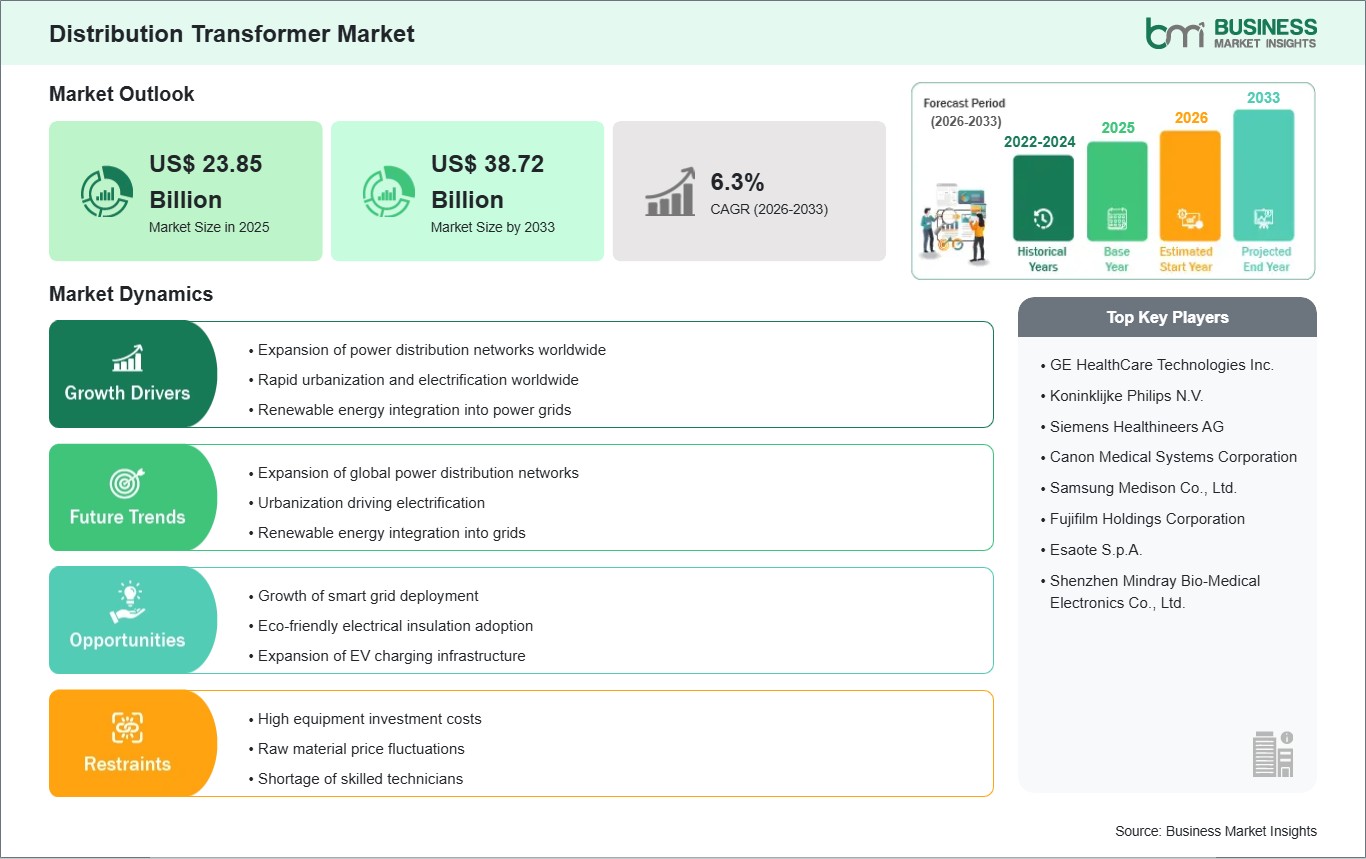
The global distribution transformer market is a fundamental and enduring component of the electrical power infrastructure, responsible for the final voltage transformation in the power delivery chain—stepping down the voltage from medium-voltage distribution lines (typically 11-33 kV) to the low-voltage levels (400/230 V) used by end consumers. This market is characterized by steady, essential demand driven by the universal need for reliable electricity. Core growth drivers include global urbanization and industrialization, which necessitate the expansion and densification of electrical grids; government-led rural electrification programs in emerging economies; and the ongoing replacement cycle of aging transformer fleets in developed regions. Furthermore, the integration of distributed energy resources (DERs) like rooftop solar and the proliferation of electric vehicle (EV) charging infrastructure are creating new demands and specifications for distribution transformers, requiring enhanced capabilities for bidirectional power flow and voltage regulation.
However, the market contends with significant challenges, including volatile prices of key raw materials like copper, aluminum, and electrical steel; intense competitive pressure leading to margin erosion; and stringent environmental regulations governing the use of insulating oils and mandating higher efficiency standards. Despite these headwinds, substantial opportunities are emerging from the development of smart and amorphous core transformers that offer significantly lower no-load losses, the growing demand for dry-type transformers in indoor and environmentally sensitive applications, and the modernization of grids to support the energy transition toward decarbonization and resilience.
Segment Analysis
Distribution Transformer Market Segmentation
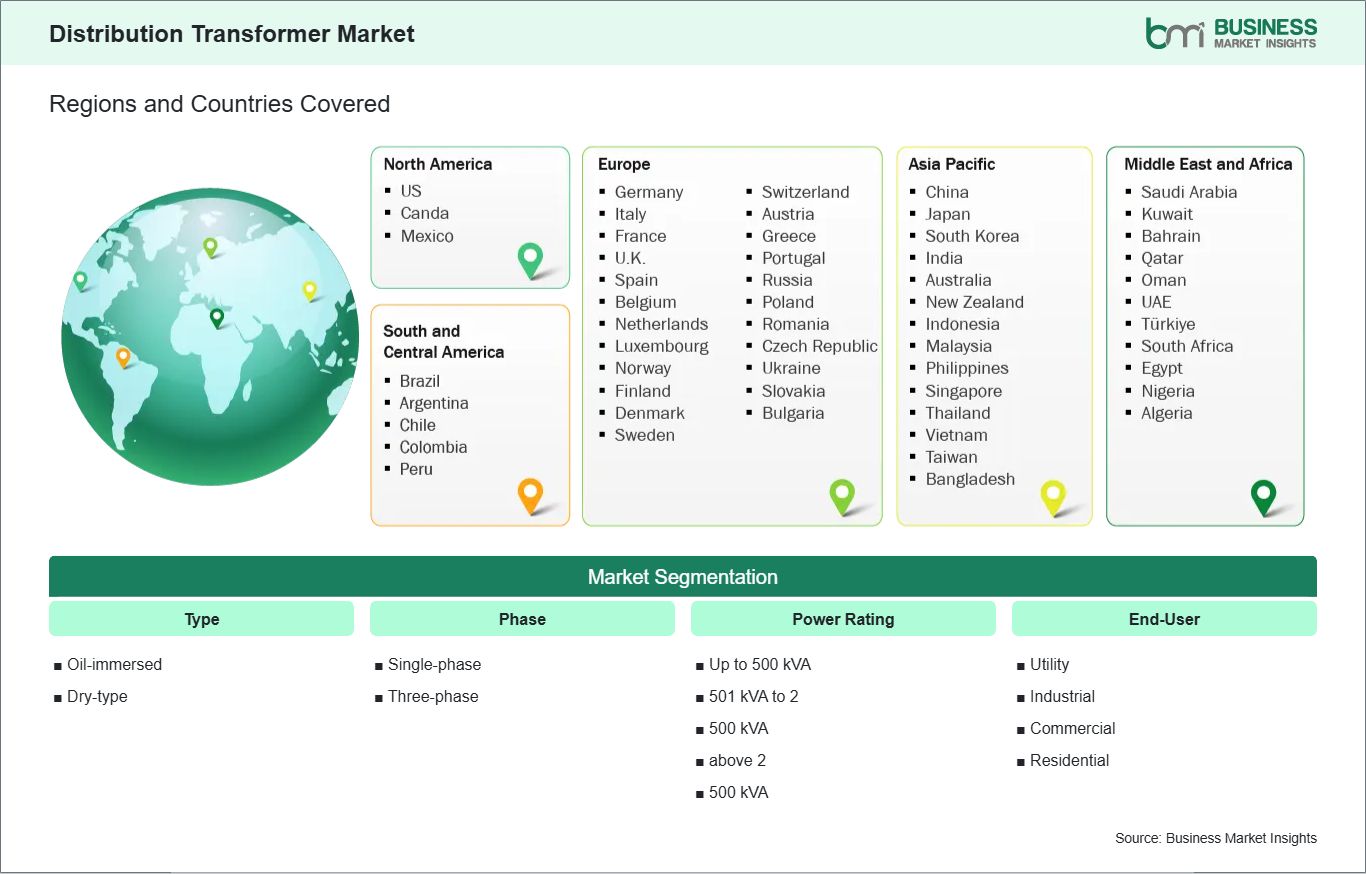
Key segments that contributed to the derivation of the distribution transformer market analysis are type, phase, power rating, and end-user.
- By type, the market is segmented into oil-immersed and dry-type transformers. The oil-immersed segment dominated the market in 2025, holding the largest share due to its cost-effectiveness, proven reliability, and superior cooling performance for outdoor utility applications.
- By phase, the market is categorized into single-phase and three-phase. Three-phase transformers accounted for the dominant revenue share in 2025, as they form the backbone of commercial, industrial, and utility distribution networks where balanced three-phase power is required.
- By power rating, the market is segmented into up to 500 kVA, 501 kVA to 2,500 kVA, and above 2,500 kVA. The up to 500 kVA segment held the largest share in 2025, representing the high-volume segment for pole-mounted and pad-mounted units serving residential neighborhoods, small commercial establishments, and as distribution points in industrial facilities.
- By end-user, the market is segmented into utility, industrial, commercial, and residential. The utility sector was the largest end-user in 2025, responsible for the vast majority of procurement to build, maintain, and expand the public electricity distribution network.
Market Forces
Distribution Transformer Market Drivers and Opportunities
Grid Expansion, Modernization, and Rural Electrification
The most significant drivers for the distribution transformer market are the parallel needs for grid expansion in developing regions and grid modernization in developed ones. Rapid urbanization and industrialization in Asia-Pacific, Africa, and parts of Latin America are driving massive investments in new distribution infrastructure, including thousands of transformers. Concurrently, rural electrification initiatives by governments and international organizations are creating sustained demand for smaller-rated transformers. In mature markets, the aging installed base of transformers—many exceeding their design life—necessitates a steady replacement cycle. Furthermore, modernizing grids to be smarter and more resilient against climate change and cyber threats often involves upgrading to more efficient, condition-monitored transformers, creating a value-added upgrade market.
The Energy Transition and Efficiency Regulations
The global energy transition presents both a challenge and a major opportunity. The integration of distributed energy resources (DERs) and electric vehicle (EV) charging stations can cause voltage fluctuations and reverse power flows, straining conventional transformers. This drives demand for transformers with advanced voltage regulation capabilities (e.g., smart transformers with on-load tap changers). Simultaneously, stringent energy efficiency regulations (such as the EU's Ecodesign Directive or DOE standards in the US) are phasing out lower-efficiency units. This regulatory push is a powerful driver for the adoption of transformers with amorphous metal cores or other advanced designs that minimize core losses, opening a premium market segment for manufacturers with advanced material and design expertise.
Size and Share Analysis
Distribution Transformer Market Size and Share Analysis
By type, oil-immersed transformers maintain cost and performance advantages for most outdoor utility applications, ensuring their continued dominance. However, the dry-type segment's growth is outpacing the market average, driven by safety codes in cities, growth in high-value commercial construction, and the expansion of data centers.
By phase, three-phase transformers command a higher average selling price and are essential for all non-residential power distribution, securing their revenue leadership. Single-phase transformers lead in unit volume, especially in regions with dispersed residential settlements
By power rating, the under-500 kVA segment is the volume workhorse of the grid. The 501-2500 kVA segment is critical for commercial complexes, medium industries, and as substation feeders. Transformers above 2500 kVA are used for heavy industry and primary distribution substations, representing a high-value, lower-volume niche.
By end-user, utilities are the anchor customers, with procurement often tied to long-term grid plans. The industrial sector's demand is closely linked to capital expenditure cycles in manufacturing and mining. The commercial segment is growing steadily with new construction and building retrofits.
Report Coverage
Distribution Transformer Market Report Coverage and Deliverables
The "Distribution Transformer Market Size and Forecast (2022-2033)" report provides a detailed analysis of the market covering below areas:
- Distribution Transformer Market size and forecast at global, regional, and country levels for all the key market segments covered under the scope
- Distribution Transformer Market trends, as well as market dynamics such as drivers, restraints, and key opportunities
- Distribution Transformer Market analysis covering key market trends, global and regional framework, major players, regulations, and recent market developments
- Industry landscape and competition analysis covering market concentration, heat map analysis, prominent players, and recent developments for the distribution transformer market
- Detailed company profiles, including SWOT analysis
Geographic Insights
Distribution Transformer Market Geographic Insights
The geographical scope of the distribution transformer market report is divided into five regions: North America, Europe, Asia Pacific, Middle East & Africa, and South & Central America. The Asia Pacific region is both the largest and the fastest-growing market, while North America and Europe are mature markets focused on replacement and efficiency upgrades.
Asia Pacific, led by China, India, Japan, and Southeast Asia, is the undisputed engine of global market growth. This is driven by unprecedented investments in power infrastructure to support economic growth, massive urban development projects, and ambitious government targets for universal electrification and renewable energy integration, all of which require vast quantities of distribution transformers.
North America and Europe are characterized by stable, replacement-driven demand. Growth is fueled by the need to replace aging infrastructure, adopt higher-efficiency units to comply with regulations and sustainability goals, and reinforce grids to accommodate EV charging and renewable generation. The markets are also seeing increased investment in grid resiliency against extreme weather events.
Industry Activity
Recent Developments
The distribution transformer market is evaluated by gathering qualitative and quantitative data post primary and secondary research, which includes important corporate publications, association data, and databases. A few of the key developments in the distribution transformer market are:
- In September 2025, Siemens Energy is investing approximately €220 million to expand its transformer factory in Nuremberg, Germany, creating 350 new jobs. The foundation stone for the site expansion was laid today in the presence of Bavaria’s Minister President Dr. Markus Söder and Nuremberg’s Mayor Marcus König. With this investment, Siemens Energy is responding to the sharp increase in global demand for large transformers which are crucial for grid expansion.
- In April 2024, Hitachi Industrial Equipment Systems Co., Ltd. and Mitsubishi Electric Corporation announced that they have agreed to transfer the distribution transformer business of Mitsubishi Electric's Nagoya Works, which develops and manufactures factory automation (FA) equipment, to Hitachi Industrial Equipment Systems and integrate their businesses.
Trust & Transparency
Research Methodology
The market analysis combines proprietary research with secondary data from government agencies, company disclosures, regulatory filings, industry databases and expert interviews. Market estimates are validated through data triangulation, cross-market benchmarking and analyst
review.
View Full Research Methodology
Key Sources Referred:
World Bank - Global Trade Indicators World Trade Organization (WTO) International Monetary Fund (IMF) International Trade Administration (ITA) Company website Company annual reports Company investor presentations