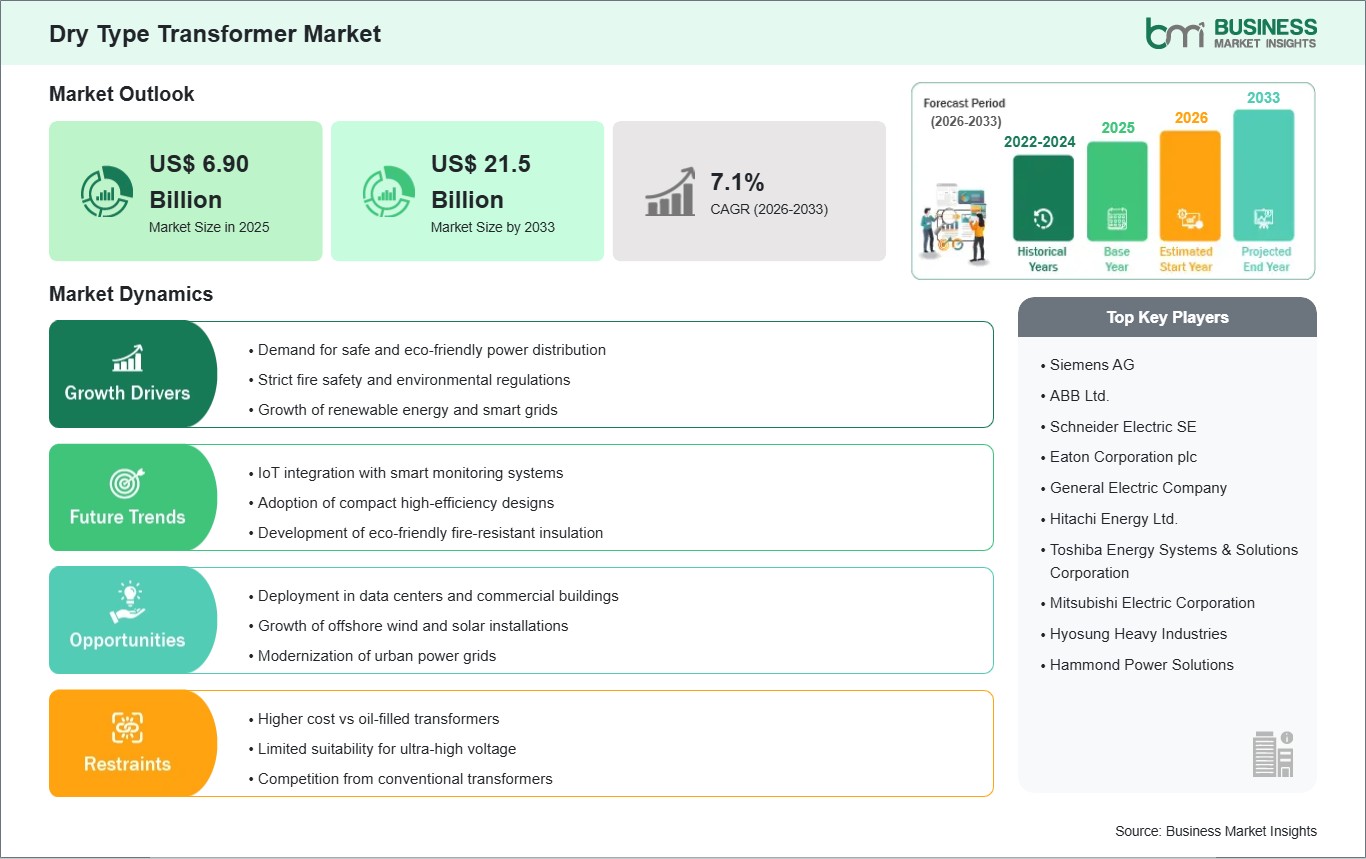
The Dry Type Transformer market size is expected to reach US$ 21.5 billion by 2033 from US$ 6.90 billion in 2025, registering a CAGR of 7.1% from 2026 to 2033.
The Dry Type Transformer market represents a critical segment of modern power distribution infrastructure, particularly in environments requiring enhanced fire safety, environmental sustainability, and low maintenance requirements. Unlike oil-filled transformers, dry type transformers use air or resin-based insulation systems, eliminating the risk of oil leakage and reducing fire hazards. These transformers are widely deployed in commercial buildings, industrial facilities, renewable energy plants, utilities, and residential complexes. Increasing urbanization, rapid industrial expansion, and modernization of aging grid infrastructure are driving market growth globally. Growing emphasis on energy efficiency, reduced carbon footprint, and safety compliance in indoor installations further strengthens demand. Dry type transformers are particularly suitable for high-rise buildings, hospitals, data centers, airports, and metro rail systems where safety and reliability are paramount.
Technological advancements in insulation materials, improved thermal performance, compact designs, and smart monitoring systems are enhancing transformer efficiency and lifespan. Integration with smart grids and digital substations enables real-time monitoring, predictive maintenance, and improved operational reliability. However, higher initial costs compared to conventional oil-filled transformers and limited capacity for very high-voltage applications may restrain adoption in certain regions. Despite these challenges, rising investments in renewable energy and infrastructure development continue to support sustained market expansion.

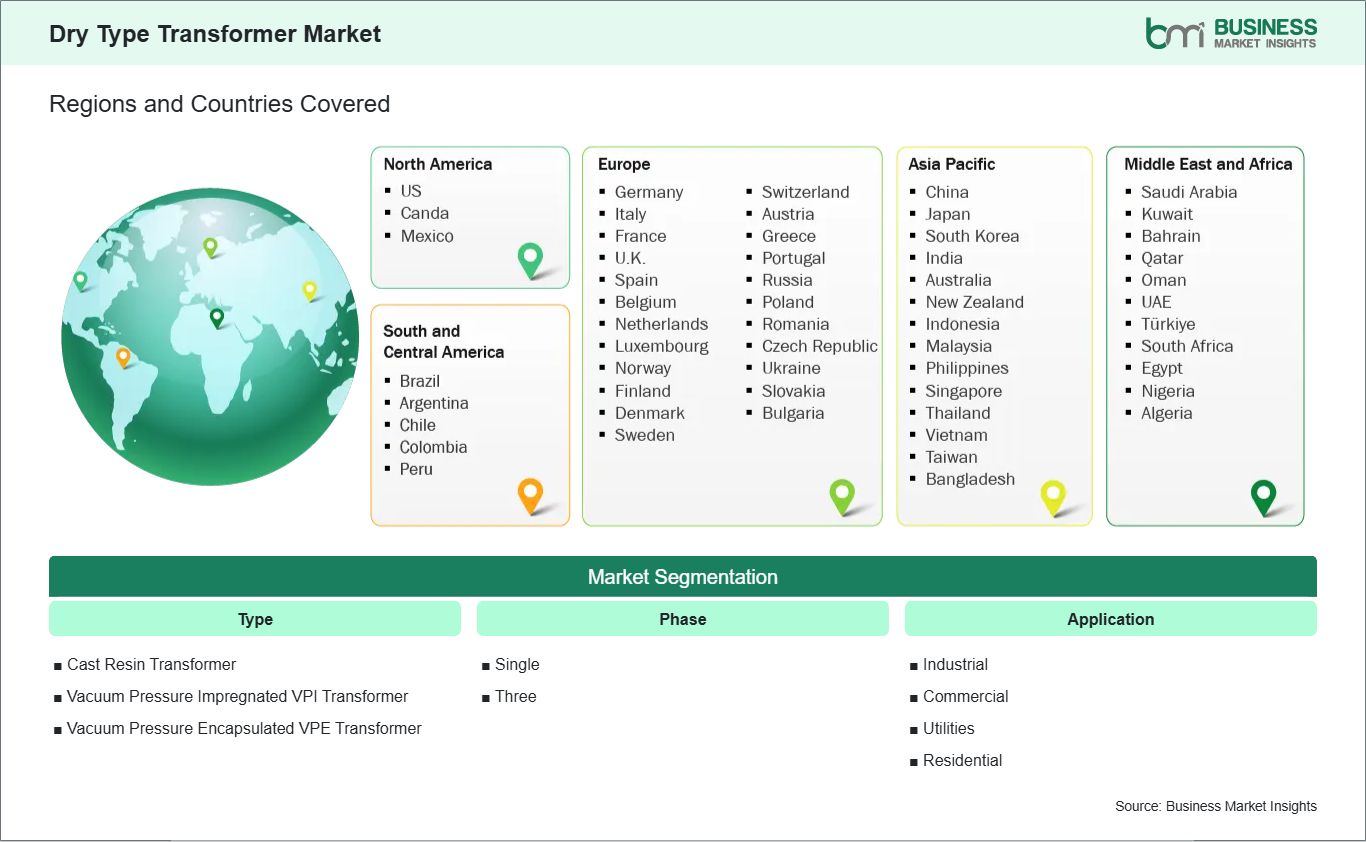
Key segments contributing to the derivation of the Dry Type Transformer market analysis include type, phase, and application.
Stringent fire safety regulations and environmental standards are playing a pivotal role in accelerating the adoption of dry type transformers across both developed and emerging economies. Unlike conventional oil-filled transformers, dry type transformers use air, epoxy resin, or cast resin insulation systems, which significantly reduce the risk of fire, explosion, and hazardous oil leakage. In high-density urban areas where electrical equipment is often installed inside buildings—such as shopping malls, hospitals, airports, data centers, metro stations, and high-rise residential complexes—minimizing fire hazards is a critical requirement. Dry type transformers offer self-extinguishing properties and lower flammability, helping facility operators comply with strict building safety codes and insurance requirements.
Environmental regulations are also becoming increasingly stringent with respect to oil containment, spill prevention, and waste disposal. Oil-filled transformers require bund walls, oil pits, and regular monitoring to prevent soil and groundwater contamination. In contrast, dry type transformers eliminate the need for oil management infrastructure, reducing installation complexity and long-term environmental liability. This makes them particularly suitable for environmentally sensitive zones such as offshore platforms, tunnels, underground substations, marine ports, and renewable energy sites.
Rapid expansion of renewable energy capacity across utility-scale and distributed generation projects is significantly strengthening the demand for advanced transformer technologies. Solar photovoltaic (PV) plants, onshore and offshore wind farms, hybrid renewable systems, and battery energy storage installations require efficient voltage step-up and step-down solutions to ensure stable grid connectivity. Dry type transformers are particularly well-suited for these applications because they offer high thermal stability, excellent short-circuit strength, and strong resistance to moisture, dust, and corrosive environments. Their oil-free design minimizes environmental risks, which is especially critical in ecologically sensitive renewable project locations such as deserts, coastal regions, and offshore platforms.
In distributed renewable setups—such as rooftop solar systems, community solar projects, and microgrids—dry type transformers support decentralized power generation models. Their compact footprint and indoor installation capability make them ideal for commercial buildings, industrial parks, and institutional campuses integrating renewable sources. Additionally, the increasing deployment of battery energy storage systems (BESS) requires transformers capable of handling bidirectional power flows and fluctuating load conditions. Dry type transformers provide stable performance under variable generation patterns, supporting grid flexibility and renewable penetration targets.

By type, the Cast Resin segment dominated in 2025, supported by high reliability and safety advantages in indoor environments.
By phase, Three Phase transformers accounted for the larger market share in 2025, owing to their widespread use in industrial and utility applications requiring higher power capacity.
By application, the Industrial segment led the market in 2025, while commercial and renewable energy applications are projected to witness steady growth due to infrastructure modernization and green energy adoption.
| Report Attribute | Details |
|---|---|
| Market size in 2025 | US$ 6.90 Billion |
| Market Size by 2033 | US$ 21.5 Billion |
| Global CAGR (2026 - 2033) | 7.1% |
| Historical Data | 2022-2024 |
| Forecast period | 2026-2033 |
| Segments Covered | By Type
|
|
Regions and Countries Covered
| |
| North America | US, Canada, Mexico |
| Europe | Belgium, Austria, Finland, Denmark, Greece, Poland, Romania, Russia, Ukraine, Czech Republic, Slovakia, Bulgaria, Italy, Luxembourg, Germany, Switzerland, France, Netherlands, Norway, Portugal, Spain, Sweden, United Kingdom |
| Asia-Pacific | Australia, China, India, Japan, South Korea, Indonesia, Malaysia, Philippines, Singapore, Thailand, Vietnam, Bangladesh, New Zealand, Taiwan |
| South and Central America | Brazil, Argentina, Peru, Chile, Colombia |
| Middle East and Africa | Bahrain, Kuwait, Oman, Qatar, Saudi Arabia, United Arab Emirates, Turkiye, South Africa, Egypt, Algeria, Nigeria |
| Market leaders and key company profiles |
|
The "Dry Type Transformer Market Size and Forecast (2022 - 2033)" report provides a detailed analysis of the market covering below areas:
The Dry Type Transformer market is segmented into North America, Europe, Asia Pacific, Middle East & Africa, and South & Central America. Asia Pacific is expected to witness the fastest growth during the forecast period, driven by rapid urbanization, industrial expansion, renewable energy deployment, and large-scale infrastructure projects in China, India, Japan, and South Korea. Increasing investments in smart grids and power distribution modernization further accelerate regional demand.
North America and Europe represent mature markets characterized by strong regulatory standards, high safety compliance requirements, and ongoing grid modernization initiatives. Growth in these regions is supported by renewable energy integration, commercial infrastructure upgrades, and data center expansion. Middle East & Africa and South & Central America are experiencing steady growth due to rising construction activities, electrification programs, and infrastructure development projects. Expanding industrial sectors and government-led energy diversification initiatives are expected to drive continued adoption of dry type transformer solutions across these emerging regions.

The Dry Type Transformer market is evaluated by gathering qualitative and quantitative data post primary and secondary research, which includes important corporate publications, association data, and databases. A few of the key developments in the Dry Type Transformer market are:
The Dry Type Transformer Market is valued at US$ 6.90 Billion in 2025, it is projected to reach US$ 21.5 Billion by 2033.
As per our report Dry Type Transformer Market, the market size is valued at US$ 6.90 Billion in 2025, projecting it to reach US$ 21.5 Billion by 2033. This translates to a CAGR of approximately 7.1% during the forecast period.
The Dry Type Transformer Market report typically cover these key segments-
The historic period, base year, and forecast period can vary slightly depending on the specific market research report. However, for the Dry Type Transformer Market report:
The Dry Type Transformer Market is populated by several key players, each contributing to its growth and innovation. Some of the major players include:
The Dry Type Transformer Market report is valuable for diverse stakeholders, including:
Essentially, anyone involved in or considering involvement in the Dry Type Transformer Market value chain can benefit from the information contained in a comprehensive market report.
Please tell us your area of interest
(Market Segments/ Regions and Countries/ Companies)