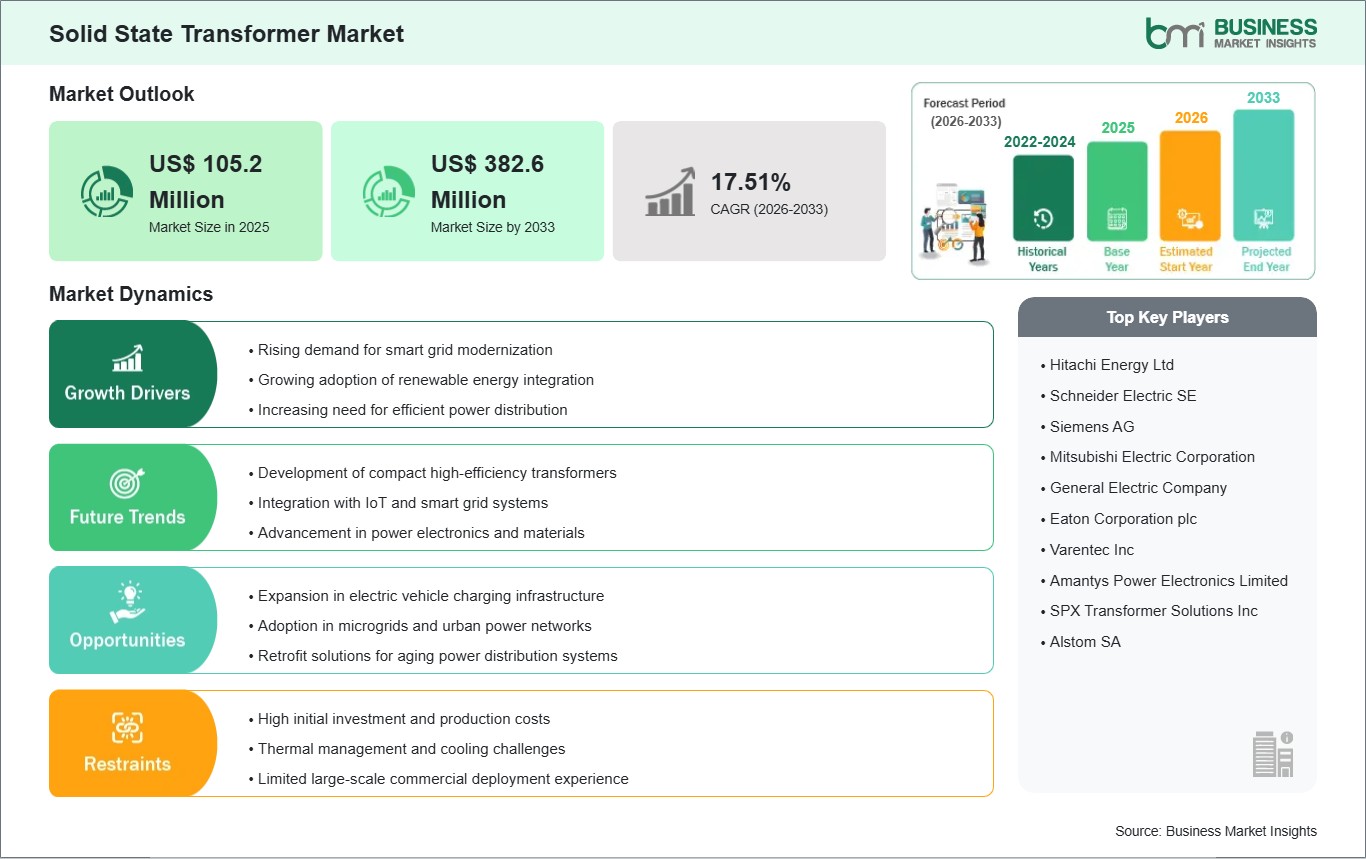
The Solid State Transformer Market size is expected to reach US$ 382.6 million by 2033 from US$ 105.2 million in 2025. The market is estimated to record a CAGR of 17.51% from 2026 to 2033.
The global solid state transformer (SST) market is growing rapidly as energy grids and power distribution networks move toward smarter, more efficient, and flexible solutions. SSTs use power electronics to replace traditional magnetic transformers. This allows for quick voltage conversion, two-way energy flow, and improved grid control. These benefits make SSTs perfect for applications in smart grids, renewable energy integration, microgrids, and electric vehicle (EV) charging infrastructure. Technological progress drives market growth. Innovations in wide-bandgap semiconductor devices, like silicon carbide (SiC) and gallium nitride (GaN), have increased the efficiency, thermal performance, and power density of SSTs. Real-time monitoring, digital control, and communication features help utilities and industrial operators manage loads better, reduce energy losses, and improve grid reliability.
The growing use of renewable energy sources, such as solar and wind, further boosts SST deployment because these transformers can handle variable power inputs and support grid stability. Moreover, electric mobility and smart city projects create higher demand for compact, modular, and highly efficient transformers that can adapt to changing load conditions. As regulations focus on energy efficiency and sustainable infrastructure, solid state transformers are set to play a key role in modernizing power networks around the world.

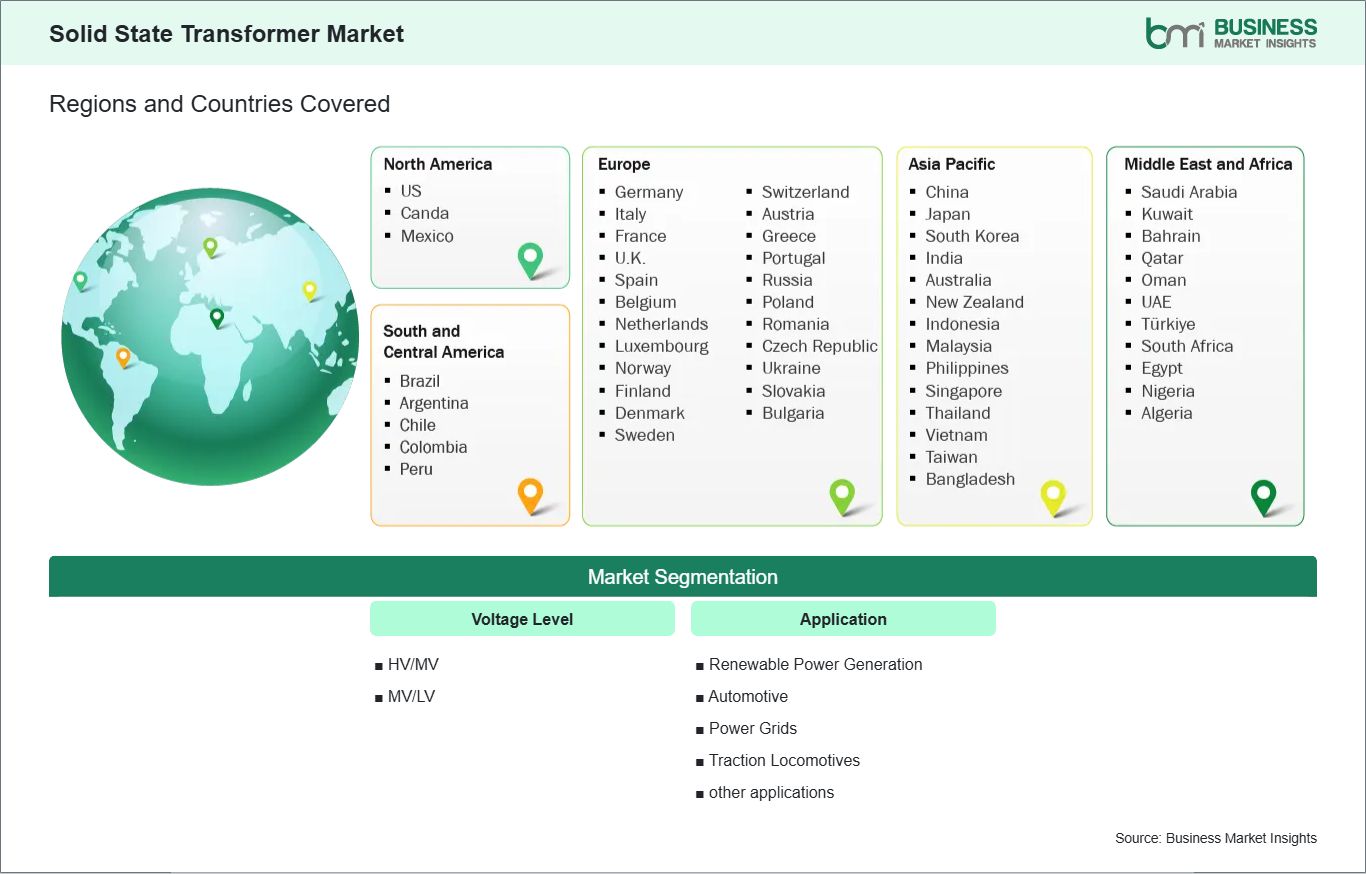
Key segments that contributed to the derivation of the solid-state transformer market analysis are voltage level and application.
The solid state transformer market is experiencing robust growth driven by increasing demand for smart grid technologies. As power systems transition from traditional infrastructure to digitally enabled networks, utilities and grid operators are prioritizing solutions that offer enhanced control, bidirectional power flow, and rapid response to load changes. Solid state transformers (SSTs) provide these capabilities, enabling more efficient energy distribution and real‑time voltage regulation within intelligent grid environments. A primary factor fueling SST adoption is the need for improved grid reliability and resilience. Legacy transformers struggle with dynamic load profiles and decentralized generation inputs, whereas SSTs with their semiconductor‑based architecture support dynamic reconfiguration and fast fault isolation. This reduces downtime and enhances overall grid stability, making SSTs a strategic investment for modern network operators.
Additionally, the surge in electrification of end uses and digital monitoring systems elevates the value of advanced grid components. SSTs integrate seamlessly with sensors, automation platforms, and advanced analytics, enabling predictive maintenance, enhanced asset management, and reduced operational costs further solidifying demand in smart grid deployments.
The expansion of renewable energy installations worldwide is creating significant demand for solid state transformers capable of handling variable and intermittent power sources. Renewable energy systems, such as those interfaced with photovoltaic arrays and wind generation assets, require power electronic converters that can manage bidirectional flows and maintain power quality. SSTs offer precise control over voltage conversion and power conditioning, making them highly suitable for renewable integration. As energy systems become more distributed and generation shifts closer to load centers, traditional distribution networks face challenges in handling fluctuating inputs. Solid state transformers provide advanced features such as harmonic mitigation, reactive power support, and power factor correction that improve the stability and efficiency of networks with high renewable penetration. Their ability to rapidly respond to power fluctuations enhances system reliability and protects sensitive downstream equipment from voltage irregularities.
Furthermore, the integration of energy storage systems with renewable generation amplifies the need for flexible transformer solutions. Solid state transformers facilitate seamless coordination between storage, generation, and load, enabling smoother integration of renewables into existing infrastructure. This expanding role in managing complex energy flows presents a compelling growth opportunity for SST technologies across modern energy systems.
The Solid-State Transformer Market demonstrates steady growth, with size and share analysis highlighting evolving trends and competitive dynamics among key players. The report examines subsegments categorized within voltage level and application offering insights into their contribution to overall market performance.
Voltage Level, the HV/MV subsegment dominated the market in 2025, driven by increasing demand for high-voltage integration in renewable energy and smart grid systems.
In terms of Application, the renewable power generation subsegment dominated the market in 2025, driven by rising adoption of wind, solar, and tidal energy requiring flexible, efficient transformers.
| Report Attribute | Details |
|---|---|
| Market size in 2025 | US$ 105.2 Million |
| Market Size by 2033 | US$ 382.6 Million |
| Global CAGR (2026 - 2033) | 17.51% |
| Historical Data | 2022-2024 |
| Forecast period | 2026-2033 |
| Segments Covered | By Voltage Level
|
|
Regions and Countries Covered
| |
| North America | US, Canada, Mexico |
| Europe | Belgium, Austria, Finland, Denmark, Greece, Poland, Romania, Russia, Ukraine, Czech Republic, Slovakia, Bulgaria, Italy, Luxembourg, Germany, Switzerland, France, Netherlands, Norway, Portugal, Spain, Sweden, United Kingdom |
| Asia-Pacific | Australia, China, India, Japan, South Korea, Indonesia, Malaysia, Philippines, Singapore, Thailand, Vietnam, Bangladesh, New Zealand, Taiwan |
| South and Central America | Brazil, Argentina, Peru, Chile, Colombia |
| Middle East and Africa | Bahrain, Kuwait, Oman, Qatar, Saudi Arabia, United Arab Emirates, Turkiye, South Africa, Egypt, Algeria, Nigeria |
| Market leaders and key company profiles |
|
The "Solid State Transformer Market Size and Forecast (2022 - 2033)" report provides a detailed analysis of the market covering below areas:
The geographical scope of the Solid State Transformer Market report is divided into North America, Asia Pacific, Europe, Middle East & Africa, and South & Central America. North America held the largest share in 2025.
Regional adoption of solid state transformers is driven by energy infrastructure modernization, renewable energy integration, and smart grid initiatives. North America is the dominant market, with the United States and Canada investing heavily in smart grid technology, utility-scale renewable integration, and electric vehicle charging networks. The region benefits from advanced research programs, early adoption of wide-bandgap semiconductor devices, and government incentives promoting energy efficiency and grid modernization.
Asia Pacific is emerging as a high-growth region, propelled by rapid urbanization, industrial expansion, and large-scale renewable energy projects in countries such as China, Japan, South Korea, and India. Utilities and industrial players are exploring SST solutions for microgrids, distributed energy systems, and urban electrification projects, while local manufacturing capabilities support cost-effective deployment.
Europe focuses on grid modernization and renewable energy integration, particularly in Germany, France, and the Netherlands, where smart grid adoption and regulatory frameworks encourage energy-efficient transformer technologies. SSTs are deployed in urban infrastructure and renewable-heavy networks to optimize energy distribution and minimize losses.
Middle East & Africa is adopting SSTs for industrial, utility, and infrastructure projects, especially in regions with high energy demand and growing renewable capacity, such as the UAE, Saudi Arabia, and South Africa.
South & Central America is gradually implementing SSTs for urban grids, microgrids, and industrial power networks, with Brazil, Mexico, and Chile investing in technology to enhance energy efficiency and support distributed energy initiatives.

The Solid State Transformer Market is evaluated by gathering qualitative and quantitative data post primary and secondary research, which includes important corporate publications, association data, and databases. A few of the key developments in the solid state transformer market are:
The Solid State Transformer Market is valued at US$ 105.2 Million in 2025, it is projected to reach US$ 382.6 Million by 2033.
As per our report Solid State Transformer Market, the market size is valued at US$ 105.2 Million in 2025, projecting it to reach US$ 382.6 Million by 2033. This translates to a CAGR of approximately 17.51% during the forecast period.
The Solid State Transformer Market report typically cover these key segments-
The historic period, base year, and forecast period can vary slightly depending on the specific market research report. However, for the Solid State Transformer Market report:
The Solid State Transformer Market is populated by several key players, each contributing to its growth and innovation. Some of the major players include:
The Solid State Transformer Market report is valuable for diverse stakeholders, including:
Essentially, anyone involved in or considering involvement in the Solid State Transformer Market value chain can benefit from the information contained in a comprehensive market report.
Please tell us your area of interest
(Market Segments/ Regions and Countries/ Companies)