
Dry Type Transformers Market Outlook: Size, Share, Trends, Growth Analysis, Competitive Landscape & Forecast, 2026-2033

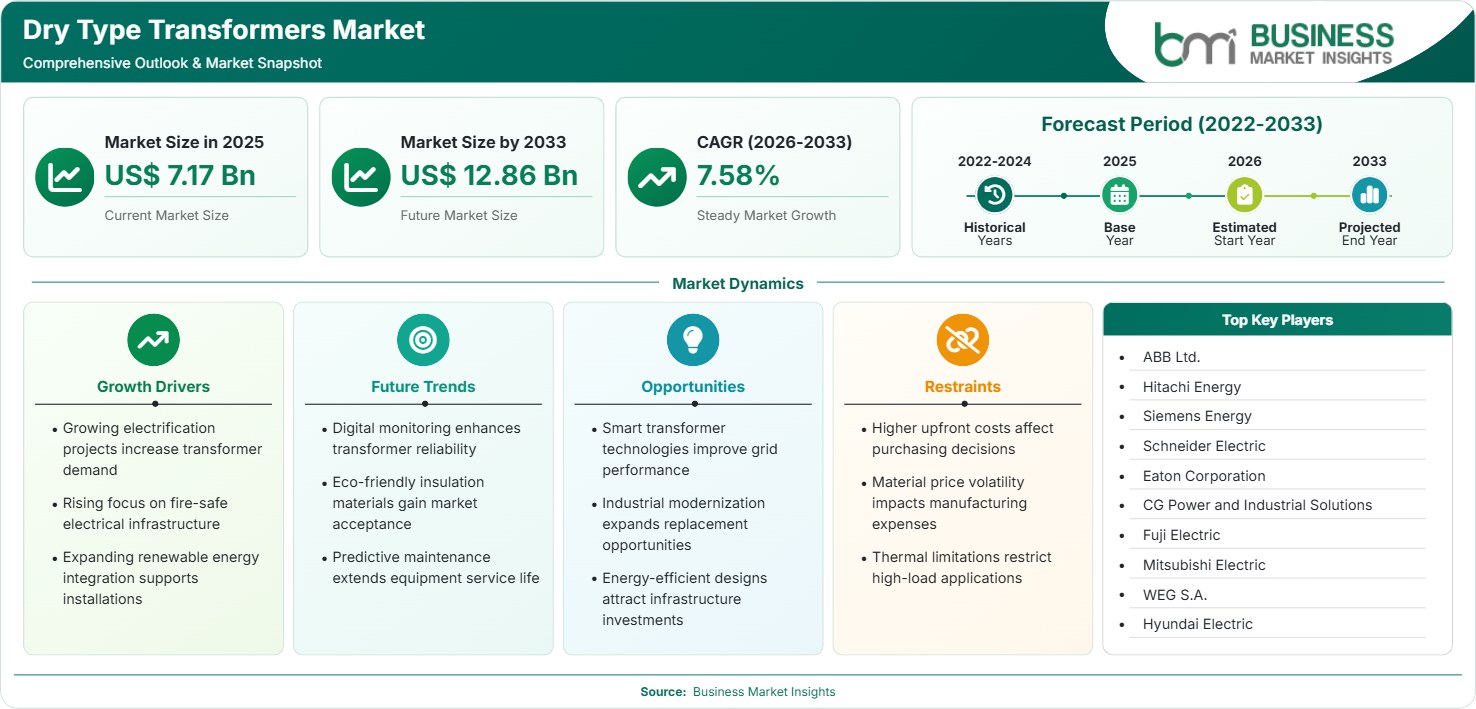
The Dry Type Transformers Market size was valued at US$ 7.17 billion in 2025 and is projected to reach US$ 12.86 billion by 2033, growing at a CAGR of 7.58% during 2026–2033. Rising electrification projects, renewable energy integration, smart grid investments, and demand for fire-safe electrical infrastructure are accelerating adoption across industrial, commercial, and utility applications.

Report Coverage
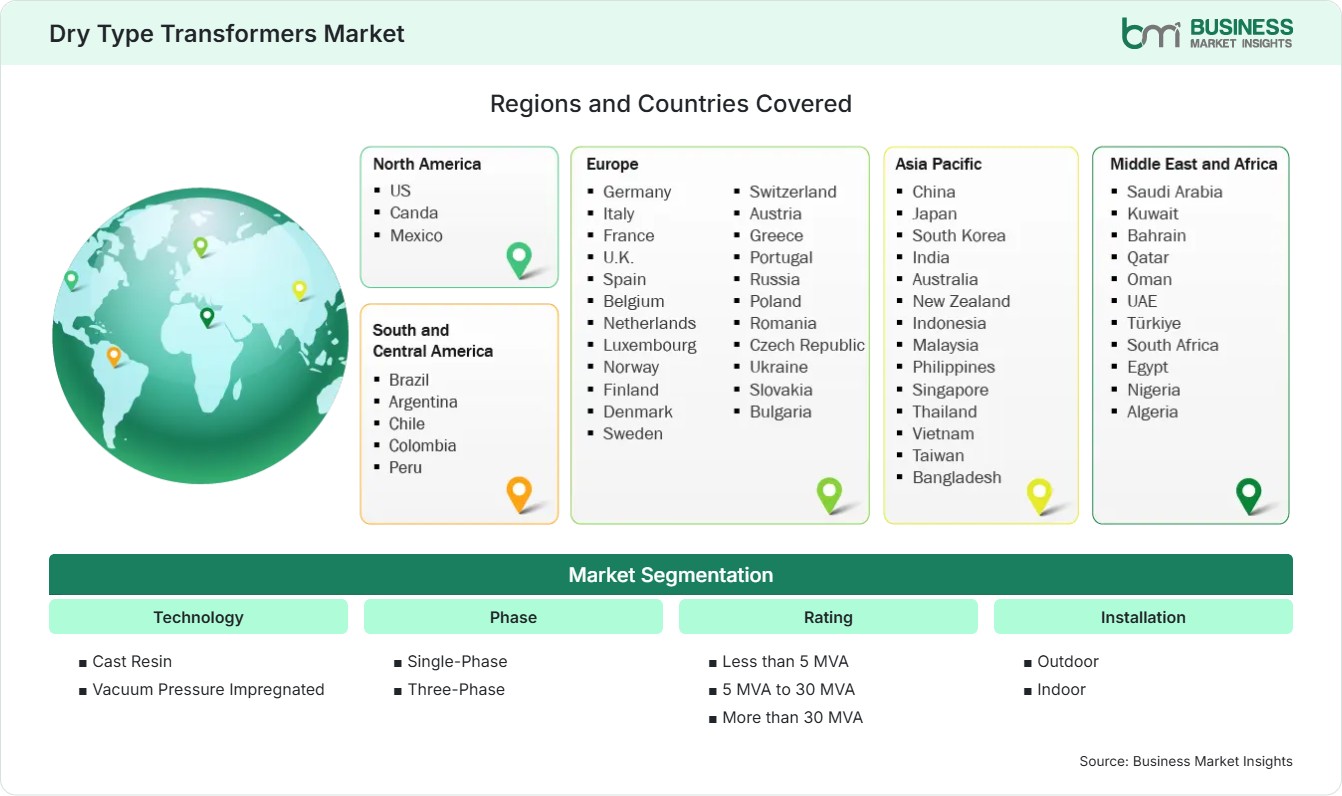
  • Technology: Cast Resin, Vacuum Pressure Impregnated
  • Phase: Single-Phase, Three-Phase
  • Rating: Less than 5 MVA, 5 MVA to 30 MVA, More than 30 MVA
  • Installation: Outdoor, Indoor
  • Application: Industries, Inner-City Substations, Indoor and Underground Substations, Renewable Generation, Others
US$ 7.17 Bn Market size in 2025
US$ 12.86 Bn Market Size by 2033
7.58% CAGR, 2026 - 2033
2026-2033 Forecast Period

AI Overview

Dry Type Transformers Market Summary

  • North America Region: North America holds 27%–30% market share in 2025 and is expected to expand at a CAGR of 7.1%–7.6% during 2026–2033. Grid modernization, renewable power expansion, and replacement of aging electrical infrastructure support regional demand. The U.S. contributes major revenue with a CAGR of 7.2%–7.7%, driven by utility upgrades, commercial construction, and clean energy investments.
  • Fastest Growing Region: Asia Pacific represents 38%–41% market share in 2025 and is projected to register a CAGR of 8.2%–8.8% during 2026–2033. Rapid industrialization, urban infrastructure development, renewable energy projects, and electricity access expansion are supporting transformer installations.
  • Leading Segment: Cast Resin technology accounts for 55%–58% market share in 2025 and is anticipated to grow at a CAGR of 7.6%–8.1%, supported by superior fire resistance, low maintenance requirements, and adoption in commercial and industrial facilities.
  • High Growth Segment: Renewable Generation application captures 18%–21% market share in 2025 and is expected to expand at a CAGR of 8.5%–9.1%, driven by solar and wind power expansion requiring reliable power conversion infrastructure.
  • Key Market Opportunity: Increasing smart grid deployment, replacement of conventional transformers, and demand for energy-efficient electrical systems are creating opportunities for manufacturers offering digitally integrated and sustainable transformer solutions.
  • Major Market Players: ABB Ltd., Hitachi Energy, Siemens Energy, Schneider Electric, Eaton Corporation, CG Power and Industrial Solutions, Fuji Electric, Mitsubishi Electric, WEG S.A., and Hyundai Electric.
Strategic Insights

Dry Type Transformers Market: Strategic Insights

Dry Type Transformers Market Strategic Framework
FREE PDF
Request your free sample
Request free sample
Stakeholder View

Key Takeaways

  • The market ecosystem is shifting toward safer and environmentally responsible transformer solutions, with manufacturers prioritizing oil-free technologies, advanced insulation materials, and compact designs for modern power infrastructure.
  • Renewable energy projects, industrial expansion, and urban substations represent major growth avenues as electricity networks require reliable transformers capable of supporting distributed power generation.
  • Digital monitoring, smart transformer technologies, and predictive maintenance capabilities are becoming important innovation areas as utilities focus on improving grid reliability and operational efficiency.
  • Asia Pacific provides strong investment potential due to rapid industrial development, renewable energy installations, and government-backed electricity infrastructure expansion programs.
  • Strategic partnerships, manufacturing expansions, and technology collaborations are increasing as established electrical equipment companies strengthen their positions in emerging energy markets.
  • Replacement of aging transformer infrastructure is creating sustained demand opportunities, particularly in developed markets upgrading transmission and distribution networks.
Geographic Outlook

Dry Type Transformers Market Regional Highlights

North America Dry Type Transformers Market

North America accounts for 27%–30% Dry Type Transformers Market share in 2025 and is expected to grow at a CAGR of 7.1%–7.6% during 2026–2033. The region benefits from grid modernization programs, renewable energy investments, and increasing demand for safer electrical equipment in commercial and industrial facilities. The United States remains the dominant contributor, supported by infrastructure upgrades, data center expansion, and utility modernization projects.

  • Utilities are replacing aging transformer assets with efficient dry-type alternatives to improve grid reliability.
  • Renewable energy installations are increasing demand for transformers used in solar and wind projects.
  • Commercial buildings prefer fire-resistant transformer technologies for enhanced operational safety.
  • Industrial facilities are adopting low-maintenance transformer solutions to reduce operational risks.

US Dry Type Transformers Market

The United States represents 82%–85% of North American demand and is projected to expand at a CAGR of 7.2%–7.7% during 2026–2033. Growing electricity consumption from data centers, manufacturing facilities, renewable projects, and commercial infrastructure is increasing demand for reliable distribution equipment.

  • Grid modernization initiatives are accelerating replacement of conventional transformer systems.
  • Renewable energy projects require efficient transformer solutions for distributed power generation.
  • Industrial automation is increasing demand for reliable electrical distribution infrastructure.
  • Energy efficiency standards encourage adoption of advanced transformer technologies.

Europe Dry Type Transformers Market

Europe holds 24%–27% market share in 2025 and is expected to register a CAGR of 7.0%–7.5% during 2026–2033. Sustainability regulations, renewable energy targets, and modernization of aging electrical networks continue supporting adoption. Germany leads regional demand, while Italy and Spain show strong growth due to renewable energy investments and grid improvement initiatives.

  • European utilities are upgrading networks to support renewable power integration.
  • Strict safety standards encourage adoption of oil-free transformer technologies.
  • Industrial facilities increasingly prioritize energy-efficient electrical systems.
  • Renewable generation projects continue creating demand for advanced transformers.

Asia Pacific Dry Type Transformers Market

Asia Pacific accounts for 38%–41% dry type transformers market share in 2025 and is projected to grow at the fastest 8.2%–8.8% CAGR during 2026–2033. Industrial expansion, urbanization, renewable energy investments, and electrification programs across China, India, and Southeast Asia are driving transformer demand. China remains the largest market, while India records strong growth due to infrastructure development.

  • Expanding manufacturing capacity increases demand for industrial transformer systems.
  • Renewable energy installations support transformer deployment across emerging economies.
  • Urban development projects require compact electrical distribution solutions.
  • Government electrification programs continue expanding power infrastructure investments.

Rest of World Dry Type Transformers Market

The Rest of World region represents 7%–10% dry type transformers market share in 2025 and is expected to grow at a CAGR of 7.4%–7.9% during 2026–2033. Growth is supported by infrastructure development, renewable energy projects, and industrial investments across Latin America, the Middle East, and Africa. Countries including Brazil, Saudi Arabia, and South Africa are expanding electrical networks.

  • Renewable energy investments are increasing transformer requirements in emerging markets.
  • Industrial development programs support demand for reliable power distribution equipment.
  • Urban infrastructure projects are creating opportunities for compact transformer installations.
  • Power access expansion initiatives continue supporting long-term market development.
Global Market Geography
FREE PDF
Request your free sample
Request free sample
Segment Analysis

Dry Type Transformers Market Segmentation

Technology

Technology selection plays a critical role in transformer performance, safety, efficiency, and application suitability across industrial, commercial, and utility environments. The technology segment accounted for 55%–58% market share in 2025 and is projected to expand at a CAGR of 7.6%–8.1% during 2026–2033. Increasing preference for environmentally safer solutions, reduced maintenance requirements, and enhanced operational reliability continues influencing adoption patterns across the Dry Type Transformers Market.

  • Cast Resin: Dominates adoption due to excellent insulation properties, fire resistance, moisture protection, and suitability for indoor installations, urban substations, and industrial applications requiring enhanced safety standards.
  • Vacuum Pressure Impregnated: Gains demand in applications requiring lightweight designs, improved thermal performance, and reliable operation in commercial buildings, renewable energy systems, and specialized industrial environments.

By Phase

Phase configuration determines transformer efficiency, load handling capability, and suitability for different electrical distribution requirements. The segment accounted for 52%–55% market share in 2025 and is expected to register a CAGR of 7.5%–8.0% during 2026–2033. Growing industrial electrification, commercial infrastructure development, and renewable power installations are supporting demand for advanced phase-based transformer solutions across diverse applications.

  • Single-Phase: Primarily used in residential, small commercial, and low-capacity applications where reliable voltage conversion and compact installation requirements are essential.
  • Three-Phase: Represents broader industrial adoption due to higher power handling capability, operational efficiency, and suitability for manufacturing facilities, utility networks, and large infrastructure projects.

By Rating

Transformer rating selection depends on power requirements, installation environment, and application complexity. The rating segment continues expanding as industries, utilities, and renewable energy operators invest in reliable electrical infrastructure. It accounted for 41%–44% market share in 2025 and is expected to grow at a CAGR of 7.7%–8.2% during 2026–2033. Increasing demand for efficient power distribution systems is strengthening opportunities across multiple capacity ranges.

  • Less than 5 MVA: Widely adopted in commercial buildings, small industrial facilities, and distributed energy applications requiring compact and efficient transformer solutions.
  • 5 MVA to 30 MVA: Experiences strong demand across industrial facilities, renewable projects, and urban substations requiring medium-capacity power distribution equipment.
  • More than 30 MVA: Used in large-scale infrastructure, utility projects, and high-capacity industrial applications requiring reliable transformers for heavy electrical loads.

By Installation

Installation type influences transformer design, protection requirements, and operational performance under different environmental conditions. The segment accounted for 47%–50% market share in 2025 and is projected to grow at a CAGR of 7.4%–7.9% during 2026–2033. Growing urban infrastructure development and increasing safety requirements are encouraging adoption of dry transformer systems across indoor and outdoor environments.

  • Outdoor: Demand is supported by utility infrastructure, renewable energy projects, and industrial installations requiring durable transformer solutions capable of operating under varying environmental conditions.
  • Indoor: Gains significant adoption in commercial buildings, data centers, healthcare facilities, and underground substations where fire safety, low maintenance, and compact designs are critical.

By Application

Application diversity continues influencing transformer demand as industries and utilities require reliable, efficient, and safer electrical distribution solutions. The application segment accounted for 35%–38% market share in 2025 and is projected to expand at a CAGR of 7.8%–8.3% during 2026–2033. Increasing infrastructure investment and renewable energy deployment continue supporting long-term demand across multiple end-use areas.

  • Industries: Represents a major application area due to increasing electrification of manufacturing operations, automation systems, and industrial facilities requiring reliable power distribution.
  • Inner-City Substations: Adoption is increasing due to urban expansion, limited installation space, and demand for safer transformer technologies in densely populated areas.
  • Indoor and Underground Substations: Growth is supported by infrastructure modernization, commercial development, and requirements for compact electrical systems with improved fire protection.
  • Renewable Generation: Expands rapidly with solar and wind energy development requiring efficient transformers for power conversion, grid connection, and renewable electricity distribution.
Market Forces

Dry Type Transformers Market Dynamics

Key Market Drivers

Growing electrification projects increase transformer demand

Increasing electrification across industrial, commercial, and residential sectors is creating sustained demand for reliable power distribution equipment. Governments and utilities are investing in transmission and distribution upgrades to improve electricity accessibility and grid stability. Expansion of manufacturing facilities, urban infrastructure, and large-scale development projects requires efficient transformer systems capable of supporting rising power consumption. Dry-type transformer solutions are gaining preference because they offer improved safety, reduced maintenance requirements, and suitability for indoor applications. These developments are strengthening Dry Type Transformers Market growth as industries and utilities prioritize dependable electrical infrastructure for expanding energy requirements.

Rising focus on fire-safe electrical infrastructure

Safety is becoming one of the most critical factors to be considered during the development of electrical infrastructures, especially in commercial buildings, health facilities, transport terminals, and densely populated cities. The dry-type transformers remove the need for the flammable insulating oil, hence minimizing the fire hazards and enabling safe installation. Building management, industrial firms, and energy companies are increasingly adopting fire-safe transformers due to increasing strict safety requirements. Increasing concern on employee safety and environmental conservation is prompting the use of superior insulating materials. These factors continue influencing Dry Type Transformers Market trends as organizations seek safer alternatives for modern power distribution networks.

Expanding renewable energy integration supports installations

The rapid expansion of renewable energy projects is increasing the need for efficient transformer solutions that can connect distributed power sources with existing electricity networks. Solar power plants, wind turbines, and hybrid power plants need transformers that can withstand the unpredictable production of power without compromising on the stability of the grid system. Dry type transformers are becoming more popular in renewable power projects due to their robust nature, minimal maintenance needs, and environmental suitability. Increased investments in renewable power infrastructures have made manufacturers develop dedicated transformers for use in renewable power generation.

Key Market Opportunities

Smart transformer technologies improve grid performance

Smart monitoring features are opening up new avenues for transformers manufacturers as more utilities look into digitally managed grids. With sensors, condition monitoring systems, and data analytics software, operators can track performance, conduct predictive maintenance, and better manage assets. By incorporating smart transformer technology, operators are able to minimize downtime, distribute energy effectively, and increase grid reliability. Manufacturers can capitalize on the increased demand for digitally managed transformers from utilities and industry. Dry Type Transformers Market Forecasts indicate that digital transformation of power infrastructure will remain a key opportunity area as electricity networks become more connected and intelligent.

Industrial modernization expands replacement opportunities

Aging electrical infrastructure across industrial facilities is creating significant replacement opportunities for advanced transformer systems. Modernization initiatives by manufacturing units, industrial plants, and commercial establishments are being undertaken to upgrade their equipment in order to increase efficiency and effectiveness. Dry transformers have certain benefits, such as lower maintenance, increased durability, and increased flexibility during installation; therefore, they are good alternatives for the existing transformers. Modernization, automation, and growth of smart factories will drive the need for replacing transformers. Companies providing custom-made transformers with better efficiency and reliability will definitely capitalize on this shift.

Energy-efficient designs attract infrastructure investments

Growing emphasis on energy conservation and operational cost reduction is encouraging investments in energy-efficient transformer technologies. Utilities, industries, and businesses are looking for transformers that reduce power losses while maintaining consistent reliability over the equipment's lifetime. Engineers are creating new transformer designs that include better core materials, insulation systems, and thermal management technology. Such features allow for reducing operating expenses and meeting sustainability requirements in all kinds of infrastructure developments. Growing amounts of money spent on energy-efficient electrical equipment should result in good market opportunities for manufacturers of such transformers.

Market Restraints and Challenges

Higher upfront costs affect purchasing decisions

Factor: The dry-type transformers usually involve high installation cost than other types due to better insulating material, advanced technology, and manufacturing process. Impact: High installation cost may affect purchase decision of price conscious consumers especially small and medium industrial customers with constrained financial budget. Despite their advantages, these transformers are costly in terms of the initial installation cost. Manufacturers are concerned about improving efficiency and reducing costs to increase affordability of the transformers.

Material price volatility impacts manufacturing expenses

Factor: Changes in the prices of copper, electrical steel, insulation, and other key materials affect the cost of transformer manufacturing. Impact: Production costs can increase due to higher material prices, which can lead to lower profits and difficulty setting the company's pricing policy in a competitive market. Companies use different approaches to deal with the problem of fluctuating raw material prices.

Company Analysis

Competitive Landscape

The competitive environment is shaped by technology innovation, manufacturing expansion, grid modernization initiatives, and increasing demand for safer electrical infrastructure. Dry Type Transformers Market analysis highlights that leading companies are focusing on advanced insulation technologies, energy-efficient designs, smart monitoring solutions, and renewable energy applications to strengthen their market position. Strategic collaborations, product launches, and investments in sustainable power equipment are supporting competition among global and regional manufacturers.

Company Name

Overview

Products and Services relevant to this market

ABB Ltd.

ABB is a global electrification and automation technology provider offering advanced power distribution solutions for industrial and utility applications.

Dry-type transformers, cast resin transformers, distribution transformers, digital monitoring solutions, and grid automation technologies.

Hitachi Energy

Hitachi Energy specializes in power grid technologies and provides transformer solutions supporting renewable energy and infrastructure development.

Dry-type transformers, cast resin transformers, power distribution systems, grid integration solutions, and transformer services.

Siemens Energy

Siemens Energy develops energy infrastructure technologies focused on reliable, efficient, and sustainable electricity networks.

Dry-type transformers, vacuum pressure impregnated transformers, energy systems, grid solutions, and digital transformer monitoring.

Schneider Electric

Schneider Electric provides energy management and electrical distribution solutions for commercial, industrial, and infrastructure markets.

Dry-type transformers, medium-voltage equipment, power distribution products, smart energy management systems, and digital solutions.

Eaton Corporation

Eaton delivers electrical equipment and power management technologies supporting safe and efficient energy distribution.

Dry-type transformers, distribution equipment, electrical protection systems, power quality solutions, and energy management technologies.

CG Power and Industrial Solutions

CG Power manufactures electrical equipment and serves utility, industrial, and infrastructure sectors globally.

Dry-type transformers, distribution transformers, power transmission equipment, electrical systems, and engineering services.

Fuji Electric

Fuji Electric provides energy and industrial solutions with transformer technologies for diverse electrical applications.

Dry-type transformers, power semiconductor systems, electrical equipment, energy management solutions, and industrial power systems.

Mitsubishi Electric

Mitsubishi Electric develops advanced electrical systems for industrial, commercial, and infrastructure applications.

Dry-type transformers, power distribution equipment, energy solutions, monitoring systems, and automation technologies.

WEG S.A.

WEG is a global electrical equipment manufacturer supplying power solutions for industrial and renewable energy markets.

Dry-type transformers, electrical motors, automation solutions, renewable energy equipment, and power distribution systems.

Hyundai Electric

Hyundai Electric manufactures power equipment supporting global utility, industrial, and renewable energy infrastructure projects.

Dry-type transformers, electrical distribution equipment, grid solutions, energy systems, and transformer maintenance services.

Trust & Transparency

Research Methodology

The market analysis combines proprietary research with secondary data from government agencies, company disclosures, regulatory filings, industry databases and expert interviews. Market estimates are validated through data triangulation, cross-market benchmarking and analyst review.

View Full Research Methodology

Questions Answered

Frequently Asked Questions

What does the Dry Type Transformers Market Report provide?

The Market Report covers market size analysis, technology developments, segmentation insights, competitive strategies, regional trends, investment opportunities, and future industry outlook.

How are renewable energy projects influencing transformer demand?

Solar and wind power projects require reliable grid connection equipment, increasing demand for transformers that support efficient electricity conversion, stable operation, and integration of renewable energy sources.

Which technology is widely adopted in dry-type transformers?

Cast resin technology is widely adopted because it provides strong insulation performance, moisture resistance, fire protection, and reliable operation in demanding industrial and commercial environments.

Why are dry-type transformers preferred over oil-filled transformers?

Dry-type transformers provide improved fire safety, reduced environmental risks, lower maintenance requirements, and easier indoor installation, making them suitable for applications where safety and reliability are critical.

What is driving demand for dry-type transformers globally?

Increasing electrification, renewable energy expansion, industrial infrastructure development, and demand for safer electrical systems are driving adoption of dry-type transformers across utilities, commercial buildings, and industrial facilities.

Access the Full Dry Type Transformers Market Report

Get segment-level forecasts, regional estimates, competitive benchmarking, company profiles and downloadable Excel datasets.

Access the full Dry Type Transformers Market Report
350 pages PDF & Excel | 2026-08-24
Similar Research

Related Market Reports