Market Summary
Executive Summary and Global Market Analysis
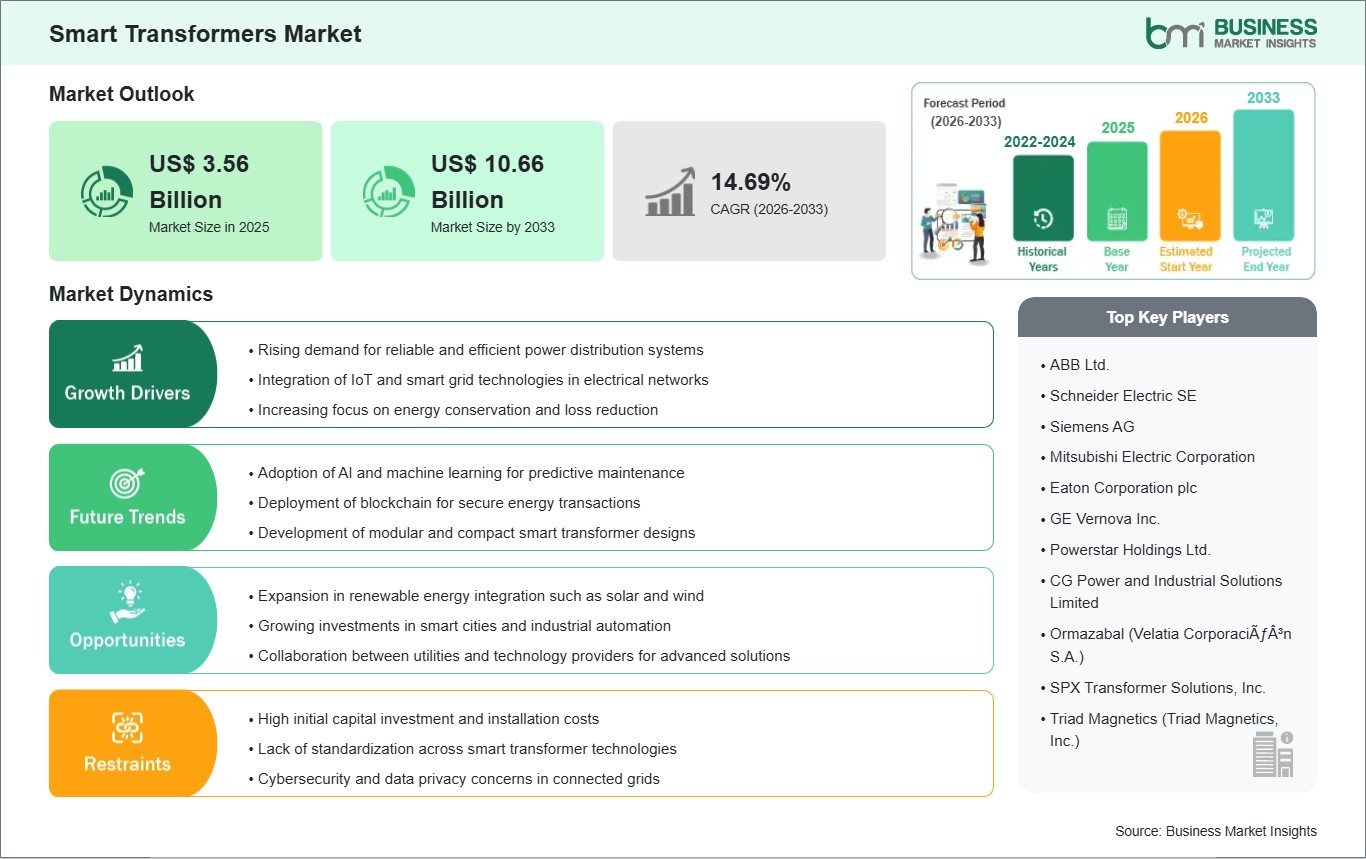
Smart Transformers represent the next generation of power distribution technology, integrating power electronics and digital communication to manage voltage and current intelligently. Unlike conventional units, these "solid-state" devices enable bidirectional power flow, making them indispensable for the modern grid's transition toward decentralized energy. They are essential for industries such as renewable energy, heavy manufacturing, and urban utility management. Smart transformers offer several advantages, including superior power quality, real-time fault detection, and the ability to stabilize grids receiving intermittent solar and wind inputs. Increasing global electricity consumption, the massive rollout of smart city initiatives, and the urgent need for carbon-neutral energy systems are fueling the market. Additionally, innovations in edge computing, IoT sensors, and high-frequency semiconductor materials are enhancing the operational lifespan and efficiency of these units.
However, several challenges can restrain market growth, such as the significantly high initial procurement costs compared to traditional oil-immersed transformers and the specialized technical expertise required for installation and maintenance. The industry is also sensitive to cybersecurity vulnerabilities, as digitalized transformers are potential targets for network-based disruptions. Despite these hurdles, the market holds significant opportunities driven by the global surge in electric vehicle (EV) adoption, the expansion of high-speed rail networks, and the increasing demand for predictive maintenance solutions. Investment in green hydrogen production and modular microgrids is also expected to open new avenues for market expansion.
Segment Analysis
Smart Transformers Market Segmentation
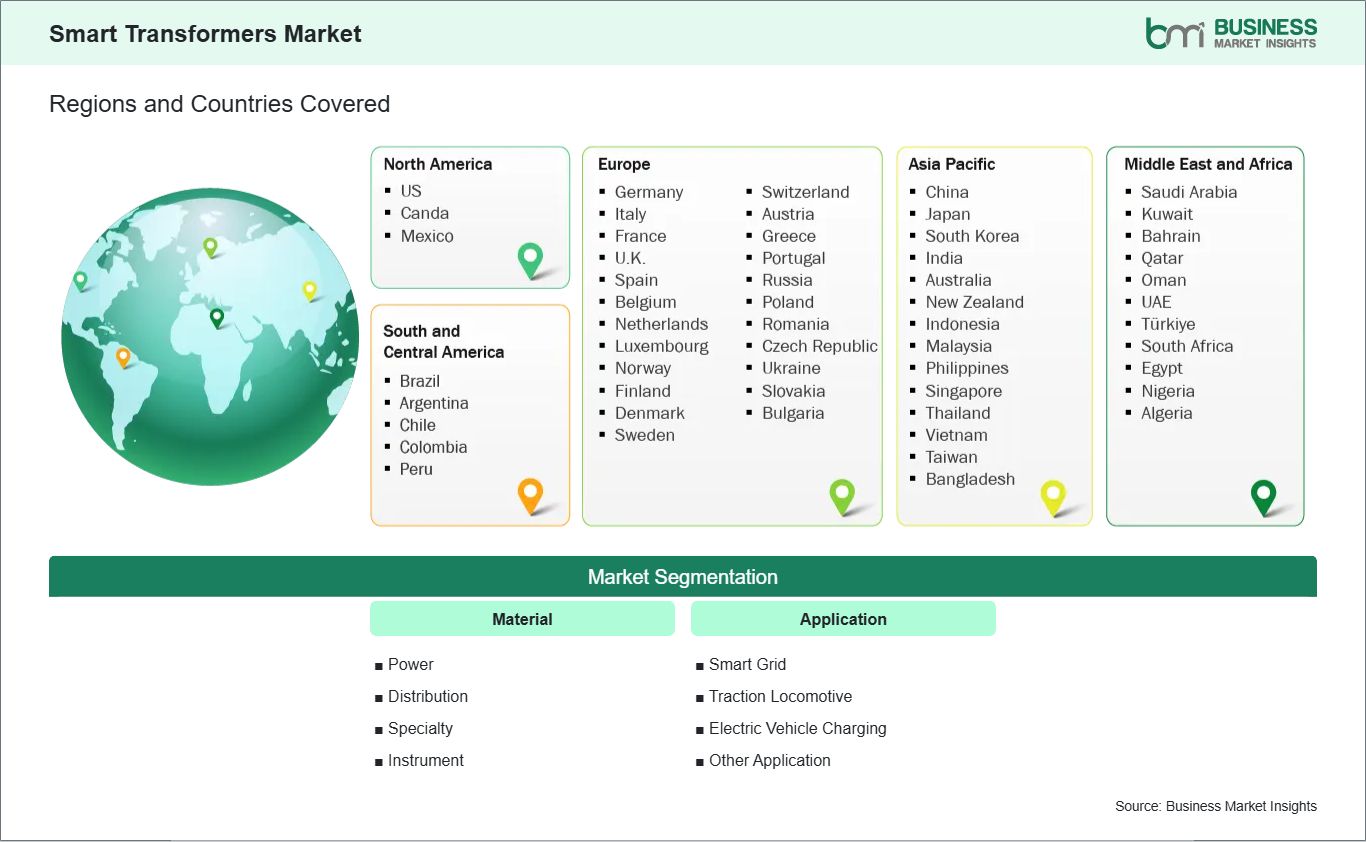
Key segments that contributed to the derivation of the Smart Transformers market analysis are material and application.
- By material, the market is segmented into Power, Distribution, Specialty, and Instrument.
- By Application, the market is categorized into Smart Grid, Traction Locomotive, Electric Vehicle Charging, and Others.
Market Forces
Smart Transformers Market Drivers and Opportunities
Global Expansion of Digitalized Smart Grids and Modern Infrastructure
The rapid transition toward digitalized power networks has emerged as a pivotal factor driving the smart transformers market. As the world moves away from aging, passive electrical systems, governments are investing billions into "Smart Grid" frameworks that require active, data-driven components. Smart transformers serve as the brain of these new systems, offering the ability to monitor load fluctuations and adjust voltage levels autonomously. This digital transformation allows utility providers to significantly reduce energy wastage during long-distance transmission and prevent cascading failures through automated fault isolation.
For instance, the global push for grid modernization is set to intensify, with utilities prioritizing equipment that supports real-time data analytics. The digitalization of power utilities is expected to grow. This robust expansion directly supports the growth of the smart transformers market, as the need for advanced power management solutions increases to meet the demands of growing urban populations and complex industrial requirements. Unlike traditional hardware, smart transformers facilitate the seamless communication necessary for demand-response programs, ensuring that energy supply precisely matches consumer needs in real-time.
Accelerating Integration of Utility-Scale Renewable Energy Sources
As international climate agreements accelerate the decommissioning of coal and gas plants, the share of intermittent energy sources like solar and wind is rising exponentially. This transition creates inherent instability in traditional grids due to the variable nature of weather-dependent power generation. Smart transformers, with their high-frequency power electronics, provide the necessary stability by regulating voltage harmonics and ensuring that sudden surges or drops in renewable output do not damage the broader network.
In recent years, trade liberalization policies and environmental mandates have encouraged the adoption of "green" transformers that utilize biodegradable esters and solid-state designs. These units are frequently utilized in large-scale offshore wind farms and desert solar arrays due to the precision and environmental safety they offer. Moreover, as multinational companies diversify their energy sourcing to meet ESG (Environmental, Social, and Governance) targets, the demand for smart transformers that can manage decentralized, renewable microgrids is expected to grow steadily. These devices are uniquely positioned to handle the bidirectional power flow required when local renewable systems feed energy back into the national grid, making them a cornerstone of the future energy landscape.
Size and Share Analysis
Smart Transformers Market Size and Share Analysis
The smart transformers market demonstrates steady growth, with size and share analysis revealing evolving trends and competitive positioning among key players. The report further examines subsegments categorized within material and application, offering insights into their contribution to overall market performance.
Based on material, the Distribution are the largest segment. This dominance is due to their critical role in managing the final stage of power delivery to residential and commercial end-users, where voltage regulation is most sensitive.
In terms of application, Traction Locomotive applications utilize specialized smart transformers to support the electrification of rail networks. This segment is growing rapidly in Europe and Asia, where government-led initiatives are replacing diesel engines with high-speed electric trains requiring efficient on-board power conversion.
Report Coverage
Smart Transformers Market Report Coverage and Deliverables
The "Smart Transformers Market Size and Forecast (2022 - 2033)" report provides a detailed analysis of the market covering below areas:
- Smart Transformers market size and forecast at global, regional, and country levels for all the key market segments covered under the scope
- Smart Transformers market trends, as well as market dynamics such as drivers, restraints, and key opportunities
- Smart Transformers market analysis covering key market trends, global and regional framework, major players, regulations, and recent market developments
- Industry landscape and competition analysis covering market concentration, heat map analysis, prominent players, and recent developments for the Smart Transformers market
- Detailed company profiles, including SWOT analysis
Geographic Insights
Smart Transformers Market Geographic Insights
The geographical scope of the Smart Transformers market report is divided into five regions: North America, Asia Pacific, Europe, Middle East and Africa, and South and Central America.
The Asia-Pacific Smart Transformers market is segmented into China, Japan, South Korea, India, Australia, and the Rest of Asia. The Asia-Pacific region is experiencing the most robust growth globally. This growth is driven by massive investments in smart city infrastructure and the rapid expansion of renewable energy capacity in China and India. China's State Grid has notably sanctioned the world`s largest smart grid facility, fueling a surge in smart transformer demand.
North America holds a significant position, with the U.S. market being driven by the urgent need to replace aging grid infrastructure, much of which has exceeded its 40-year life expectancy. Europe is the second-largest market, focusing on the refurbishment of grids to meet stringent "Green Deal" carbon reduction targets. The Middle East and Africa and South America are emerging as key growth areas, supported by rural electrification programs and the development of large-scale solar projects in regions like Saudi Arabia and Brazil. Across all regions, the surge in manufacturing activity and the rapid growth of the electric vehicle market are positioning smart transformers as a critical component of the global energy ecosystem.
Industry Activity
Recent Developments
The Smart Transformers market is evaluated by gathering qualitative and quantitative data post primary and secondary research, which includes important corporate publications, association data, and databases. A few of the key developments in the smart transformers market are:
- In January 2026, Bharat Heavy Electricals Limited (BHEL) achieved yet another significant milestone in its 'Make in India' initiatives for the rail transportation sector by commencing supply of underslung traction transformers for the prestigious Vande Bharat Sleeper Train project being executed by a BHEL-led consortium with TRSL.
- In December 2025, Hitachi Energy UK Limited and Omexom signed a Memorandum of Understanding (MoU) to collaborate on the delivery of Integrated GIS Applications (IGA) for high-voltage grid connections across the United Kingdom. This partnership brings together Hitachi Energy`s expertise in advanced grid technologies with Omexom`s proven capabilities as an EPC and delivery contractor in transmission and distribution projects.
Trust & Transparency
Research Methodology
The market analysis combines proprietary research with secondary data from government agencies, company disclosures, regulatory filings, industry databases and expert interviews. Market estimates are validated through data triangulation, cross-market benchmarking and analyst
review.
View Full Research Methodology
Key Sources Referred:
World Bank - Global Trade IndicatorsWorld Trade Organization (WTO)International Monetary Fund (IMF)International Trade Administration (ITA)Company websiteCompany annual reportsCompany investor presentations