Market Summary
Executive Summary and Global Market Analysis
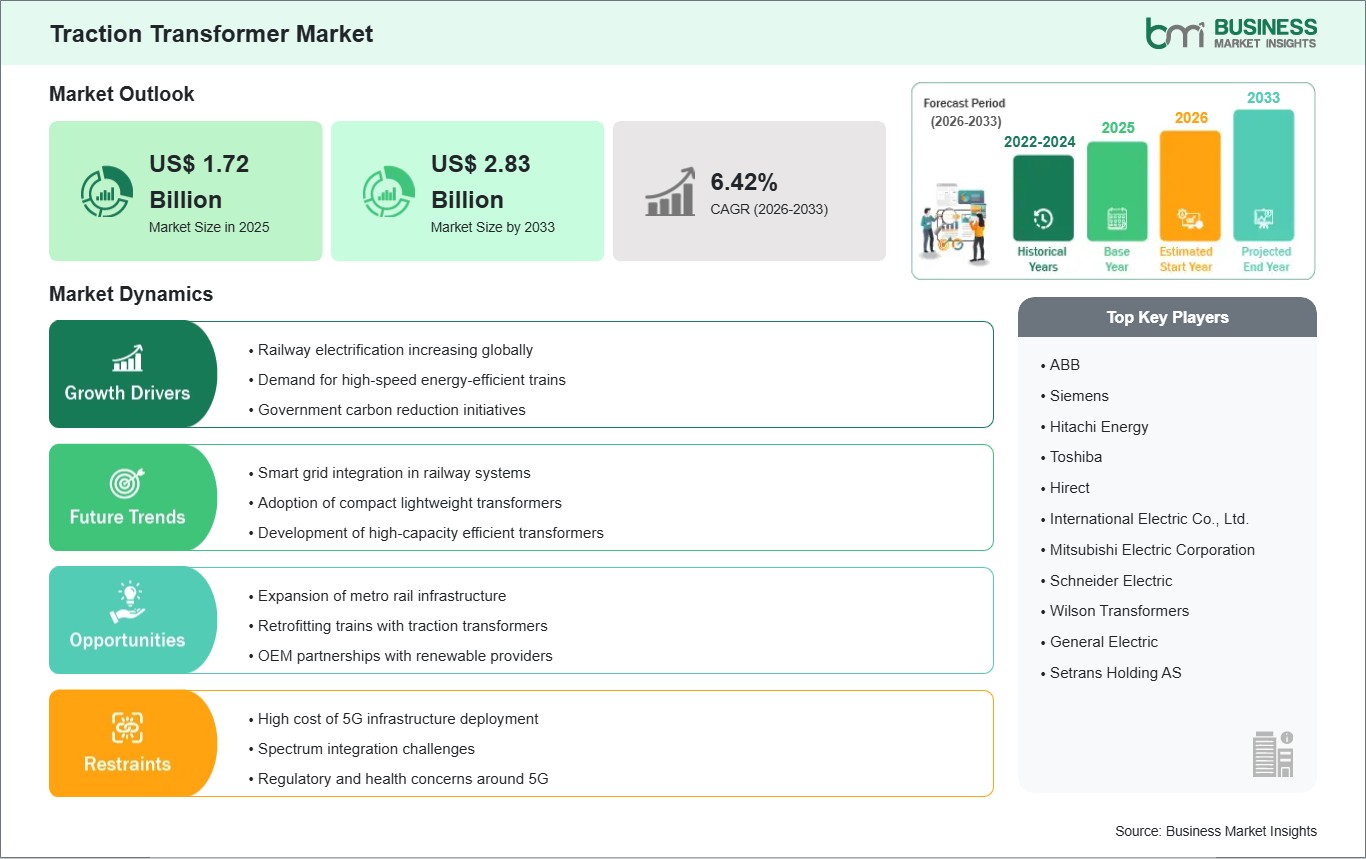
A traction transformer is a specialized, onboard electrical device designed to convert high-voltage electricity from overhead catenary lines (AC or DC) into lower voltage levels suitable for a train’s traction motors and auxiliary systems (such as lighting, heating, and signaling). Unlike stationary power transformers, these units are engineered to withstand extreme vibrations, mechanical shocks, and fluctuating weather conditions while maintaining a compact, lightweight profile to fit within the limited space of a locomotive’s machine room, roof, or underframe. Market expansion is primarily attributed to the massive global push for rail electrification, the rising demand for high-speed rail connectivity to reduce short-haul flight emissions, and the expansion of urban metro networks in megacities. Furthermore, the integration of lightweight composite materials and digital health monitoring, which already play a significant role in new rolling stock procurements, is substantially improving procedural efficiency for rail operators.
However, several challenges can restrain market growth: high R&D and manufacturing costs, often requiring specialized non-flammable insulation and vibration-resistant engineering, can limit the competitive field to a few major players. Technical complexities in multi-voltage cross-border travel (interoperability) require sophisticated, multi-system transformers that increase capital expenditure for international rail corridors. Additionally, the industry faces constraints due to volatile raw material prices, particularly for high-grade electrical steel and copper, which can represent a substantial share of production costs and lead to unpredictable project budgeting.
Despite these hurdles, the market holds immense opportunities in the universal mandate for net-zero transport and the accelerating deployment of automated, driverless metro systems. The expansion of under-the-floor mounting positions to maximize passenger capacity and the development of bio-based ester-filled transformers for environmentally sensitive areas are expected to create significant opportunities for market growth.
Segment Analysis
Traction Transformer Market Segmentation
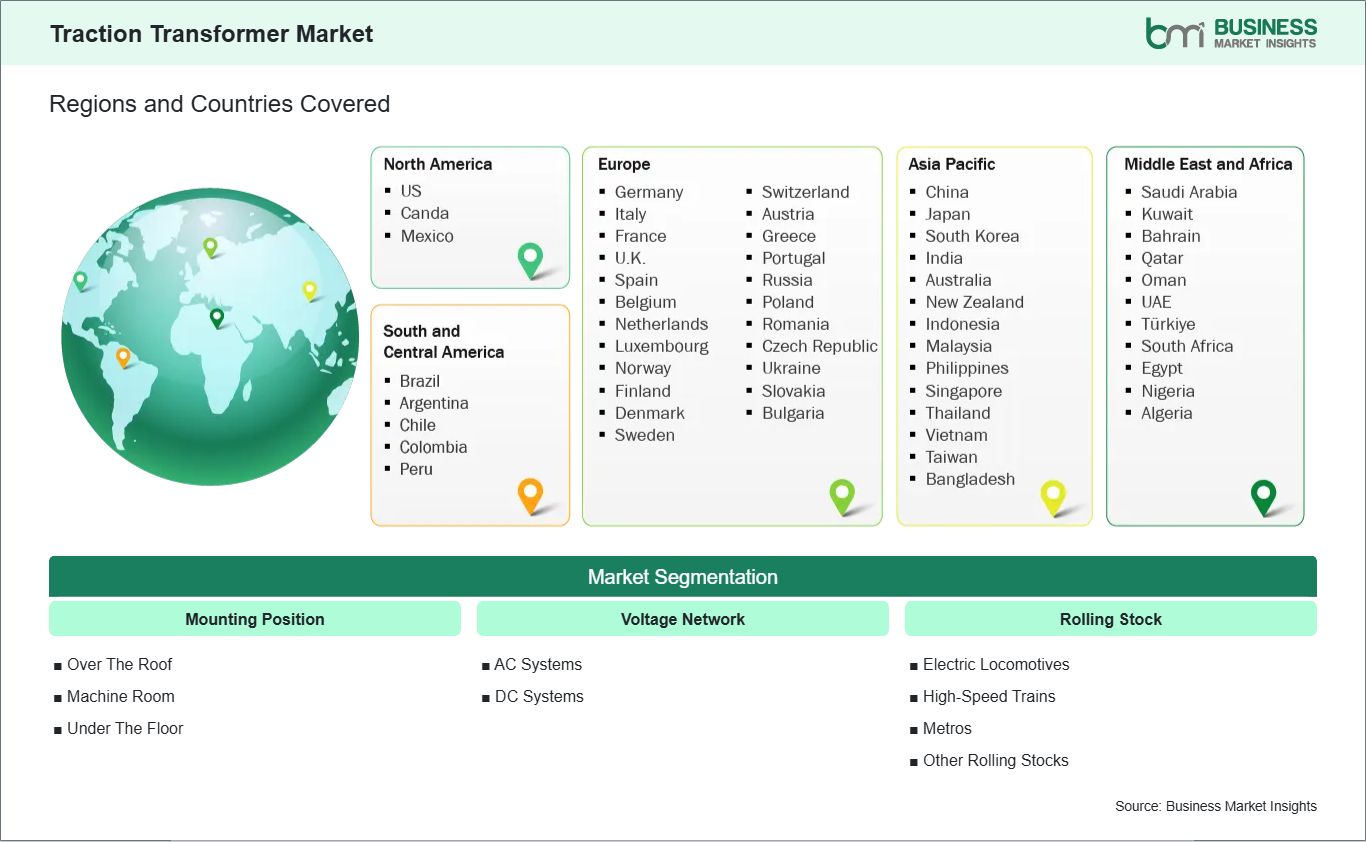
Key segments that contributed to the derivation of the Traction Transformer market analysis are mounting position, voltage network, and rolling stock.
- By Mounting Position, the market is segmented into Over The Roof, Machine Room, and Under The Floor.
- By Voltage Network, the market is divided into AC Systems and DC Systems.
- By Rolling Stock, the market is categorized into Electric Locomotives, High-Speed Trains, Metros, and Others.
Market Forces
Traction Transformer Market Drivers and Opportunities
Advancing Rail Electrification and Global Decarbonization Mandates
The primary driver for the Traction Transformer Market is the accelerating global imperative to decarbonize transportation through large-scale rail electrification. Governments are aggressively shifting passenger and freight traffic from road to rail, viewing electrified networks as non-discretionary for meeting net-zero carbon targets. This momentum is further amplified by massive investments in high-speed rail (HSR) networks and urban metro expansions, particularly in the Asia-Pacific and European regions. These modern systems require advanced traction transformers capable of handling higher power densities and variable voltage regimes (ranging from 1.2kV to 25kV AC) to support rapid acceleration and high-velocity transit. Furthermore, the rising integration of renewable energy sources, such as solar and wind, into railway power grids necessitates sophisticated transformers that can stabilize and regulate fluctuating power flows. Together, these factors ensure that traction transformers are foundational to the global transition toward sustainable, high-capacity infrastructure.
Digital Twins and SiC-Based Efficiency Innovation
A significant high-value opportunity lies in the convergence of Traction Transformers with Silicon Carbide (SiC) semiconductor technology. By integrating SiC-based converters, manufacturers can significantly reduce energy losses and greatly increase power density, enabling much lighter and more compact onboard designs.There is also a major growth frontier in the adoption of Digital Twin technology and IoT-enabled predictive maintenance. Next-generation "smart" transformers equipped with embedded sensors can monitor thermal stress and insulation aging in real-time, allowing operators to transition from scheduled maintenance to a data-driven prescriptive model that minimizes unplanned downtime. Furthermore, the rise of Power Electronic Traction Transformers (PETT) presents a lucrative opportunity for multi-system rolling stock that needs to operate across different national borders with varying voltage standards. Manufacturers who focus on Eco-friendly insulation, such as biodegradable ester fluids and dry-type materials, and those pioneering modular under-frame or roof-mounted configurations are positioned to lead the most innovative and high-margin segments of the rail industry.
Size and Share Analysis
Traction Transformer Market Size and Share Analysis
The Traction Transformer market demonstrates steady growth, with size and share analysis revealing evolving trends and competitive positioning among key players. The report further examines subsegments categorized within mounting position, voltage network, and rolling stock, offering insights into their contribution to overall market performance.
Based on mounting position, the Under The Floor subsegment holds a significant market share, representing the gold standard for space optimization in modern passenger rail. Under The Floor installations are indispensable for the Metros sector, where they provide the compact, low-profile design required to maximize passenger cabin capacity and improve vehicle stability through a lower center of gravity. A notable trend is the surge in the Machine Room subsegment, which is registering a higher CAGR as rail operators move toward high-power Electric Locomotives and heavy-haul freight. Machine Room units are becoming essential for long-distance mainline carriers, allowing for maximum reliability and ease of maintenance in multi-phase rail systems without the spatial constraints of under-carriage mounting.
Report Coverage
Traction Transformer Market Report Coverage and Deliverables
The "Traction Transformer Market Size and Forecast (2022 - 2033)" report provides a detailed analysis of the market covering below areas:
- Traction Transformer market size and forecast at global, regional, and country levels for all the key market segments covered under the scope
- Traction Transformer market trends, as well as market dynamics such as drivers, restraints, and key opportunities
- Traction Transformer market analysis covering key market trends, global and regional framework, major players, regulations, and recent market developments
- Industry landscape and competition analysis covering market concentration, heat map analysis, prominent players, and recent developments for the Traction Transformer market
- Detailed company profiles, including SWOT analysis
Geographic Insights
Traction Transformer Market Geographic Insights
The geographical scope of the Traction Transformer market report is divided into five regions: North America, Asia Pacific, Europe, Middle East & Africa, and South & Central America.
The Asia-Pacific Traction Transformer Market is segmented into China, Japan, South Korea, India, Australia, and the Rest of Asia. This region is the fastest-growing market globally, fueled by the aggressive expansion of the high-speed rail network in China and the comprehensive electrification of national railways in India. Japan and South Korea continue to lead in technological innovation, focusing on the development of ultra-lightweight and compact transformers that allow for higher passenger capacity on high-speed lines.
Growth is further bolstered by a significant shift toward environmentally friendly and energy-efficient systems among rail operators looking to meet carbon neutrality targets. The integration of advanced cooling technologies (such as ester-based fluids) and digital monitoring sensors for predictive maintenance, alongside the rising demand for under-the-floor mounting solutions to maximize interior train space, solidifies Asia-Pacific as a critical hub for innovation and the future scaling of the Traction Transformer industry.
Industry Activity
Recent Developments
The Traction Transformer market is evaluated by gathering qualitative and quantitative data post primary and secondary research, which includes important corporate publications, association data, and databases. A few of the key developments in the Traction Transformer market are:
- In Jan 2024, Hitachi Energy completed the acquisition of COET, a manufacturer of DC traction products and power electronics for rail, electric mobility, and industrial applications. The acquisition strengthens Hitachi Energy’s global position in traction technology and high-power infrastructure, supporting sustainable transport and grid-edge solutions. This development is a key advancement for the Traction Transformer sector enhancing capabilities in rail electrification and related traction systems.
- In March 2024, Maschinenfabrik Reinhausen (MR) acquired shares of Easun-MR Tap Changers (EMR) in India, making it a wholly owned subsidiary while retaining its independent operations. EMR, a market leader in in-tank tap changers for transformers, will continue supplying critical components to the Indian and global transformer markets. This acquisition is a significant development for the Traction Transformer industry, strengthening MR’s presence in India and enhancing capabilities in traction and power transformer systems.
Trust & Transparency
Research Methodology
The market analysis combines proprietary research with secondary data from government agencies, company disclosures, regulatory filings, industry databases and expert interviews. Market estimates are validated through data triangulation, cross-market benchmarking and analyst
review.
View Full Research Methodology
Key Sources Referred:
World Bank - Global Trade IndicatorsWorld Trade Organization (WTO)International Monetary Fund (IMF)International Trade Administration (ITA)Company websiteCompany annual reportsCompany investor presentations