Market Summary
Executive Summary and Global Market Analysis
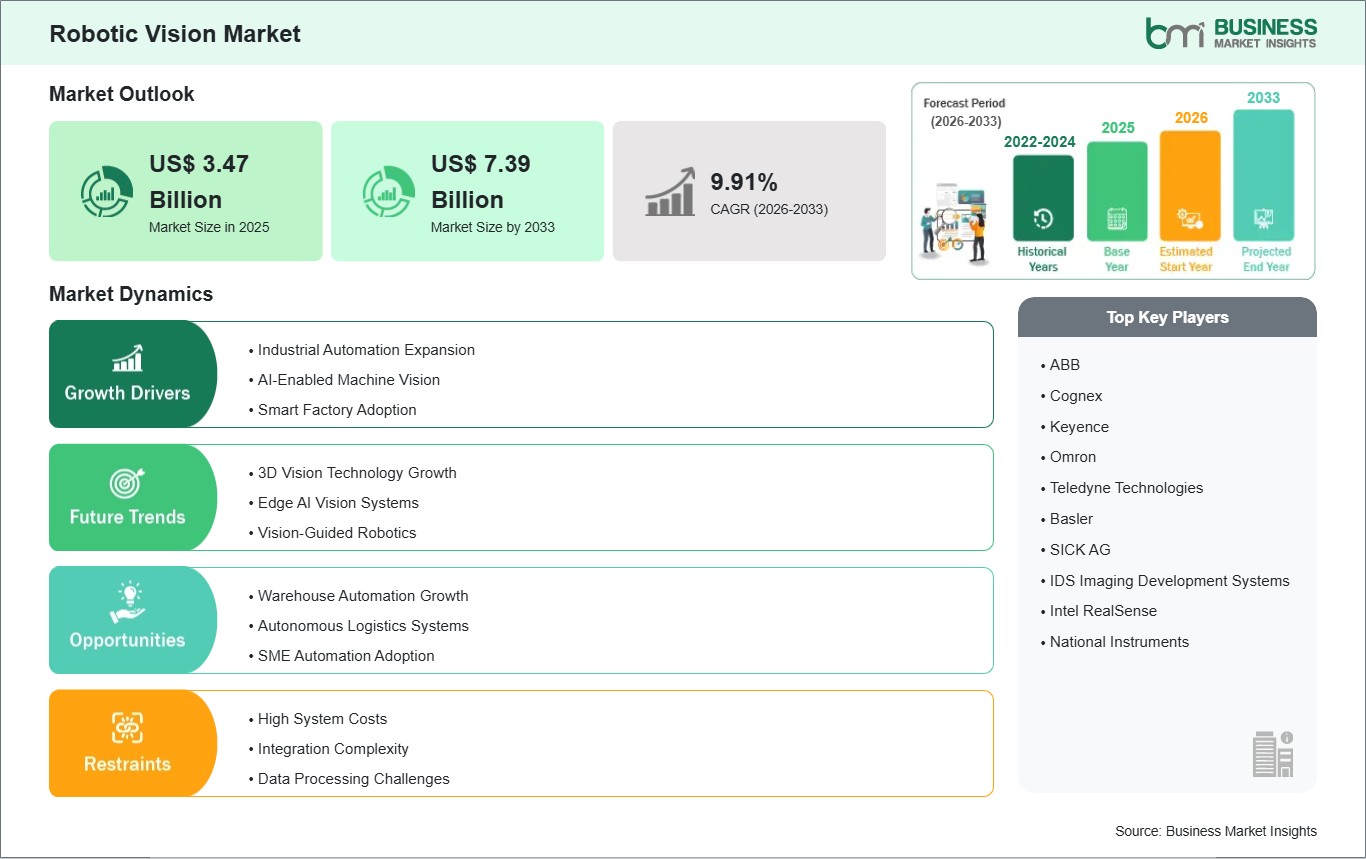
The global robotic vision market is being driven by rapid advancements in artificial intelligence, machine learning, and high-performance imaging solutions that enable robots to interpret their environments with precision. Robotic vision systems provide machines with detailed visual perception capabilities, facilitating tasks such as high-speed quality inspection, object recognition, and depth estimation across industrial processes.
Industry 4.0 initiatives and smart factory deployments are elevating the importance of vision-guided automation, particularly in automotive and electronics manufacturing where precision assembly, inspection, and material handling require real-time visual feedback.
Vision hardware including cameras, LED lighting, optics, processors & controllers, and frame grabbers combined with advanced software platforms allows robots to adapt to variable lighting, object orientation, and environmental conditions.
As software platforms become more sophisticated and affordable, mid-sized manufacturers are increasingly able to deploy robotic vision systems to improve throughput, reduce errors, and enable flexible manufacturing processes.
Segment Analysis
Robotic Vision Market Segmentation
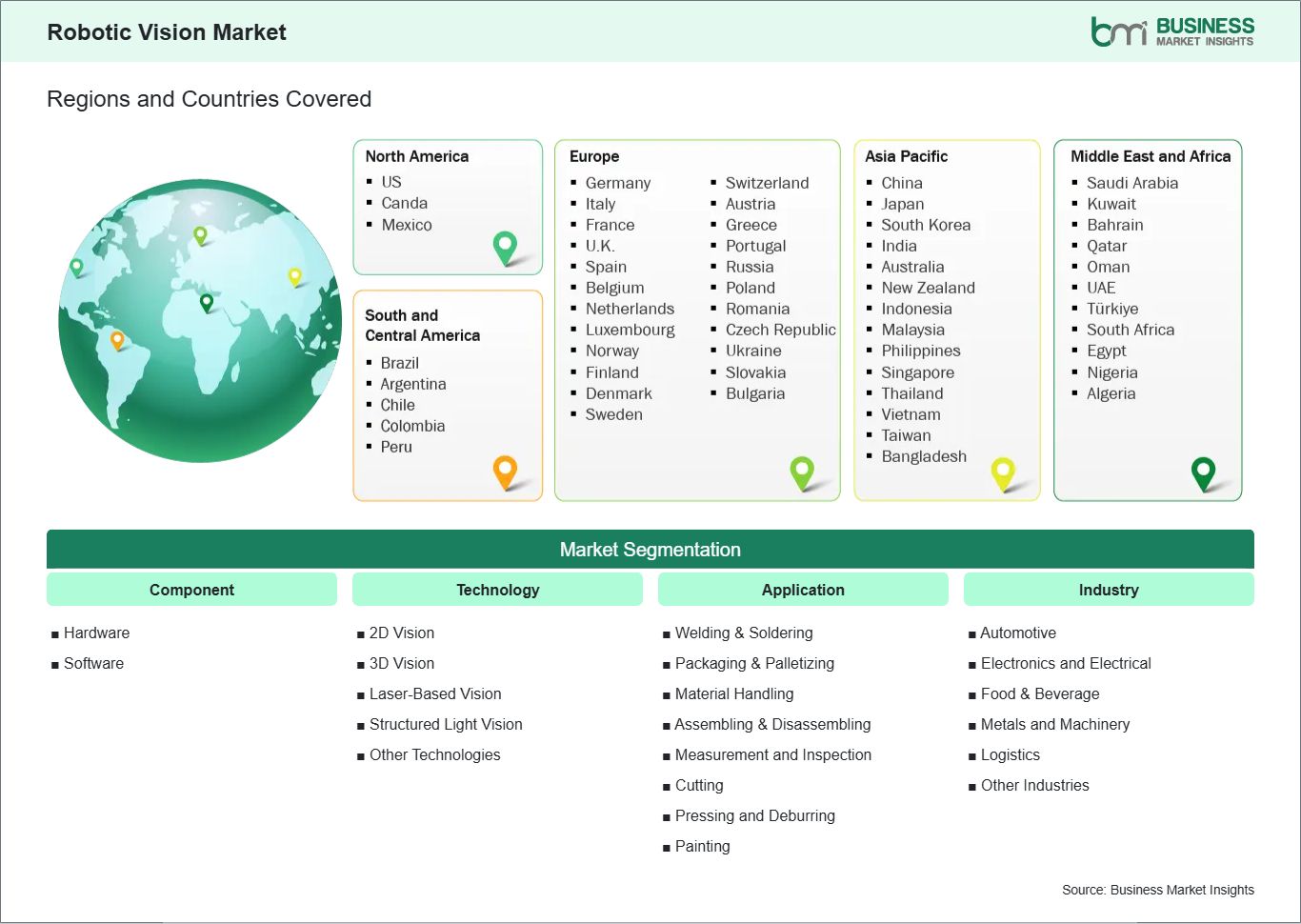
Key segments that contributed to the derivation of the robotic vision market analysis are component, technology, application, and industry.
- By component, the robotic vision market is segmented into hardware and software. The hardware subsegment dominated the market in 2025.
- By technology, the robotic vision market is segmented into 2D vision, 3D vision, laser-based vision, structured light vision, and other technologies. The 2D vision subsegment dominated the market in 2025.
- In terms of application, the robotic vision market is segmented into welding & soldering, packaging & palletizing, material handling, assembling & disassembling, measurement and inspection, cutting, pressing, and deburring, and painting. The material handling subsegment dominated the market in 2025.
- By industry, the robotic vision market is segmented into automotive, electronics and electrical, food & beverage, metals and machinery, logistics, and other industries. The automotive subsegment dominated the market in 2025.
Market Forces
Robotic Vision Market Drivers and Opportunities
Automation and AI-Enabled Industrial Transformation
The growing shift toward automation and intelligent manufacturing is a major driver for the robotic vision market. Industries including automotive, electronics, and food & beverage are adopting robotic vision systems to increase production efficiency, reduce defect rates, and overcome labor shortages.
Vision systems provide robots with the ability to detect object orientation, verify component placement, and perform quality inspection with high precision. These capabilities significantly improve operational accuracy and reduce production errors.
Artificial intelligence and deep learning algorithms further enhance vision capabilities by enabling pattern recognition and anomaly detection in real time. AI-powered vision software allows robotic systems to adapt to environmental variations such as lighting changes and irregular object shapes.
Logistics and Autonomous Material Handling Opportunities
The rapid growth of e-commerce and warehouse automation is creating new opportunities for robotic vision adoption. Logistics facilities increasingly rely on autonomous mobile robots and automated guided vehicles equipped with vision systems to identify packages, navigate warehouse environments, and perform sorting operations.
Vision-guided robots enable accurate pick-and-place tasks, palletizing, and inventory tracking, improving operational efficiency and reducing fulfillment errors.
Advancements in 3D vision and machine learning are enabling robots to perform complex tasks such as random bin picking and dynamic path planning, supporting highly automated logistics operations.
Size and Share Analysis
Robotic Vision Market Size and Share Analysis
The Robotic Vision Market demonstrates steady growth, with size and share analysis highlighting evolving trends and competitive dynamics among key players. The report examines subsegments categorized within component, technology, application, and industry.
By component, the hardware subsegment dominated the market in 2025 driven by strong demand for cameras, lighting systems, optics, and processors used in robotic vision platforms.
By technology, the 2D vision subsegment dominated the market in 2025 driven by widespread use in inspection, positioning, and measurement applications.
In terms of application, the material handling subsegment dominated the market in 2025 driven by the growing deployment of vision-enabled robots in warehouses and manufacturing facilities.
By industry, the automotive subsegment dominated the market in 2025 driven by extensive use of robotic vision systems for welding inspection, component alignment, and quality control in automotive production lines.
Report Coverage
Robotic Vision Market Report Coverage and Deliverables
The "Robotic Vision Market Size and Forecast (2022 - 2033)" report provides a detailed analysis of the market covering below areas:
- Robotic Vision Market size and forecast at global, regional, and country levels for all the key market segments covered under the scope
- Robotic Vision Market trends, as well as drivers, restraints, and opportunities
- Robotic Vision Market analysis covering key trends, global and regional framework, major players, regulations, and recent developments
- Industry landscape and competition analysis covering market concentration, heat map analysis, prominent players, and recent developments for the Robotic Vision Market
- Detailed company profiles including SWOT analysis
Geographic Insights
Robotic Vision Market Geographic Insights
The geographical scope of the Robotic Vision Market report is divided into North America, Asia Pacific, Europe, Middle East & Africa, and South & Central America. North America held the largest share in 2025.
North America leads the market due to strong adoption of industrial automation technologies and substantial investments in artificial intelligence and machine vision research.
Europe represents a significant market supported by advanced manufacturing sectors and strict quality standards across industries including automotive, metals, and electronics.
Asia Pacific is projected to experience the fastest growth due to rapid industrialization and expanding robotics adoption in countries such as China, Japan, South Korea, and India.
Middle East & Africa and South & Central America are witnessing gradual adoption driven by industrial modernization and logistics automation initiatives.
Industry Activity
Recent Developments
The Robotic Vision Market is evaluated by gathering qualitative and quantitative data post primary and secondary research, which includes important corporate publications, association data, and databases. A few of the key developments in the robotic vision market are:
- In July 2025, RealSense spun out from Intel Corp and raised US$50 million to expand AI vision development for robotics, accelerating depth‑sensing camera innovation.
- In September 2025, ABB Robotics introduced OmniCore EyeMotion, a vision-powered autonomy system that allows robots to recognize and adapt to their surroundings in real time using any third-party camera or sensor. The system enhances perception and visual reasoning, enabling faster deployment and greater versatility in industrial automation.
Trust & Transparency
Research Methodology
The market analysis combines proprietary research with secondary data from government agencies, company disclosures, regulatory filings, industry databases and expert interviews. Market estimates are validated through data triangulation, cross-market benchmarking and analyst
review.
View Full Research Methodology
Key Sources Referred:
International Federation of Robotics (IFR)International Organization for Standardization (ISO)United Nations Industrial Development Organization (UNIDO)World Economic Forum (WEF)International Telecommunication Union (ITU)International Trade Administration