Market Summary
Executive Summary and Global Market Analysis
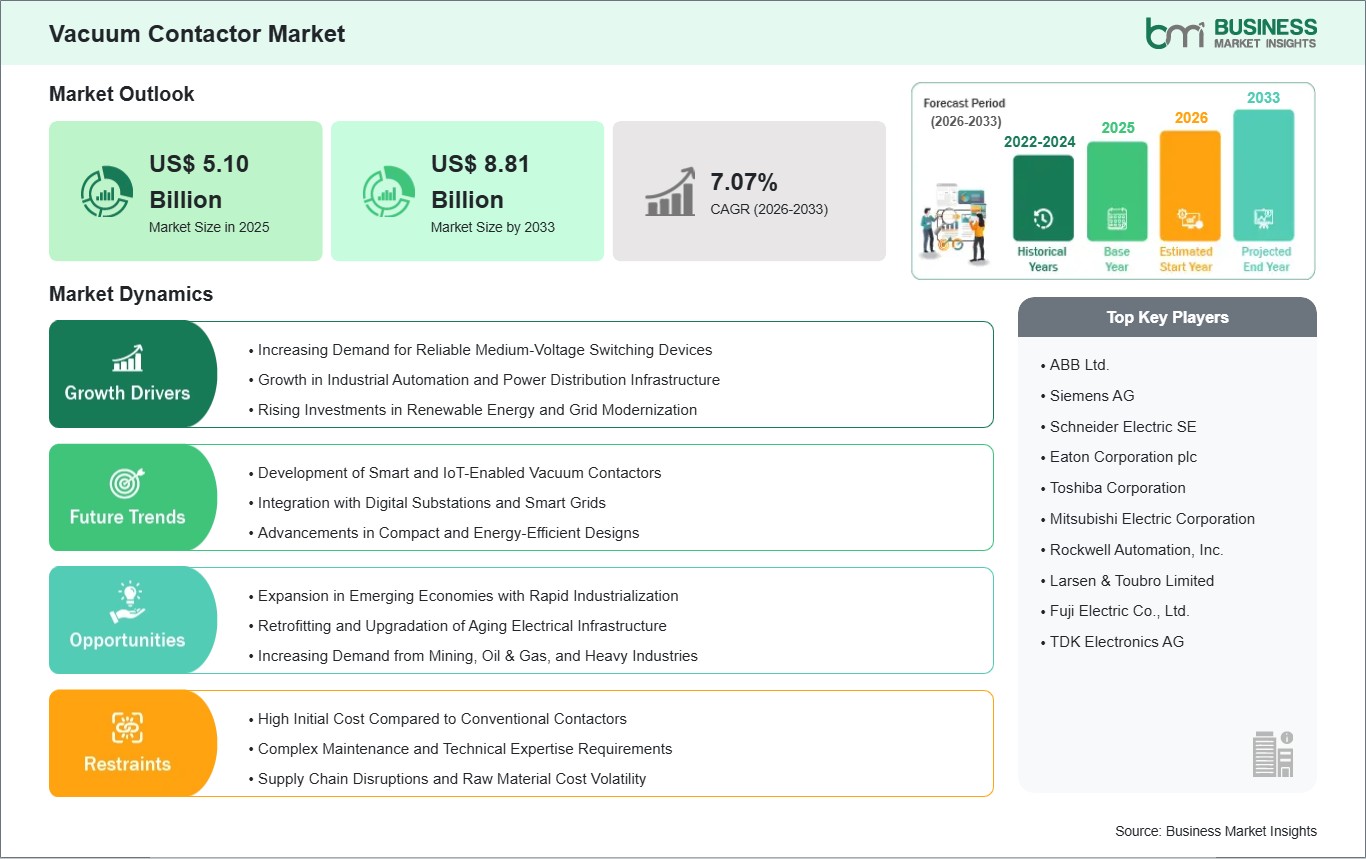
Vacuum contactors refer to specialized electrical switching devices where the primary contacts operate within a sealed vacuum chamber to interrupt currents and suppress electrical arcs. By utilizing the superior dielectric strength of a vacuum, these contactors facilitate rapid arc quenching and eliminate the risk of contact oxidation, resulting in a significantly longer operational lifespan compared to traditional air or oil-based alternatives. This technology is fundamental to high-frequency switching applications across the utilities, mining, and manufacturing sectors, particularly for controlling medium-voltage motors, transformers, and capacitor banks. Market expansion is being propelled by the global electrification of everything, the rising requirement for reliable switching in renewable energy interconnections, and the increasing institutional demand for low-maintenance, compact switchgear in space-constrained urban environments.
However, several factors may restrain market progression. The high initial capital intensity associated with precision-engineered vacuum interrupters and specialized housing materials remains a significant hurdle for budget-sensitive industrial operators. The industry also faces technical challenges regarding current chopping and the generation of transient overvoltage’s during high-speed switching, which may necessitate the integration of additional surge suppression components. Additionally, while vacuum contactors are inherently low-maintenance, the requirement for specialized technical expertise and testing equipment to verify vacuum integrity over time can increase the total cost of ownership. These hurdles, compounded by the presence of alternative technologies like solid-state relays in lower-power applications and the volatility of raw material prices for copper and silver, require a strategic focus on demonstrating long-term lifecycle value.
Despite these hurdles, the market outlook remains favorable. Opportunities are emerging through the adoption of smart vacuum contactors equipped with IoT sensors and microcontrollers that facilitate real-time condition monitoring and predictive maintenance. The expansion of the electric vehicle (EV) charging infrastructure and large-scale battery energy storage systems (BESS) is gaining traction, requiring robust DC and AC vacuum switching solutions to manage high-load surges safely. Furthermore, the growth of modular contactor-fuse combinations aligns with global goals for simplified panel design and enhanced short-circuit protection. Collectively, these innovations position the vacuum contactor industry for sustained long-term development as a cornerstone of the modern, digitized, and resilient power distribution network.
Segment Analysis
Vacuum Contactor Market Segmentation
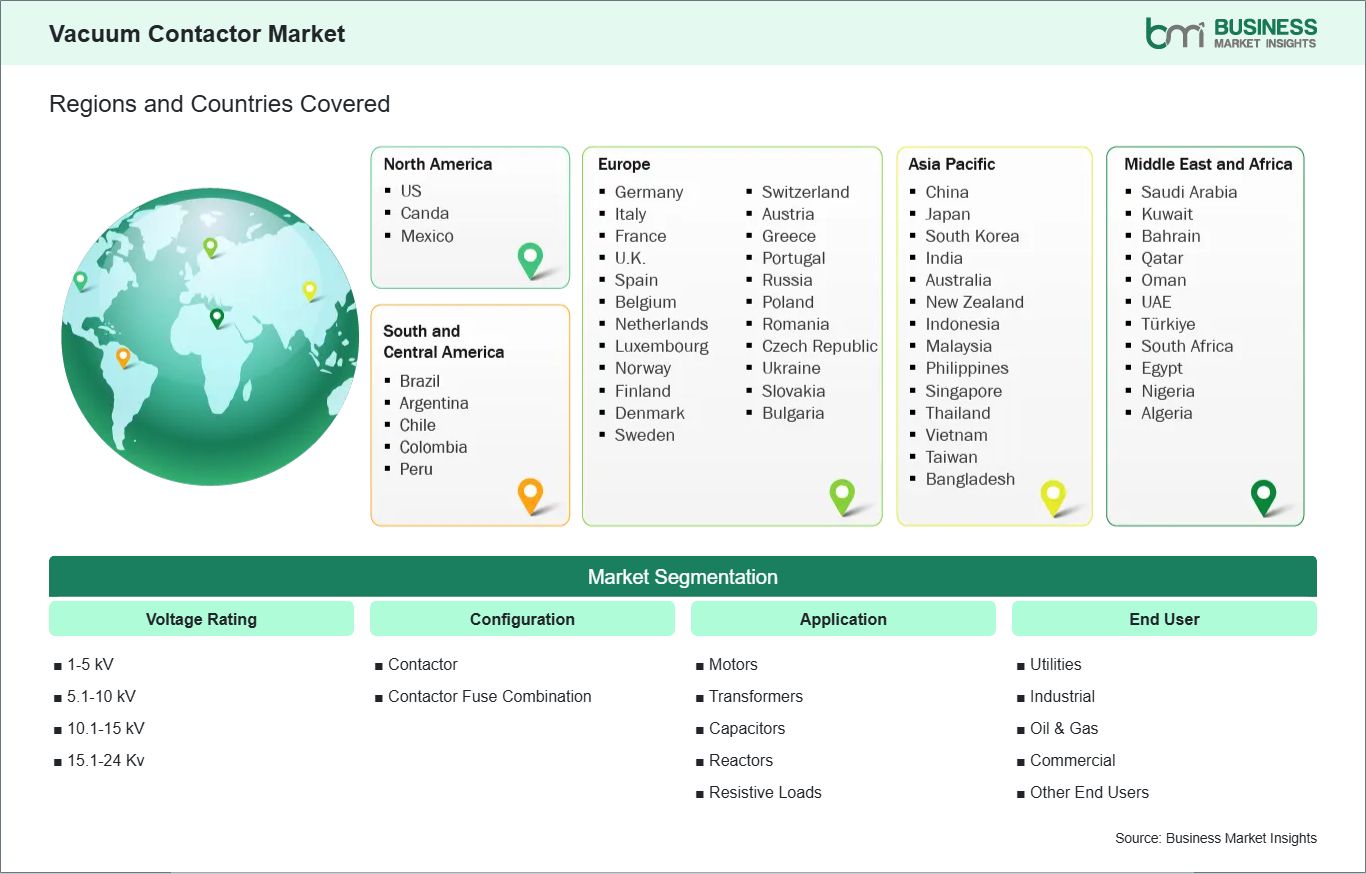
Key segments that contributed to the derivation of the Vacuum Contactor market analysis are voltage rating, configuration, application, and end user.
- By Voltage Rating, the market is segmented into 1 - 5 kV, 5.1 - 10 kV, 10.1 - 15 kV, and 15.1 - 24 kV.
- By Configuration, the market is divided into Contactor and Contactor Fuse Combination.
- By Application, the market is categorized into Motors, Transformers, Capacitors, Reactors, and Resistive Loads.
- By End User, the market is segmented into Utilities, Industrial, Oil & Gas, Commercial, and Others.
Market Forces
Vacuum Contactor Market Drivers and Opportunities
Rising Demand for Reliable Switching and Grid Safety
The vacuum contactor market is being driven by the growing need for reliable medium‑voltage switching solutions that ensure grid safety and equipment protection. Vacuum contactors are widely used in applications such as motors, transformers, and capacitor banks, offering arc‑quenching capabilities that extend equipment life and reduce maintenance costs. With industrial automation expanding globally, demand for efficient and durable switching devices is rising across sectors including mining, oil & gas, manufacturing, and utilities. Regulatory mandates emphasizing electrical safety, energy efficiency, and operational reliability are reinforcing adoption, particularly in regions investing heavily in smart grids and electrification.
The increasing integration of renewable energy sources is amplifying demand, as vacuum contactors provide stable performance under fluctuating load conditions. Additionally, the modernization of legacy infrastructure and the expansion of data centers and transportation networks are driving adoption. Collectively, industrial growth, grid modernization, and safety compliance are propelling sustained expansion in the global vacuum contactor market.
Rising Integration of Smart Monitoring and Eco‑Friendly Designs
Opportunities in the vacuum contactor market are expanding through the integration of smart monitoring technologies, IoT connectivity, and eco‑friendly innovations. Modern vacuum contactors equipped with sensors and digital platforms enable real‑time fault detection, predictive maintenance, and enhanced asset management, creating new pathways for adoption across diverse industries. IoT‑enabled systems are gaining traction, offering seamless integration with supervisory control and data acquisition (SCADA) systems and smart grids. The growing emphasis on sustainability is encouraging manufacturers to develop energy‑efficient and environmentally responsible designs, aligning with global decarbonization goals.
Modular and compact contactors are also opening lucrative opportunities, particularly in urban infrastructure and renewable energy projects where space optimization is critical. Additionally, the expansion of electric vehicle charging networks and smart city initiatives is fueling demand for advanced vacuum contactors that ensure reliable switching and grid stability. Vendors who focus on cost‑effective, digitally enabled, and eco‑friendly solutions are well‑positioned to capture growth. The convergence of smart functionality, predictive analytics, and sustainability underscores a transformative trajectory for the global vacuum contactor market.
Size and Share Analysis
Vacuum Contactor Market Size and Share Analysis
The Vacuum Contactor market demonstrates steady growth, with size and share analysis revealing evolving trends and competitive positioning among key players. The report examines subsegments categorized within voltage rating, configuration, application, and end user, offering insights into their contribution to overall market performance.
Based on Application, the Motors subsegment holds a strong presence in the market. Vacuum contactors here are indispensable for motor control in manufacturing, mining, and oil & gas. The Transformers subsegment is essential for safe switching and protection in power distribution. The Capacitors subsegment anchors demand in reactive power compensation and voltage regulation. The Reactors subsegment is critical for harmonic filtering and system stability. The Resistive Loads subsegment is indispensable for heating and lighting applications requiring reliable switching.
Report Coverage
Vacuum Contactor Market Report Coverage and Deliverables
The "Vacuum Contactor Market Size and Forecast (2022 - 2033)" report provides a detailed analysis of the market covering below areas:
- Vacuum Contactor market size and forecast at global, regional, and country levels for all market segments covered under the scope
- Vacuum Contactor market trends, as well as drivers, restraints, and opportunities
- Vacuum Contactor market analysis covering key trends, global and regional framework, major players, regulations, and recent developments
- Industry landscape and competition analysis covering market concentration, heat map analysis, prominent players, and recent developments for the Vacuum Contactor market
- Detailed company profiles, including SWOT analysis
Geographic Insights
Vacuum Contactor Market Geographic Insights
The geographical scope of the Vacuum Contactor market report is divided into five regions: North America, Asia Pacific, Europe, Middle East & Africa, and South & Central America.
North America maintains a preeminent position within the global industry, a standing solidified by the region's advanced utility infrastructure and the aggressive modernization of aging electrical grids. The regional landscape is characterized by high-stakes investments in the United States and Canada, where the transition toward Smart Grid Architectures and decentralized power systems has become a strategic priority. This market leadership is further supported by stringent regulatory frameworks regarding industrial safety and the integration of energy-efficient components, which facilitate the adoption of vacuum-based switching technologies to ensure high reliability in critical power distribution networks.
Technological progression in the United States and Canada is largely driven by a decisive shift toward IoT-Enabled and Digitalized Vacuum Contactors. These advanced systems utilize real-time telemetry and cloud-integrated monitoring to perform predictive maintenance, allowing utilities to identify potential failures before they result in unplanned downtime. Furthermore, the region is witnessing an increasing utilization of Environmentally Friendly and Non-Toxic Switchgear, as enterprises seek to comply with sustainability mandates and reduce the use of hazardous insulating materials. This focus on Intelligent Switching allows North American operators to improve system resilience and enhance safety for personnel in high-voltage environments.
Industry Activity
Recent Developments
The Vacuum Contactor market is evaluated by gathering qualitative and quantitative data post primary and secondary research, which includes important corporate publications, association data, and databases. A few of the key developments in the Vacuum Contactor market are:
- In May 2025, CNC Electric launched several new electrical control products, including the YCC7 industrial contactor, smart circuit breakers, and YCKB7 control and protection switchgear. The YCC7 contactor supports 06 - 400A applications with AC/DC compatibility, targeting industrial control systems and modular electrical installations. The new product lineup strengthens CNC Electric’s portfolio for industrial power control, protection, and automation applications, impacting the vacuum contactor market.
- In October 2025, HD Hyundai Electric secured UL and cUL certifications for four types of low- and medium-voltage circuit breakers, including air circuit breakers, molded case circuit breakers, vacuum circuit breakers, and magnetic contactors. The certification strengthens the company’s entry into the North American power distribution equipment market and enhances competitiveness in industrial electrical systems. HD Hyundai Electric also plans to expand production capacity with a new smart manufacturing plant in Cheongju, supporting growth in low- and medium-voltage equipment.
Trust & Transparency
Research Methodology
The market analysis combines proprietary research with secondary data from government agencies, company disclosures, regulatory filings, industry databases and expert interviews. Market estimates are validated through data triangulation, cross-market benchmarking and analyst
review.
View Full Research Methodology
Key Sources Referred:
World Bank - Global Trade Indicators World Trade Organization (WTO) International Monetary Fund (IMF) International Trade Administration (ITA) Company Websites Company Annual Reports Company Investor Presentations