
Flat Antenna Market Outlook: Size, Share, Trends, Growth Analysis, Competitive Landscape & Forecast, 2026-2033

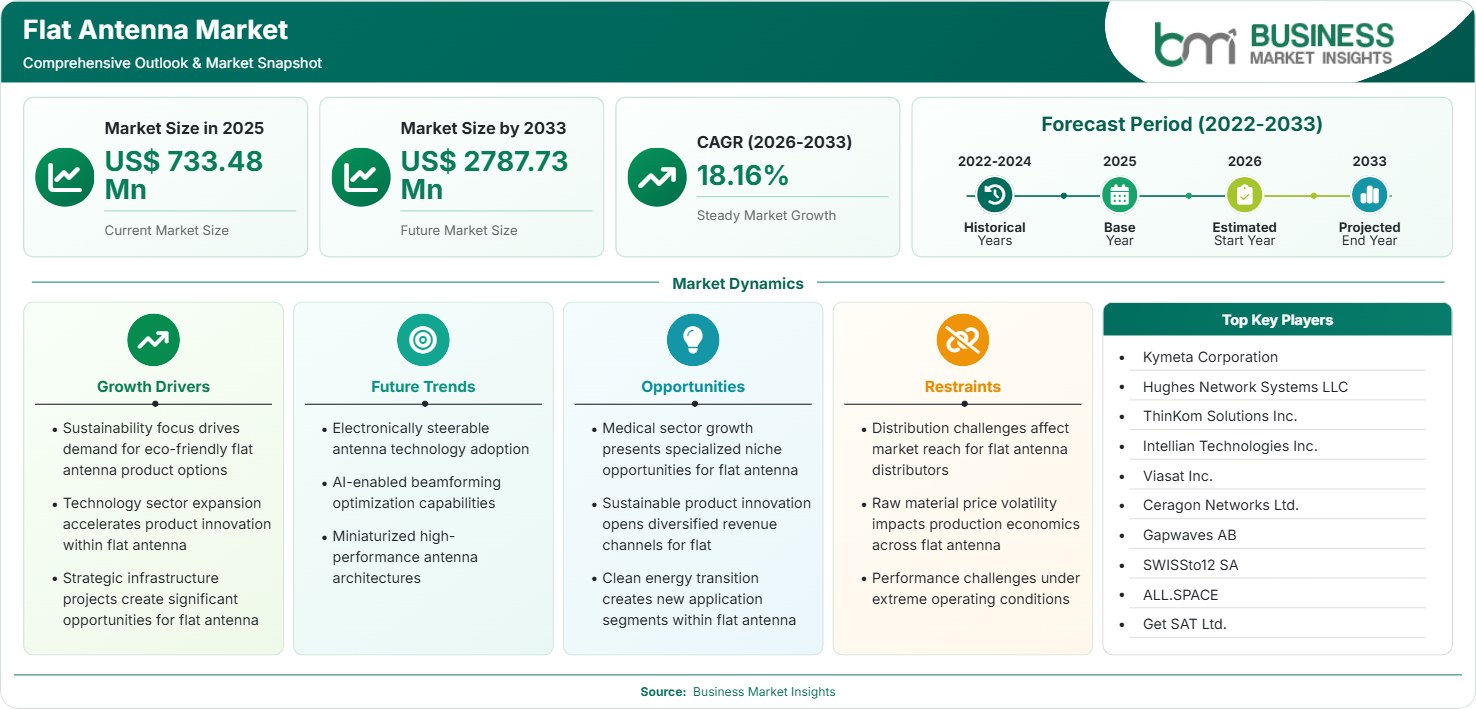
The Flat Antenna Market size was valued at US$ 733.48 million in 2025 and is projected to reach US$ 2787.73 million by 2033, growing at a CAGR of 18.16% during 2026–2033. Rising satellite connectivity demand, expanding 5G infrastructure, increasing defense communication investments, and rapid adoption of electronically steerable antenna technologies continue strengthening long-term market expansion.

Report Coverage
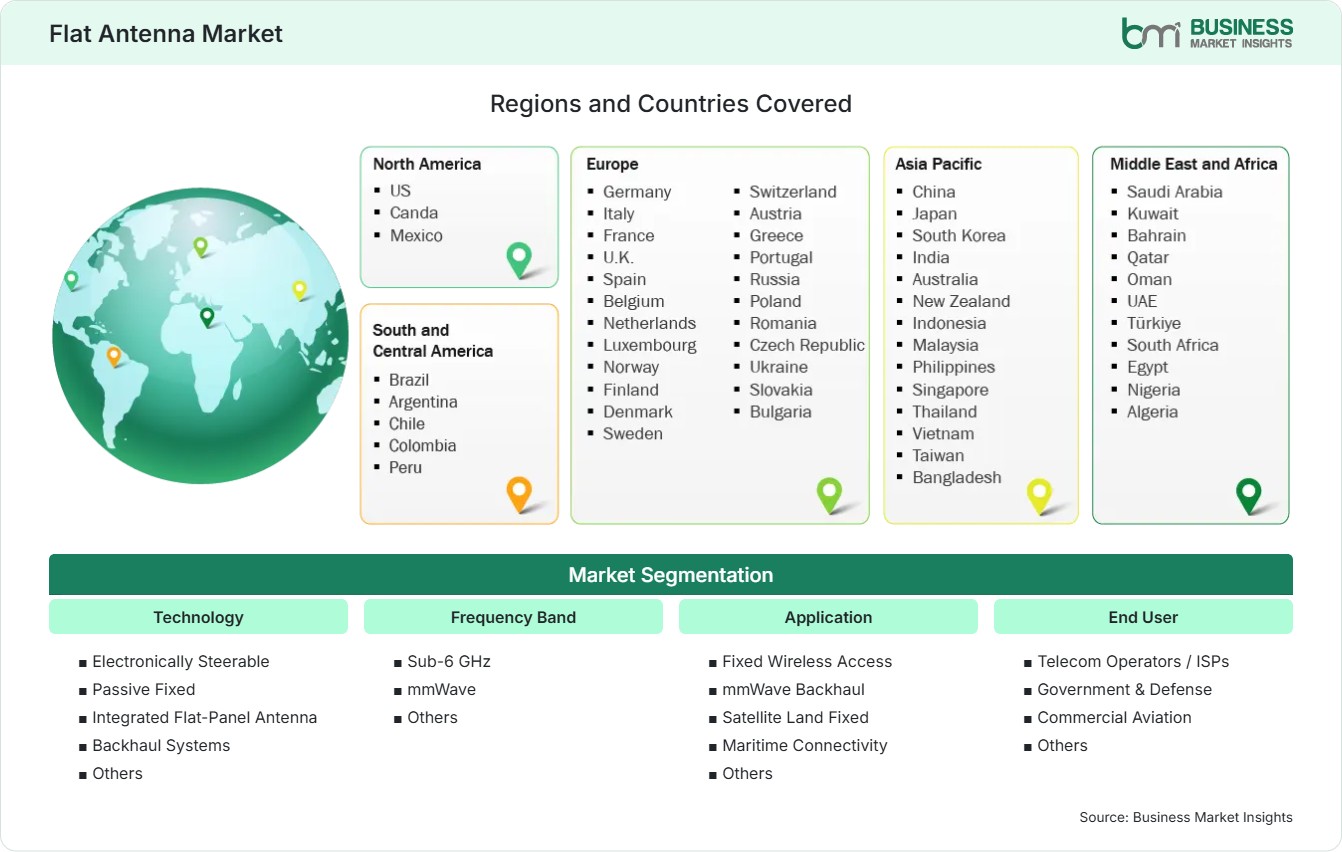
  • Technology: Electronically Steerable, Passive Fixed, Integrated Flat-Panel Antenna, Backhaul Systems, Others
  • Frequency Band: Sub-6 GHz, mmWave , Others
  • Application: Fixed Wireless Access, mmWave Backhaul, Satellite Land Fixed, Maritime Connectivity, Others
  • End User: Telecom Operators / ISPs, Government & Defense, Commercial Aviation, Others
US$ 733.48 Mn Market size in 2025
US$ 2787.73 Mn Market Size by 2033
18.16% CAGR, 2026 - 2033
2026-2033 Forecast Period

AI Overview

Flat Antenna Market Summary

  • North America Region: North America accounts for 36%–39% market share in 2025 and is projected to register a CAGR of 17.5%–18.0% during 2026–2033. Strong satellite communications deployment, defense modernization programs, and commercial broadband investments continue driving regional adoption. The U.S. remains the largest contributor with a CAGR of 17.7%–18.2%, supported by growing low Earth orbit (LEO) satellite deployments and government communication programs.
  • Fastest Growing Region: Asia Pacific represents 27%–30% flat antenna market share in 2025 and is expected to expand at a CAGR of 19.3%–19.9%, driven by expanding satellite broadband coverage, increasing defense expenditure, 5G network deployment, and rising investments in aerospace communication infrastructure.
  • Leading Segment: Electronically Steerable technology accounts for 41%–44% market share in 2025 and is projected to register a CAGR of 18.8%–19.4%, supported by superior beam steering, mobility, and compatibility with next-generation satellite constellations.
  • High Growth Segment: Telecom Operators / ISPs account for 33%–36% market share in 2025 and are anticipated to grow at a CAGR of 19.6%–20.2%, driven by expanding fixed wireless access services and satellite-enabled broadband connectivity.
  • Key Market Opportunity: Expanding satellite broadband services, mobile connectivity platforms, and electronically steerable antenna technologies continue creating strong commercial opportunities across telecommunications, aviation, maritime, and defense sectors.
  • Major Market Players: Kymeta Corporation, Hughes Network Systems, LLC, ThinKom Solutions, Inc., Intellian Technologies, Inc., Viasat, Inc., Ceragon Networks Ltd., Gapwaves AB, SWISSto12 SA, ALL.SPACE, and Get SAT Ltd.
Strategic Insights

Flat Antenna Market: Strategic Insights

Flat Antenna Market Strategic Framework
FREE PDF
Request your free sample
Request free sample
Stakeholder View

Key Takeaways

  • Increasing deployment of LEO satellite constellations is strengthening demand for flat-panel antennas capable of delivering high-speed, low-latency broadband connectivity across mobile and fixed applications.
  • Electronically steerable antenna technology continues gaining preference because it eliminates mechanical movement while improving tracking accuracy, reliability, and communication performance.
  • Telecommunications operators remain key growth contributors as fixed wireless access and satellite broadband services expand into rural and underserved regions.
  • Asia Pacific offers significant long-term investment potential due to rising satellite launches, expanding telecommunications infrastructure, and increasing defense modernization initiatives.
  • Strategic collaborations among satellite operators, antenna manufacturers, and communication technology providers continue accelerating commercialization of advanced connectivity solutions.
  • Continued investment in lightweight materials, integrated electronics, and phased-array architectures is improving antenna efficiency while reducing installation complexity across multiple end-use industries.
Geographic Outlook

Flat Antenna Market Regional Highlights

North America Flat Antenna Market

North America accounts for 36%–39% Flat Antenna Market share in 2025 and is expected to expand at a CAGR of 17.5%–18.0% during 2026–2033. Strong investment in satellite communications, defense modernization, and commercial broadband infrastructure supports regional demand. Continuous deployment of LEO satellite constellations and growing adoption of mobility-focused communication systems are encouraging manufacturers to introduce advanced flat-panel antenna technologies with higher bandwidth and improved operational flexibility.

  • Defense modernization programs continue increasing procurement of advanced satellite communication systems for secure tactical operations.
  • Commercial aviation and maritime operators expand broadband connectivity services using electronically steerable antenna technologies.
  • Growing satellite broadband subscriptions strengthen demand for compact and high-performance communication terminals.
  • Technology partnerships accelerate product innovation across mobility, enterprise, and government communication applications.

US Flat Antenna Market

The United States contributes 84%–87% of North American revenue and is projected to register a CAGR of 17.7%–18.2% through 2026–2033. Government space initiatives, expanding commercial satellite services, and increasing adoption of next-generation communication technologies continue supporting market development.

  • Satellite communication investments continue supporting broadband connectivity across remote and underserved locations.
  • Defense agencies increasingly adopt electronically steerable antenna platforms for secure communication capabilities.
  • Commercial enterprises continue investing in resilient communication infrastructure for business continuity.
  • Aerospace innovation encourages deployment of advanced phased-array antenna technologies.

Europe Flat Antenna Market

Europe represents 24%–27% market share in 2025 and is forecast to expand at a CAGR of 17.0%–17.6% during the forecast period. Demand is supported by satellite communication investments, defense cooperation programs, and digital infrastructure expansion. Germany leads regional deployment, while the United Kingdom records the fastest growth owing to increasing investments in satellite technology and aerospace innovation.

  • Space technology initiatives continue strengthening demand for advanced communication systems.
  • Defense organizations expand satellite-based communication capabilities across multiple operational environments.
  • Aviation connectivity projects encourage deployment of lightweight flat-panel antenna solutions.
  • Public and private investments support research in phased-array and electronically steerable technologies.

Asia Pacific Flat Antenna Market

Asia Pacific holds 27%–30% market share in 2025 and is projected to record the fastest 19.3%–19.9% CAGR during 2026–2033. Rapid deployment of communication satellites, expanding 5G infrastructure, rising defense expenditure, and increasing digital connectivity initiatives continue driving regional demand. China remains the leading regional market, while India demonstrates the fastest growth supported by satellite communication programs and expanding broadband infrastructure.

  • Growing investments in satellite communication infrastructure improve digital connectivity across remote regions.
  • Expansion of 5G and fixed wireless access networks strengthens commercial antenna demand.
  • Defense modernization programs continue supporting procurement of advanced communication platforms.
  • Domestic satellite manufacturing capabilities accelerate regional technology development.

Rest of World Flat Antenna Market

The Rest of World region accounts for 7%–10% market share in 2025 and is expected to register a CAGR of 17.8%–18.5% during the forecast period. Expanding satellite communication projects, maritime connectivity initiatives, and government broadband programs continue supporting demand across Latin America, the Middle East, and Africa.

  • Brazil leads regional adoption through expanding satellite broadband infrastructure and enterprise connectivity projects.
  • Gulf countries continue investing in defense communication modernization and smart infrastructure initiatives.
  • Maritime operators increasingly deploy advanced satellite terminals for uninterrupted onboard connectivity.
  • Rural broadband programs encourage wider adoption of flat-panel antenna technologies across underserved communities.
Global Market Geography
FREE PDF
Request your free sample
Request free sample
Segment Analysis

Flat Antenna Market Segmentation

Installation Type

The installation type segment represents a critical factor influencing product design and deployment across communication environments. It accounted for 34%–37% market share in 2025 and is projected to expand at a CAGR of 18.5%–19.1% during 2026–2033. Increasing mobility requirements, satellite communication deployments, and rugged field applications continue broadening the Flat Antenna Market scope, encouraging manufacturers to develop lightweight, compact, and high-performance installation solutions.

  • Indoor / Window-Mounted: Increasingly adopted for fixed wireless access and enterprise connectivity where compact design, simplified installation, and reliable indoor signal reception are essential.
  • Outdoor Fixed: Widely deployed in broadband communication infrastructure, remote enterprise sites, and public networks requiring stable, high-capacity satellite connectivity under varying environmental conditions.
  • Vehicular / Mobile: Experiences strong demand from public safety agencies, logistics fleets, rail transportation, and emergency response services requiring uninterrupted connectivity during movement.
  • Shipborne: Gains wider adoption across commercial shipping, offshore energy operations, fishing fleets, and naval vessels where continuous satellite communication supports navigation, safety, and operational efficiency.
  • Airborne: Increasing deployment across commercial aviation, business jets, unmanned aerial vehicles, and military aircraft requiring reliable high-speed in-flight broadband communication.
  • Ruggedized Tactical: Preferred by defense organizations because of superior durability, mobility, and secure communication capabilities across harsh operational environments and tactical field missions.

Technology

Technology innovation remains the primary competitive differentiator as communication systems require higher bandwidth, faster tracking, and improved signal reliability. This segment represented 41%–44% market share in 2025 and is expected to register a CAGR of 18.8%–19.4% during 2026–2033. Ongoing Flat Antenna Market trends show increasing investments in electronically steerable platforms, integrated communication systems, and advanced phased-array architectures supporting next-generation satellite connectivity.

  • Electronically Steerable: Holds the leading position owing to rapid beam steering, low maintenance requirements, enhanced reliability, and compatibility with low Earth orbit satellite constellations.
  • Passive Fixed: Continues serving cost-sensitive installations where fixed communication links provide dependable connectivity without requiring active beam steering capabilities.
  • Integrated Flat-Panel Antenna: Growing adoption across compact communication terminals combining antennas, electronics, and signal processing within lightweight integrated platforms for simplified deployment.
  • Backhaul Systems: Increasingly utilized by telecommunications providers to support high-capacity wireless backhaul links connecting distributed broadband infrastructure and 5G networks.
  • Others: Includes specialized antenna technologies designed for niche communication environments requiring customized performance characteristics and application-specific integration.

Frequency Band

Frequency selection plays a crucial role in determining communication performance, bandwidth capacity, propagation characteristics, and deployment suitability. The segment accounted for 46%–49% market share in 2025 and is anticipated to expand at a CAGR of 18.2%–18.8% through the forecast period. Increasing satellite deployments and high-speed wireless communication requirements continue accelerating adoption of advanced frequency technologies.

  • Sub-6 GHz: Maintains broad deployment across fixed wireless access, enterprise connectivity, and government communication networks because of wider coverage and dependable signal propagation.
  • mmWave (24-100 GHz): Records the fastest adoption due to exceptionally high data transmission capacity supporting 5G infrastructure, satellite broadband, and high-throughput communication services.
  • Others: Includes specialized frequency bands supporting customized defense, aerospace, scientific, and industrial communication applications requiring unique operational capabilities.

Application

Application diversity continues expanding as satellite communication becomes essential across commercial, transportation, and public-sector operations. This segment represented 38%–41% market share in 2025 and is projected to grow at a CAGR of 18.7%–19.3% during 2026–2033. Increasing broadband demand, digital transformation, and mobility-focused communication services continue strengthening market opportunities across multiple industries.

  • Fixed Wireless Access: Represents one of the largest application areas, enabling broadband connectivity in rural, suburban, and underserved locations without extensive wired infrastructure.
  • mmWave Backhaul: Supports high-capacity wireless communication links connecting 5G base stations and expanding broadband infrastructure with minimal latency.
  • Satellite Land Fixed: Continues expanding across enterprise, government, and remote industrial facilities requiring dependable satellite communication for mission-critical operations.
  • Maritime Connectivity: Experiences strong growth as shipping companies, offshore platforms, and cruise operators invest in continuous broadband communication and digital fleet management.
  • Others: Includes emergency response, disaster recovery, broadcasting, mining, public safety, and specialized industrial communication applications requiring reliable satellite connectivity.

End User

End-user demand continues broadening as digital connectivity becomes increasingly important across commercial, government, and transportation sectors. The segment accounted for 33%–36% market share in 2025 and is forecast to register a CAGR of 19.6%–20.2% during 2026–2033. Expanding satellite broadband services and growing communication requirements continue encouraging investment across multiple end-user industries.

  • Telecom Operators / ISPs: Lead market adoption by expanding satellite broadband coverage, fixed wireless access services, and next-generation communication infrastructure.
  • Government & Defense: Continue investing in secure, resilient, and mobile communication systems supporting surveillance, tactical operations, border security, and emergency response.
  • Commercial Aviation: Increasingly deploys flat-panel antenna systems to provide reliable in-flight broadband connectivity, operational communications, and enhanced passenger digital services.
  • Others: Includes maritime operators, enterprise organizations, energy companies, transportation providers, research institutions, and public safety agencies utilizing advanced satellite communication technologies.
Market Forces

Flat Antenna Market Dynamics

Key Market Drivers

Sustainability focus drives demand for eco-friendly flat antenna product options

Sustainability has become an important consideration across the communications and electronics industry, encouraging manufacturers to adopt environmentally responsible production practices and energy-efficient product designs. Organizations have increasingly been using light-weight materials, recyclable parts, and methods of production that minimize the carbon footprint while being more efficient. Flat antennas occupy lesser installation space and allow for lower energy consumption than mechanically steered antennas in many cases. This trend continues to fuel the growth of the Flat Antenna market as telecom companies, satellite firms, and enterprises make their infrastructure investments in a sustainable manner.

Technology sector expansion accelerates product innovation within flat antenna

Rapid advances in satellite communications, phased-array technology, semiconductor integration, and wireless networking continue accelerating innovation across the industry. The development of Low Earth Orbit Satellite constellations, expansion of 5G network infrastructure, and increasing requirements for seamless broadband connectivity have made companies consider launching antenna systems that are smaller in size, electronically controlled, have higher bandwidths, and lower latencies. Studies on beamforming techniques, chips integration, and composite materials have made antennas more efficient but less complex. This has been making antenna technology even more commercially attractive in communications within various industries around the world.

Strategic infrastructure projects create significant opportunities for flat antenna

The continuous investment by governments and private firms in digital infrastructure projects necessitates communication systems using satellites. Programs for broadband deployment, smart cities, transport network, and defense communications are contributing to the growing demand for high-end flat panel antennas. Moreover, there is a growing involvement by international agencies in promoting digital inclusion through expanding broadband coverage in underprivileged areas. These investments continue shaping Flat Antenna Market trends, encouraging manufacturers to develop scalable communication platforms capable of supporting diverse operational environments while meeting growing bandwidth requirements.

Key Market Opportunities

Medical sector growth presents specialized niche opportunities for flat antenna

Healthcare providers increasingly rely on dependable communication infrastructure to support telemedicine, emergency response, mobile healthcare services, and remote patient monitoring. Communication via satellite-based connectivity technology with small flat-panel antennas will ensure effective communication in rural hospital environments, disaster relief work, military medical services, and temporary healthcare units where terrestrial communication technologies have not been sufficiently developed yet. The firms which design lightweight, easily portable, and very reliable communication devices for healthcare organizations are going to take advantage of the digital health trends.

Sustainable product innovation opens diversified revenue channels for flat

Increasing attention toward environmentally sustainable technology practices is forcing antenna manufacturers to redesign products with the use of environmentally friendly materials, energy-efficient electronics, and efficient production methods. There is a growing consumer preference for communication equipment that can help reduce lifecycle costs and achieve corporate sustainability goals. Flat Antenna Market Forecasts indicate that sustainable product innovation will remain an important competitive differentiator as governments and commercial organizations strengthen environmental procurement standards.

Clean energy transition creates new application segments within flat antenna

The expansion of renewable energy infrastructure is generating new opportunities for satellite communication systems supporting remote operations and asset monitoring. The use of wind farms, solar facilities, off shore energy installations and energy distribution requires broadband Internet for control and predictive maintenance purposes. Flat panel antennas ensure reliable communication in cases when the terrestrial infrastructure cannot be used due to technical or financial reasons. As clean energy investments continue increasing worldwide, manufacturers are expected to benefit from broader deployment across distributed energy and utility applications.

Market Restraints and Challenges

Distribution challenges affect market reach for flat antenna distributors

Expanding into emerging markets often requires extensive distribution networks, specialized technical support, and compliance with diverse regulatory requirements. Factor: The lack of capability to distribute products regionally and reliance on channel partners that are specialized in their operations affects product accessibility and slows customer acquisition process in rapidly growing regions. Impact: There will be an increase in the delivery time and operation costs and also decrease in the market penetration levels, hence limiting the income generation capabilities especially for small-scale manufacturers.

Raw material price volatility impacts production economics across flat antenna

Manufacturers remain exposed to fluctuations in the prices of semiconductor components, specialty metals, advanced composite materials, and electronic assemblies required for flat-panel antenna production. Factor: Volatile input costs increase manufacturing expenses and complicate long-term procurement planning across global supply chains. Impact: Profit margins may decline while product pricing becomes less predictable, affecting investment decisions and competitive positioning. To reduce these risks, manufacturers are diversifying supplier networks, optimizing component sourcing strategies, and investing in production efficiency to maintain stable operational performance.

Company Analysis

Competitive Landscape

The competitive environment is characterized by continuous innovation in phased-array technology, electronically steerable antennas, satellite connectivity solutions, and integrated communication platforms. Flat Antenna Market analysis shows that leading companies are expanding research and development investments, strengthening partnerships with satellite operators, and enhancing production capabilities to address growing demand from telecommunications, defense, maritime, aviation, and enterprise communication sectors.

Company Name

Overview

Products and Services Relevant to this Market

Kymeta Corporation

Develops advanced satellite communication solutions using software-defined, electronically steerable flat-panel antenna technologies for mobility applications.

Electronically steerable flat-panel antennas, satellite terminals, hybrid cellular-satellite connectivity solutions, and mobile communication platforms.

Hughes Network Systems, LLC

Global provider of satellite broadband and managed network solutions serving enterprise, government, and consumer markets.

Satellite communication terminals, broadband connectivity solutions, flat-panel antenna systems, managed network services, and enterprise communication platforms.

ThinKom Solutions, Inc.

Specializes in broadband antenna technologies for commercial aviation, military, and mobility communication applications.

ThinAir flat-panel antennas, airborne connectivity systems, satellite communication technologies, and aviation broadband solutions.

Intellian Technologies, Inc.

Leading manufacturer of satellite communication equipment supporting maritime, enterprise, defense, and mobility markets.

Flat-panel antennas, maritime VSAT terminals, enterprise satellite communication systems, and multi-orbit connectivity solutions.

Viasat, Inc.

Global communications company delivering satellite broadband, mobility, and secure networking services worldwide.

Satellite communication terminals, broadband services, flat-panel connectivity systems, defense communication solutions, and aviation connectivity.

Ceragon Networks Ltd.

Develops wireless transport and backhaul solutions supporting mobile network operators and enterprise connectivity.

Wireless backhaul systems, microwave communication solutions, transport networking equipment, and high-capacity communication infrastructure.

Gapwaves AB

Designs advanced waveguide and antenna technologies for millimeter-wave communication and automotive applications.

Millimeter-wave antennas, high-frequency communication components, phased-array technologies, and advanced antenna modules.

SWISSto12 SA

Aerospace technology company specializing in satellite payloads, RF products, and advanced antenna manufacturing.

Flat-panel antenna technologies, satellite communication equipment, RF components, and aerospace communication systems.

ALL.SPACE

Provides advanced satellite communication terminals supporting defense, maritime, enterprise, and mobility applications.

Multi-link satellite terminals, flat-panel antennas, defense communication systems, and resilient broadband connectivity platforms.

Get SAT Ltd.

Develops compact satellite communication terminals designed for defense, airborne, maritime, and tactical operations.

Lightweight satellite terminals, flat-panel antenna systems, tactical communication equipment, and secure mobility connectivity solutions.

Trust & Transparency

Research Methodology

The market analysis combines proprietary research with secondary data from government agencies, company disclosures, regulatory filings, industry databases and expert interviews. Market estimates are validated through data triangulation, cross-market benchmarking and analyst review.

View Full Research Methodology

Questions Answered

Frequently Asked Questions

What does the Flat Antenna Market Report include?

The Market Report provides detailed insights into market dynamics, competitive landscape, regional performance, segmentation, technology developments, investment opportunities, emerging applications, and long-term industry outlook supporting strategic business decisions.

Which region offers the highest growth opportunities?

Asia Pacific is expected to witness the fastest expansion owing to rising satellite deployments, rapid 5G infrastructure development, growing defense expenditure, and increasing investments in broadband communication networks.

Why are flat-panel antennas becoming increasingly important?

Flat-panel antennas offer lightweight construction, compact design, simplified installation, improved mobility, and high-speed broadband connectivity, making them suitable for aviation, maritime, defense, enterprise, and fixed wireless communication applications.

Which technology segment leads the market?

Electronically steerable antennas hold the leading position because they provide rapid beam steering, higher reliability, lower maintenance requirements, and compatibility with next-generation satellite communication networks.

What factors are driving the Flat Antenna Market?

The market is driven by expanding satellite broadband services, increasing deployment of low Earth orbit satellite constellations, rising defense communication investments, and growing demand for compact, electronically steerable antenna technologies across multiple industries.

Access the Full Flat Antenna Market Report

Get segment-level forecasts, regional estimates, competitive benchmarking, company profiles and downloadable Excel datasets.

Access the full Flat Antenna Market Report
350 pages PDF & Excel | 2026-08-18
Similar Research

Related Market Reports