Market Summary
Executive Summary and Global Market Analysis
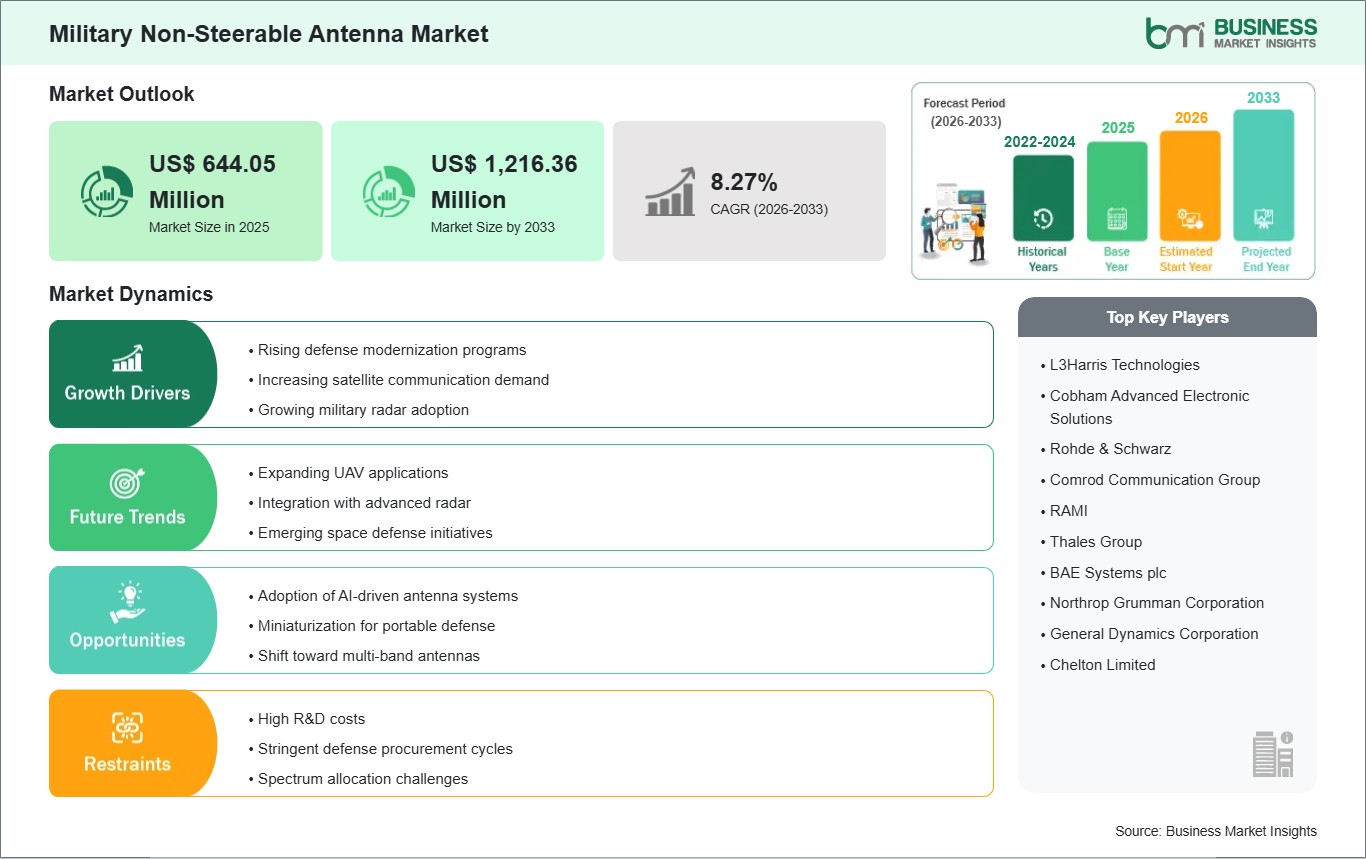
Military non-steerable antennas are fixed-direction communication and signal transmission systems designed to support secure and reliable defense communications across land, naval, airborne, and space-based military operations. These antennas are widely used in tactical radios, radar systems, satellite communications, electronic warfare systems, surveillance infrastructure, and battlefield communication networks. Common antenna technologies include parabolic, helical, patch, and dipole antennas, each offering unique operational advantages for military-grade communication, navigation, and signal intelligence applications. Military non-steerable antennas operate across multiple frequency bands including HF, VHF, UHF, and SHF to support long-range communication, secure data transmission, radar operations, and real-time situational awareness in complex operational environments.
Market growth is being driven by increasing global defense expenditures, rising geopolitical tensions, and the growing need for secure and uninterrupted military communication systems. Modern military forces are increasingly investing in advanced communication infrastructure capable of supporting network-centric warfare, autonomous defense systems, and integrated command-and-control operations. The expanding deployment of unmanned aerial vehicles, next-generation naval vessels, battlefield communication systems, and satellite-based defense platforms is further accelerating demand for high-performance non-steerable antennas. In addition, advancements in electronic warfare and ISR operations are increasing the requirement for resilient antenna systems capable of operating effectively in contested electromagnetic environments.
However, several factors may restrain market growth. The high cost associated with military-grade antenna design, ruggedization, testing, and integration remains a key challenge, particularly for developing economies with constrained defense budgets. Military non-steerable antennas must comply with strict operational and environmental standards, increasing manufacturing complexity and deployment costs. The market also faces technical limitations related to signal interference, bandwidth constraints, and performance degradation in harsh operational environments. Additionally, long defense procurement cycles, export control regulations, and dependence on specialized raw materials and semiconductor components can delay deployment timelines and increase supply chain risks for manufacturers.
Despite these challenges, the market outlook remains positive due to continuous advancements in military communication technologies and increasing investments in next-generation defense systems. Opportunities are emerging through the integration of AI-enabled communication systems, software-defined radios, satellite communication modernization, and multi-band antenna architectures. The growing focus on electronic warfare resilience, secure battlefield connectivity, and space-based defense communication networks is expected to create strong long-term demand for military non-steerable antennas. Furthermore, modernization programs across air, naval, and land defense platforms are expected to accelerate adoption of compact, lightweight, and high-frequency antenna solutions capable of supporting modern military mission requirements.
Segment Analysis
Military Non-Steerable Antenna Market Segmentation
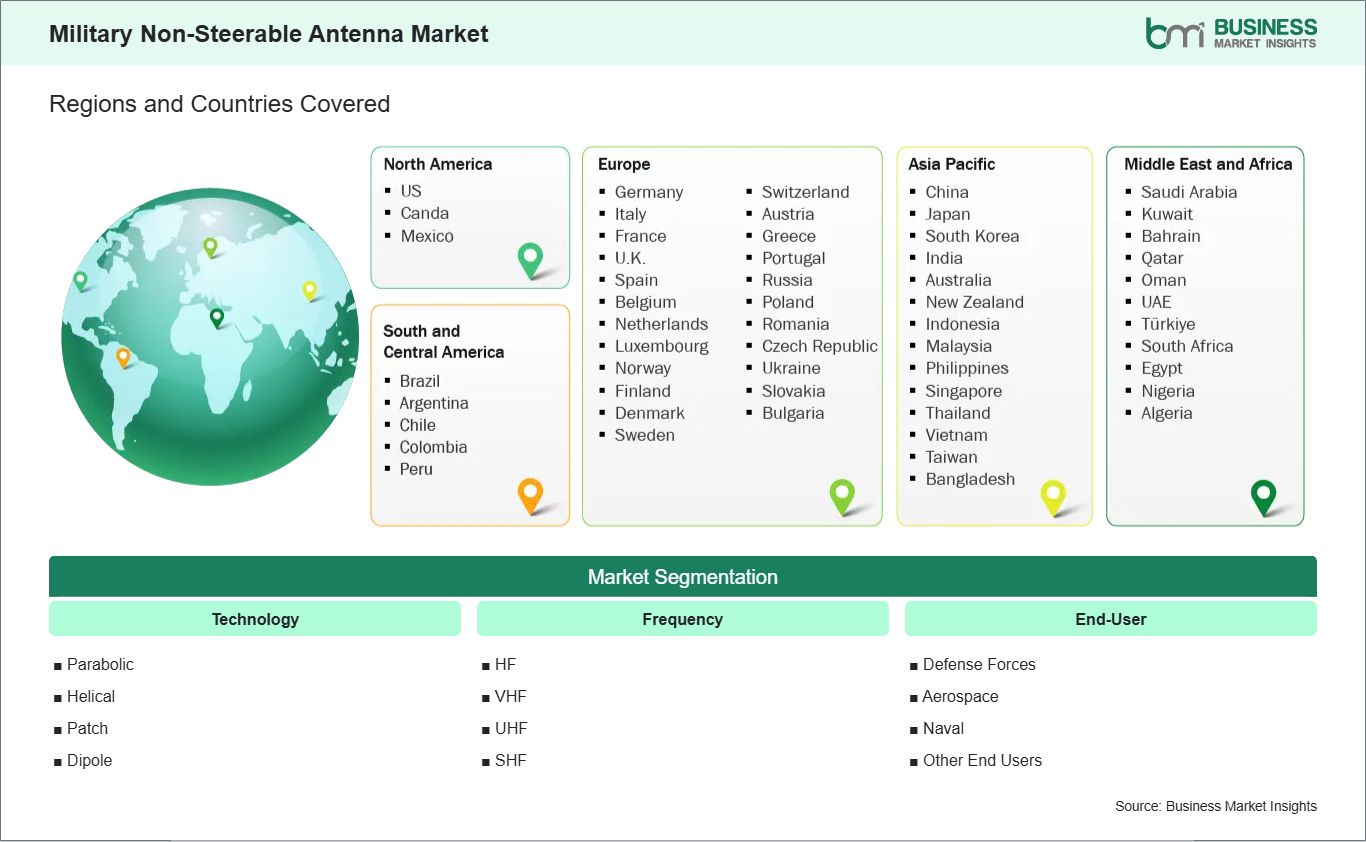
The military non-steerable antenna market is segmented based on technology, frequency, and end-user, reflecting the growing demand for advanced imaging and depth-sensing solutions across multiple applications.
By Technology
- Parabolic: High-gain antennas widely used in military radar systems, satellite communication, and long-range secure communication applications
- Helical: Circularly polarized antennas deployed in satellite tracking, airborne communication, missile guidance, and electronic warfare systems
- Patch: Compact and lightweight antennas integrated into UAVs, wearable defense devices, tactical communication systems, and advanced military vehicles
- Dipole: Traditional antenna systems extensively used in tactical radios, battlefield communication, HF broadcasting, and surveillance applications
By Frequency
- HF: Supports long-range communication and over-the-horizon transmission capabilities for naval and strategic military operations
- VHF: Used for ground troop coordination, tactical communication, and short-to-medium-range battlefield connectivity
- UHF: Enables satellite communication, airborne communication, secure tactical radio systems, and modern defense networking infrastructure
- SHF: Supports high-frequency radar systems, satellite communication terminals, electronic intelligence, and advanced surveillance systems
By End-User
- Defense Forces: Military communication systems deployed across army, air force, and joint command operations for secure battlefield connectivity
- Aerospace: Antenna systems integrated into military aircraft, UAVs, satellites, and space-based defense communication platforms
- Naval: Communication and radar antennas used in warships, submarines, maritime surveillance systems, and naval combat operations
- Other End Users: Includes border security agencies, homeland security organizations, defense research institutions, and paramilitary forces
Market Forces
Military Non-Steerable Antenna Market Drivers and Opportunities
Rising Demand for Secure Battlefield Communication and Electronic Warfare Capabilities
The military non-steerable antenna market is witnessing strong growth due to the increasing requirement for secure, reliable, and real-time military communication systems across modern warfare environments. Defense organizations globally are focusing on strengthening communication infrastructure to support network-centric warfare, ISR missions, command-and-control operations, and electronic warfare capabilities. Rising geopolitical tensions and border security challenges are encouraging governments to invest heavily in advanced tactical communication systems and resilient defense networking technologies.
The growing adoption of unmanned systems, satellite communication platforms, and integrated battlefield management systems is significantly increasing demand for advanced antenna technologies. Modern defense operations require uninterrupted communication across multiple operational domains including land, air, naval, cyber, and space. Military non-steerable antennas are increasingly being integrated into radar systems, tactical radios, electronic surveillance platforms, and secure military communication networks to ensure reliable signal transmission in hostile environments. Additionally, advancements in electronic warfare and anti-jamming technologies are driving demand for high-frequency and multi-band antenna systems capable of supporting secure and resilient communication under complex combat conditions.
Expansion of Space-Based Defense Communication and Multi-Band Antenna Technologies
Significant opportunities are emerging in the military non-steerable antenna market through the expansion of satellite-based defense communication systems and next-generation multi-band antenna technologies. Governments are increasingly investing in military satellite constellations, space surveillance programs, and secure communication infrastructure to enhance strategic defense capabilities. This trend is creating substantial demand for SHF and UHF antenna systems capable of supporting high-speed and secure data transmission across military communication networks.
The increasing deployment of compact military electronics, wearable defense communication systems, and autonomous defense platforms is also accelerating demand for lightweight and miniaturized patch and helical antennas. Emerging technologies such as software-defined radios, AI-enabled signal processing, and electronically protected communication systems are creating new growth opportunities for antenna manufacturers. Additionally, growing investments in advanced naval communication systems, airborne ISR platforms, and next-generation combat aircraft are supporting market expansion. Vendors focusing on high-performance, ruggedized, and electronically resilient antenna solutions are expected to gain a competitive advantage as military organizations continue to modernize defense communication infrastructure globally.
Size and Share Analysis
Military Non-Steerable Antenna Market Size and Share Analysis
The Military Non-Steerable Antenna Market is projected to grow from US$ 644.05 Million in 2025 to US$ 1,216.36 Million by 2033 , registering a CAGR of 8.27% from 2026 to 2033.
By technology, the parabolic antenna segment holds a significant market share due to its extensive use in military satellite communication and radar applications requiring long-range and high-gain signal transmission. Patch antennas are witnessing strong growth driven by increasing deployment in UAVs, wearable defense electronics, and compact communication systems. Helical antennas continue to gain traction across aerospace and missile communication applications due to their circular polarization capabilities and reliability in dynamic operational environments. Dipole antennas maintain steady demand owing to their widespread deployment in tactical communication systems and battlefield radio operations.
By frequency, the UHF segment accounts for a substantial share owing to its widespread application in secure military communication, satellite connectivity, and airborne communication systems. SHF frequencies are witnessing rapid growth due to increasing deployment in advanced radar systems, electronic warfare platforms, and military satellite communication infrastructure. VHF systems continue to support tactical ground communication and troop coordination applications, while HF frequencies remain essential for long-range naval communication and strategic defense operations.
By end-user, defense forces dominate the market due to increasing investments in battlefield communication modernization and integrated defense networking systems. The aerospace segment is experiencing strong growth driven by rising deployment of military UAVs, advanced combat aircraft, and satellite communication systems. Naval applications are also expanding steadily with modernization programs focused on maritime surveillance, naval combat systems, and submarine communication technologies. Other end users including border security and homeland defense agencies are increasingly adopting military-grade antenna systems for surveillance and emergency communication operations.
Report Coverage
Military Non-Steerable Antenna Market Report Coverage and Deliverables
The "Military Non-Steerable Antenna market Size and Forecast (2022–2033)" report provides a detailed analysis of the market covering below areas:
- Military non-steerable antenna market size and forecast at global, regional, and country levels for all market segments covered under the scope
- Military non-steerable antenna market trends, as well as drivers, restraints, and opportunities
- Military non-steerable antenna market analysis covering key trends, global and regional framework, major players, regulations, and recent developments
- Industry landscape and competition analysis covering market concentration, heat map analysis, prominent players, and recent developments for the military non-steerable antenna market
- Detailed company profiles, including SWOT analysis
Geographic Insights
Military Non-Steerable Antenna Market Geographic Insights
The Military Non-Steerable Antenna market shows diverse regional adoption patterns influenced by by defense modernization initiatives, geopolitical developments, and increasing demand for secure positioning and guidance technologies across military operations.
North America holds a dominant position in the market due to high defense spending, strong technological capabilities, and the presence of major defense communication system providers. The United States continues to invest heavily in advanced battlefield communication systems, military satellite infrastructure, electronic warfare technologies, and integrated ISR operations. Increasing deployment of autonomous defense systems, advanced radar platforms, and space-based communication technologies is further driving demand for military non-steerable antennas across the region. Canada is also investing in defense communication modernization and secure military networking programs to strengthen operational readiness and interoperability.
Asia Pacific is witnessing substantial market growth driven by rising geopolitical tensions, increasing military modernization programs, and expanding investments in indigenous defense manufacturing capabilities. Countries such as China, India, Japan, and South Korea are strengthening military communication infrastructure through the deployment of advanced radar systems, naval surveillance platforms, tactical communication networks, and military satellites. The region is increasingly focusing on secure communication technologies, electronic warfare preparedness, and integrated defense communication systems to enhance national security capabilities. Rising investments in UAVs, missile defense systems, and naval modernization programs are further contributing to market expansion across Asia Pacific.
Both regions are contributing significantly to the growth of the military non-steerable antenna market through ongoing investments in secure communication systems, advanced defense electronics, and next-generation military networking technologies.
Industry Activity
Recent Developments
The military non-steerable antenna market is evaluated by gathering qualitative and quantitative data post primary and secondary research, which includes important corporate publications, association data, and databases. A few of the key developments in the military non-steerable antenna market are:
- In October 2025, Alaris COJOT’s wideband VHF/UHF antennas deliver the performance and flexibility that modern forces require. Covering the full 30–512 MHz tactical spectrum, they enable seamless interoperability across voice, data, and SATCOM-on-the-move networks. Designed for vehicle, command post, or portable deployment, these antennas provide true broadband coverage in a single, ruggedized form factor - reducing the need for multiple antenna systems, simplifying field integration, and offering magnetic-mount options for rapid or temporary installations.
- In April 2025, C-COM Satellite Systems Inc., a leading global provider of commercial grade mobile auto-deploying satellite antenna systems, announced that it has received US$2 Million worth of orders for iNetVu Manpack antenna systems, next generation 1200+ Ku-band and 98G Ka-band Vehicle Mount systems.
Trust & Transparency
Research Methodology
The market analysis combines proprietary research with secondary data from government agencies, company disclosures, regulatory filings, industry databases and expert interviews. Market estimates are validated through data triangulation, cross-market benchmarking and analyst
review.
View Full Research Methodology
Key Sources Referred:
Stockholm International Peace Research Institute (SIPRI)
North Atlantic Treaty Organization (NATO)
International Institute for Strategic Studies (IISS)
S. Department of Defense (DoD)
Company Websites
Company Annual Reports
Company Investor Presentations