Market Summary
Executive Summary and Global Market Analysis
Satellite antennas are communication systems engineered to transmit and receive radio frequency signals between satellites and terrestrial or mobile platforms. These antennas support connectivity across broadcasting, military communications, navigation, broadband internet, and aerospace operations. Their configurations differ according to mobility requirements, operating frequency bands, tracking precision, and environmental endurance conditions.
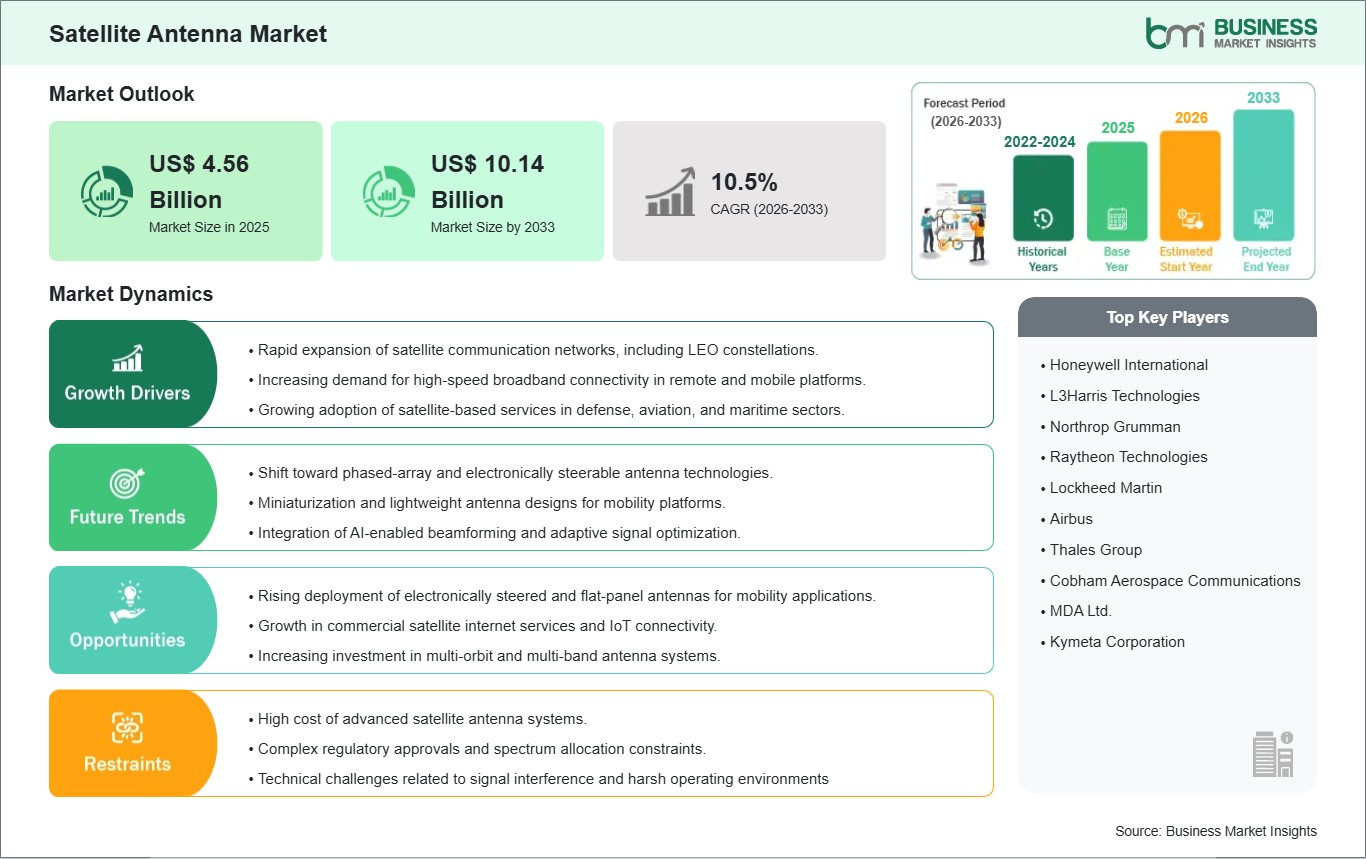
Global communication infrastructure modernization and expanding satellite constellations continue reinforcing deployment activity across the sector. Enterprises and government agencies increasingly seek uninterrupted connectivity for remote operations, transportation systems, and mission-critical networks. Rising utilization of low Earth orbit satellite networks additionally supports antenna integration across mobility-focused communication applications.
Flat panel antennas are gaining commercial attention because compact architectures and electronically steered capabilities support high-speed communication on moving platforms. Parabolic reflector antennas maintain considerable industry relevance for fixed installations requiring stable long-distance signal transmission. Ku/Ka band systems continue witnessing broader integration due to expanding broadband communication requirements across commercial and defense sectors.
Technology evolution within the industry increasingly emphasizes phased-array architectures, lightweight materials, and software-controlled beam steering functionality. Manufacturers are refining antenna efficiency to improve signal tracking accuracy, lower latency, and optimize bandwidth performance across multi-orbit satellite networks. Advanced integration with maritime, airborne, and autonomous mobility systems is additionally shaping next-generation satellite communication infrastructure.
Competitive conditions remain influenced by satellite broadband expansion, defense communication modernization, and connected mobility initiatives. Market participants prioritize compact antenna engineering, thermal resilience, and interoperability across multiple frequency bands and orbital systems. Long-term strategic emphasis on global connectivity infrastructure and real-time communication capability continues supporting innovation across the satellite antenna market.
Segment Analysis
Satellite Antenna Market Segmentation
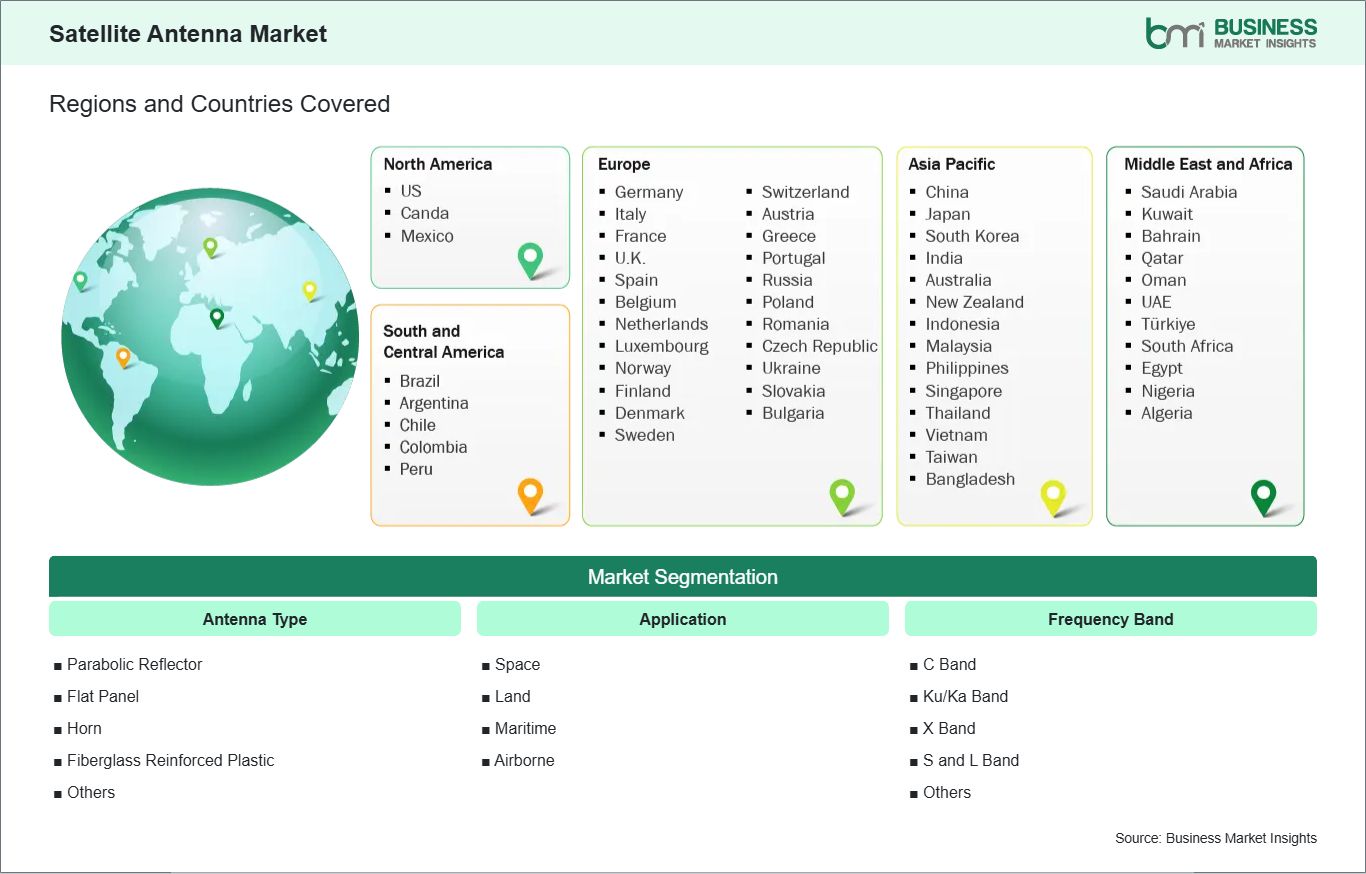
The satellite antenna market is segmented based on antenna type, application and frequency band.
By Antenna Type
- Parabolic Reflector – Maintains strong signal concentration for long-range satellite communication systems.
- Flat Panel – Supports compact mobility applications with electronically steered transmission capability.
- Horn – Enables controlled microwave signal radiation within specialized communication environments.
- Fiberglass Reinforced Plastic – Provides structural durability under demanding operational conditions.
- Others – Addresses customized communication requirements across niche satellite applications.
By Application
- Space – Facilitates spacecraft communication, tracking, and orbital data transmission functions.
- Land – Supports terrestrial broadband infrastructure and remote communication operations.
- Maritime – Strengthens continuous vessel connectivity across offshore navigation routes.
- Airborne – Enhances in-flight communication and real-time aerospace data exchange systems.
By Frequency Band
- C Band – Delivers reliable communication performance under challenging environmental conditions.
- Ku/Ka Band – Improves high-throughput broadband transmission for advanced satellite networks.
- X Band – Serves defense and secure communication operations requiring resilient connectivity.
- S and L Band – Maintains stable communication for navigation and mobile applications.
- Others – Covers specialized operational frequencies supporting emerging satellite services.
Market Forces
Satellite Antenna Market Drivers and Opportunities
Expansion of Satellite-Based Broadband and Mobility Communication
Telecommunication providers and aerospace operators continue strengthening satellite-based communication infrastructure to support uninterrupted global connectivity. Mobile platforms across aviation, shipping, and remote terrestrial operations increasingly require stable high-bandwidth communication systems capable of operating under dynamic environmental conditions. This requirement has accelerated deployment of advanced satellite antenna technologies with enhanced tracking precision and multi-band communication capability.
The operational impact extends into defense modernization, disaster response coordination, and broadband accessibility initiatives. Governments and commercial entities increasingly prioritize resilient communication architecture supporting remote operations and mission continuity. Satellite antennas therefore maintain heightened strategic relevance across connected transportation systems, intelligence operations, and next-generation communication ecosystems.
Development of Electronically Steered and Flat Panel Antenna Systems
Advancements in phased-array engineering and electronically steered communication technologies are reshaping antenna system capabilities. Flat panel antennas increasingly support mobility-oriented communication environments by reducing mechanical complexity and improving aerodynamic efficiency. Innovations in beamforming technologies and lightweight materials are also enabling more compact and energy-efficient antenna deployment across airborne and maritime platforms.
Future opportunities are associated with expanding low Earth orbit satellite constellations and integrated multi-orbit communication networks. Enterprises continue evaluating antenna systems capable of seamless broadband connectivity across terrestrial and mobile environments. Expanding deployment of autonomous transportation systems and connected defense platforms is anticipated to reinforce broader market progression.
Size and Share Analysis
Satellite Antenna Market Size and Share Analysis
The Satellite Antenna Market was valued at USD 4.56 Billion in 2025 and is projected to reach USD 10.14 Billion by 2033, expanding at a CAGR of 10.50% during 2026–2033. Market progression reflects stronger investment in satellite communication infrastructure, connected mobility systems, and advanced broadband connectivity solutions across commercial and government sectors.
Flat panel antennas maintain rising industry prominence due to compact integration capability and electronically steered communication functionality. Ku/Ka band systems also account for considerable deployment because high-throughput communication networks increasingly require enhanced bandwidth efficiency and advanced signal performance.
Land-based applications represent a substantial market contribution owing to expanding satellite broadband infrastructure and remote communication requirements. Airborne and maritime applications additionally demonstrate notable deployment momentum as transportation systems prioritize uninterrupted connectivity and operational communication reliability.
Report Coverage
Satellite Antenna Market Report Coverage and Deliverables
The Satellite Antenna report provides a detailed analysis of the market covering the below areas:
- Market size and forecast at global, regional, and country levels for all the key market segments covered under the scope
- Market size and forecast at global, regional, and country levels for all the key market segments covered under the scope
- Market trends, as well as market dynamics such as drivers, restraints, and key opportunities
- Market analysis covering key market trends, global and regional framework, major players, regulations, and recent market developments
- Industry landscape and competition analysis covering market concentration, heat map analysis, prominent players, and recent developments for the market
- Detailed company profiles, including SWOT analysis
Geographic Insights
Satellite Antenna Market Geographic Insights
The Satellite Antenna market shows diverse regional adoption patterns influenced by satellite broadband expansion, defense communication priorities, aerospace modernization programs, and connected mobility infrastructure development. Communication providers and government agencies worldwide continue strengthening satellite connectivity capabilities to support resilient broadband coverage and mission-critical communication systems.
North America demonstrates strong market advancement due to extensive aerospace innovation, defense communication investment, and commercial satellite deployment activity. Enterprises across the region increasingly integrate flat panel and phased-array antenna technologies into airborne, maritime, and terrestrial communication platforms. Expanding low Earth orbit satellite programs additionally contribute to higher deployment of next-generation antenna systems supporting high-throughput connectivity.
Asia Pacific reflects accelerating communication infrastructure development supported by expanding space programs and rising broadband accessibility initiatives. Governments and telecommunication operators throughout the region continue prioritizing satellite connectivity solutions for remote coverage expansion and transportation communication networks. Maritime trade activity and aviation modernization programs further strengthen utilization of advanced antenna systems across regional markets.
Europe maintains a technologically advanced communication ecosystem emphasizing secure connectivity, aerospace research, and integrated satellite communication capability. Regional organizations continue focusing on electronically steered antenna systems and multi-band communication platforms for defense and commercial environments. Emerging markets across the Middle East, Africa, and South and Central America are additionally strengthening satellite communication infrastructure to improve digital access, navigation efficiency, and remote connectivity coverage.
Industry Activity
Recent Developments
The satellite antenna market is evaluated by gathering qualitative and quantitative data post primary and secondary research, which includes important corporate publications, association data, and databases. Recent developments and news in the market include:
- In Apri, 2026, Amazon Leo is preparing to provide fast, reliable internet connectivity to a wide variety of customers, using satellites in low Earth orbit to deliver high speeds and low latency across land, sea, and skies. The company is designing its own hardware to optimize performance across the network, and its newest antenna, the Amazon Leo Aviation Antenna, will allow commercial airline passengers and crew to enjoy high performance from their departure gate all the way to their arrival gate.
- In November 2025, KYOCERA AVX launched a new LDS cap antenna and evaluation board optimized for Iridium® satellite IoT applications and designated as Iridium Qualified Antenna products for Iridium Certus 9704 modules. Developed to provide Iridium with an embedded antenna optimized for low Earth orbit (LEO) satellites used to provide seamless connectivity and data exchange for IoT devices anywhere in the world, the new KYOCERA AVX LDS cap antenna developed for Iridium outperforms the ceramic patch antennas traditionally used in these applications.
Trust & Transparency
Research Methodology
The market analysis combines proprietary research with secondary data from government agencies, company disclosures, regulatory filings, industry databases and expert interviews. Market estimates are validated through data triangulation, cross-market benchmarking and analyst
review.
View Full Research Methodology
Key Sources Referred:
Satellite communication industry reportsGovernment aerospace and communication databasesAcademic journals related to RF and antenna engineeringCompany annual reports and communication filingsSpace communication and broadband research studiesDefense communication technology publicationsMaritime and airborne connectivity research papersSatellite mobility infrastructure and phased-array antenna studies