
Endpoint Detection and Response Market Outlook: Size, Share, Trends, Growth Analysis, Competitive Landscape & Forecast, 2026-2033

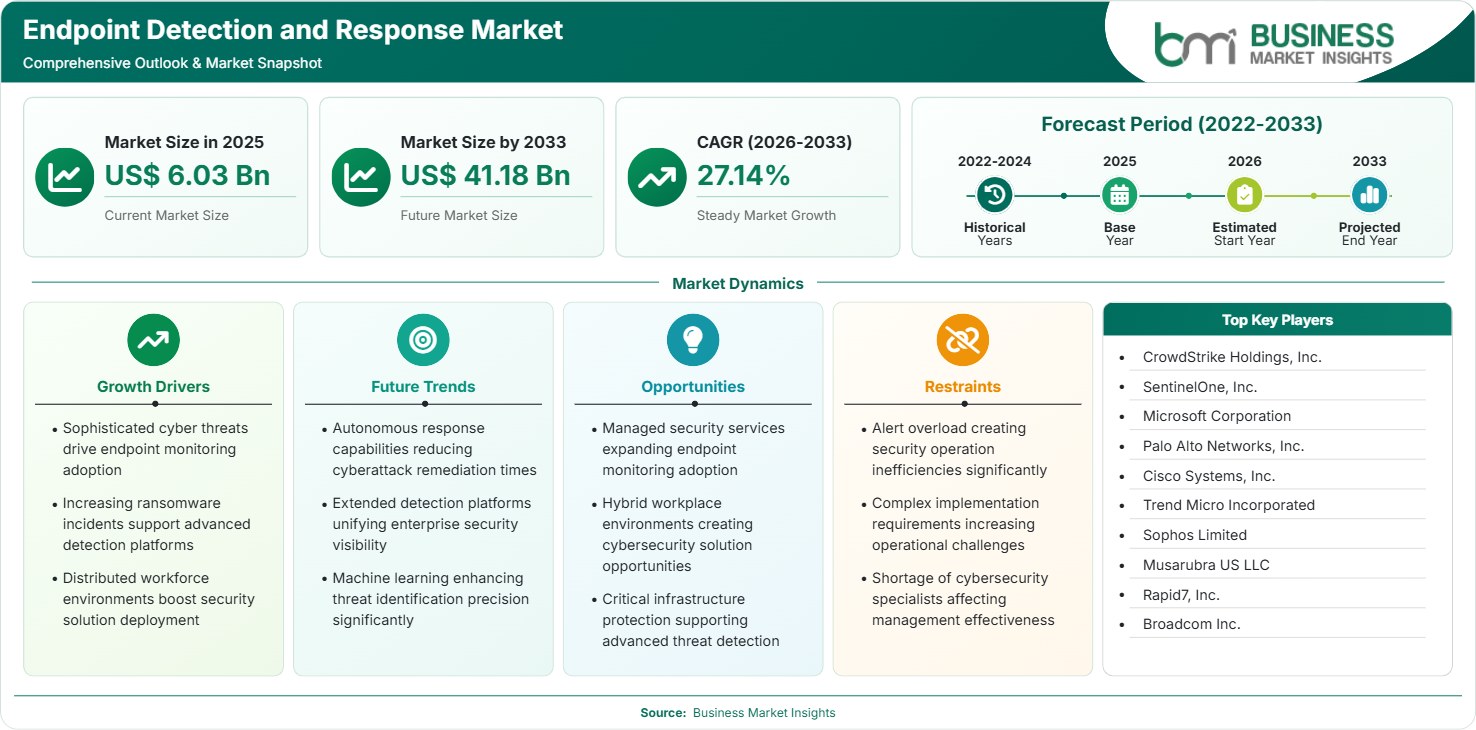
The Endpoint Detection and Response Market size was valued at US$ 6.03 Billion in 2025 and is projected to reach US$ 41.18 Billion by 2033, growing at a CAGR of 27.14% during 2026–2033, driven by ransomware exposure, cloud adoption, AI-enabled attacks, zero-trust programs, and demand for automated threat containment.

Report Coverage
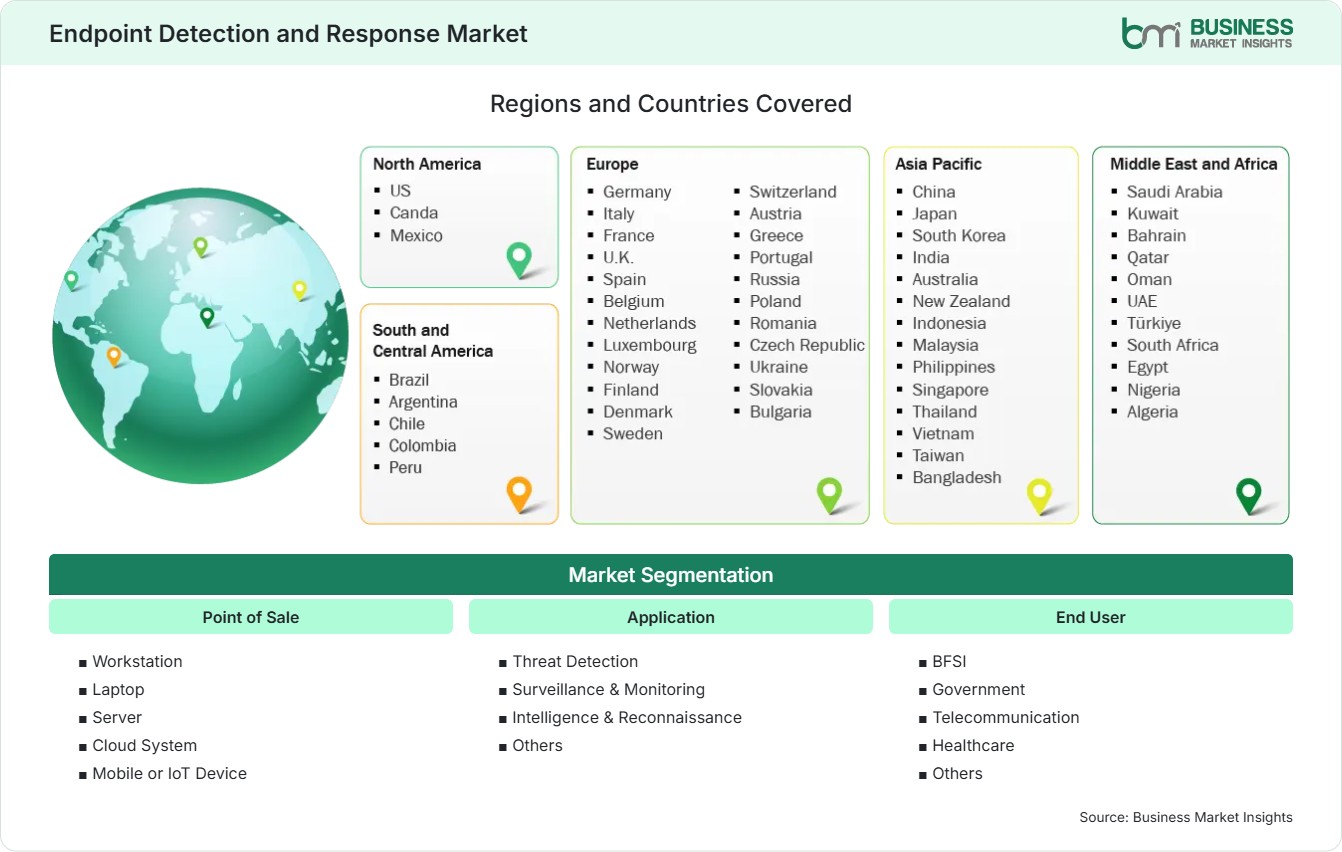
  • Point of Sale: Workstation, Laptop, Server, Cloud System, Mobile or IoT Device
  • Application: Threat Detection, Surveillance & Monitoring, Intelligence & Reconnaissance, Others
  • End User: BFSI, Government, Telecommunication, Healthcare, Others
US$ 6.03 Bn Market size in 2025
US$ 41.18 Bn Market Size by 2033
27.14% CAGR, 2026 - 2033
2026-2033 Forecast Period

AI Overview

Endpoint Detection and Response Market Summary

  • North America Region: North America holds a 35%–39% share in 2025, growing at a 25%–28% CAGR during 2026–2033, supported by mature security spending, cloud workloads, regulatory pressure, ransomware exposure, AI security investment, and enterprise automation. The US remains the principal contributor, with large enterprises expanding endpoint telemetry, automated response, identity protection, and security operations integration across distributed workforces.
  • Fastest Growing Region: Asia Pacific holds a 22%–26% Endpoint Detection and Response Market share in 2025 and is expanding at a 29%–32% CAGR, driven by cloud migration, digital banking, connected devices, expanding technology infrastructure, cybersecurity modernization, regulatory enforcement, and increasing investment in automated endpoint protection across rapidly digitizing economies.
  • Leading Segment: Point of Sale leads with a 38%–42% share in 2025 and a 26%–29% CAGR, supported by extensive endpoint deployment, remote work, server modernization, cloud infrastructure, mobile computing, IoT expansion, centralized telemetry, automated investigation, and stronger requirements for endpoint visibility across distributed enterprise environments.
  • High Growth Segment: Cloud System represents a 23%–27% share in 2025 and is growing at a 31%–34% CAGR, benefiting from workload migration, hybrid infrastructure, cloud-native applications, distributed identities, elastic computing, security automation, and increasing demand for continuous monitoring across dynamically changing enterprise environments.
  • Key Market Opportunity: The principal opportunity lies in autonomous detection and response, where AI-assisted investigation, behavioral analytics, identity context, cloud telemetry, and automated remediation can reduce analyst workload while expanding security coverage.
  • Major Market Players: CrowdStrike Holdings, Inc.; SentinelOne, Inc.; Microsoft Corporation; Palo Alto Networks, Inc.; Cisco Systems, Inc.; Trend Micro Incorporated; Sophos Limited; Musarubra US LLC; Rapid7, Inc.; Broadcom Inc.
Strategic Insights

Endpoint Detection and Response Market: Strategic Insights

Endpoint Detection and Response Market Strategic Framework
FREE PDF
Request your free sample
Request free sample
Stakeholder View

Key Takeaways

  • The value chain is coming to rely on platforms that combine information from endpoints, threat intelligence, identity signals, cloud visibility, security analytics, and automated response, thereby decreasing its dependence on separately deployed monitoring tools.
  • Since cloud systems and IoT-connected environments have dynamic configurations and a distributed attack surface, they offer a great deal of scope for deployment because they need continuous behavioral monitoring rather than periodic checks of endpoints.
  • The development of products is now moving in the direction of incorporating AI assistance, with companies adding to their standard detection features such as autonomous triage, agent discovery, behavioral correlation, natural-language investigation, and automated containment.
  • Asia Pacific has a strong case for expansion since the areas of digital banking, telecommunications, cloud adoption, manufacturing automation, and connected infrastructure are increasing endpoint density, even though security modernization is not even across all markets.
  • More competitive activity is focusing on convergence, by combining capabilities relating to the endpoint, identity, the cloud, exposure management, and security operations to boost customer retention and increase security spending on a per-deployment basis.
  • Providers are now competing more on the speed of their responses, the range of telemetry they offer, analyst productivity, interoperability, the flexibility of deployment, and their ability to secure both traditional endpoints and cloud workloads, as well as those driven by artificial intelligence.
Geographic Outlook

Endpoint Detection and Response Market Regional Highlights

North America Endpoint Detection and Response Market

North America accounted for a 35%–39% Endpoint Detection and Response Market share in 2025 and is projected to register a 25%–28% CAGR during 2026–2033. Strong enterprise security budgets, ransomware exposure, cloud adoption, zero-trust programs, and regulatory expectations support sustained demand across financial services, healthcare, government, and technology organizations.

  • Increasingly, business customers are combining endpoint telemetry with data from identity, cloud, and security operations, which helps to speed up investigations and cuts down on the need for duplicate security infrastructure in geographically dispersed environments.
  • Organizations are therefore encouraged to focus on automated isolation, behavioral detection, and quick remediation rather than depending entirely on preventive endpoint controls because of ransomware, credential abuse, and vulnerability exploitation.
  • The need for endpoint security has grown as a result of cloud migration, now extending from employee computers to include servers, containers, virtual machines, and other workloads that are connected to the cloud, and this brings about wider platform possibilities for security vendors.
  • Government agencies and industries that are subject to regulation are now calling for continuous monitoring, more effective incident response, and a higher level of measurable cyber resilience, which in turn leads to greater long-term investment in endpoint detection and response capabilities.

US Endpoint Detection and Response Market

The US represents approximately 74%–78% of North America's 2025 Endpoint Detection and Response Market share and is expected to grow at a 25%–28% CAGR during 2026–2033. Large technology budgets, federal cybersecurity requirements, ransomware exposure, and widespread cloud adoption sustain demand across enterprise and public-sector deployments.

  • Increasingly, large enterprises in the United States are combining endpoint security with identity and cloud controls so that their security teams can correlate information on user behavior, device activity, vulnerabilities, and suspicious processes when carrying out investigations.
  • The federal cybersecurity requirements for critical infrastructure promote continuous monitoring, preparedness for incident response, a reduction in vulnerabilities, and centralized visibility in geographically dispersed technology environments.
  • As healthcare organizations come to have greater exposure to digital health technologies due to the expansion of electronic records, cloud applications, connected devices, and telemedicine, it has become an important part of overall cyber resilience to have visibility into endpoints.

Europe Endpoint Detection and Response Market

Europe held a 27%–31% Endpoint Detection and Response Market share in 2025 and is projected to expand at a 24%–27% CAGR through 2033. Germany, the UK, France, and Italy represent leading demand centers, while Poland, Spain, and the Netherlands provide attractive high-growth opportunities as organizations strengthen cyber resilience.

  • The security requirements associated with NIS2 and the growing focus on critical infrastructure are leading organizations to establish formal procedures for monitoring, incident response, vulnerability management, and security governance at the endpoint level.
  • Germany and the UK are still important markets for businesses since manufacturing, financial services, government, and technology organizations have large and complex collections of endpoints that require centralized security visibility.
  • As digital transformation, cloud migration, financial technology, and public-sector modernization advance, Poland and Spain are becoming more exposed to cyber risks relating to endpoints.
  • The assessment carried out by ENISA in 2026 showed that 73 percent of the organizations targeted were essential or important entities within the framework of NIS2, thus underlining the need for continuous cyber monitoring in organizations across Europe.

Asia Pacific Endpoint Detection and Response Market

Asia Pacific represented a 22%–26% Endpoint Detection and Response Market share in 2025 and is forecast to grow at a 29%–32% CAGR. China, Japan, South Korea, Australia, and India provide major demand pools, while India, Indonesia, and Southeast Asia offer higher-growth opportunities.

  • The quick uptake of cloud services, together with the growth of digital services, is leading to a greater number of laptops, servers, mobile devices, and connected workloads that need central behavioral monitoring and automated responses.
  • India is gaining from the expansion of digital payments, financial technology, telecommunications infrastructure, cloud migration, and enterprise modernization, which in turn increases the demand for scalable endpoint security architectures.
  • In Japan and South Korea, there are well-developed technology environments, and it is increasingly the case that manufacturers, financial institutions, telecommunication providers, and government organizations require integrated capabilities covering both endpoints and threat intelligence.
  • Verizon's 2025 analysis showed that system intrusions were responsible for four out of every five APAC breaches, underscoring the need for continuous detection and response capabilities in operations.

Rest of World Endpoint Detection and Response Market

South and Central America represented approximately 6%–9% of the 2025 Endpoint Detection and Response Market demand, with Brazil and Mexico as leading markets and Colombia and Chile developing higher-growth opportunities. Digital banking, cloud adoption, and telecommunications modernization are expanding enterprise endpoint estates.

  • As Brazil and Mexico increase their spending on security, financial services, and telecommunications companies are expanding their digital channels and connected infrastructure, and this is leading to a greater need for continuous monitoring of endpoints.
  • The economies of the Gulf are incorporating cloud platforms, intelligent infrastructure, and digital government services, which is increasing the need for endpoint controls that are capable of functioning in distributed technological environments.
  • South Africa is still a significant regional security market since financial institutions, telecommunication providers, and companies have to manage complex digital environments involving a great deal of identity and endpoint exposure.
  • Broadening the range of managed security services can speed up their acceptance in companies that do not have large in-house security teams, especially when automated investigation and response are able to make up for the lack of specialist resources.
Global Market Geography
FREE PDF
Request your free sample
Request free sample
Segment Analysis

Endpoint Detection and Response Market Segmentation

Point of Sale

Point of Sale accounted for approximately 38%–42% Endpoint Detection and Response Market share in 2025 and is projected to grow at a 26%–29% CAGR during 2026–2034. Adoption is supported by expanding endpoint estates, cloud workloads, remote operations, IoT connectivity, centralized monitoring, and increasing requirements for rapid isolation of compromised devices.

  • Workstation: Workstations remain core monitoring points because employee devices process credentials, applications, files, and communications, making behavioral analytics essential for detecting suspicious execution and unauthorized activity.
  • Laptop: Laptop deployment across hybrid workforces increases exposure outside traditional network boundaries, encouraging continuous telemetry, policy enforcement, behavioral detection, and automated containment across employee-owned and corporate-managed devices.
  • Server: Servers provide concentrated access to applications and business data, increasing the value of process monitoring, privileged-activity analysis, lateral-movement detection, and rapid isolation following compromise.
  • Cloud System: Cloud environments require scalable telemetry and workload-aware monitoring because configurations, identities, and compute resources change continuously across hybrid and multicloud infrastructure.
  • Mobile or IOT device: Connected devices expand the endpoint perimeter into operational and consumer environments, increasing demand for lightweight monitoring, anomaly detection, device inventory, and centralized response controls.

Application

Application demand is led by threat detection and increasingly integrated surveillance capabilities, with the overall application category expected to expand at approximately 26%–30% CAGR during 2026–2034. The Endpoint Detection and Response Market scope is widening as security teams correlate endpoint, identity, network, and cloud signals.

  • Threat detection: Threat detection remains central to endpoint security because behavioral analytics can identify malicious execution, credential misuse, ransomware activity, and anomalous processes beyond conventional signature-based controls.
  • Surveillance & Monitoring: Continuous surveillance supports visibility across distributed endpoints, enabling security teams to identify policy violations, unusual process activity, persistence mechanisms, and suspicious communication patterns.
  • Intelligence & Reconnaissance: Intelligence capabilities improve contextual investigation by correlating indicators, threat behavior, vulnerabilities, identities, and attack techniques to prioritize incidents according to operational risk.

End User

End-user adoption is concentrated across organizations with sensitive data, regulated operations, and extensive digital infrastructure. The Endpoint Detection and Response Market segment is projected to expand at approximately 25%–30% CAGR during 2026–2034, with financial services, government, telecommunications, and healthcare driving sophisticated deployments.

  • BFSI: Financial institutions require endpoint visibility because payment systems, employee devices, privileged identities, and customer information create concentrated targets for credential theft, fraud, ransomware, and unauthorized access.
  • Government: Government agencies require centralized monitoring across diverse endpoints and legacy infrastructure, with detection and response supporting resilience against espionage, ransomware, disruption, and targeted intrusion campaigns.
  • Telecommunication: Telecommunications operators manage extensive infrastructure and connected endpoints, creating demand for behavioral analytics, threat intelligence, automated containment, and monitoring across complex distributed environments.
  • Healthcare: Healthcare organizations increasingly protect electronic records, connected medical devices, cloud applications, and digital services, creating demand for endpoint controls that minimize operational disruption and protect sensitive information.
Market Forces

Endpoint Detection and Response Market Dynamics

Key Market Drivers

AI-assisted detection and automated incident response

AI-assisted security is accelerating the transition from alert-centric monitoring toward contextual investigation and automated response. ENISA's 2026 threat landscape identifies emerging AI models as an increasingly relevant tool for malicious operations, increasing pressure on defenders to automate analysis and containment. The Endpoint Detection and Response Market growth, therefore, increasingly depends on machine-assisted behavioral analytics, anomaly prioritization, automated investigation, and response orchestration. Vendors are adding capabilities that identify suspicious activity across endpoints and connect it with identities, applications, cloud workloads, and threat intelligence.

Ransomware and vulnerability exploitation remain major demand catalysts

Ransomware and vulnerability exploitation continue to create direct financial and operational consequences, strengthening enterprise demand for rapid detection and isolation. Verizon's 2025 analysis covered more than 22,000 incidents and 12,195 confirmed breaches, reporting a 34% increase in vulnerability exploitation and ransomware presence in 44% of breaches. The Endpoint Detection and Response Market trends increasingly reflect demand for continuous endpoint telemetry rather than periodic assessment.

Expansion of distributed and cloud-connected endpoints

The concept of an endpoint is being altered by the rise of hybrid working, cloud migration, mobile computing, and connected devices. Nowadays, organizations have to handle laptops, workstations, servers, virtual machines, cloud workloads, mobile devices, and IoT devices at the same time. From each of these endpoints, security signals are generated that need to be collected, normalized, analyzed for behavior, and responded to. The fact that the range of endpoints has expanded in this way means that there is greater demand for platforms that can ensure visibility in diverse environments without setting up separate operational silos.

Key Market Opportunities

Securing AI agents and autonomous enterprise workloads

AI agents have introduced a new level of security since software is capable of carrying out tasks, gaining access to systems, calling up applications, and making decisions, all without the need for continuous human involvement. This enables endpoint platforms to keep an eye on agent activity, check the context in which executions take place, identify unusual use of tools, and automatically end dangerous processes. Manufacturers can take their current endpoint telemetry and expand it into AI-runtime security, thus offering additional subscription options and more valuable platform packages. This opportunity is particularly pertinent to businesses that are deploying coding agents, automated workflows, customer-service systems, and operational AI.

Endpoint security convergence with identity and cloud protection

The bringing together of endpoint security, identity management, cloud security, and exposure management offers vendors the chance to boost the value of their platform while at the same time reducing the fragmentation of their security operations. By means of endpoint events, it is possible to find out which identity carried out an action, which workload was accessed, what vulnerability allowed the execution to take place, and where lateral movement happened. When these different signals are integrated, organizations can prioritize incidents based on how relevant the attack path is rather than on the number of alerts. Platform providers can make money from this convergence by offering bundled subscriptions, managed services, threat intelligence, and automated response features.

Managed detection and response expansion in underserved enterprises

Managed security services offer an achievable way for companies that are unable to keep large internal security operations teams. Endpoint detection platforms are able to combine cloud-delivered telemetry, automated investigation, threat intelligence, and remote remediation with specialist monitoring services. This approach is especially suitable for mid-sized enterprises, regional banks, healthcare providers, manufacturers, and government organizations that have limited cybersecurity staffing. Moreover, service providers can standardize endpoint protection for their customers, which in turn improves the efficiency of deployment and lowers the technical difficulty linked to investigation and response.

Market Restraints and Challenges

Deployment complexity and telemetry management

The volume of telemetry produced is high in cases where there are large endpoint estates covering a variety of operating systems, applications, identities, cloud workloads, and connected devices. This large amount of data can lead to greater demands in terms of storage, processing, tuning, and the need for analysts, thereby lowering operational efficiency if the detection rules are not properly calibrated. It is necessary for organizations to strike a balance between having comprehensive visibility and taking into account performance, privacy, and cost issues. Moreover, endpoint agents need to be compatible with updates to operating systems, business applications, legacy systems, and specific workloads. In complex environments, difficulties can arise in the deployment of security tools when organizations are using multiple such tools or when they do not maintain a centralized inventory of their assets.

Skills shortages and integration constraints

The fact is that security operations teams are short of experienced analysts who are able to interpret endpoint behavior, threat intelligence, identity context, and cloud activity at the same time. As a result, organizations might make inadequate use of advanced features, delay their investigations, or place heavy reliance on managed services. The problem is made worse by integration complexity in the case where the endpoint platforms have to share information with security information and event management, orchestration, identity, vulnerability, network, and cloud tools. When systems are not well integrated, this leads to a duplication of alerts and to fragmented investigation workflows.

Company Analysis

Competitive Landscape

The Endpoint Detection and Response Market analysis indicates a competitive environment shaped by platform breadth, autonomous response, threat intelligence, cloud integration, identity security, deployment flexibility, and security operations integration. The principal vendors increasingly position endpoint capabilities as components of broader cybersecurity platforms rather than isolated products.

Company Name

Overview

Products and Services relevant to this market

CrowdStrike Holdings, Inc.

Cybersecurity provider focused on cloud-delivered security and endpoint telemetry, with extensive enterprise and public-sector adoption.

Falcon endpoint protection, detection, and response, threat intelligence, managed detection, identity security, cloud security, and AI-agent protection.

SentinelOne, Inc.

Security technology company focused on autonomous protection, behavioral analytics, automated response, and unified security operations.

Singularity Endpoint, XDR, identity security, cloud security, threat intelligence, automated remediation, and managed security capabilities.

Microsoft Corporation

Global technology provider integrating endpoint security with operating systems, identity, cloud infrastructure, and security operations.

Microsoft Defender for Endpoint, vulnerability management, endpoint detection, automated investigation, attack-surface management, and security analytics.

Palo Alto Networks, Inc.

Cybersecurity platform provider integrating endpoint protection with network, cloud, exposure, and security operations capabilities.

Cortex XDR, endpoint prevention, detection, and response, threat intelligence, exposure management, and AI-driven security operations.

Cisco Systems, Inc.

Networking and cybersecurity provider combining endpoint, network, access, and data protection capabilities across enterprise environments.

Cisco Secure Endpoint, endpoint detection, malware protection, vulnerability visibility, endpoint DLP, and integrated security controls.

Trend Micro Incorporated

Cybersecurity specialist providing protection across endpoints, servers, cloud workloads, and enterprise infrastructure.

Endpoint security, XDR, behavioral detection, ransomware protection, threat intelligence, cloud workload protection, and managed services.

Sophos Limited

Security provider serving enterprises and managed service customers with endpoint, firewall, and incident response capabilities.

Sophos Endpoint, XDR, managed detection and response, threat intelligence, ransomware protection, and automated response.

Musarubra US LLC

Legal entity operating Trellix-branded cybersecurity products and services for enterprise security environments.

Trellix Endpoint Security, XDR, threat intelligence, managed detection, endpoint protection, data protection, and security operations capabilities.

Rapid7, Inc.

Cybersecurity company combining exposure management, threat detection, analytics, and security operations for enterprise environments.

InsightIDR, endpoint detection, SIEM, vulnerability management, threat intelligence, detection engineering, and managed services.

Broadcom Inc.

Technology company providing enterprise security products through its Symantec portfolio and broader infrastructure technology ecosystem.

Symantec endpoint security, threat prevention, behavioral analysis, application control, ransomware protection, and enterprise security management.

Trust & Transparency

Research Methodology

The market analysis combines proprietary research with secondary data from government agencies, company disclosures, regulatory filings, industry databases and expert interviews. Market estimates are validated through data triangulation, cross-market benchmarking and analyst review.

View Full Research Methodology

Questions Answered

Frequently Asked Questions

What should enterprises evaluate when selecting an endpoint platform?

Enterprises should assess operating-system coverage, telemetry depth, response automation, cloud integration, identity context, threat intelligence, deployment architecture, API capabilities, data retention, managed-service options, and compatibility with existing security operations processes.

How can organizations reduce endpoint alert fatigue?

Organizations can reduce alert fatigue through behavioral prioritization, automated investigation, threat-intelligence enrichment, risk-based scoring, response orchestration, and integration with identity and vulnerability information. These capabilities allow analysts to focus on incidents with stronger evidence of malicious behavior.

What role does identity security play in endpoint protection?

Identity context helps determine whether an endpoint action is associated with a legitimate user, compromised credential, privileged account, service identity, or automated process. Combining identity and endpoint signals can improve investigation accuracy and help security teams prioritize high-risk activity.

Why are cloud systems becoming important deployment environments?

Cloud systems are dynamic and frequently change configurations, identities, workloads, and computing resources. Continuous monitoring helps security teams identify abnormal activity across virtual machines, cloud-connected endpoints, applications, and workloads that may not be adequately covered by conventional perimeter-focused controls.

How does endpoint detection differ from traditional antivirus protection?

The Endpoint Detection and Response Market Report highlights that Endpoint detection combines behavioral analytics, telemetry, threat intelligence, investigation, and response capabilities. Traditional antivirus generally emphasizes malware identification and prevention, whereas modern endpoint detection can investigate suspicious activity, correlate events, isolate devices, and support automated remediation.

Access the Full Endpoint Detection and Response Market Report

Get segment-level forecasts, regional estimates, competitive benchmarking, company profiles and downloadable Excel datasets.

Access the full Endpoint Detection and Response Market Report
350 pages PDF & Excel | 2026-10-12
Similar Research

Related Market Reports