
Endpoint Security Market Outlook: Size, Share, Trends, Growth Analysis, Competitive Landscape & Forecast, 2026-2033

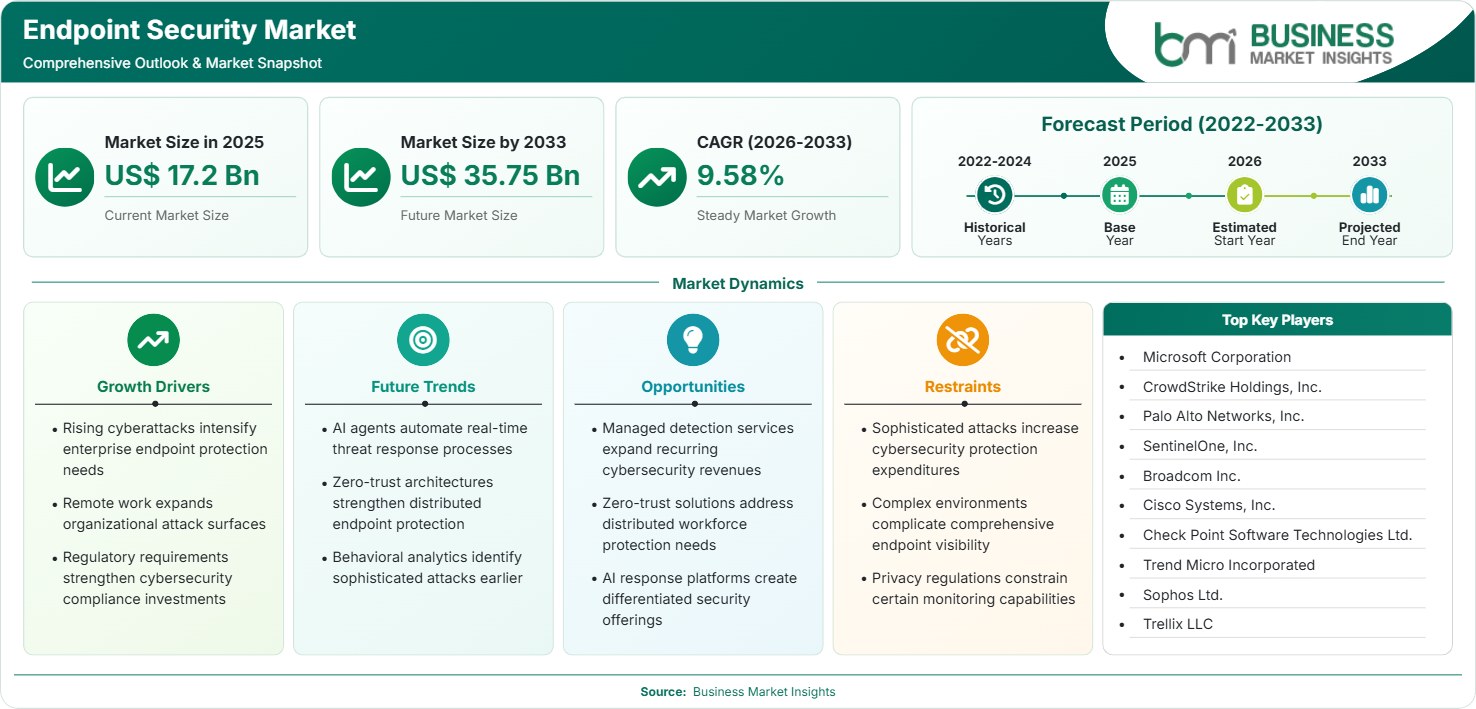
The Endpoint Security Market size was valued at US$ 17.2 Billion in 2025 and is projected to reach US$ 35.75 Billion by 2033, growing at a CAGR of 9.58% during 2026–2033. Rising ransomware incidents, expansion of hybrid workforces, increasing endpoint proliferation, and growing adoption of AI-driven threat detection are creating significant opportunities across enterprise and public-sector environments.

Report Coverage
  • Component: Software, Services
  • Deployment: Cloud, On-premises
  • User Type: Commercial, Consumer
  • Enterprise Type: Large Enterprises, Small & Medium Enterprises
  • End-use: BFSI, Telecom & IT, Retail, Healthcare, Government & Public Sector, Transportation, Others
US$ 17.2 Bn Market size in 2025
US$ 35.75 Bn Market Size by 2033
9.58% CAGR, 2026 - 2033
2026-2033 Forecast Period

AI Overview

Endpoint Security Market Summary

  • North America Region: North America holds a market share of 36%–39% in 2025, growing with a CAGR of 8.5%–9.2% during 2026–2033, supported by cybersecurity spending, zero-trust deployment, cloud security modernization, regulatory compliance requirements, managed detection adoption, critical infrastructure protection initiatives, advanced threat intelligence integration, and enterprise digital transformation investments. The US market benefits from strong cybersecurity budgets and is projected to grow at a CAGR of 8.8%–9.4% during 2026–2033.
  • Fastest Growing Region: Asia Pacific holds a market share of 24%–27% in 2025, growing with a CAGR of 11.2%–12.0% during 2026–2033, driven by rapid digitalization, cloud migration, expanding SME security investments, government cyber resilience programs, growing internet penetration, increasing ransomware exposure, mobile workforce expansion, and data localization compliance initiatives.
  • Leading Segment: Software accounts for 68%–71% share in 2025 and is expected to expand at a CAGR of 9.2%–10.0% during 2026–2033. Growth is fueled by AI-powered endpoint protection, behavioral analytics, endpoint detection and response integration, automated remediation capabilities, cloud-native architectures, threat hunting functions, and centralized security management.
  • High Growth Segment: Cloud deployment represents 44%–47% share in 2025 and is projected to grow at a CAGR of 11.0%–11.8% during 2026–2033. Demand is increasing through SaaS adoption, remote workforce expansion, simplified updates, scalable management, reduced infrastructure requirements, enhanced visibility, and integrated threat intelligence services.
  • Key Market Opportunity: Organizations are increasingly consolidating security tools into unified endpoint, identity, and network protection platforms, creating opportunities for vendors offering integrated XDR capabilities, automation, analytics, and proactive threat response.
  • Major Market Players: Microsoft Corporation, CrowdStrike Holdings, Inc., Palo Alto Networks, Inc., SentinelOne, Inc., Broadcom Inc., Cisco Systems, Inc., Check Point Software Technologies Ltd., Trend Micro Incorporated, Sophos Ltd., Trellix LLC.
Strategic Insights

Endpoint Security Market: Strategic Insights

Endpoint Security Market Strategic Framework
FREE PDF
Request your free sample
Request free sample
Stakeholder View

Key Takeaways

  • The value chain is nowadays focused on integrated platforms that combine endpoint detection, real-time telemetry, threat intelligence, identity protection, and the ability to carry out automated remediation.
  • The biggest growth opportunities are in cloud-based deployments and in solutions designed for small and medium-sized businesses, as companies look for scalable security architectures with lower operational overhead.
  • Security operations are being reshaped by the use of artificial intelligence, machine learning-driven analytics, and extended detection and response platforms, which are at the same time, cutting down mean response times.
  • The Asia Pacific region has the strongest case for regional investment because of the expansion of its digital infrastructure, the growing awareness of cybersecurity issues, and the increasing adoption of enterprise cloud services.
  • Vendors are still carrying out strategic acquisitions to broaden their platform capabilities to include those relating to endpoint, network, identity, and cloud security.
  • Interest in managed security and MDR services is growing since the shortage of skilled personnel is leading organizations to outsource their advanced monitoring and incident response tasks.
Geographic Outlook

Endpoint Security Market Regional Highlights

North America Endpoint Security Market

North America accounted for approximately 36%–39% Endpoint Security Market share in 2025 and is projected to expand at a CAGR of 8.5%–9.2% during 2026–2033. Advantages include a mature cybersecurity ecosystem, high adoption of cloud technology, and robust company spending on threat prevention technologies. Ransomware is getting more sophisticated by the day, which is driving adoption of XDR, EDR, and detection-as-a-service solutions. Government-backed cybersecurity programs are reinforcing this demand for the foreseeable future.

  • Large companies are combining their various cybersecurity tools into single platforms to increase visibility, automate responses, and cut down on operational complexity in their distributed working environments.
  • Financial institutions are still prioritizing improved endpoint monitoring to reduce their exposure to fraud, strengthen compliance with regulatory requirements, and improve their ability to detect sophisticated credential theft campaigns.
  • Healthcare providers are increasingly using endpoint monitoring systems to guard sensitive patient data and protect connected medical devices against cyberattacks.
  • The demand for MDR services is rising as a result of the shortage of security professionals and the increasing need for continuous threat-monitoring capabilities.

US Endpoint Security Market

The United States represented approximately 82%–85% of North American Endpoint Security Market revenue in 2025 and is expected to grow at a CAGR of 8.8%–9.4% during 2026–2033. Federal cybersecurity mandates, increasing enterprise cloud dependence, and elevated ransomware risks continue stimulating demand. Investments in security operations automation and zero-trust architectures remain substantial. Growing adoption of AI-enabled security platforms across defense, healthcare, financial services, and technology sectors is reinforcing leadership. Continued modernization of critical infrastructure cybersecurity frameworks supports long-term technology deployment across both public and private organizations.

  • Federal agencies are growing zero-trust programs. This creates ongoing buying opportunities for new endpoint detection and response technologies in government settings.
  • Financial institutions continue to increase their cybersecurity spending to improve fraud prevention, meet regulatory requirements, and guard against cybercrime carried out by nation-states and organized criminal groups.
  • Large technology companies are accelerating their efforts to consolidate platforms to boost operational efficiency and achieve a unified view of threats across their hybrid infrastructures.
  • The demand for threat intelligence powered by AI as well as for automated response capabilities, is still rising since attacks are becoming faster, more sophisticated, and harder to investigate manually.

Europe Endpoint Security Market

Europe held approximately 26%–29% Endpoint Security Market share in 2025 and is projected to grow at a CAGR of 8.7%–9.5% during 2026–2033. Data privacy regulations, digital sovereignty initiatives, and rising cyberattack frequency remain key adoption drivers. Organizations are prioritizing advanced prevention technologies as operational technology and IT environments converge. Germany remains the largest regional market, while Eastern European countries demonstrate stronger expansion rates due to digitalization investments. Growing adoption of managed security services is improving security maturity among mid-sized organizations across multiple industries.

  • Germany maintains its position of regional leadership through large budgets for enterprise cybersecurity and strong demand from the industrial sector for endpoint protection in manufacturing and engineering.
  • Poland and Romania are among the fastest-growing markets, due to their digital transformation programmes and the growing regulatory demands regarding cyber resilience.
  • Interest in cloud-native security platforms is growing as companies modernise their infrastructure and move their workloads away from older environments.
  • The cybersecurity requirements resulting from the changing European digital regulations are still pushing organizations to improve their threat monitoring and endpoint visibility.
  • In recent years, healthcare and organizations in the public sector have placed greater importance on endpoint protection after there have been highly publicized incidents of ransomware attacking essential services.

Asia Pacific Endpoint Security Market

Asia Pacific accounted for 24%–27% Endpoint Security Market share in 2025 and is anticipated to register a CAGR of 11.2%–12.0% during 2026–2033, making it the fastest-growing regional market. Rising internet penetration, expanding cloud ecosystems, and accelerating enterprise digitalization are driving demand for cybersecurity. China remains the largest contributor, while India demonstrates the highest growth trajectory due to increasing cybersecurity awareness and government-backed digital initiatives. Enterprises across banking, telecommunications, e-commerce, and public services continue increasing investments in advanced endpoint defense technologies and managed security solutions.

  • China's demand in the region is driven by its large-scale enterprise digital infrastructure and the widespread implementation of cybersecurity solutions across both government and commercial sectors.
  • India has one of the strongest growth profiles, due to the uptake of cloud services, the expansion of startups, and higher enterprise spending on cybersecurity.
  • The rapid growth of e-commerce and digital payments is leading Southeast Asian economies to increase their investment in endpoint protection.
  • More regional businesses are adopting cloud-based endpoint security platforms to support their hybrid workforces and distributed operational models.
  • The increasing number of ransomware attacks is leading executives to place greater emphasis on proactive threat detection, threat hunting, and automated containment capabilities.

Rest of World Endpoint Security Market

Rest of World represented approximately 9%–11% Endpoint Security Market share in 2025 and is projected to advance at a CAGR of 9.5%–10.3% during 2026–2033. South & Central America benefits from expanding financial services digitalization and increasing cybersecurity awareness among enterprises. Brazil remains the dominant market, while Mexico demonstrates notable growth.

Within the Middle East and Africa, government-led smart city projects and critical infrastructure security investments are supporting technology adoption. Saudi Arabia and the UAE lead spending, while South Africa shows growing enterprise cybersecurity demand driven by increasing digital transformation activities.

  • Brazil keeps its position of regional leadership through increasing its cybersecurity budgets, growing awareness of ransomware, and by enhancing the use of enterprise-grade protection technologies.
  • Mexico is witnessing accelerated adoption as multinational firms strengthen cyber resilience programs and modernize IT infrastructures.
  • Saudi Arabia is continuing its investment in cybersecurity as part of its national digital transformation plans, which are providing opportunities for advanced providers of endpoint protection.
  • The security automation being deployed by organizations in the UAE is aimed at improving their effectiveness in responding to incidents and in preparing for regulatory compliance.
  • South African enterprises increasingly adopt managed detection services to address cybersecurity skill shortages and strengthen defensive capabilities.
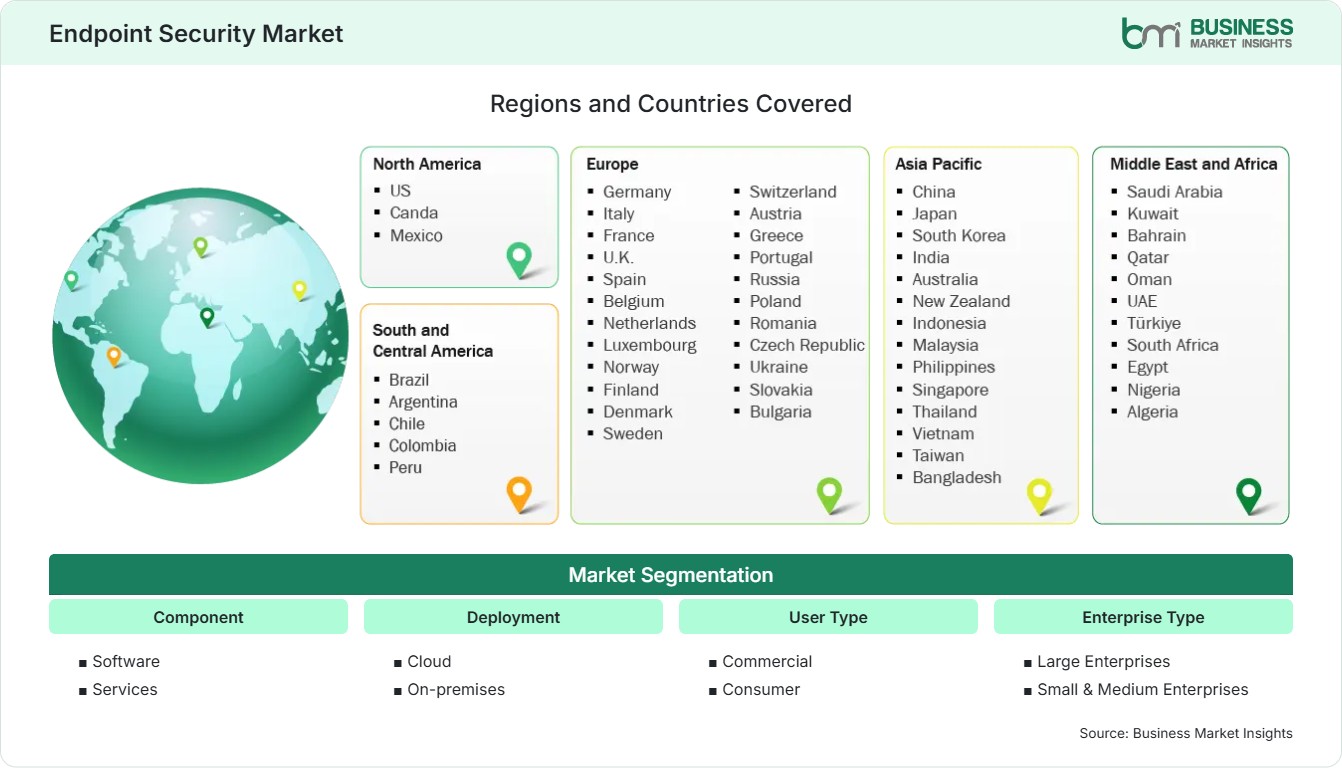
Global Market Geography
FREE PDF
Request your free sample
Request free sample
Segment Analysis

Endpoint Security Market Segmentation

Component

The component segment remains dominated by software solutions, accounting for approximately 68%–71% market share in 2025 and expanding at a CAGR of 9.2%–10.0% through 2033. Enterprise demand centers on integrated prevention, detection, investigation, and remediation capabilities. Endpoint Security Market scope continues to broaden as organizations require continuous visibility across increasingly diverse endpoint environments and distributed digital infrastructures.

  • Software: Software platforms provide centralized management, automated threat detection, behavioral analytics, and endpoint response capabilities, supporting enterprise-wide cybersecurity operations and regulatory compliance requirements.
  • Services: Services encompass managed detection, deployment, consulting, incident response, and training functions that help organizations improve security maturity and address cybersecurity talent shortages.

Deployment

Cloud deployment accounted for approximately 44%–47% share in 2025 and is expected to record the fastest segment expansion at 11.0%–11.8% CAGR through 2033. Organizations increasingly seek scalable and remotely managed security architectures. On-premises deployments remain important among highly regulated sectors requiring greater operational control, sovereignty, and customization of security environments.

  • Cloud: Cloud-based platforms offer simplified deployment, faster updates, centralized visibility, and flexible scalability for organizations operating distributed and hybrid workforce environments.
  • On-premises: On-premises solutions remain relevant where compliance requirements, operational sovereignty concerns, or specialized infrastructure demand localized endpoint security management capabilities.

User Type

Commercial users represent the larger revenue contribution with an estimated 72%–75% share in 2025, supported by rising cyber risk exposure. Consumer adoption is also strengthening as personal devices experience growing phishing, ransomware, and identity theft attacks. Both categories increasingly utilize AI-enhanced security capabilities to improve protection effectiveness and user experiences.

  • Commercial: Enterprises deploy advanced protection technologies to secure critical business assets, comply with regulations, and minimize operational disruption resulting from cyber incidents.
  • Consumer: Individual users increasingly adopt endpoint security tools to safeguard financial information, digital identities, connected devices, and personal data from evolving cyber threats.

Enterprise Type

Large enterprises continue accounting for the majority of spending, estimated at 61%–64% share in 2025, due to complex IT ecosystems and higher cybersecurity budgets. However, small and medium enterprises are experiencing faster adoption rates as threat exposure rises and cloud-based security models lower deployment barriers and management complexity.

  • Large Enterprises: Large organizations require advanced analytics, extensive integration capabilities, security orchestration functions, and centralized management across geographically distributed endpoint environments.
  • Small & Medium Enterprises: SMEs increasingly adopt subscription-based security platforms that provide enterprise-grade protection while reducing infrastructure investment and administrative burden.

End-use

The BFSI segment remains among the leading adopters, contributing approximately 19%–22% share in 2025 with strong emphasis on fraud prevention and regulatory compliance. Healthcare, government, telecom, retail, and transportation sectors are also accelerating investments as cyberattacks increasingly target critical operational systems and sensitive information assets.

  • BFSI: Financial institutions depend on advanced endpoint defense capabilities to protect transactions, customer data, payment systems, and digital banking infrastructure.
  • Telecom & IT: Telecommunications and technology companies require continuous monitoring to secure expansive networks, cloud resources, and distributed workforces against sophisticated threats.
  • Retail: Retail organizations strengthen endpoint protection to safeguard payment systems, customer information, and omnichannel commerce operations from cyber risks.
  • Healthcare: Healthcare providers implement endpoint security solutions to protect patient records, connected devices, and mission-critical clinical applications.
  • Government & Public Sector: Public-sector organizations emphasize cyber resilience to secure citizen data, critical services, and national digital infrastructure assets.
  • Transportation: Transportation operators deploy endpoint protection to secure operational technology environments, logistics platforms, and connected mobility systems.
Market Forces

Endpoint Security Market Dynamics

Key Market Drivers

Escalating Ransomware and Advanced Cyber Threat Activity

Organizations continue facing increasingly sophisticated ransomware campaigns, fileless malware attacks, and credential-based intrusions targeting endpoints across distributed environments. Security agencies worldwide report a sustained rise in ransomware incidents affecting financial institutions, healthcare providers, governments, and critical infrastructure operators. Endpoint devices remain primary attack vectors because they provide direct access to enterprise networks and sensitive information assets. Endpoint Security Market growth is increasingly linked to enterprise demand for behavioral analytics, threat intelligence integration, automated detection, and rapid incident response capabilities.

Expansion of Hybrid Work and Distributed Endpoint Ecosystems

Remote and hybrid work models have significantly increased the number and diversity of corporate endpoints requiring protection. Employees access enterprise systems through laptops, mobile devices, tablets, and remote connections spread across multiple locations and networks. This shift has expanded organizational attack surfaces and complicated traditional security management strategies. Companies are therefore deploying modern cloud-managed endpoint protection solutions capable of maintaining visibility and enforcement across geographically dispersed assets. Endpoint Security Market trends increasingly reflect demand for centralized management, continuous monitoring, endpoint detection and response functionality, and automated policy enforcement.

Growing Regulatory Focus on Cyber Resilience and Data Protection

Stricter cybersecurity and data protection rules are still being introduced by governments and industry regulators in a number of sectors, including financial services, healthcare, telecommunications, defence, and the public sector. The requirements concerning compliance now call on organizations to show that they have in place proactive monitoring, the ability to detect threats, access control measures, and incident response capabilities. Endpoint security technologies are of great importance in meeting these requirements since they offer visibility into what is happening on endpoints and assist with being ready for audits. Various regulatory initiatives focused on protecting critical infrastructure, privacy, operational resilience, and cyber risk management are driving further investment in both the public and private sectors. Organizations see advanced endpoint protection as not only a security necessity but also as a technology that enables them to meet compliance requirements and thus helps to lower operational, legal, and reputational risks.

Key Market Opportunities

Expansion of Extended Detection and Response Platforms

The convergence of endpoint, network, cloud, and identity security capabilities is creating significant opportunities for extended detection and response platforms. Organizations increasingly seek consolidated security architectures that reduce tool sprawl and improve analytical accuracy. Vendors capable of integrating telemetry from multiple security layers can provide more comprehensive threat visibility and response automation. Endpoint Security Market Forecasts increasingly support investment in unified security ecosystems because enterprises prioritize operational efficiency and faster incident response. Growing board-level attention to cyber resilience is encouraging larger budgets for platform modernization initiatives.

Rising Cybersecurity Adoption Among Small and Medium Enterprises

Small and medium enterprises make up a customer group that is still not being adequately served, but one that is growing rapidly. In the past, they were constrained by small budgets and a lack of cybersecurity expertise, but nowadays they can access affordable cloud-based protection services. Because of their increasing experience of ransomware, phishing operations, and attacks on the supply chain, greater investment in security is being made across this sector. Companies are now offering subscription plans that include simplified deployment, centralised administration, and managed detection features that are aimed at smaller businesses. The wider awareness among businesses of cyber risks and their legal obligations is speeding up the rate at which these services are being taken up. As digital transformation continues to take place among small and medium enterprises worldwide, endpoint protection providers can achieve considerable long-term growth by providing scalable, cost-effective security services tailored to the changing needs of their operations.

Protection of Connected Devices and Industry 4.0 Environments

The growing presence of connected devices across manufacturing, healthcare, transportation, and utility environments is expanding demand for specialized endpoint protection technologies. Industrial control systems, connected medical devices, operational technology assets, and smart infrastructure components increasingly require protection from sophisticated cyber threats. Traditional security approaches are often insufficient for these environments due to operational constraints and unique risk profiles. Vendors developing solutions tailored to connected ecosystems have opportunities to address emerging security gaps. Increased investment in digital factories, smart cities, logistics automation, and connected infrastructure is expected to drive demand for endpoint visibility, anomaly detection, and threat containment capabilities tailored to non-traditional endpoint environments.

Market Restraints and Challenges

High Deployment Complexity and Security Skills Shortages

Factor: Organizations frequently struggle with integrating endpoint security solutions across diverse operating systems, legacy systems, cloud environments, and third-party applications. Limited availability of experienced cybersecurity professionals further complicates implementation, monitoring, and optimization activities. Impact: Deployment timelines become longer, operational costs increase, and organizations may fail to fully utilize advanced platform capabilities. Smaller enterprises are particularly affected because they often lack dedicated cybersecurity teams.

Alert Fatigue and Expanding Endpoint Volumes

Factor: Modern enterprises generate enormous volumes of endpoint telemetry and security alerts, making it increasingly difficult for analysts to identify genuine threats. Growing numbers of connected devices, cloud workloads, and remote endpoints further increase monitoring complexity. Impact: Security operations teams face investigation backlogs, slower response times, and a higher probability of overlooking critical events. Excessive false positives can reduce operational efficiency and contribute to analyst burnout.

Company Analysis

Competitive Landscape

Endpoint Security Market analysis indicates increasing competition around AI-powered detection, XDR integration, cloud-native management, and managed security services.

Company Name

Overview

Products and Services relevant to this market

Microsoft Corporation

Global technology leader providing enterprise cybersecurity solutions integrated across cloud, identity, productivity, and security ecosystems.

Microsoft Defender for Endpoint, XDR solutions, threat intelligence, vulnerability management, and endpoint protection platforms.

CrowdStrike Holdings, Inc.

Cybersecurity specialist known for cloud-native protection and AI-powered threat intelligence capabilities.

Falcon platform, endpoint detection and response, managed threat hunting, incident response, and security analytics.

Palo Alto Networks, Inc.

Cybersecurity provider delivering integrated security platforms for network, cloud, and endpoint protection.

Cortex XDR, endpoint security, attack surface management, threat intelligence, and security operations automation.

SentinelOne, Inc.

Security company focused on autonomous endpoint protection and machine-learning driven threat detection.

Endpoint protection, EDR, XDR, threat intelligence, workload security, and automated remediation capabilities.

Broadcom Inc.

Technology company providing enterprise cybersecurity solutions through its security software portfolio.

Endpoint protection, threat prevention, information security management, and enterprise security software offerings.

Cisco Systems, Inc.

Networking and cybersecurity provider offering integrated security platforms for enterprise environments.

Secure Endpoint, threat response, zero-trust security, device visibility, and network-integrated protection services.

Check Point Software Technologies Ltd.

Cybersecurity vendor delivering prevention-first security architectures for enterprises globally.

Harmony Endpoint, threat prevention, anti-ransomware solutions, endpoint compliance, and threat intelligence.

Trend Micro Incorporated

Long-established cybersecurity provider serving enterprise, government, and mid-market customers.

Endpoint protection, XDR, managed detection, cloud security, and ransomware defense solutions.

Sophos Ltd.

Cybersecurity specialist emphasizing simplified security operations and managed services.

Sophos Intercept X, MDR services, endpoint defense, threat hunting, and security management platforms.

Trellix LLC

Security company focused on detection, analytics, response orchestration, and extended security visibility.

Endpoint security, XDR, threat intelligence, incident response, and security analytics platforms.

Trust & Transparency

Research Methodology

The market analysis combines proprietary research with secondary data from government agencies, company disclosures, regulatory filings, industry databases and expert interviews. Market estimates are validated through data triangulation, cross-market benchmarking and analyst review.

View Full Research Methodology

Questions Answered

Frequently Asked Questions

What insights does an Endpoint Security Market Report typically provide?

An Endpoint Security Market Report typically includes market sizing, segment performance, competitive assessment, technology developments, regional analysis, growth opportunities, regulatory influences, and forward-looking industry outlooks.

What differentiates endpoint detection and response from traditional antivirus?

EDR solutions provide continuous monitoring, behavioral analysis, forensic investigation, automated containment, and threat hunting capabilities, whereas traditional antivirus primarily relies on signature-based malware detection.

Why are cloud-deployed security solutions gaining adoption?

Cloud-based deployments provide faster implementation, centralized visibility, automatic updates, flexible scalability, lower infrastructure requirements, and stronger support for remote and hybrid workforce environments.

How is artificial intelligence changing endpoint security platforms?

Artificial intelligence improves threat detection accuracy, automates investigation workflows, reduces response times, identifies behavioral anomalies, and helps security teams process large volumes of endpoint telemetry efficiently.

Which industry vertical generates the strongest demand for endpoint protection solutions?

Financial services, healthcare, government, and technology sectors represent the most security-intensive adopters due to sensitive data exposure, regulatory requirements, and elevated cyberattack risks.

Access the Full Endpoint Security Market Report

Get segment-level forecasts, regional estimates, competitive benchmarking, company profiles and downloadable Excel datasets.

Access the full Endpoint Security Market Report
350 pages PDF & Excel | 2026-09-16
Similar Research

Related Market Reports