
Electric Utility Vehicle Market Outlook: Size, Share, Trends, Growth Analysis, Competitive Landscape & Forecast, 2026-2033

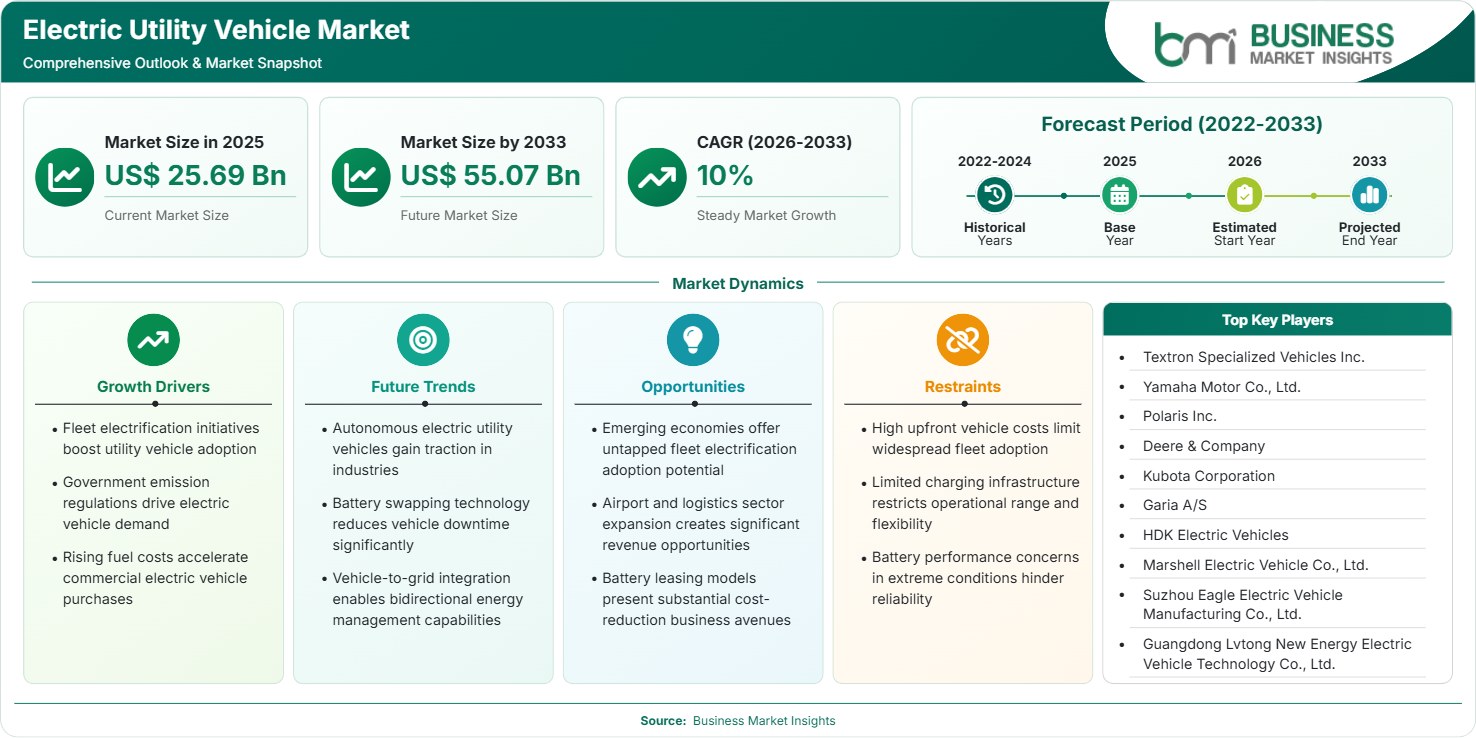
The Electric Utility Vehicle Market size was valued at US$ 25.69 Billion in 2025 and is projected to reach US$ 55.07 Billion by 2033, growing at a CAGR of 10% during 2026–2033, driven by fleet electrification, lithium-ion adoption, diversified commercial use, and low-emission mobility investments.

Report Coverage
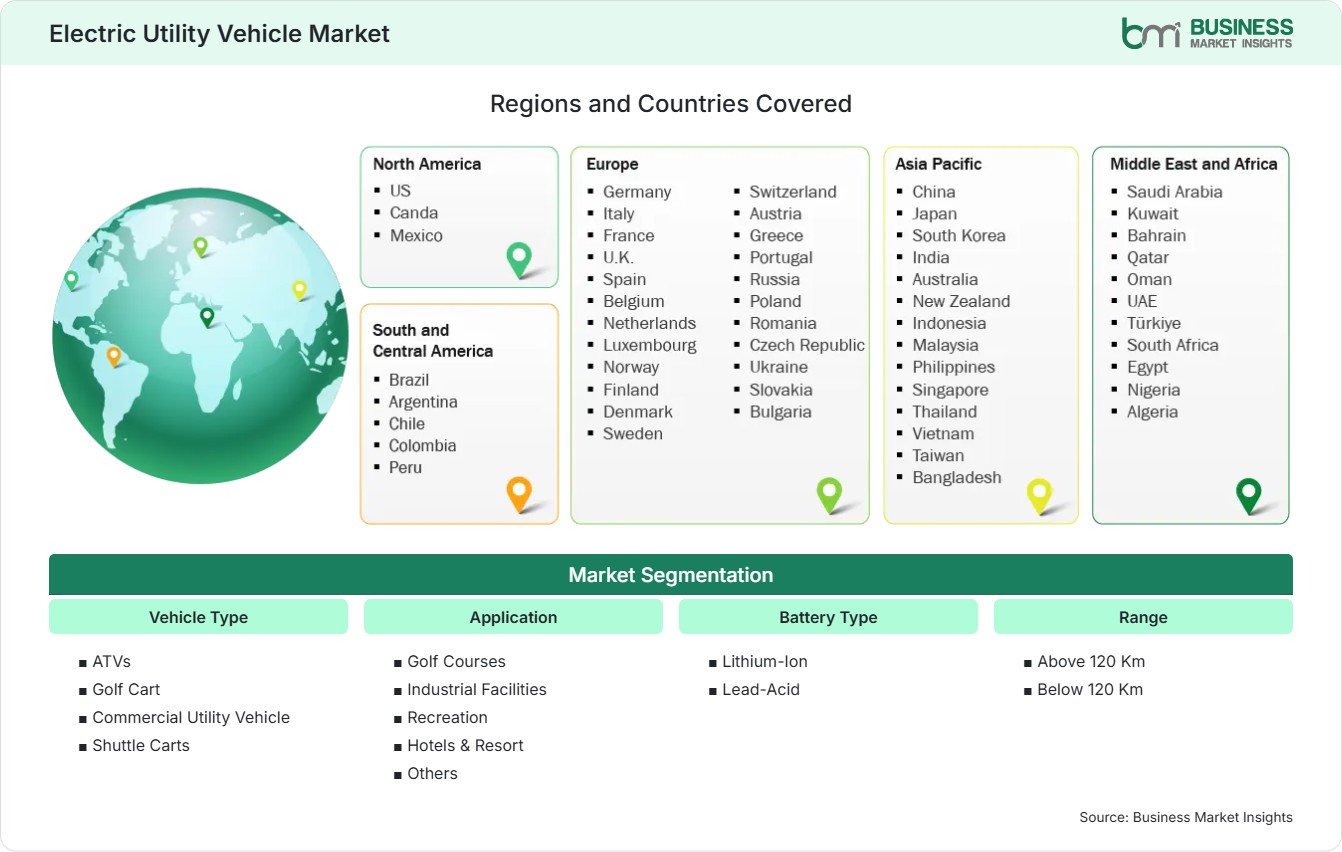
  • Vehicle Type: ATVs, Golf Cart, Commercial Utility Vehicle, Shuttle Carts
  • Application: Golf Courses, Industrial Facilities, Recreation, Hotels & Resort, Others
  • Battery Type: Lithium-Ion, Lead-Acid
  • Range: Above 120 Km, Below 120 Km
US$ 25.69 Bn Market size in 2025
US$ 55.07 Bn Market Size by 2033
10% CAGR, 2026 - 2033
2026-2033 Forecast Period

AI Overview

Electric Utility Vehicle Market Summary

  • North America Region: North America holds a 42%–46% Electric Utility Vehicle Market share in 2025, growing at a CAGR of 8%–10%, supported by established golf, industrial, agricultural, airport, resort, and campus fleets, alongside replacement demand and expanding low-emission transportation opportunities. The U.S. remains the largest regional market, supported by fleet replacement, commercial applications, and a CAGR of 8%–10%.
  • Fastest Growing Region: Asia Pacific holds a 25%–29% share in 2025 and grows at a CAGR of 11%–13%, supported by manufacturing expansion, tourism infrastructure, industrial electrification, lower operating costs, and growing adoption across resorts, logistics facilities, airports, and large campuses.
  • Leading Segment: Commercial Utility Vehicle accounts for a 38%–42% share in 2025 and advances at a CAGR of 10%–12%, driven by industrial transport requirements, configurable platforms, rising demand for quiet operations, and opportunities across warehouses, agriculture, municipalities, and facilities management.
  • High Growth Segment: Lithium-Ion holds a 58%–63% Electric Utility Vehicle Market share in 2025 and grows at a CAGR of 12%–14%, supported by longer service life, lower maintenance, faster charging, improved energy density, and replacement opportunities among operators upgrading aging lead-acid fleets.
  • Key Market Opportunity: Connected fleet platforms can create recurring value through telematics, battery monitoring, predictive maintenance, route optimization, and centralized fleet management, particularly for airports, resorts, campuses, industrial facilities, and multi-vehicle commercial operators.
  • Major Market Players: Textron Specialized Vehicles Inc.; Yamaha Motor Co., Ltd.; Polaris Inc.; Deere & Company; Kubota Corporation; Garia A/S; HDK Electric Vehicles; Marshell Electric Vehicle Co., Ltd.; Suzhou Eagle Electric Vehicle Manufacturing Co., Ltd.; and Guangdong Lvtong New Energy Electric Vehicle Technology Co., Ltd.
Strategic Insights

Electric Utility Vehicle Market: Strategic Insights

Electric Utility Vehicle Market Strategic Framework
FREE PDF
Request your free sample
Request free sample
Stakeholder View

Key Takeaways

  • Value-chain integration is becoming strategically important. Competitive advantage increasingly depends on battery sourcing, vehicle assembly, dealer coverage, replacement parts, software, and after-sales service. Fleet customers evaluate lifetime uptime rather than vehicle acquisition cost alone.
  • Commercial utility platforms offer substantial upside. Demand is broadening across industrial facilities, agriculture, airports, resorts, campuses, and property operations, where hauling capacity, configurable bodies, and dependable daily operation matter more than conventional passenger mobility features.
  • Battery technology is reshaping product economics. Lithium-ion systems reduce maintenance requirements and can improve vehicle availability, encouraging replacement of lead-acid fleets. Yamaha's 2025 launch of models using its newly developed lithium-ion battery illustrates continued OEM investment in proprietary electric platforms.
  • Asia Pacific presents the strongest expansion case. The region combines expanding industrial infrastructure, tourism investment, local manufacturing, and demand for compact electric transport. Suppliers capable of balancing durability, price, and service access can address highly diverse operating environments.
  • Product launches remain an important competitive mechanism. Polaris introduced its 2026 RANGER 500 in July 2025 to address value-oriented utility users, while Yamaha expanded its UMAX portfolio in August 2026 with four-passenger commercial and personal transportation models.
  • Connected fleet services can expand recurring revenue. Telematics, geofencing, remote diagnostics, utilization analytics, and battery-health monitoring enable manufacturers and dealers to move beyond one-time vehicle sales toward service-led customer relationships.
Geographic Outlook

Electric Utility Vehicle Market Regional Highlights

North America Electric Utility Vehicle Market

North America represents 42%-46% of global revenue in 2025 and is estimated to grow at an 8%-10% CAGR until 2033. North America has an installed base across various applications, including golf courses, industrial facilities, agriculture, resorts, airports, and planned communities. Lithium-ion batteries and connectivity in the fleet are gaining more popularity in replacement cycles. The Electric Utility Vehicle Market share continues to be driven by OEMs, dealers, customizability, and the preference for low-noise, maintenance-free transport under controlled operating conditions. Global market benchmarks have also identified North America as the hub of the highest regional demand.

  • Fleet replacement is a major demand driver as operators compare battery life, maintenance requirements, charging needs, payload performance, and total operating costs when replacing older utility and recreational vehicle fleets.
  • U.S. industrial and recreational demand supports product diversity, encouraging manufacturers to offer vehicles for hauling, personnel transport, hospitality, maintenance, property management, and specialized low-speed transportation applications.
  • Trade and sourcing developments can influence competitive dynamics, particularly where imported low-speed vehicles compete with established regional manufacturing and dealer-supported brands.
  • Lithium-ion adoption is strengthening premium fleet demand because operators increasingly prioritize uptime, longer battery life, and lower routine maintenance over the lowest possible initial purchase price.

US Electric Utility Vehicle Market

The U.S. is the largest country in the region in terms of North American market share for electric utility vehicles, at 80%-84%. It is also expected to post the highest compound annual growth rate, at 8%-10%, in the Electric Utility Vehicle Market through 2033. The size of the U.S. market is attributed to extensive adoption in golf courses, retirement villages and housing estates, farming, industries, airports, resorts, and universities. The presence of dealers and the need for replacements further contribute to market depth, and fleet electrification is essential for upgrading technologies.

  • Expanding multi-purpose use is reducing dependence on traditional golf demand, with fleets increasingly deployed for maintenance, security, guest transportation, warehousing, agriculture, and campus mobility.
  • Higher adoption of lithium-ion platforms supports premiumization, particularly among commercial customers seeking reduced maintenance, improved charging performance, and greater vehicle availability during intensive daily duty cycles.
  • Domestic dealers remain important to fleet purchasing decisions because maintenance support, replacement parts, customization, financing, and rapid service can materially affect lifecycle economics.

Europe Electric Utility Vehicle Market

Europe accounts for 15%–19% of global revenue in 2025 and is expected to register a CAGR of 8%–10% in the Electric Utility Vehicle Market through 2033. The growth is backed by sustainability policies, tourism amenities, industrial electrification, and the need for quiet transportation in enclosed and environmentally sensitive areas. Germany dominates regional commercial sales, whereas the U.K. and France are significant market players in the golf, hospitality, and institutional segments. Germany is expected to see growth of 8%–10%, while Spain is expected to see growth of 9%–11%.

  • Sustainability procurement increasingly favors electric fleets where conventional vehicles create noise, local-emission, or maintenance concerns, particularly across resorts, logistics compounds, campuses, municipalities, and industrial facilities.
  • Germany provides a strong investment case through industrial applications, while the U.K. benefits from established leisure infrastructure and fleet replacement across golf, hospitality, and institutional environments.
  • Spain and southern European tourism markets support demand for passenger-oriented shuttle carts and service vehicles used by resorts, holiday developments, golf facilities, and large recreational destinations.
  • Battery upgrades offer suppliers an opportunity to target existing fleets because operators can evaluate replacement economics around charging efficiency, maintenance savings, and longer useful service intervals.

Asia Pacific Electric Utility Vehicle Market

Asia Pacific region will have a market share of 25%-29% in 2025 and is expected to register an 11%–13% CAGR through 2033 in the Electric Utility Vehicle Market, making it the fastest-growing regional market. Manufacturing capacity and domestic demand will be provided by China, while Japan will remain technologically advanced in the electric golf and utility vehicle market. India and Southeast Asia will offer growth opportunities driven by industrial development, tourism, airports, and commercial facilities. While China is expected to grow at 11%–13% CAGR, India is expected to grow at 12%–14% CAGR as application diversity and infrastructure investment expand.

  • Regional manufacturers benefit from scale and cost advantages, increasing competition across entry-level and commercial fleets while encouraging global brands to differentiate through reliability, technology, and service networks.
  • China's manufacturing ecosystem supports component availability and export capacity, whereas Japan remains important for high-quality electric vehicle engineering and battery-focused product development.
  • India's industrial parks, hospitality properties, airports, and institutional campuses create a widening addressable base for compact electric transport and material-handling vehicles with lower operating costs.
  • Tourism investment across Southeast Asia supports demand for shuttle carts and hospitality fleets, particularly where quiet operation and frequent short-distance movement improve guest transportation efficiency.

Rest of World Electric Utility Vehicle Market

Rest of World accounts for 12%–16% of 2025 revenue and is projected to grow at an 8%–11% CAGR in the Electric Utility Vehicle Market through 2033. South & Central America benefits from agriculture, tourism, mining sites, and resort developments, with Brazil estimated at 9%–11% growth. Middle East and Africa demand is concentrated around airports, luxury hospitality, gated developments, industrial sites, and large infrastructure projects. The United Arab Emirates is positioned for 10%–12% growth, supported by premium tourism and commercial fleet requirements.

  • Brazil's agricultural operations and expanding commercial facilities create opportunities for utility-oriented vehicles capable of carrying personnel, tools, and materials across large properties and semi-structured terrain.
  • Resort development and airport expansion in the Gulf support passenger shuttle applications, where electric operation can reduce noise and improve suitability for high-traffic hospitality environments.
  • Distribution infrastructure remains a decisive factor because limited service coverage can restrain adoption despite attractive use cases in mining, agriculture, tourism, and large institutional properties.
  • Fleet leasing and managed service models could improve adoption in emerging markets by reducing upfront capital barriers and packaging maintenance, battery support, and replacement services.
Global Market Geography
FREE PDF
Request your free sample
Request free sample
Segment Analysis

Electric Utility Vehicle Market Segmentation

Vehicle Type

Vehicle Type is the broadest area of product differentiation and includes the whole market in specific applications’ platforms. The leading segment is Commercial Utility Vehicle, with market share between 38% and 42% in 2025 and a 10%-12% CAGR from 2026 to 2033. The scope of the Electric Utility Vehicle Market is expanding as customers prioritize versatility in payload capacity, body configurations, passenger capacity, off-road capabilities, and overall efficiency.

  • ATVs: Electric ATVs support agriculture, recreation, property maintenance, and specialized off-road activity, with demand strengthened by quiet operation, instant torque, reduced maintenance, and growing interest in lower-emission off-road mobility.
  • Golf Cart: Golf carts retain broad demand through golf facilities, planned communities, resorts, campuses, and personal transportation, while lithium-ion upgrades and connected fleet systems expand their role beyond conventional recreational use.
  • Commercial Utility Vehicle: Commercial utility vehicles serve industrial, agricultural, airport, campus, municipal, and facilities-management requirements, benefiting from modular cargo configurations, frequent-duty capability, lower noise, and fleet electrification initiatives.
  • Shuttle Carts: Shuttle carts support passenger movement at resorts, airports, campuses, healthcare facilities, and recreational sites, with larger seating configurations and quiet electric drivetrains improving suitability for controlled environments.

Application

The demand for applications has diversified as electric platforms begin to replace low-speed conventional vehicles across different operational contexts. Industrial Facilities are high-growth applications, with an 11%-13% CAGR through 2033 and a 22%-26% market share in 2025. This depends on the number of operational hours, payload requirements, the size of the industrial facility, charging availability, workplace noise levels, and the focus on the electrified internal transport fleet.

  • Golf Courses: Golf courses remain an important installed-base application, supporting recurring replacement demand as operators upgrade fleets to improve reliability, reduce maintenance requirements, and enhance player and course operations.
  • Industrial Facilities: Industrial facilities increasingly use electric utility fleets for material movement, maintenance, personnel transportation, security, and logistics, where low operating noise and reduced local emissions offer practical operational benefits.
  • Recreation: Recreational applications benefit from rising demand for quiet electric off-road and low-speed vehicles, particularly across parks, campgrounds, outdoor destinations, and managed private properties.
  • Hotels & Resorts: Hotels and resorts use electric vehicles for guest transportation, housekeeping, maintenance, baggage handling, and security, with quiet operation supporting service quality across premium hospitality environments.

Battery Type

Battery technology plays a critical role in determining the vehicle’s range, charging patterns, maintenance needs, load-carrying efficiency, and replacement frequency. Lithium-ion batteries have the largest market share, with 58%-63% of the Electric Utility Vehicle Market share by 2025, and are forecast to grow at a 12%-14% CAGR. This has been due to the increased need for greater service life, higher energy density, and lower maintenance requirements.

  • Lithium-Ion: Lithium-ion batteries support higher utilization through improved energy density, faster charging potential, longer lifecycle performance, and reduced maintenance, making them increasingly attractive for demanding commercial fleets.
  • Lead-Acid: Lead-acid batteries remain relevant where purchase price is prioritized, particularly among smaller operators, although maintenance demands and replacement requirements can weaken their long-term lifecycle advantage.

Range

Range Segmentation is based on disparities in duty cycles, charging facilities, vehicle applications, and fleet utilization. The Below 120 Km category is the dominant range category, comprising 64%-69% of total demand by 2025 and experiencing an 8%- 10% CAGR. The above 120 km range category has experienced the highest growth rate, at 11%-13% as battery improvements enable longer shifts and wider operating territories for industrial and commercial fleets.

  • Above 120 Km: Longer-range vehicles gain importance for large industrial sites, agriculture, airports, and extended commercial operations where reduced charging interruptions can improve fleet productivity and asset utilization.
  • Below 120 Km: Shorter-range vehicles remain well suited to golf courses, resorts, campuses, warehouses, and managed properties where predictable routes and overnight charging simplify daily fleet operations.
Market Forces

Electric Utility Vehicle Market Dynamics

Key Market Drivers

Fleet Electrification Across Commercial and Institutional Operations

Electric vehicle fleet conversion is a key factor, as the operational characteristics of electric utility vehicles align with those of controlled, low-speed environments. Many airports, industrial sites, colleges and universities, vacation destinations, golf courses, and farms typically use short-distance transportation instead of driving on highways. Electric solutions minimize noise during vehicle operation and could help lower maintenance costs by reducing the need for engine-related services. Thus, the Electric Utility Vehicle Market growth depends on fleet replacement rather than on the development of private passenger vehicles. Modern commercial utility vehicles are equipped for cargo transportation, maintenance, personnel transportation, and logistics operations. The demand for such vehicles arises from agriculture, logistics, recreation, and commercial purposes.

Lithium-Ion Technology Improves Fleet Availability and Lifecycle Economics

Innovation in batteries is driving adoption by changing how fleet managers view the total cost of ownership. Lithium-ion batteries tend to be superior to traditional lead-acid batteries in terms of energy storage capacity, maintenance requirements, and longevity. This becomes even more important when looking at commercial fleets that use their vehicles heavily, because any downtime is a productivity issue. The Electric Utility Vehicle Market trends are becoming dominated by battery technology as the deciding factor in buying decisions, rather than a minor specification issue. Launching in March 2025, Yamaha's electric golf cars that utilize an internally designed lithium-ion battery and lithium iron phosphate batteries are a good example of ongoing investments in battery longevity.

Expanding Applications Beyond Traditional Golf Transportation

The addressable market is expanding as electric platforms are being tailored to suit applications involving work and people movement. The golf application still holds strong, but the applications have now expanded to include resort, airport, university, industrial, private development, farm, and recreational use. This is reflected in the inclusion of cargo beds, increased passenger accommodation, better suspension, unique body designs, and accessory features that can be customized by the manufacturers. For instance, the release of the UMAX4 by Yamaha in August 2026 for use in fleet, commercial, hospitality, campus, and industrial applications illustrates this. Such a wide range of applications will reduce manufacturers' dependence on a single end market.

Key Market Opportunities

Connected Fleet Management and Predictive Maintenance Services

Fleet Management in Digital Form is a very promising market opportunity for the manufacturer, the software vendor, and the dealer. Large organizations require information on vehicle locations, usage, battery status, charging habits, maintenance schedules, and even unauthorized vehicle use. Telematics integration will help allocate resources more effectively and generate additional software and services revenue after the vehicle purchase. The Electric Utility Vehicle Market forecasts rely largely on manufacturers' ability to capitalize on these capabilities. Airports, resorts, campuses, industrial sites, and logistics facilities represent very interesting places to deploy such fleets, as there are usually several vehicles operating along a specific route. Investment in predictive maintenance can also reduce unexpected downtime and strengthen long-term customer retention through data-driven service contracts and fleet optimization packages.

Industrial and Logistics Sites Offer High-Utilization Deployment Potential

Industrial facilities represent a major investment opportunity because electric utility vehicles can support repetitive movement of workers, tools, components, and materials. Longer distances will be traveled by larger factories, warehouses, ports, and logistics yards; hence, the need for smaller cars that can move slowly becomes more important. The highest potential lies in commercially developed cars with flexible cargo capacity and high-capacity batteries. Supplier differentiation will come from application engineering, lease programs, maintenance programs, and charging stations. Integration with facility management systems could result in even higher levels of efficiency in fleet operations. In contrast to recreational applications, industrial applications have predictable replacement cycles based on usage time and cost economics.

Premium Hospitality and Airport Shuttle Electrification

Hotels, resorts, airports, and large tourism developments offer opportunities for specialized passenger transportation fleets. These environments value quiet operation, smooth ride quality, appearance, and reliable availability because vehicles directly influence guest and passenger experience. Electric shuttle cart applications are also available to assist baggage, cleaning, security, and maintenance functions by employing common-platform configurations. The potential for investment will be particularly great in locations that are developing tourism infrastructure and premium accommodation facilities. Manufacturers can take advantage of this opportunity by developing high-capacity seating, enclosed compartments, climate-specific accessories, remote-control systems, and luxury interiors. Fleet operators may also prefer manufacturers that can offer financing, maintenance, replacements, and on-site technical assistance.

Market Restraints and Challenges

Factor: Battery Cost and Charging Constraints Impact Fleet Economics

Factor: Lithium-ion batteries could increase vehicle purchase costs, and commercial operators would need to invest in charging and electrical upgrades. Charging schedules for facilities with many vehicles should be planned to avoid vehicle unavailability during operating hours. Impact: This factor will affect the decision on when to replace the battery, particularly for price-conscious operators who depend on their working lead-acid battery installations. Factors such as economic feasibility and compatibility may influence purchasing decisions. Although life-cycle benefits can justify the high purchase cost, some operators, such as small resorts, agricultural installations, and recreational installations, would base their decisions on purchase cost.

Factor: Service Coverage and Supply Disruptions Impact Vehicle Uptime

Factor: Fleet operations of electric utility vehicles require dependable supply chains for batteries, controllers, chargers, electronics, replacement parts, and service technicians. Local supply chain disruptions or a lack of service facilities at local dealerships can lead to maintenance delays. Impact: Fleet managers may be reluctant to embrace new technologies when downtime could compromise industrial production processes, hotel operations, or passenger transit timetables. The competition among suppliers will also impact the availability and prices of foreign vehicle and component supplies. In reality, the market will still depend upon after-sales services, regional stock, and technician expertise. Rapid growth in vehicle sales without rapid development of services can affect the manufacturer's image, particularly in commercial use, where fleet availability is more important than anything else.

Company Analysis

Competitive Landscape

The Electric Utility Vehicle Market analysis indicates competition between established powersports and golf-car manufacturers, agricultural and commercial equipment suppliers, and specialized low-speed electric vehicle producers. Product reliability, battery technology, dealer coverage, customization, pricing, and after-sales support are key differentiators.

Company Name

Overview

Products and Services relevant to this market

Textron Specialized Vehicles Inc.

Major specialized vehicle manufacturer with established brands and distribution capabilities serving golf, utility, commercial, and personal transportation applications.

Offers E-Z-GO and Cushman electric vehicles, golf cars, utility platforms, personnel carriers, and application-specific fleet solutions with dealer and service support.

Yamaha Motor Co., Ltd.

Global mobility manufacturer with a significant position in electric golf and utility vehicle technology and broad engineering capabilities.

Supplies electric golf cars and UMAX utility platforms, including lithium-ion battery-equipped models for golf, commercial, hospitality, campus, industrial, and personal transportation applications.

Polaris Inc.

Major powersports manufacturer with extensive off-road vehicle engineering, brand recognition, dealer networks, and utility-focused product development capabilities.

Provides Ranger utility side-by-side vehicles and related accessories designed for property work, agriculture, outdoor maintenance, and commercial applications, including expanding electrified mobility solutions.

Deere & Company

Global equipment manufacturer serving agricultural, construction, commercial, and property-management customers through extensive product and service networks.

Provides Gator utility vehicles and related work solutions supporting material movement, agriculture, property maintenance, landscaping, and institutional fleet applications.

Kubota Corporation

Global machinery company with strong agricultural and industrial customer relationships and established expertise in compact work-oriented equipment.

Offers utility vehicles and equipment for agricultural, commercial, landscaping, and property operations, supported by broad dealer networks and application-focused service capabilities.

Garia A/S

Specialized premium electric mobility manufacturer focused on luxury, leisure, golf, and lifestyle-oriented vehicle platforms.

Provides premium electric golf and leisure vehicles with customization options, advanced comfort features, and configurations serving resorts, private developments, and high-end recreational environments.

HDK Electric Vehicles

Electric vehicle manufacturer supplying golf, utility, and passenger transport products across multiple international markets and distributor networks.

Offers electric golf carts, utility vehicles, personnel carriers, shuttle carts, and customized low-speed electric vehicles for commercial, hospitality, recreational, and institutional applications.

Marshell Electric Vehicle Co., Ltd.

Established Chinese manufacturer of low-speed electric mobility products serving domestic and international recreational and commercial markets.

Produces electric golf carts, utility vehicles, sightseeing buses, shuttle vehicles, and customized electric transport platforms for resorts, communities, and commercial properties.

Suzhou Eagle Electric Vehicle Manufacturing Co., Ltd.

Specialized electric vehicle producer with an international product portfolio focused on low-speed passenger and utility transportation requirements.

Supplies electric golf carts, utility vehicles, sightseeing vehicles, shuttle carts, and customized electric transportation products for hospitality, institutional, and recreational customers.

Guangdong Lvtong New Energy Electric Vehicle Technology Co., Ltd.

Manufacturer of low-speed electric vehicles with a broad product portfolio and participation in international golf and utility vehicle markets.

Offers electric golf carts, utility vehicles, sightseeing vehicles, shuttle models, and application-specific products supported through dealer and export distribution channels.

Trust & Transparency

Research Methodology

The market analysis combines proprietary research with secondary data from government agencies, company disclosures, regulatory filings, industry databases and expert interviews. Market estimates are validated through data triangulation, cross-market benchmarking and analyst review.

View Full Research Methodology

Access the Full Electric Utility Vehicle Market Report

Get segment-level forecasts, regional estimates, competitive benchmarking, company profiles and downloadable Excel datasets.

Access the full Electric Utility Vehicle Market Report
350 pages PDF & Excel | 2026-09-23
Similar Research

Related Market Reports