
Electric Vehicle Telematics Market Outlook: Size, Share, Trends, Growth Analysis, Competitive Landscape & Forecast, 2026-2033

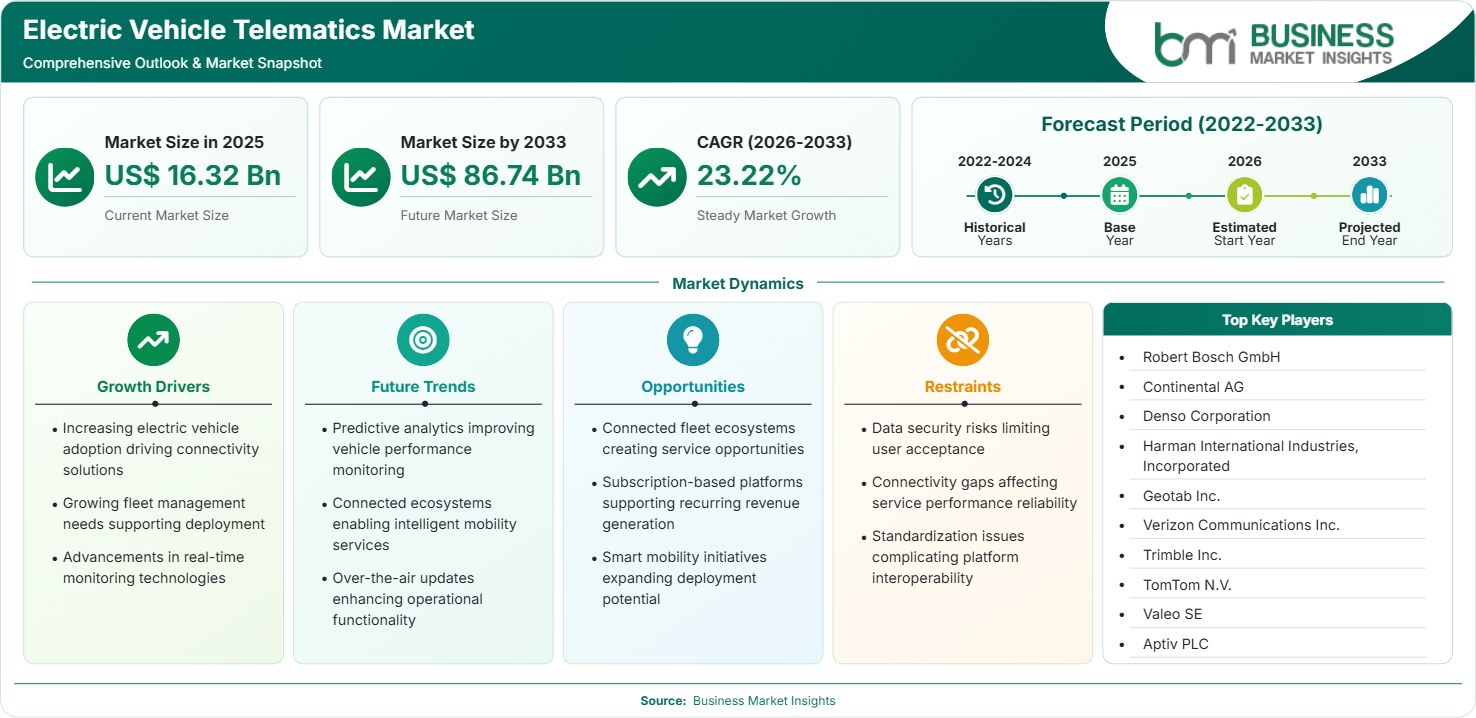
The Electric Vehicle Telematics Market size was valued at US$ 16.32 Billion in 2025 and is projected to reach US$ 86.74 Billion by 2033, growing at a CAGR of 23.22% during 2026–2033, driven by connected EV adoption, battery intelligence, predictive diagnostics, fleet electrification, and software-led mobility services.

Report Coverage
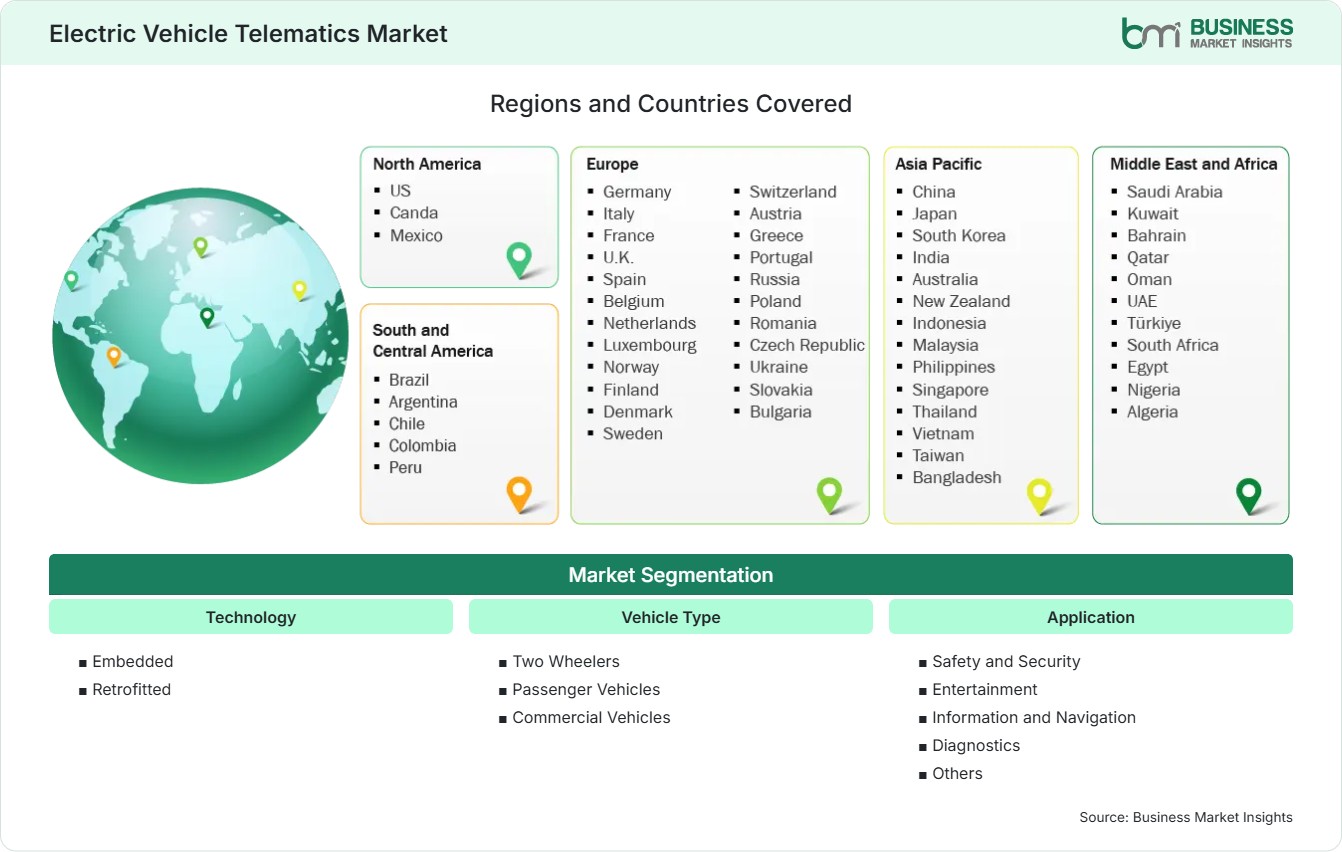
  • Technology: Embedded, Retrofitted
  • Vehicle Type: Two Wheelers, Passenger Vehicles, Commercial Vehicles
  • Application: Safety and Security, Entertainment, Information and Navigation, Diagnostics, Others
US$ 16.32 Bn Market size in 2025
US$ 86.74 Bn Market Size by 2033
23.22% CAGR, 2026 - 2033
2026-2033 Forecast Period

AI Overview

Electric Vehicle Telematics Market Summary

  • North America Region: holds an Electric Vehicle Telematics Market share of 29%–32% in 2025, growing at a CAGR of 21%–23% during 2026–2033, influenced by fleet electrification, connected vehicle platforms, insurance telematics, battery monitoring, charging optimization, and regulatory pressure. The US market is projected to expand at 22%–24% CAGR through 2033, supported by commercial EV fleets, embedded connectivity, and predictive diagnostics.
  • Fastest Growing Region: Asia Pacific holds a market share of 30%–34% in 2025, growing at a CAGR of 25%–27% during 2026–2033, supported by EV manufacturing, two-wheeler electrification, smart mobility programs, expanding charging networks, connected fleet deployments, domestic software ecosystems, and rising vehicle digitization.
  • Leading Segment: Passenger Vehicles hold a market share of 55%–59% in 2025, growing at a CAGR of 22%–24% during 2026–2033, driven by factory-installed connectivity, safety services, navigation, remote vehicle functions, battery monitoring, software updates, and consumer demand for connected ownership.
  • High Growth Segment: Embedded technology holds an Electric Vehicle Telematics Market share of 58%–62% in 2025, growing at a CAGR of 24%–27% during 2026–2033, benefiting from OEM integration, lower installation friction, continuous data access, battery analytics, cybersecurity architecture, over-the-air updates, and software-defined vehicle development.
  • Key Market Opportunity: Rising electric fleet deployment creates demand for integrated telematics combining battery state monitoring, charging intelligence, predictive maintenance, route optimization, driver analytics, energy management, and emissions reporting across commercial operations.
  • Major Market Players: Robert Bosch GmbH, Continental AG, Denso Corporation, Harman International Industries, Incorporated, Geotab Inc., Verizon Communications Inc., Trimble Inc., TomTom N.V., Valeo SE, and Aptiv PLC.
Strategic Insights

Electric Vehicle Telematics Market: Strategic Insights

Electric Vehicle Telematics Market Strategic Framework
FREE PDF
Request your free sample
Request free sample
Stakeholder View

Key Takeaways

  • The value chain increasingly spans automotive electronics suppliers, connectivity providers, cloud platforms, data analytics companies, OEMs, charging operators, and fleet-management specialists. Competitive advantage depends on integrating these layers rather than supplying an isolated tracking device.
  • Passenger vehicles provide the largest installed base opportunity, while commercial EV fleets offer stronger recurring revenue potential because operators require utilization analytics, charging optimization, battery-health monitoring, route planning, and maintenance intelligence.
  • Telematics architecture is moving toward embedded connectivity, edge analytics, AI-assisted diagnostics, vehicle-to-cloud communication, and software-defined functions. Battery telemetry is becoming a central differentiator as operators seek accurate range and degradation intelligence.
  • Asia Pacific combines high EV manufacturing volumes, expanding two-wheeler electrification, large urban populations, and accelerating digital infrastructure investment. China, India, Japan, and South Korea provide differentiated opportunities across OEM and aftermarket ecosystems.
  • Consolidation is strengthening the scale of connected-fleet platforms. Geotab's 2025 acquisition of Verizon Connect's international commercial operations demonstrates how providers are using strategic transactions to expand geographic reach and customer coverage.
  • Subscription-based analytics, connected-service packages, fleet optimization, insurance applications, and EV suitability assessments can generate recurring revenue after telematics hardware installation.
Geographic Outlook

Electric Vehicle Telematics Market Regional Highlights

North America Electric Vehicle Telematics Market

North America accounted for 29%-32% of the Electric Vehicle Telematics Market and is projected to grow at a 21%-23% CAGR from 2026-2033. This region has telematics technology infrastructure, commercial fleet digitalization, adoption of electric vehicles, use in the insurance industry, and advanced cloud eco-systems. The United States continues to be the largest market owing to the growing need for battery, charging, safety, and predictive maintenance by fleet managers. Growth in the region is becoming more reliant on combining data from OEMs with fleet software platforms.

  • Commercial fleets are adopting EV telematics to coordinate charging schedules, monitor range, reduce energy costs, and improve vehicle utilization across delivery and service operations.
  • US insurance and fleet-management ecosystems support data-driven driver scoring, safety monitoring, incident analysis, and usage-based services, expanding telematics beyond conventional tracking applications.
  • OEM connectivity is increasing the availability of factory-generated vehicle data, creating opportunities for platforms that normalize information across mixed EV fleets and software environments.
  • Canada presents additional potential as municipal, logistics, and public-service fleets transition toward electrified vehicles requiring centralized monitoring and charging coordination.

US Electric Vehicle Telematics Market

The US accounted for about 24%-27% of the global share in 2025 and is projected to grow at a 22%-24% CAGR through 2033. Market demand will be driven by connectivity in commercial vehicles, the growth of EV fleets, advanced cloud infrastructure, telematics in the insurance sector, and car connectivity offered by OEMs. An increasing need for real-time information about the state of batteries, the ability to track charging, optimize routes, ensure driver safety, and perform predictive maintenance becomes important for fleet managers.

  • Large commercial fleets are creating demand for EV suitability assessments that identify routes, charging requirements, utilization patterns, and vehicle replacement opportunities.
  • Cloud-based analytics increasingly convert raw vehicle telemetry into actionable maintenance, energy, utilization, and driver-performance recommendations.
  • OEM data access is creating opportunities for platforms that integrate factory connectivity with aftermarket fleet-management applications.

Europe Electric Vehicle Telematics Market

Europe accounted for around 25%–28% in 2025 and is projected to grow at a CAGR of 22%–24% through 2033 in the Electric Vehicle Telematics Market. Some of the leading countries in the region include Germany, the UK, France, and the Netherlands, while others, such as Poland and Spain, are expected to have good growth potential. Germany is backed by automotive engineering, the UK, and the Netherlands, owing to advanced fleet digitization. Strict regulations on vehicle security, data management, emissions control, and fleet optimization have increased demand for telematics.

  • Germany combines major automotive OEM activity with sophisticated vehicle electronics capabilities, supporting embedded telematics development and connected-service integration.
  • The UK fleet sector is adopting EV management platforms to coordinate charging, maintenance, utilization, and driver performance across multi-vehicle operations.
  • France and the Netherlands benefit from electrification programs, connected infrastructure, and urban mobility initiatives requiring better vehicle visibility.
  • Poland and Spain provide higher-growth opportunities as commercial fleets modernize and EV adoption expands from major metropolitan areas into broader regional markets.

Asia Pacific Electric Vehicle Telematics Market

The Asia Pacific region held a market share of 30% to 34% in 2025 and is expected to exhibit the highest 25% to 27% CAGR from 2026 to 2033. The key countries in the Asia Pacific region include China, which is the market leader, India, Japan, and South Korea. Other factors that support the growth of telematics services in the region include the high rate of electric vehicle production, the adoption of two-wheelers, the development of digital infrastructure, and government initiatives towards electrification.

  • China combines high EV production with extensive connected-vehicle deployment, creating a large addressable base for embedded telematics and cloud analytics.
  • India offers strong potential through electric two-wheelers, commercial fleets, ride-hailing applications, and expanding charging infrastructure across major urban centers.
  • Japan emphasizes advanced automotive electronics, safety, diagnostics, and connected mobility services, supporting sophisticated embedded telematics applications.
  • South Korea benefits from strong electronics capabilities and EV manufacturing, encouraging integration between vehicle connectivity, infotainment, battery intelligence, and cloud platforms.

Rest of World Electric Vehicle Telematics Market

South & Central America accounted for 6%-8% of the market share in 2025, while the Middle East & Africa accounted for about 4%-5% of the global share, with RoW accounting for 10%-13% in total. RoW is projected to grow at a 18%-21% CAGR through 2033 in the Electric Vehicle Telematics Market. Brazil, Mexico, the UAE, Saudi Arabia, and South Africa have been identified as key opportunities, as connected technologies will be utilized by fleets, with gradual EV adoption and infrastructure development.

Opportunities in Latin America are mostly in fleet management, delivery vehicles, urban mobility, and aftermarket telematics, whereas opportunities in the Middle East increasingly link EV adoption to smart cities initiatives and luxury connected vehicles. The growth of the charging infrastructure will increase the adoption of telematics by creating value for vehicle energy monitoring.

  • Brazil offers opportunities in fleet telematics, electric urban mobility, logistics, and connected commercial transportation as electrification gradually broadens.
  • Mexico benefits from automotive manufacturing capabilities and proximity to North American supply chains, supporting connected vehicle component and software deployment.
  • The UAE and Saudi Arabia are investing in smart mobility and electrified transportation, creating demand for premium connectivity and centralized fleet intelligence.
  • South Africa provides opportunities for fleet safety, asset tracking, diagnostics, and emerging electric mobility applications where operational efficiency remains a major purchasing criterion.
Global Market Geography
FREE PDF
Request your free sample
Request free sample
Segment Analysis

Electric Vehicle Telematics Market Segmentation

Technology

Embedded and Retrofitted technologies are critical to deployment economics and data quality. In 2025, the embedded segment accounted for 58%-62% share and is expected to register a 24%-27% CAGR between 2026 and 2033. The OEM integration ensures data availability, easy installation, and battery analytics. The retrofitted technologies remain applicable to the existing fleet and to mixed fleets that require rapid deployment without vehicle redesign.

  • Embedded: Factory-integrated systems provide continuous access to vehicle, battery, charging, diagnostics, location, and safety data, supporting software-defined architectures and recurring connected-service models across new EV platforms.
  • Retrofitted: Aftermarket systems allow operators to connect existing vehicles, supporting fleet modernization, asset tracking, driver monitoring, and operational analytics without replacing installed vehicles.

Vehicle Type

The Passenger Vehicles segment accounted for about 55% to 59% of the share in 2025 and is estimated to expand at 22% to 24% CAGR in the Electric Vehicle Telematics Market from 2026 to 2033, due to which it is considered the leading vehicle type. The Commercial Vehicles segment offers high recurring demand for analysis, as utilization and energy impact fleet costs.

  • Two Wheelers: Electric two-wheelers increasingly use connected modules for location, battery status, theft protection, navigation, ride analytics, and remote diagnostics, particularly across Asian urban markets.
  • Passenger Vehicles: Connected passenger EVs combine navigation, safety, remote functions, diagnostics, battery information, infotainment, and software updates, increasing the value of embedded telematics.
  • Commercial Vehicles: Fleet operators deploy telematics to monitor utilization, charging, battery health, route performance, driver behavior, maintenance, and total operating costs across electrified fleets.

Application

Application demand is spread out among Safety & Security, Entertainment, Information and Navigation, Diagnostics, and other applications. Diagnostics and safety functions are becoming more significant as the EV operators need to monitor the battery and vehicle health continuously. The Information & Navigation application continues to be highly important for passenger vehicles, whereas the commercial fleet focuses on operational intelligence.

  • Safety and Security: Real-time location, collision-related information, geofencing, driver behavior, theft detection, and emergency support strengthen the safety proposition of connected EVs.
  • Entertainment: Connected infotainment links vehicle connectivity with audio, digital services, personalization, and passenger experiences, particularly in premium and software-defined passenger vehicles.
  • Information and Navigation: Navigation systems increasingly incorporate traffic, charging availability, energy consumption, range estimation, and route optimization to improve EV trip planning.
  • Diagnostics: Remote diagnostics monitor vehicle and battery conditions, enabling predictive maintenance, faster fault identification, service scheduling, and improved fleet uptime.
Market Forces

Electric Vehicle Telematics Market Dynamics

Key Market Drivers

Battery Intelligence Is Becoming Core Telematics Infrastructure

State of charge and state of health of the battery, thermal environment, number of charging cycles, and estimated range are among the most important data streams integrated into connected EV platforms. The reason behind this is that the economics of electric vehicle operations are based significantly on battery performance and energy availability. Telematics technologies have started integrating battery performance with other parameters such as route conditions, driving patterns, battery charging cycle history, and environmental conditions to accurately predict range and facilitate maintenance actions. An ongoing IEA study on global electric mobility indicates that electric vehicle deployment has been growing exponentially, providing a larger base of connected data services to draw value from.

Fleet Electrification Is Increasing Demand for Operational Intelligence

A commercial EV fleet management framework needs to be distinct from that for conventional vehicles, since the presence of charging infrastructure, travel distance, EV battery capacity, energy costs, and vehicle usage interact. It becomes possible for telematics software to integrate all such factors and identify appropriate routes, charging times, vehicle allocation, and maintenance schedules. It is thus possible to eliminate unnecessary delays during charging and optimize asset utilization without any manual processes. Market potential can hence grow out of operational complexities arising from fleet electrification, not just vehicle connectivity. The Emerging Electric Vehicle Telematics Market trends include automated charging recommendations, EV suitability scoring, energy-cost analytics, battery degradation alerts, and integrated fleet dashboards that connect vehicles with charging infrastructure and enterprise systems.

OEM Integration Is Expanding Continuous Vehicle Data Availability

Factory-fitted connectivity is making data resources more robust for OEMs, fleet operators, insurers, service providers, and software vendors. According to Geotab, in 2026 all new passenger cars sold in Europe came with factory-fitted telematics, exemplifying the shift toward connectivity being built into the car rather than an aftermarket addition. Embedded solutions provide better access to vehicle electronics and simplify installation. The shift makes a positive contribution to Electric Vehicle Telematics Market growth through enhancing the number of connected cars and improving the quality of data.

Key Market Opportunities

Integrated Charging and Telematics Platforms

This area presents an enormous opportunity, as vehicle connectivity would enable the integration of battery status, route needs, charging station status, electricity pricing, and vehicle scheduling. Rather than viewing charging as an independent infrastructure task, platforms could determine the amount of charge, when and where it should be delivered, in consideration of vehicle needs. It presents a business case for telematics companies to develop software that will help coordinate vehicles, chargers, electricity companies, and fleet management systems. Electric Vehicle Telematics Market Forecasts clearly favor software solutions in which charging optimization is part of a broader mobility management subscription.

AI-Enabled Predictive Vehicle and Battery Diagnostics

AI can turn massive amounts of vehicle telemetry data into predictive maintenance alerts, anomaly detection, battery degradation, and automation recommendations. The value proposition is not just about identifying problems but also about prioritizing vehicle servicing based on usage and other parameters such as fault severity, battery degradation, and schedules. This is shown in Geotab's 2026 vision focused on AI and digital representation of connected operations. Providers that can marry the vehicle data to domain models would have a much more valuable proposition for the fleet management, insurance, leasing, and OEM markets.

Connected Services for Emerging EV Two-Wheeler Fleets

There is a nascent opportunity in electric two-wheelers to explore the telematics market, as there may be a substantial number of vehicles, though the value of each may not be high. Connectivity devices for such applications can help with security, tracking, battery monitoring, maintenance reminders, diagnostics, driver information analysis, and even fleet management. There are several interesting implementations of this opportunity in India and South-East Asia, including delivery vehicles, ride-sharing, logistics, and urban commuting. This opportunity depends on cheap technology, connectivity, scalable back-end solutions, and easy to use application software. Solutions that do not depend on car performance and target fleet economics will be implemented in large numbers of installations, generating recurring service revenue.

Market Restraints and Challenges

Cybersecurity and Data Governance Complexity

Factor: Connected EVs generate a stream of data on location, vehicle condition, driver, battery, and operation from various suppliers at varying levels of communication. Different jurisdictions have different requirements regarding data privacy, cybersecurity, vehicle software, and third-party access.

Impact: Compliance increases the cost of development, testing, and infrastructure, and introduces potential liabilities. A lack of security measures can damage customer trust and fleet operations. Therefore, electric vehicle telematics market players need to ensure that their architectures, authentication, encryption, access control, monitoring and software updates are secure. This becomes more complex when original equipment manufacturers, cloud providers, charging networks and fleets need to exchange information through interconnected APIs. This may result in high compliance costs for smaller players.

Fragmented Vehicle and Connectivity Architectures

Factor: Electric vehicles are equipped with dissimilar electronic infrastructure, communication protocols, connectivity options, battery management systems, and OEMs' data access policies.

Impact: This will increase integration costs and limit the consistency of analytics across mixed fleets. Different integrators and telematics providers will require distinct connectors, hardware modules, application programming interfaces, or software adapters to standardize vehicle data. The process can take longer and reduce profits for small telematics providers. Efforts to achieve standardization will help overcome fragmentation; however, the commercial and proprietary nature of data remains an obstacle. Telematics vendors with an extensive library of integration capabilities and OEM connections will overcome the issue, while clients will benefit from platforms able to deal with a heterogeneous fleet of vehicles.

Company Analysis

Competitive Landscape

Competitive positioning spans automotive electronics, embedded connectivity, fleet-management software, navigation, cloud analytics, and connected mobility services. Electric Vehicle Telematics Market analysis indicates that suppliers increasingly compete through ecosystem depth rather than isolated hardware capabilities. The market includes established Tier-1 automotive suppliers and specialist telematics companies, with strategic emphasis shifting toward AI analytics, OEM data integration, predictive diagnostics, cybersecurity, and recurring software revenue.

Company Name

Overview

Products and Services relevant to this market

Robert Bosch GmbH

Global automotive technology supplier with extensive expertise in connected vehicle electronics, diagnostics, and mobility systems.

Telematics control units, vehicle connectivity, diagnostics, automotive software, connected mobility, and fleet-related technologies.

Continental AG

Major automotive supplier providing connected vehicle electronics, software, sensing, and digital mobility technologies.

Telematics systems, connectivity control units, diagnostics, vehicle software, fleet technologies, and connected services.

Denso Corporation

Japanese automotive technology company supplying electronics, connectivity, vehicle control, and mobility components globally.

Telematics control units, connected vehicle electronics, navigation, diagnostics, communication modules, and vehicle software.

Harman International Industries, Incorporated

Connected automotive technology provider focused on cockpit electronics, connectivity, software, and digital experiences.

Connected car platforms, telematics, infotainment, navigation, cybersecurity, cloud-connected services, and digital cockpit technologies.

Geotab Inc.

Connected transportation specialist providing cloud-based fleet intelligence and vehicle data services.

EV fleet management, telematics devices, EV suitability assessment, diagnostics, routing, driver analytics, and connected vehicle data.

Verizon Communications Inc.

Communications and technology company supporting connected fleet and vehicle-management applications through Verizon Connect.

Fleet tracking, vehicle diagnostics, driver safety, asset monitoring, route management, and connected fleet software.

Trimble Inc.

Technology company providing positioning, fleet, transportation, and operational management solutions across commercial mobility.

Fleet telematics, positioning, route optimization, vehicle tracking, compliance, asset management, and transportation analytics.

TomTom N.V.

Location technology company specializing in digital maps, navigation, traffic information, and location services.

Navigation, digital mapping, traffic services, location intelligence, routing, and connected vehicle technologies.

Valeo SE

Automotive technology supplier developing electrification, driving assistance, thermal, lighting, and connected mobility systems.

Vehicle electronics, connectivity, driver assistance, parking systems, electrification technologies, and software-enabled automotive solutions.

Aptiv PLC

Global vehicle technology company focused on electrical architecture, software, connectivity, and advanced vehicle systems.

Connected vehicle architecture, telematics, software, vehicle networking, data systems, and advanced electrical platforms.

Trust & Transparency

Research Methodology

The market analysis combines proprietary research with secondary data from government agencies, company disclosures, regulatory filings, industry databases and expert interviews. Market estimates are validated through data triangulation, cross-market benchmarking and analyst review.

View Full Research Methodology

Questions Answered

Frequently Asked Questions

What role will AI play in EV telematics?

AI can transform telemetry into predictive battery-health estimates, maintenance alerts, anomaly detection, route recommendations, charging decisions, and automated operational insights, increasing the value of continuous vehicle data.

How can an Electric Vehicle Telematics Market report support strategic planning?

A market report can help suppliers compare regional demand, technology adoption, vehicle categories, applications, competitive positioning, investment opportunities, and emerging business models before allocating product-development or market-entry resources.

Which vehicle category offers the strongest commercial opportunity?

Passenger vehicles provide the largest installed-base opportunity, while commercial vehicles can generate strong recurring revenue because fleet operators continuously require charging, utilization, maintenance, route, safety, and battery-management analytics.

Why are embedded telematics systems gaining adoption in electric vehicles?

Embedded systems provide continuous access to vehicle electronics and battery information without requiring separate aftermarket installation. They support diagnostics, navigation, safety, software updates, and connected services while improving data consistency.

What factors will shape the Electric Vehicle Telematics Market through 2033?

Battery analytics, embedded connectivity, fleet electrification, charging optimization, predictive diagnostics, cybersecurity, and OEM-cloud integration will shape competitive positioning. Recurring software services are likely to capture increasing value as telematics moves beyond tracking.

Access the Full Electric Vehicle Telematics Market Report

Get segment-level forecasts, regional estimates, competitive benchmarking, company profiles and downloadable Excel datasets.

Access the full Electric Vehicle Telematics Market Report
350 pages PDF & Excel | 2026-09-18
Similar Research

Related Market Reports