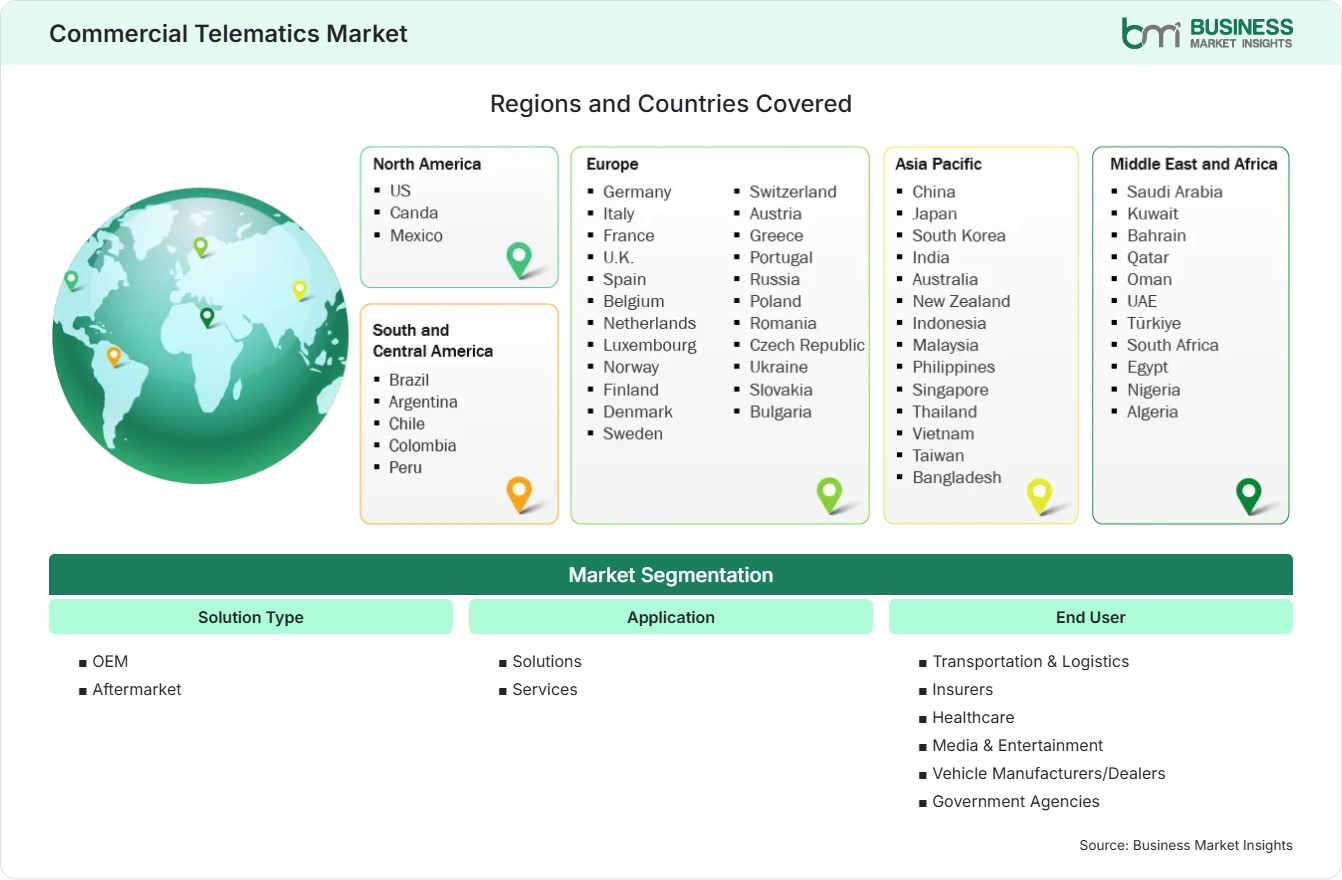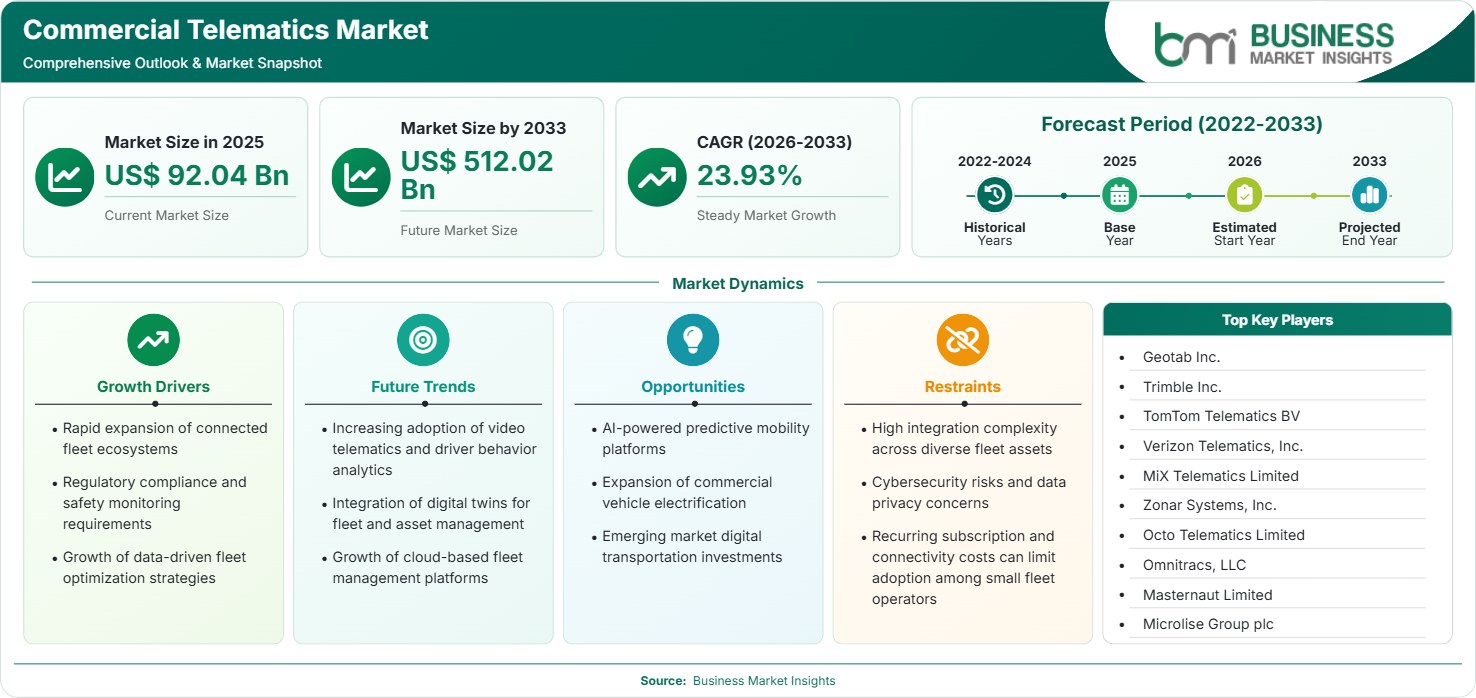
Commercial Telematics Market Regional Highlights
North America Commercial Telematics Market
North America accounts for approximately 34%–37% of global revenue in 2025 and is projected to expand at a CAGR of 22%–24% through 2033. The area has modern IT infrastructure, extensive use of fleet management services and mature transport network. Major logistics providers keep investing in analytical approaches to make operations more efficient and compliant. Mature technology ecosystems, large presence of connected cars and favorable regulation of fleet tracking ensure continuous growth. The Commercial Telematics Market share remains highest in this region due to established enterprise fleet deployment and software subscription penetration.
- Fleet operators are now leveraging platforms that incorporate driving monitoring, predictive maintenance, route optimization, and fuel analysis in order to increase productivity and cut down costs through use of AI.
- The need for compliance to electronic logging devices, vehicle safety monitoring, and emission reporting regulations is further pushing the integration of connected vehicle platforms in commercial transportation fleets.
- The rising need for last-mile deliveries is making logistics firms invest in real-time tracking and asset visibility solutions along with fleet intelligence software running on the cloud platform.
- The rise in the number of electric commercial vehicles has led to increased demand for monitoring and managing the performance of batteries along with efficient charging.
US Commercial Telematics Market
The United States represents approximately 78%–82% of North American revenue in 2025 and is anticipated to register a CAGR of 22%–24% through 2033. A large number of logistics fleets, widespread use of road transport services, and high digitization are the factors supporting the demand. Businesses are progressively leveraging connected vehicle data for improving efficiency, safety results, and customer services. The development of intelligent transportation systems and cloud computing is enhancing the competitive position of the national market while promoting telematics solutions adoption.
- Large transportation companies increasingly deploy advanced analytics platforms capable of processing vehicle, driver, and asset data to improve utilization rates and operational decision-making effectiveness.
- E-commerce expansion continues generating demand for fleet visibility tools that support route optimization, delivery scheduling, and customer experience management across complex distribution networks in commercial telematics market.
- Fleet electrification initiatives are encouraging adoption of telematics systems capable of monitoring battery health, charging patterns, and energy efficiency performance metrics.
- Strong venture investment and innovation activity support development of artificial intelligence-enabled mobility platforms designed to enhance predictive maintenance and transportation intelligence capabilities.
Europe Commercial Telematics Market
Europe contributes approximately 27%–30% of global revenue in 2025 and is expected to expand at a CAGR of 21%–23% through 2033. Sustainability, road safety, and efficiency in transportation are key factors that contribute to the uptake of such technology. Germany is leading in terms of revenue generated in the region, whereas eastern Europe is growing faster due to investments in the logistics industry. Manufacturing capability and connected mobility technologies facilitate the deployment of smart fleet management systems in the region.
- Germany maintains leadership through strong automotive technology capabilities, extensive logistics infrastructure, and widespread enterprise adoption of connected fleet management platforms.
- Poland and Romania are among faster-growing regional markets, supported by transportation modernization programs and increasing investment in logistics digitization initiatives in commercial telematics market.
- Fleet operators increasingly utilize telematics-enabled emissions monitoring tools to align transportation activities with evolving sustainability and environmental compliance objectives.
- Connected mobility strategies promoted across the European Union continue accelerating integration of vehicle intelligence, analytics, and digital transportation services.
Asia Pacific Commercial Telematics Market
Asia Pacific represents approximately 25%–28% of global revenue in 2025 and is forecast to achieve a CAGR of 26%–29% through 2033, making it the fastest-growing market in terms of regions. Urbanization and infrastructure development along with digitization have boosted the growth rate of the requirement for connected fleet management solutions. China continues to be the biggest contributor in terms of region, whereas India shows some of the fastest growth rates owing to modernization of logistics. Increasing e-commerce activities and commercial vehicles enhance adoption potential.
- China drives regional initiatives via its significant logistics operations, intelligent transportation system initiatives, connected vehicles initiatives, and robust government backing of digital mobility applications.
- India ranks highly in terms of growth of national markets owing to its fast logistics industry growth, transport digitalization, and increasing use by fleet operators.
- E-commerce growth is leading to considerable demand for fleet efficiency solutions, including fleet route optimization and performance management in commercial transport systems.
- The proliferation of 4G and 5G technology increases connectivity, facilitating fleet intelligence platforms' wider implementation within regional markets.
Rest of World Commercial Telematics Market
Rest of World accounts for approximately 8%–10% of global revenue in 2025 and is projected to expand at a CAGR of 20%–22% through 2033. Factors that encourage adoption include logistics networks, the advancement of transportation, and the benefits associated with being operationally efficient. The Middle East is experiencing more adoption in fleets due to intensive industries in the region. South & Central America is experiencing increased adoption due to the growth of the e-commerce and investments in transportation infrastructure.
Brazil is the leader in South & Central America, and Mexico showcases its strong momentum because of the digitization efforts in logistics and cross-border trade. On the other hand, the leading country in Middle East & Africa is the United Arab Emirates, while Saudi Arabia exhibits better growth because of smart mobility.
- Brazil remains dominant in terms of regional demand due to the use of transportation fleets, logistics expansion, and the deployment of vehicle management technology.
- The Saudi Arabian market is becoming an attractive high growth region due to investments in digital infrastructure, transportation improvements, and increased commercial vehicle use.
- The mining, construction, and oil and gas industry is using fleet intelligence technology to enhance workforce safety performance.
- Smart cities initiatives being developed in Gulf countries are influencing the adoption of connected transport technologies and vehicle monitoring solutions.