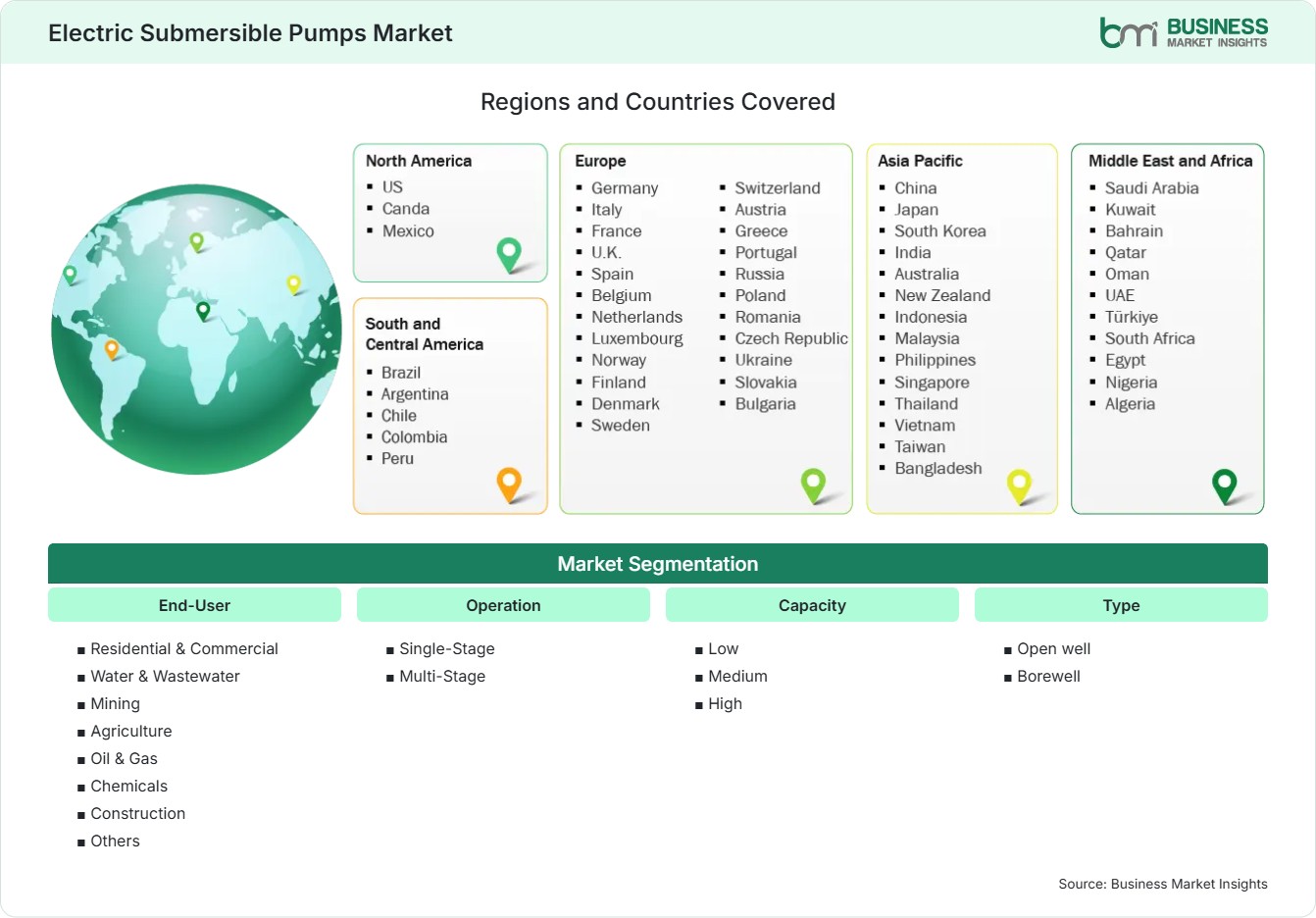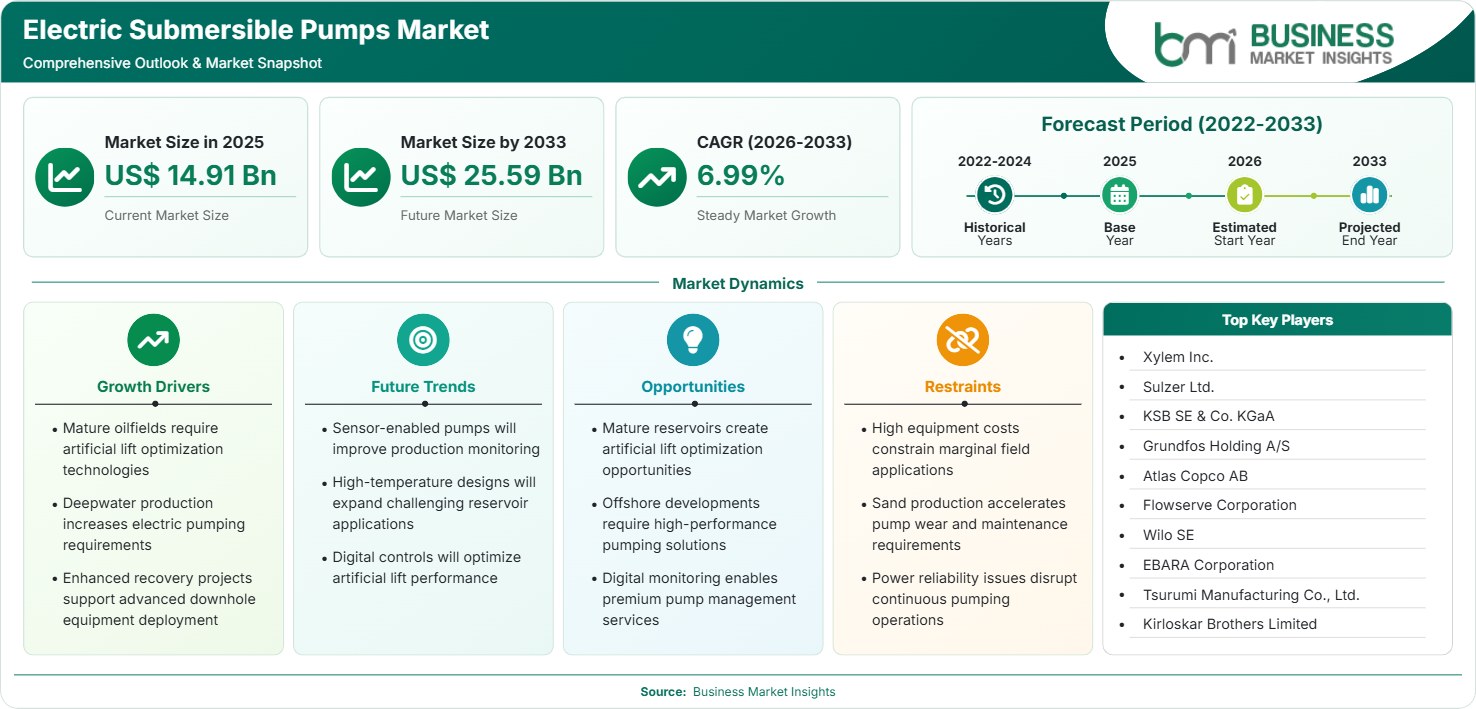
Electric Submersible Pumps Market Regional Highlights
North America Electric Submersible Pumps Market
North America accounted for a 20%–24% Electric Submersible Pumps Market share in 2025 and is projected to grow at a 5.5%–6.2% CAGR from 2026–2033. The demand is driven by wastewater treatment rehabilitation, construction dewatering, mining, industrial water management, and replacement of existing equipment. Developed infrastructure makes after-sales services, energy efficiency, reliability engineering, and monitoring highly significant. The United States leads the regional market demand, and Canada provides mining, municipal, and industrial applications. The regional market share is defined by replacement frequency and engineered systems demand.
- Because their systems are getting older, municipal wastewater operators need dependable drainage and sewage equipment as part of the rehabilitation work, which leads to frequent requirements for replacement and servicing.
- Mining operations prefer dewatering equipment that is sturdy and able to cope with abrasive conditions, varying water levels, and the need for continuous operation in isolated areas.
- Industrial users are now more likely to assess energy consumption and lifecycle cost, and this has led to the adoption of efficient motors, better hydraulics, variable-speed controls, and monitoring technologies.
- The need for construction dewatering arises repeatedly since transportation, commercial, and infrastructure projects require temporarily installed pumping systems that can be quickly deployed.
US Electric Submersible Pumps Market
The U.S. represents 75%–80% of North American Electric Submersible Pumps Market demand in 2025, equivalent to approximately 15%–19% of global demand, with a 5.7%–6.3% CAGR from 2026–2033. Demand includes municipal water, wastewater, construction, mining, industrial, and agricultural segments. Efficiency, availability, compliance, monitoring, and reliability are becoming more important considerations for buyers. Infrastructure upgrades facilitate the process of replacement, whereas rental and dewatering temporary uses enable easier access to mobile units.
- In the case of municipal uses, reliability is stressed since pump failures can have an impact on wastewater conveyance, stormwater management, and the continuity of public services, which has in turn led to greater interest in having redundant systems and entering into service contracts.
- More and more industrial facilities are now evaluating their consumption of energy used in pumping, which provides opportunities for the use of efficient hydraulics, the use of optimised motors, the operation of machinery at variable speeds, and for replacing existing equipment.
- People involved in construction and mining prefer portable equipment since site conditions change quickly, making deployment flexibility, repairability, and local stock important.
Europe Electric Submersible Pumps Market
Europe Electric Submersible Pumps Market held an 18%–22% share in 2025 and is projected to grow at a 5.0%–5.7% CAGR from 2026–2033. The demand for efficient motors comes from Germany, the UK, France, Italy, Spain, and the Nordic countries. Southern and Eastern Europe provide high growth potentials related to water shortage and infrastructure development. Energy efficiency, wastewater treatment, industrial decarbonization, and performance considerations affect purchases. Efficiency motors, advanced controls, high-quality materials, and servicing are critical factors in replacements.
- Germany meets the demand for industrial use, for wastewater, for building services and for process water, since engineering reliability and efficiency have an impact on the procurement.
- There are opportunities in southern Europe due to the problem of water scarcity, the need for irrigation, and the process of modernizing municipalities, which in turn increases the demand for groundwater and water-management equipment.
- The United Kingdom has demand in the areas of wastewater, construction, utilities, and flood management and this supports its specialised dewatering and replacement operations.
- In the Nordic markets, efficiency, durability, and environmental performance are stressed, and premium equipment is supported by monitoring and optimized hydraulics.
Asia Pacific Electric Submersible Pumps Market
Asia Pacific Electric Submersible Pumps Market represented a 45%–49% share in 2025 and is projected to grow at a 6.3%–7.0% CAGR from 2026–2033. China and India provide substantial volume, while Southeast Asia, Japan, South Korea, and Australia contribute specialized demand. Agriculture, groundwater extraction, urbanization, wastewater expansion, industrialization, and mining underpin equipment requirements. India offers strong country-level expansion potential, while China remains important through its manufacturing and infrastructure ecosystem.
- The country supports efficient and solar-compatible pumping systems by combining agricultural irrigation, demand from domestic borewells, municipal water development, and local manufacturing.
- China meets the demand for industrial and municipal uses, and competition exists across a range of areas including standard products, engineered systems, wastewater applications, and high-volume distribution.
- Urbanization, agricultural modernization, industrial expansion, and decentralized water infrastructure all provide opportunities in Southeast Asia.
- In mining and in the use of groundwater, Australia's involvement is influenced by factors such as reliability, the ability for remote monitoring, corrosion resistance, and the level of service support when it comes to equipment economics.
Rest of World Electric Submersible Pumps Market
Rest of World Electric Submersible Pumps Market accounted for a 7%–13% share in 2025 and is projected to grow at a 5.0%–5.8% CAGR from 2026–2033. South and Central America provide opportunities through irrigation, mining, municipal water, and industrial development, particularly in Brazil and Chile. The demand in the Middle East and Africa is linked to groundwater development, municipal systems, construction, mining, and industrial infrastructure. Distributed pumping creates opportunities where centralized networks remain limited.
- Brazil meets the demands of both its agricultural and industrial sectors, especially in cases where the expansion of irrigation and the use of groundwater systems require reliable equipment.
- Chile and other mining countries adjacent to it need specialized dewatering solutions to carry out deeper extraction, manage water, and advance mineral development.
- In the Gulf region, emphasis is placed on water infrastructure, construction, groundwater management, and industrial uses, with a preference for equipment that is resistant to corrosion and for services that support these areas.
- There are opportunities for decentralised water supply in African markets, particularly with regard to solar-compatible systems in areas where the availability of the grid and the cost of operation limit the use of conventional pumping.