
Electric Drive Unit Market Outlook: Size, Share, Trends, Growth Analysis, Competitive Landscape & Forecast, 2026-2033

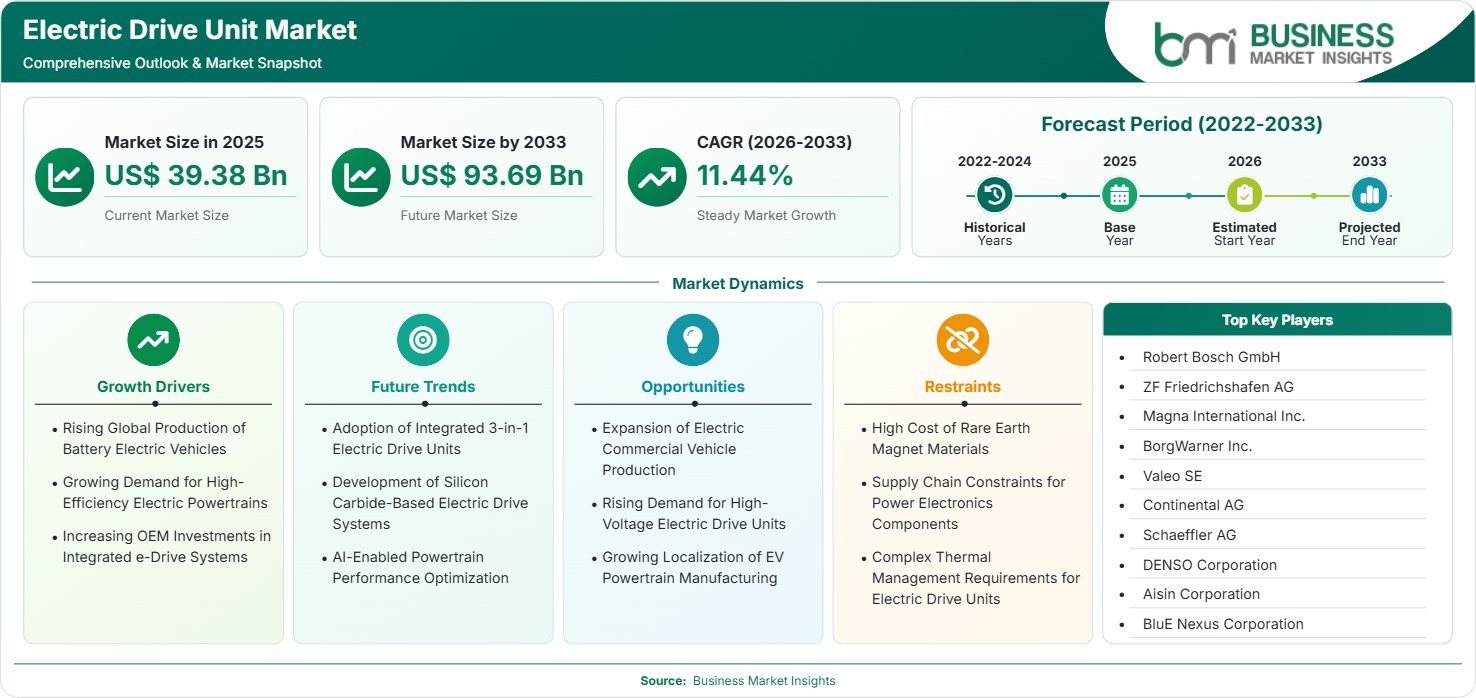
The Electric Drive Unit Market size was valued at US$ 39.38 Billion in 2025 and is projected to reach US$ 93.69 Billion by 2033, growing at a CAGR of 11.44% during 2026–2033. Rising electric vehicle production, increasing drivetrain integration, growing investments in e-mobility platforms, and advancements in compact high-efficiency propulsion technologies continue creating significant growth opportunities worldwide.

Report Coverage
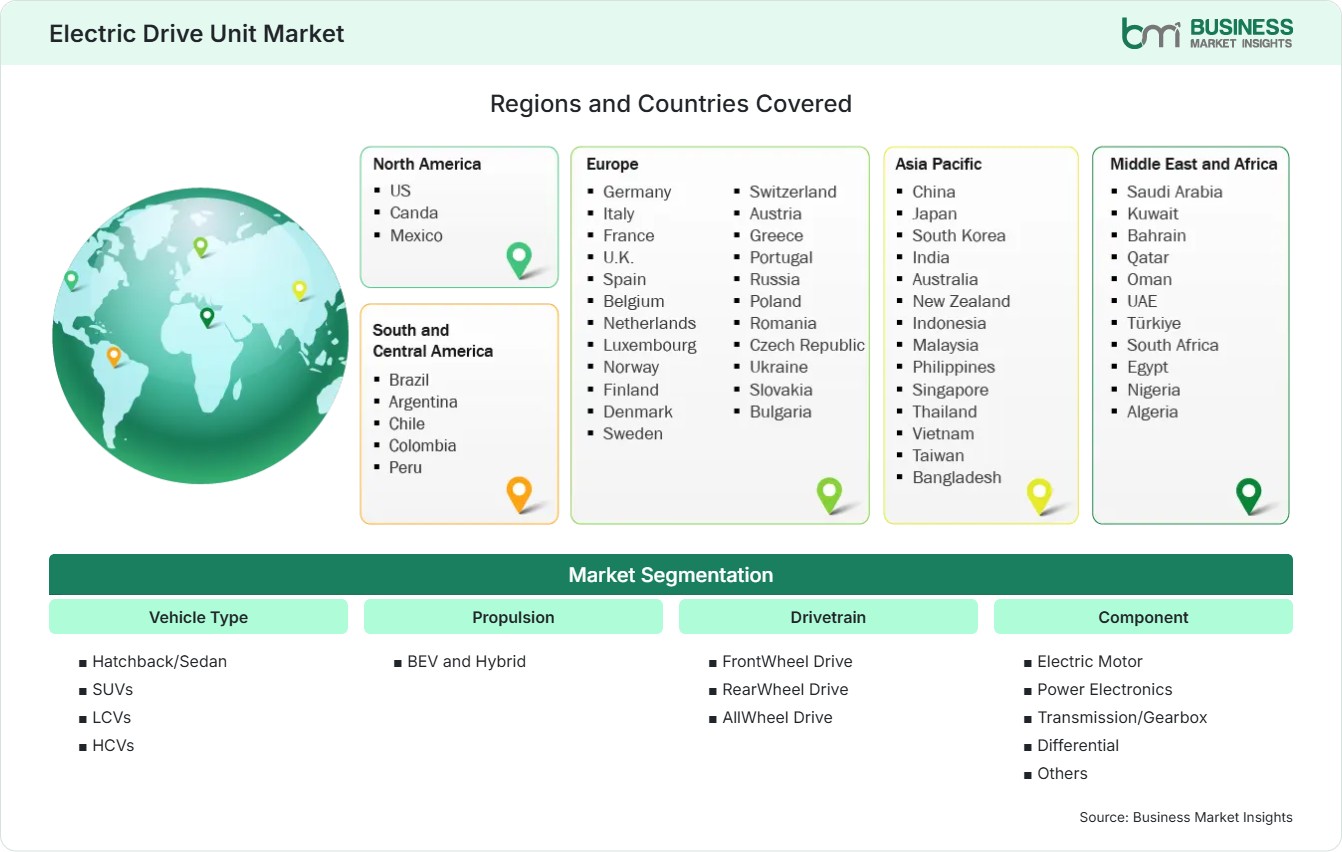
  • Vehicle Type: Hatchback/Sedan, SUVs, LCVs, HCVs
  • Propulsion: BEV and Hybrid
  • Drivetrain: FrontWheel Drive, RearWheel Drive, AllWheel Drive
  • Component: Electric Motor, Power Electronics, Transmission/Gearbox, Differential, Others
  • Power Output: Below 100 kW, 100250 kW, Above 250 kW
US$ 39.38 Bn Market size in 2025
US$ 93.69 Bn Market Size by 2033
11.44% CAGR, 2026 - 2033
2026-2033 Forecast Period

AI Overview

Electric Drive Unit Market Summary

  • North America Region: North America holds 25%–28% electric drive unit market share in 2025 and is projected to grow at a CAGR of 10.8%–11.3% during 2026–2033. Strong EV production, government incentives, domestic battery investments, and localized powertrain manufacturing continue supporting market expansion. The U.S. dominates regional demand owing to rising EV production, increasing investments in integrated e-powertrain manufacturing, and expanding OEM partnerships, registering a CAGR of 10.9%–11.4% during the forecast period.
  • Fastest Growing Region: Asia Pacific accounts for 45%–48% market share in 2025 and is expected to expand at a CAGR of 12.2%–12.7%. Rapid electric vehicle adoption, battery manufacturing expansion, supportive government policies, and growing automotive production continue driving regional demand.
  • Leading Segment: BEV accounts for 67%–70% market share in 2025 while growing at a CAGR of 11.8%–12.3%. Increasing production of battery electric vehicles and demand for integrated electric propulsion systems continue supporting segment leadership.
  • High Growth Segment: OEM represents 82%–85% market share in 2025 and is projected to register a CAGR of 11.9%–12.4%. Expanding factory-installed electric drive unit integration, platform standardization, and long-term supply agreements continue accelerating growth.
  • Key Market Opportunity: Development of highly integrated e-axles, silicon carbide power electronics, lightweight drivetrain architectures, and high-voltage propulsion systems is creating substantial long-term opportunities for manufacturers.
  • Major Market Players: Robert Bosch GmbH, ZF Friedrichshafen AG, Magna International Inc., BorgWarner Inc., Valeo SE, Continental AG, Schaeffler AG, DENSO Corporation, AISIN Corporation, and BluE Nexus Corporation.
Strategic Insights

Electric Drive Unit Market: Strategic Insights

Electric Drive Unit Market Strategic Framework
FREE PDF
Request your free sample
Request free sample
Stakeholder View

Key Takeaways

  • Vertical integration across motors, power electronics, transmissions, and software is strengthening supply chain efficiency while reducing manufacturing complexity.
  • Passenger battery electric vehicles continue presenting the strongest commercial opportunity due to accelerating global electrification and supportive policy frameworks.
  • Innovation increasingly focuses on integrated e-axles, silicon carbide inverters, oil-cooled motors, and compact high-efficiency propulsion systems.
  • Asia Pacific remains the most attractive manufacturing and investment destination due to expanding EV production capacity and battery ecosystem development.
  • Strategic collaborations between OEMs and tier-one suppliers continue accelerating integrated electric drive unit development and commercialization.
  • Companies investing in modular propulsion architectures and localized manufacturing are expected to strengthen long-term competitiveness across global EV markets.
Geographic Outlook

Electric Drive Unit Market Regional Highlights

North America Electric Drive Unit Market

North America accounted for approximately 25%–28% of global revenue during 2025 and is projected to expand at a CAGR of 10.8%–11.3% through 2033. Growing electric vehicle manufacturing, battery investments, and government incentives continue supporting regional expansion. The Electric Drive Unit Market share benefits from increasing localization of EV supply chains, integrated drivetrain manufacturing, and strong automotive innovation.

  • Domestic manufacturing capabilities for electric powertrains continue to receive investments from car manufacturers.
  • Increasing battery production helps achieve greater localizations of integrated electric drives.
  • Government incentives keep promoting electric transportation and technological innovations.
  • Investments in silicon carbide power electronics help increase the efficiency of the drivetrain.

US Electric Drive Unit Market

The United States represents approximately 84%–87% of North American demand and is projected to register a CAGR of 10.9%–11.4% during the forecast period. Expanding EV manufacturing, technology innovation, and supplier investments continue strengthening long-term electric drive unit market development.

  • Major automotive manufacturers continue expanding domestic EV production capacity.
  • Integrated e-powertrain development supports higher manufacturing efficiency.
  • Federal clean mobility policies encourage continued investments across the EV ecosystem.
  • Supplier partnerships accelerate commercialization of next-generation propulsion technologies.

Europe Electric Drive Unit Market

Europe accounted for approximately 24%–27% of global revenue during 2025 and is expected to grow at a CAGR of 11.1%–11.6% through 2033. Strong vehicle electrification targets, automotive innovation, and emission regulations continue supporting regional demand. Germany leads regional production, while Hungary records one of the fastest growth rates through expanding EV manufacturing investments.

  • Germany continues leading electric drivetrain innovation and integrated vehicle production.
  • Hungary attracts substantial investments in EV manufacturing and component production.
  • European emission regulations continue accelerating electrified vehicle adoption.
  • Growing battery manufacturing strengthens regional electric drive unit supply chains.

Asia Pacific Electric Drive Unit Market

Asia Pacific represented approximately 45%–48% of global revenue during 2025 and is forecast to grow at a CAGR of 12.2%–12.7% through 2033, making it the fastest-growing regional electric drive unit market. Strong EV adoption, battery manufacturing, and automotive production continue driving demand. China leads regional revenue, while India records the fastest growth.

  • China maintains leadership through large-scale EV production and integrated battery manufacturing.
  • India experiences rapid expansion supported by EV incentives and domestic automotive investments.
  • Japan and South Korea continue advancing electric propulsion technologies.
  • Southeast Asia increasingly attracts investments in electric vehicle assembly and component manufacturing.

Rest of World Electric Drive Unit Market

The Rest of World accounted for approximately 5%–7% of global revenue during 2025 and is projected to expand at a CAGR of 11.3%–11.8% through 2033. South & Central America gradually increase EV adoption, while the Middle East and Africa strengthen investments in sustainable transportation infrastructure. Brazil leads Latin America, whereas the UAE records the fastest regional growth.

  • Brazil continues encouraging localized electric vehicle production.
  • UAE expands investments in electric mobility infrastructure and clean transportation.
  • Fleet electrification supports increasing demand for integrated electric propulsion systems.
  • Automotive manufacturers continue evaluating regional assembly opportunities.
Global Market Geography
FREE PDF
Request your free sample
Request free sample
Segment Analysis

Electric Drive Unit Market Segmentation

Vehicle Type

The Vehicle Type segment accounted for approximately 52%–55% of the market in 2025 and is projected to expand at a CAGR of 11.7%–12.2% during 2026–2033. Rising electrification across passenger and commercial vehicle categories continues driving demand for compact, efficient, and integrated propulsion systems. The Electric Drive Unit Market scope continues expanding as automakers introduce dedicated electric vehicle platforms across multiple vehicle classes.

  • Hatchback/Sedan: Hatchbacks and sedans account for significant demand owing to high global electric passenger vehicle production, efficient drivetrain integration, and growing consumer preference for zero-emission urban mobility.
  • SUVs: Electric SUVs continue recording strong adoption as manufacturers introduce longer-range models equipped with high-performance drive units supporting improved torque delivery, towing capability, and all-weather driving performance.
  • LCVs: Electric light commercial vehicles increasingly utilize integrated drive units to improve operational efficiency, reduce maintenance requirements, and support expanding urban logistics and last-mile delivery services.
  • HCVs: Heavy commercial vehicles increasingly adopt high-power electric drive units for buses and freight transportation, supported by fleet electrification initiatives and stricter emission regulations.

Propulsion

Propulsion technologies remain central to electric drivetrain development, accounting for approximately 67%–70% of the market in 2025 while registering a CAGR of 11.8%–12.3% through 2033. The Electric Drive Unit Market trends indicate growing preference for fully electric propulsion systems as governments and manufacturers accelerate vehicle electrification.

  • BEV: Battery electric vehicles dominate demand through increasing global production, expanding charging infrastructure, longer driving range, and growing investments in dedicated electric vehicle platforms.
  • Hybrid: Hybrid vehicles continue supporting market demand by combining internal combustion engines with electric propulsion systems, improving fuel efficiency while easing the transition toward full electrification.

Drivetrain

Drivetrain architecture continues evolving as manufacturers optimize efficiency, vehicle dynamics, and packaging flexibility. This segment represented approximately 46%–49% of the market in 2025 and is expected to grow at a CAGR of 11.5%–12.0% during the forecast period.

  • Front-Wheel Drive: Front-wheel drive remains widely adopted in passenger electric vehicles because of compact packaging, manufacturing efficiency, and lower production costs.
  • Rear-Wheel Drive: Rear-wheel drive systems provide improved weight distribution, higher performance, and superior driving dynamics for premium and performance-oriented electric vehicles.
  • All-Wheel Drive: All-wheel drive configurations utilize dual electric drive units to enhance traction, acceleration, vehicle stability, and off-road capability across diverse operating conditions.

Component

Component integration continues driving innovation as manufacturers combine multiple propulsion elements into compact systems. The segment accounted for approximately 31%–34% of market revenue in 2025 and is projected to register a CAGR of 11.6%–12.1% during 2026–2033.

  • Electric Motor: Electric motors generate propulsion power while delivering high torque, energy efficiency, rapid acceleration, and compact packaging for modern electric vehicles.
  • Power Electronics: Power electronics regulate electrical energy flow between batteries and motors while improving efficiency, thermal performance, and overall drivetrain reliability.
  • Transmission/Gearbox: Electric transmissions optimize torque delivery and vehicle efficiency while supporting smooth acceleration across varying operating conditions.
  • Differential: Differentials distribute torque effectively between drive wheels, improving traction, cornering stability, and vehicle handling performance.
  • Others: Additional components include controllers, cooling systems, housings, integrated software, bearings, sensors, and auxiliary drivetrain elements supporting efficient electric propulsion.

Power Output

Power output classifications continue diversifying as manufacturers address varying vehicle performance requirements. This segment represented approximately 44%–47% of market revenue during 2025 and is forecast to expand at a CAGR of 11.9%–12.4% through 2033.

  • Below 100 kW: These drive units primarily serve compact passenger vehicles emphasizing affordability, urban mobility, and energy-efficient transportation.
  • 100–250 kW: Medium-power drive units support mainstream passenger vehicles, SUVs, and light commercial vehicles requiring balanced efficiency and performance.
  • Above 250 kW: High-power drive units are increasingly deployed in premium passenger vehicles, heavy commercial vehicles, performance EVs, and specialized industrial mobility applications.

Sales Channel

Sales channels remain dominated by original equipment manufacturers due to factory integration of propulsion systems. The segment accounted for approximately 82%–85% of the market in 2025 and is projected to register a CAGR of 11.9%–12.4% during the forecast period.

  • OEM: OEMs dominate demand through factory-installed integrated electric drive units developed specifically for dedicated electric vehicle platforms and long-term production programs.
  • Aftermarket: The aftermarket continues expanding gradually as electric vehicle fleets mature, increasing demand for replacement components, refurbishment services, and drivetrain maintenance solutions.
Market Forces

Electric Drive Unit Market Dynamics

Key Market Drivers

Rising Global Production of Battery Electric Vehicles

Global battery electric vehicle production continues expanding rapidly as governments strengthen emission regulations, consumers increasingly adopt zero-emission mobility, and automakers accelerate electrification strategies. Every battery electric vehicle requires one or more electric drive units, directly supporting component demand across passenger and commercial vehicle segments. The Electric Drive Unit Market growth continues benefiting from expanding manufacturing capacity, battery cost reductions, improved charging infrastructure, and increasing investments in dedicated EV production facilities. Growing consumer acceptance of electric mobility further reinforces sustained long-term demand for integrated electric propulsion technologies.

Growing Demand for High-Efficiency Electric Powertrains

The current focus in the the automotive industry is on highly efficient electric powertrains, which can enhance the car's driving range, reduce energy consumption, and offer better driving dynamics. Electric drive modules with electric motors, inverters and transmission systems provide less weight to the system and increase the efficiency of the package. The constant progress of such semiconductor technologies as silicon carbide, cooling systems, lightweight materials and smart powertrain management makes the electric cars more efficient.

Increasing OEM Investments in Integrated e-Drive Systems

Manufacturers of vehicles have been focusing a lot on designing e-drives which make the assembly easy, less complex to handle and scalable too. The e-drives that are currently being developed incorporate electric motor, power electronics, gearing and even the software within a compact and modular system that can support different types of vehicles. Collaboration of OEMs and tier-one suppliers not only fastens up the development process but also reduces the costs of production.

Key Market Opportunities

Expansion of Electric Commercial Vehicle Production

Commercial fleet electrification continues accelerating as governments introduce stricter emission standards and logistics companies pursue lower operating costs. Electric buses, delivery vans, medium-duty trucks, and heavy commercial vehicles require durable, high-output electric drive units capable of supporting demanding operating conditions. The Electric Drive Unit Market Forecasts remain highly favorable as fleet operators increasingly invest in sustainable transportation solutions. Manufacturers developing robust propulsion systems specifically designed for commercial applications are expected to benefit from rapidly expanding global fleet electrification initiatives.

Rising Demand for High-Voltage Electric Drive Units

Auto makers are increasingly moving towards 800 volts or higher voltage vehicle architecture in order to enhance charging times, drivetrain efficiency, and power. High-voltage electric drives allow for rapid acceleration, reduction of losses and range improvement while offering future electric mobility platforms. Companies that have invested in technology development in the areas of insulation, high-efficiency motors, silicon carbide power electronics, and thermal management systems can take advantage of this emerging technological trend.

Growing Localization of EV Powertrain Manufacturing

Electric vehicles' components can be produced domestically by governments in countries around the world via various manufacturing incentives and localization strategies. More and more automotive manufacturers have been investing in regionalized production lines for motors, power electronics, transmissions, and integrated drive units to increase supply chain resilience and lower logistic costs. Such localization programs present many business opportunities for parts suppliers, technological firms, automation companies, and engineering firms.

Market Restraints and Challenges

High Cost of Rare Earth Magnet Materials

Factor: High-performance permanent magnet electric motors depend on rare earth materials including neodymium and dysprosium, whose prices fluctuate because of concentrated global supply and geopolitical uncertainties.

Impact: Rising raw material costs increase manufacturing expenses for electric drive units while reducing supplier margins and complicating long-term pricing strategies. Manufacturers increasingly invest in magnet-efficient motor designs, alternative motor technologies, material recycling, and diversified sourcing strategies to reduce dependence on volatile rare earth supply chains and improve long-term cost competitiveness.

Supply Chain Constraints for Power Electronics Components

Factor: Electric drive units rely on semiconductors, silicon carbide devices, control modules, and other advanced electronic components that remain vulnerable to supply shortages and manufacturing bottlenecks.

Impact: Component shortages can delay production schedules, increase procurement costs, and disrupt electric vehicle manufacturing programs. Automotive suppliers increasingly diversify semiconductor sourcing, establish long-term supply agreements, expand regional manufacturing capacity, and invest in inventory resilience to minimize operational disruptions and maintain reliable electric drive unit production.

Company Analysis

Competitive Landscape

The Electric Drive Unit market analysis suggests that the market is characterized by intense competition, as leading automotive suppliers are working on the integration of electric drives, efficient motors, power electronics made from silicon carbide, and lightweight drive-train architecture. The companies are developing and improving their positions in the fast growing eco-system of electric mobility through further investments.

Company Name

Overview

Products and Services Relevant to this Market

Robert Bosch GmbH

Robert Bosch GmbH is a leading global automotive technology supplier developing advanced electrification solutions for passenger and commercial vehicle manufacturers worldwide.

Integrated electric drive units, electric motors, power electronics, e-axles, vehicle control software, and electrified powertrain systems.

ZF Friedrichshafen AG

ZF Friedrichshafen AG develops advanced electric propulsion technologies and integrated drivetrain systems supporting global automotive electrification initiatives.

Electric drive units, e-axles, electric motors, transmissions, power electronics, and integrated mobility solutions.

Magna International Inc.

Magna International Inc. provides complete vehicle engineering and electrified propulsion technologies for leading global automotive manufacturers.

Integrated e-drive systems, electric motors, transmission technologies, vehicle engineering, drivetrain components, and electrification solutions.

BorgWarner Inc.

BorgWarner Inc. develops high-performance propulsion technologies supporting battery electric, hybrid, and commercial vehicle electrification worldwide.

Electric drive modules, electric motors, inverters, transmission technologies, battery systems, and integrated propulsion solutions.

Valeo SE

Valeo SE supplies innovative automotive electrification technologies designed to improve efficiency, sustainability, and vehicle performance across global markets.

Electric drive systems, power electronics, electric motors, thermal management, drivetrain technologies, and mobility solutions.

Continental AG

Continental AG develops intelligent automotive technologies supporting connected, autonomous, and electrified vehicle platforms globally.

Electric drive units, power electronics, motor control systems, automotive software, sensors, and electrified drivetrain technologies.

Schaeffler AG

Schaeffler AG specializes in precision motion technologies and integrated electric propulsion solutions for modern automotive platforms.

E-axles, electric motors, transmission components, bearings, drivetrain technologies, and integrated electric propulsion systems.

DENSO Corporation

DENSO Corporation develops advanced automotive components and electrification technologies supporting efficient next-generation mobility solutions.

Electric motors, inverters, power electronics, thermal management systems, automotive electronics, and integrated e-drive components.

AISIN Corporation

AISIN Corporation manufactures advanced automotive drivetrain and electrification technologies serving global passenger and commercial vehicle markets.

Electric drive units, transmissions, e-axles, drivetrain components, electric propulsion technologies, and mobility systems.

BluE Nexus Corporation

BluE Nexus Corporation develops integrated electric drive systems and advanced propulsion technologies primarily supporting electric vehicle manufacturers.

Integrated e-axles, electric motors, inverter systems, electric propulsion technologies, drivetrain integration, and vehicle electrification solutions.

Trust & Transparency

Research Methodology

The market analysis combines proprietary research with secondary data from government agencies, company disclosures, regulatory filings, industry databases and expert interviews. Market estimates are validated through data triangulation, cross-market benchmarking and analyst review.

View Full Research Methodology

Questions Answered

Frequently Asked Questions

What does an electric drive unit market report include?

A comprehensive report includes market size, regional analysis, competitive landscape, segmentation, technology trends, supply chain assessment, growth opportunities, regulatory outlook, and long-term market forecasts.

Which region is expected to grow the fastest?

Asia Pacific is projected to record the highest growth owing to large-scale EV manufacturing, battery production expansion, supportive government incentives, and increasing investments in localized automotive supply chains.

Why are OEMs the leading sales channel?

OEMs dominate because electric drive units are generally integrated during vehicle manufacturing, ensuring optimized performance, system compatibility, quality control, and long-term warranty support.

Which propulsion segment dominates the market?

Battery Electric Vehicles (BEVs) hold the largest market share due to increasing global EV production, stricter emission regulations, expanding charging infrastructure, and continuous investments in dedicated electric vehicle platforms.

What is an electric drive unit in an electric vehicle?

An electric drive unit is an integrated propulsion system that combines components such as the electric motor, power electronics, transmission, and differential to deliver efficient power from the battery to the wheels.

Access the Full Electric Drive Unit Market Report

Get segment-level forecasts, regional estimates, competitive benchmarking, company profiles and downloadable Excel datasets.

Access the full Electric Drive Unit Market Report
350 pages PDF & Excel | 2026-08-07
Similar Research

Related Market Reports