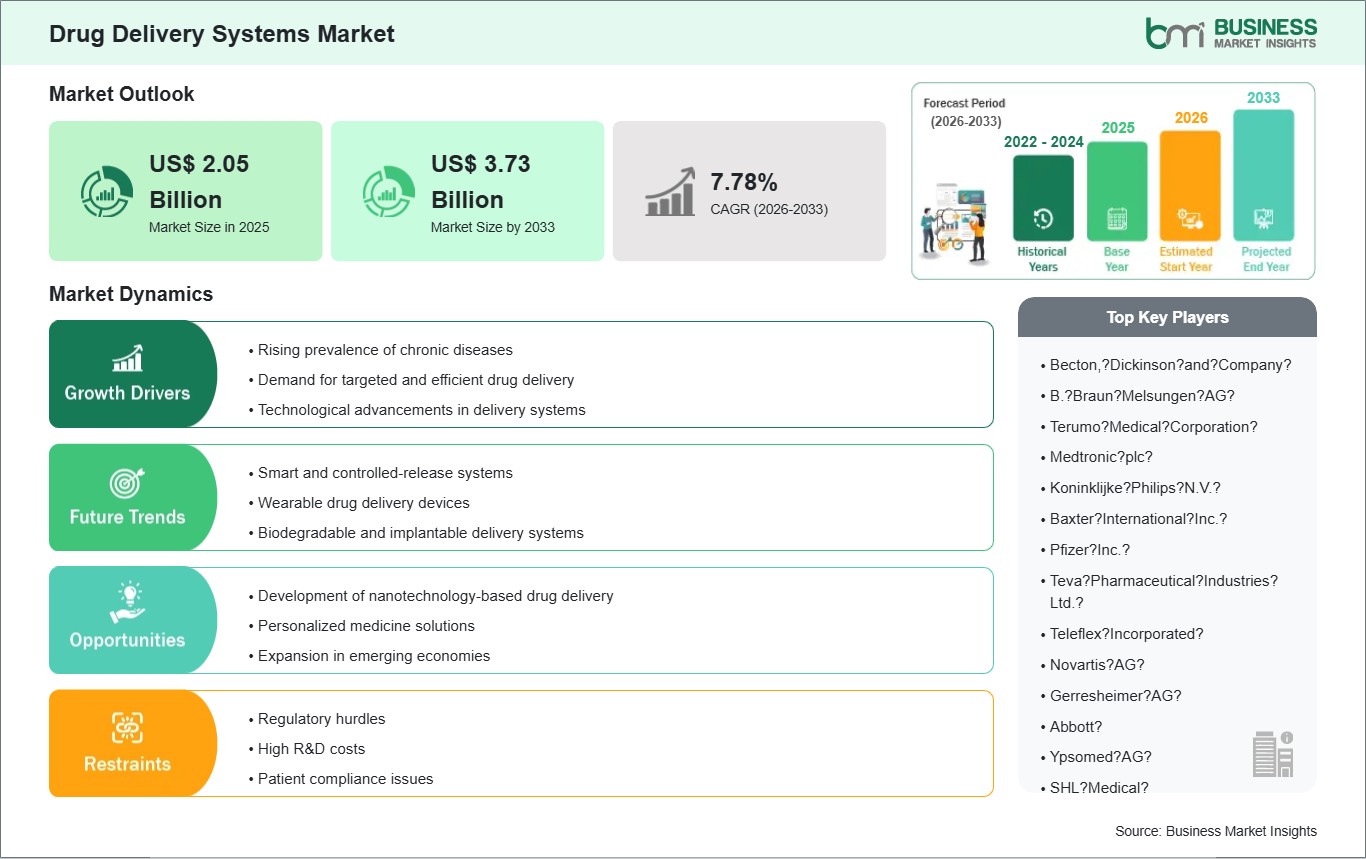
The Drug Delivery Systems market size is expected to reach US$ 3.73 billion by 2033 from US$ 2.05 billion in 2025. The market is estimated to record a CAGR of 7.78% from 2026 to 2033.
Globally, Drug Delivery Systems are responsible for the administration of therapeutic compounds and are at the forefront of the medicine delivery world with their targeted, controlled, and efficient nature. They are a must for the treatment of chronic, infectious, oncological, cardiovascular, respiratory, and autoimmune diseases. Drug delivery systems hold many benefits for the patients such as increased bioavailability, fewer side effects, better patient adherence, and drugs being able to reach non-invasive sites in the body. The market is driven by the increasing prevalence of chronic diseases, the rising demand for personalized medicine, and the growing awareness of novel treatment options. Besides, the innovations in oral, transdermal, injectable, inhalation, and implantable drug delivery systems are not only making different treatments more effective but also more patient-friendly.
On the other hand, there are some challenges that are capable of limiting the market growth like the high development costs, the very tight regulatory approvals and the technical difficulties that come with advanced delivery systems. The industry is also affected by the pressure on prices and the unequal distribution of healthcare facilities in different areas. Nevertheless, the market has immense opportunities which are coming from the growing demand for less invasive therapies, the increase in the number of healthcare facilities in emerging economies, and the use of smart and controlled-release delivery technologies. Investing in next-generation delivery platforms, combination therapies, and patient-centric solutions will also be key in unlocking new areas for market growth, thus supporting better therapeutic outcomes and making healthcare accessible worldwide

Key segments that contributed to the derivation of the Drug Delivery Systems market analysis are type, application, and end user.
The Drug Delivery Systems market is anticipated to remain vigorous mainly due to the increasing global prevalence of chronic diseases that necessitate very accurate, on-going, and patient-centered drugs administration to be able to increase compliance, efficacy and man's life quality while cutting down on healthcare system burden.
As per the U.S. Centers for Disease Control and Prevention (CDC, 2024), chronic diseases touch 194 million adults in the U.S.—which is 76.4% of the adult population—with diabetes very much affecting 37 million patients and heart diseases alone accounting for 695,000 deaths every year. The scenario is identical globally with the World Health Organization (WHO, 2024) mentioning that non-communicable diseases are responsible for 41 million deaths each year which is 74% of the worldwide mortality rate, cardiovascular diseases, diabetes, cancer, and chronic respiratory diseases being the leading causes.
The older population is an additional factor for the increasing demand for drugs delivery systems. The U.S. Census Bureau (2024) gives a figure of 61.2 million Americans aged 65 and over, which is a 3.1% rise from 2023, while the World Health Organization (2024) has good. By the End of 2050, one in six people worldwide will be over 65 compared to one in eleven in 2019. Of elderly people in the U.S., 93% have at least one chronic condition (CDC, 2024) asking for delivery systems that will ensure adherence over the long haul, such as transdermal patches, autoinjectors, and implantable pumps.
The converging forces of chronic disease epidemic, demographic aging, and regulatory support for patient-friendly technologies have positioned drug delivery systems as a cornerstone of modern, personalized therapeutics. Recent regulatory approvals have underlined this factor. The U.S. Food and Drug Administration (FDA, 2025) approved the broader use of Medtronic's MiniMed 780G insulin pump system in February 2025, which connects the advanced glucose monitoring and the automated delivery system for 7.3 million diabetes patients in the U.S. (CDC, 2024). On the European side, the European Medicines Agency (EMA, 2024) gave the nod to Novo Nordisk's Ozempic® pre-filled pen improvements for weekly semaglutide delivery, which is in line with the 60 million diabetes cases in the area. The National Institutes of Health (NIH, 2025) also backed more than 15 projects that are developing microneedle patches and smart inhalers, which are aimed at respiratory and cardiovascular diseases that affect 6.7 million heart failure patients in the U.S. every year (CDC, 2024).
The market for drug delivery systems is opening a new door through the improvement of targeted drug delivery technologies. In addition to the rising prevalence of chronic diseases like cancer, diabetes, and cardiovascular disorders, patients want treatments that are not only effective but also gentler on the body. Among the various drug delivery systems, that is, nanocarriers, liposomes, and polymer-based carriers, are able to give great precision in the delivery of active pharmaceutical ingredients to specific cells or tissues, which reduces the amount that enters the bloodstream and thus, produces the desired effect.
The development of these systems is being fast-tracked by the advances in both biotechnology and nanomedicine. For example, the use of ligand-targeted nanoparticles is one of the innovations that makes it possible for drugs to be extremely selective in attaching only to diseased cells thus improving treatment efficiency and patient compliance. More so, the combination of smart delivery systems that are able to release drugs when and only if certain body conditions trigger it allows for more application in personalized medicine.
The opportunity is further strengthened by the fact that the big pharmaceutical companies and research organizations are committing more funds to R&D in order to optimize drug delivery platforms. Along with the regulatory bodies' approval of new delivery mechanisms, patient and healthcare professional's rising awareness about the advantages of targeted therapies is also driving the trend. In addition, the emerging markets, which are characterized by an increase in healthcare costs and better facilities, also present a neglected area for these modern drug delivery systems.
Adopting a strategic approach that focuses on targeted drug delivery will enable pharmaceutical companies to not only distinguish their products but also increase the efficacy, thus, overcoming the medical needs, which is why it is considered as a high-growth opportunity in the global drug delivery market

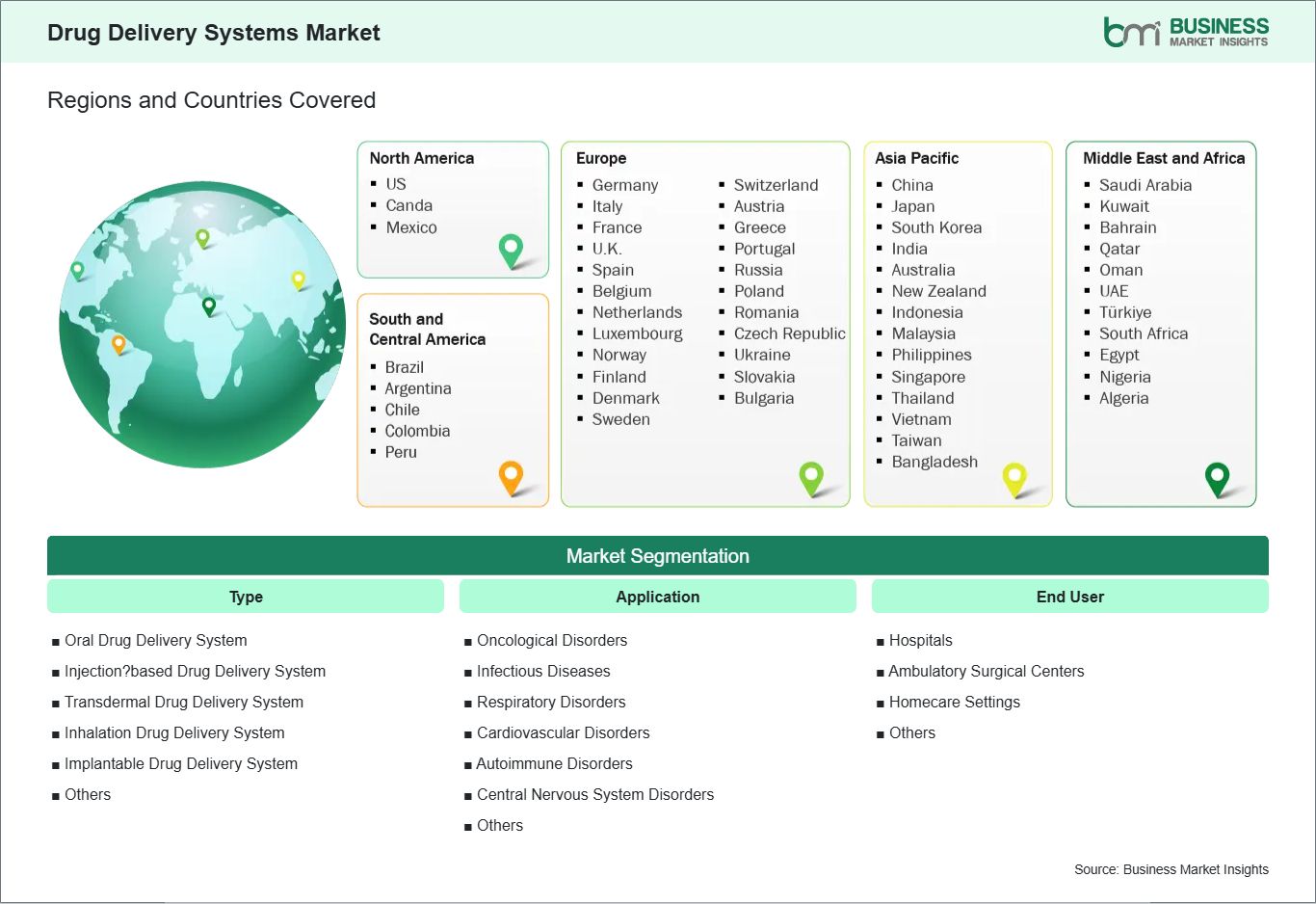
By type, the Drug Delivery Systems market is segmented into Oral Drug Delivery System, Injection-based Drug Delivery System, Transdermal Drug Delivery System, Inhalation Drug Delivery System, Implantable Drug Delivery System, and Others. The Injection-based Drug Delivery System segment dominated the market in 2025. Injection-based systems dominated in 2025 due to precise dosing, rapid therapeutic effect, and suitability for complex drugs, including biologics and chemotherapy, which cannot be effectively delivered orally or transdermally.
By application, the market is segmented into Oncological Disorders, Infectious Diseases, Respiratory Disorders, Cardiovascular Disorders, Autoimmune Disorders, Central Nervous System (CNS) Disorders, and Others. The Oncological Disorders segment held the largest share of the market in 2025. Oncological disorders held the largest market share due to increasing cancer prevalence, growing adoption of advanced therapies, higher treatment costs, and preference for targeted drug delivery methods to improve patient outcomes.
By end user, the market is segmented into Hospitals, Ambulatory Surgical Centers, Homecare Settings, and Others. The Hospitals segment held the largest share of the market in 2025. Hospitals dominated as end users because they provide specialized infrastructure, trained staff, and advanced equipment necessary for administering complex injectable therapies, especially for cancer and critical care treatments.
| Report Attribute | Details |
|---|---|
| Market size in 2025 | US$ 2.05 Billion |
| Market Size by 2033 | US$ 3.73 Billion |
| Global CAGR (2026 - 2033) | 7.78% |
| Historical Data | 2022 - 2024 |
| Forecast period | 2026-2033 |
| Segments Covered | By Type
|
| Regions and Countries Covered | North America
|
| Market leaders and key company profiles |
|
The "Drug Delivery Systems Market Size and Forecast (2022–2033)" report provides a detailed analysis of the market covering below areas:
The region is also witnessing accelerated adoption of advanced drug delivery technologies, including nanocarriers, liposomes, polymer-based systems, and controlled-release platforms—particularly for oncology, cardiovascular, and diabetes treatments. Growing government initiatives to improve healthcare infrastructure, coupled with regulatory support for novel therapies, are further boosting market growth. Additionally, rising awareness among patients and healthcare providers about the benefits of targeted and sustained-release formulations is driving adoption. The expansion of contract development and manufacturing organizations (CDMOs) and strategic collaborations between pharmaceutical companies are positioning Asia-Pacific as a critical hub for innovative drug delivery solutions. Strong infrastructure development, alongside advancements in biotechnology and digital health integration, reinforces the region’s prominent market position

The Drug Delivery Systems market is evaluated by gathering qualitative and quantitative data post primary and secondary research, which includes important corporate publications, association data, and databases. A few of the key developments in the Drug Delivery Systems market are:
The Drug Delivery Systems Market is valued at US$ 2.05 Billion in 2025, it is projected to reach US$ 3.73 Billion by 2033.
As per our report Drug Delivery Systems Market, the market size is valued at US$ 2.05 Billion in 2025, projecting it to reach US$ 3.73 Billion by 2033. This translates to a CAGR of approximately 7.78% during the forecast period.
The Drug Delivery Systems Market report typically cover these key segments-
The historic period, base year, and forecast period can vary slightly depending on the specific market research report. However, for the Drug Delivery Systems Market report:
The Drug Delivery Systems Market is populated by several key players, each contributing to its growth and innovation. Some of the major players include:
The Drug Delivery Systems Market report is valuable for diverse stakeholders, including:
Essentially, anyone involved in or considering involvement in the Drug Delivery Systems Market value chain can benefit from the information contained in a comprehensive market report.
Please tell us your area of interest
(Market Segments/ Regions and Countries/ Companies)