Market Summary
Executive Summary and Global Market Analysis
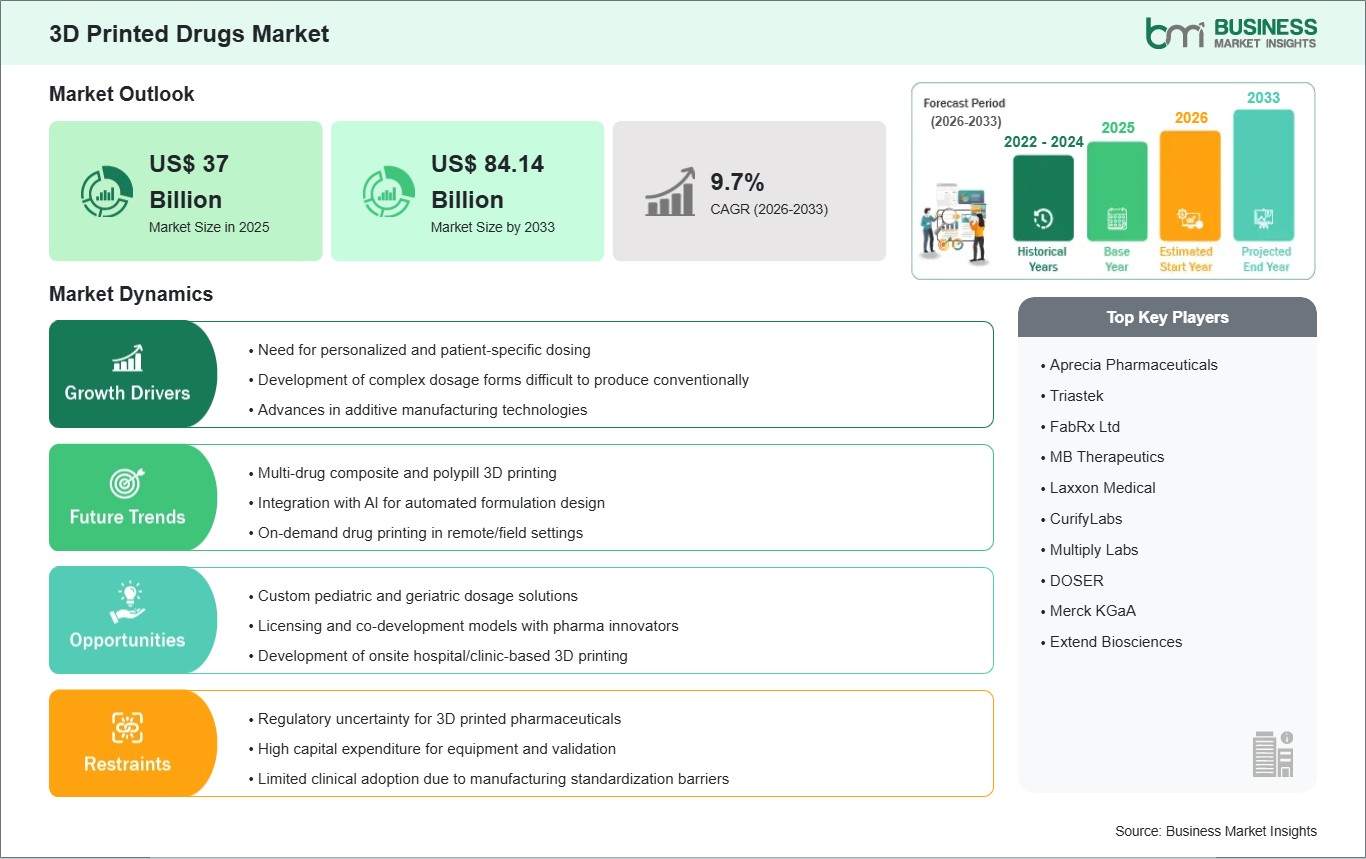
3D printed drugs are pharmaceutical products that are made using additive manufacturing techniques, where the active ingredients and excipients are added one layer at a time to create the required dosage forms. This method provides a very high level of control over the drug release profiles and the creation of complex shapes and other patient-specific changes that cannot be done easily through the traditional mass production processes. Moreover, the technology empowers the production of personalized medicine, polypills, immediate or controlled release tablets, implants, and other advanced delivery systems, which in turn lead to better therapeutic outcomes and patient adherence.
The global market of 3D printed drugs is on a fast track to extensive growth, thanks to the innovations in printing technologies like inkjet and zip dose, and the increasing demand for personalized therapies, as well as the hospitals, clinics, and research institutions that are adopting the technology more and more. North America is the leading market at present, holding the largest share that is supported by a strong healthcare infrastructure and significant R&D investment, while Asia-Pacific is predicted to be the region with the highest growth rate owing to the increasing access to healthcare and the manufacturing initiatives that are being set up locally. The regulatory clarity, digital integration with AI-powered dosage design, and decentralized on-demand production are the major opportunities, but at the same time, the complex approval processes and high initial capital costs are the factors that slow down the widespread industrial adoption in the near term. In general, the industry is likely to experience continuous growth as the adoption of customized medicines and the integration of additive manufacturing in pharmaceutical supply chains worldwide speed up.
Segment Analysis
3D Printed Drugs Market Segmentation
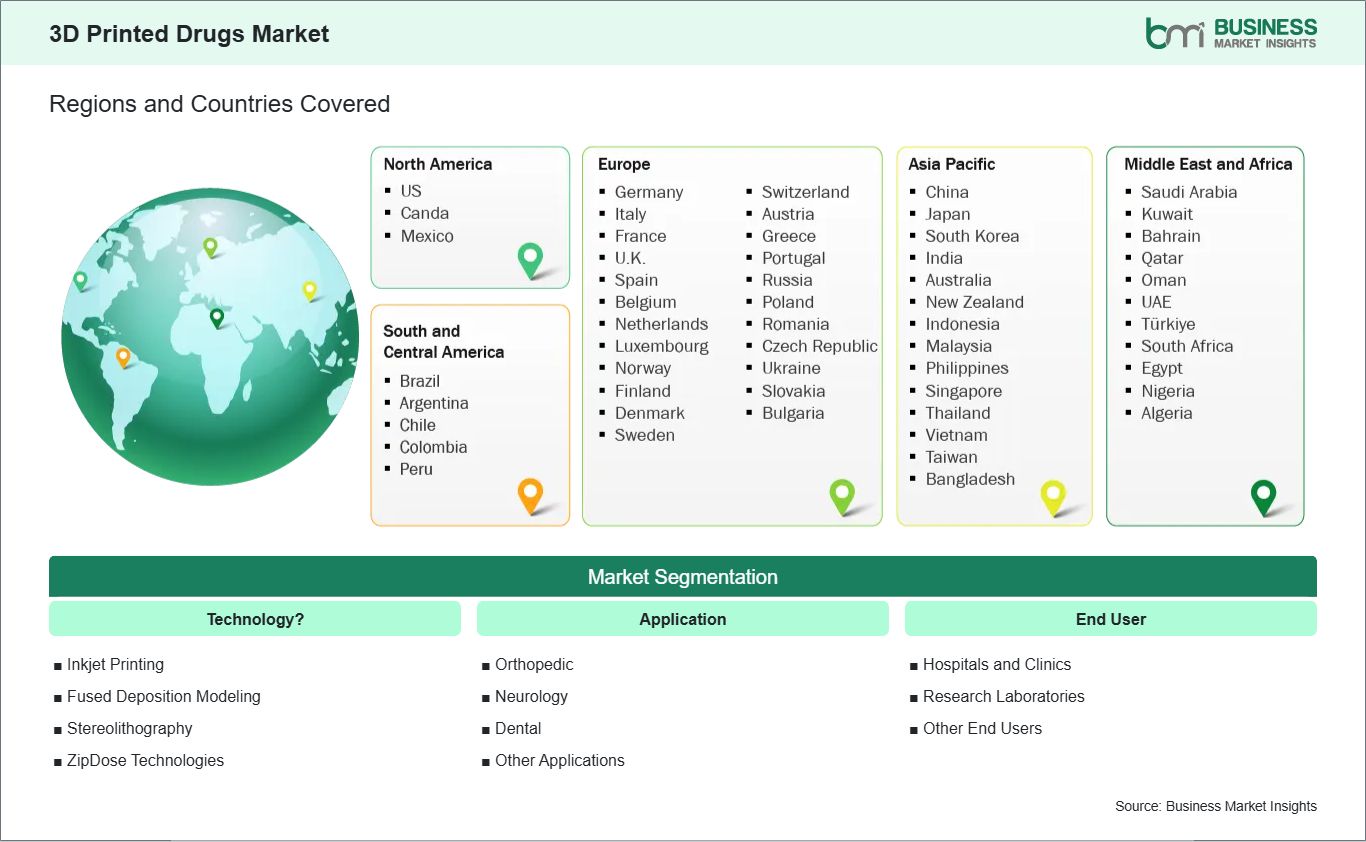
Key segments that contributed to the derivation of the 3D printed drugs market analysis are technology, application, and end user.
- By technology, the 3D printed drugs market is categorized into inkjet printing, fused deposition modeling, stereolithography, zipdose technologies. The inkjet printing segment held the largest share of the market in 2025.
- By application, the market is segmented into orthopedic, neurology, dental, other applications. The neurology segment held the largest share of the market in 2025.
- By end user, the 3D printed drugs market is segmented into hospitals and clinics, research laboratories, other end users. The hospitals and clinics segment dominated the market in 2025.
Market Forces
3D Printed Drugs Market Drivers and Opportunities
Rising Demand for Personalized Medicine
One of the major factors of the market for 3D-printed drugs is the demand for personalized medicine that is rising rapidly all over the world, and this medicine allows for the production of the most suitable drug doses and release profiles for each patient. For pediatrics, geriatrics, or those suffering from chronic diseases, the specific dosing requirements cannot be satisfied very often by the usual mass-produced drugs. On the other hand, 3D printing allows for the precise layer-by-layer fabrication of custom dosages and complex polypills that combine multiple APIs with controlled release characteristics, thus improving therapeutic effectiveness and patient adherence. Recently, more than 45 countries have started pilot hospital programs to test 3D-printed personalized tablets, which are a sign of quick acceptance in clinical settings. Additionally, around 30% of the pharmaceutical manufacturers are now using the combination of AI-driven dosage design and 3D printing, thus improving precision and speeding up formulation development. These trends are indicative of the technology's capability to cater to individual health care needs while at the same time dealing with the inefficiencies in the conventional drug production process, thereby securing the position of personalized therapeutics as a major growth catalyst.
Growth in Decentralized and On-Demand Manufacturing
The foremost prospect in the 3D printed drugs market is the decentralized, on-demand drug manufacturing. In centralized and inventory-heavy traditional pharmaceutical supply chains, 3D printing techniques are capable of producing local medicines designed to meet the requirements of the patient. The transition favors the point-of-care production taking place right inside the hospitals, pharmacies, or clinics, thus diminishing the reliance on big inventories, cutting out waste, and speeding up the delivery process. One of the latest trends indicates that nearly half of the new 3D-printed drug pipelines are targeting the so-called niche populations that include pediatric and geriatric patients needing very specific doses. The number of collaborations between drug developers and 3D printing equipment makers has gone up by ~60% since 2023, thus further boosting the adoption of distributed manufacturing technology. Asia-Pacific and Latin America have become the new geographical areas of interest for off-site production ecosystem investments, thereby allowing the healthcare infrastructures of the respective regions to cater to the demand for customized medicines through local production. Decentralized on-demand manufacturing is, therefore, the way to reconfigure pharmaceutical supply chains in a manner that is widely scalable, all thanks to the combined support of regulations, technology, and market acceptance.
Size and Share Analysis
3D Printed Drugs Market Size and Share Analysis
By technology, the 3D printed drugs market is categorized into inkjet printing, fused deposition modeling, stereolithography, zipdose technologies. The inkjet printing segment held the largest share of the market in 2025. The inkjet printing segment leads the technology category due to its high precision, versatility, and cost-effectiveness in depositing active pharmaceutical ingredients with excellent control over dose and geometry. It supports complex, multi-layered tablets, controlled-release formulations, and on-demand small batch production, which are essential for personalized medicine. Its higher throughput, lower waste, and easier integration into existing pharmaceutical processes further cement its dominance.
By application, the market is segmented into orthopedic, neurology, dental, other applications. The neurology segment held the largest share of the market in 2025. The neurology segment is driven by the strong demand for customized dosing and controlled-release drugs for complex neurological disorders like epilepsy and Parkinson’s disease. 3D printing enables tailored formulations and polypills that improve therapeutic outcomes and patient adherence in long-term treatments, making this application area particularly attractive to pharmaceutical developers and clinicians.
By end user, the 3D printed drugs market is segmented into hospitals and clinics, research laboratories, other end users. The hospitals and clinics segment dominated the market in 2025. Within end users, hospitals and clinics dominate because they adopt 3D printed drugs to provide personalized medication quickly and efficiently at the point of care. This segment benefits from the ability to produce tailored doses for individual patients, manage chronic conditions with precision, and reduce inventory needs and waste, fostering broader clinical use of 3D printed pharmaceuticals.
Report Coverage
3D Printed Drugs Market Report Coverage and Deliverables
The " 3D Printed Drugs Market Size and Forecast (2022–2033)" report provides a detailed analysis of the market covering below areas:
- 3D printed drugs market size and forecast at global, regional, and country levels for all the key market segments covered under the scope
- 3D printed drugs market trends, as well as market dynamics such as drivers, restraints, and key opportunities
- 3D printed drugs market analysis covering key market trends, global and regional framework, major players, regulations, and recent market developments
- Industry landscape and competition analysis covering market concentration, heat map analysis, prominent players, and recent developments for the 3D printed drugs market
- Detailed company profiles, including SWOT analysis
Geographic Insights
3D Printed Drugs Market Geographic Insights
The geographical scope of the 3D printed drugs market report is divided into five regions: North America, Asia Pacific, Europe, Middle East & Africa, and South & Central America. The 3D printed drugs market in Asia Pacific is expected to grow significantly during the forecast period.
The Asia-Pacific 3D printed drugs market is segmented into China, Japan, South Korea, India, Australia, New Zealand, Indonesia, Malaysia, the Philippines, Singapore, Thailand, Vietnam, Taiwan, Bangladesh, and the Rest of Asia. The Asia-Pacific 3D printed drugs market is experiencing robust growth due to a number of interconnected factors. Increasingly, the demand for personalized medicine in countries such as China, India, and Japan is leading to the adoption of 3D printed pharmaceuticals, which provide custom doses, complex drug delivery systems, and thus, quality treatment for the entire humongous population. Government support in terms of regulations and healthcare infrastructure development is the major force behind this trend, as the governments' initiatives in precision medicine are making the technology integration process easier through the creation of innovation frameworks, among other things.
Moreover, growing healthcare expenditure and the investment in advanced manufacturing technologies have resulted in faster commercialization as well as R&D collaborations among local and global pharmaceutical companies—for instance, biotech firms in China are conducting research on developing oral RNA therapeutics using 3D printing and drug printing methods in collaboration with scientists from the USA. The high incidence of chronic diseases and the rising proportion of elderly people in the population are also major factors leading to the demand for customizing and the patient-need-specific production of drugs through 3D printing. Lastly, the aforementioned factors in conjunction with the improvements in clinical trial and hospital infrastructure capabilities have made Asia-Pacific the fastest-growing region for 3D printed drugs in the world market.
Industry Activity
Recent Developments
The 3D printed drugs market is evaluated by gathering qualitative and quantitative data post primary and secondary research, which includes important corporate publications, association data, and databases. A few of the key developments in the 3D printed drugs market are:
- In September 2024, Adare Pharma Solutions, a global technology-driven CDMO focused on oral dosage forms, announced a collaboration with Laxxon Medical, a pharma-technology company pioneering a new generation of advanced pharmaceuticals, to provide the pharmaceutical market with cGMP 3D printing capabilities from Adare’s Pessano facility in Milan, Italy. Adare and Laxxon will utilize the Screen-Printed Innovative Drug (SPID) Technology, licensed from Exentis Group, to create 3D-printed oral dosage forms featuring advanced geometric internal structures and a heterogeneous distribution of active ingredients.
- In December 2024, BioSapien, a patented drug delivery platform treating cancer ‘locally’, completed its US$5.5 million (20.2M AED) pre-Series A fundraising. The capital will fund BioSapien’s clinical trials in the UAE, with patient enrolments in Abu Dhabi set to begin imminently. BioSapien’s flagship product, MediChip, is a 3D printed, slow-release drug delivery platform attachable to any tissue with minimal systemic side effects.
Trust & Transparency
Research Methodology
The market analysis combines proprietary research with secondary data from government agencies, company disclosures, regulatory filings, industry databases and expert interviews. Market estimates are validated through data triangulation, cross-market benchmarking and analyst
review.
View Full Research Methodology
Key Sources Referred:
World Health Organization (WHO)
Centers for Disease Control and Prevention (CDC)
Global Health Data Exchange
HealthMap Disease Surveillance System
Company websites
Company annual reports
Company investor presentations