Market Summary
Executive Summary and Global Market Analysis
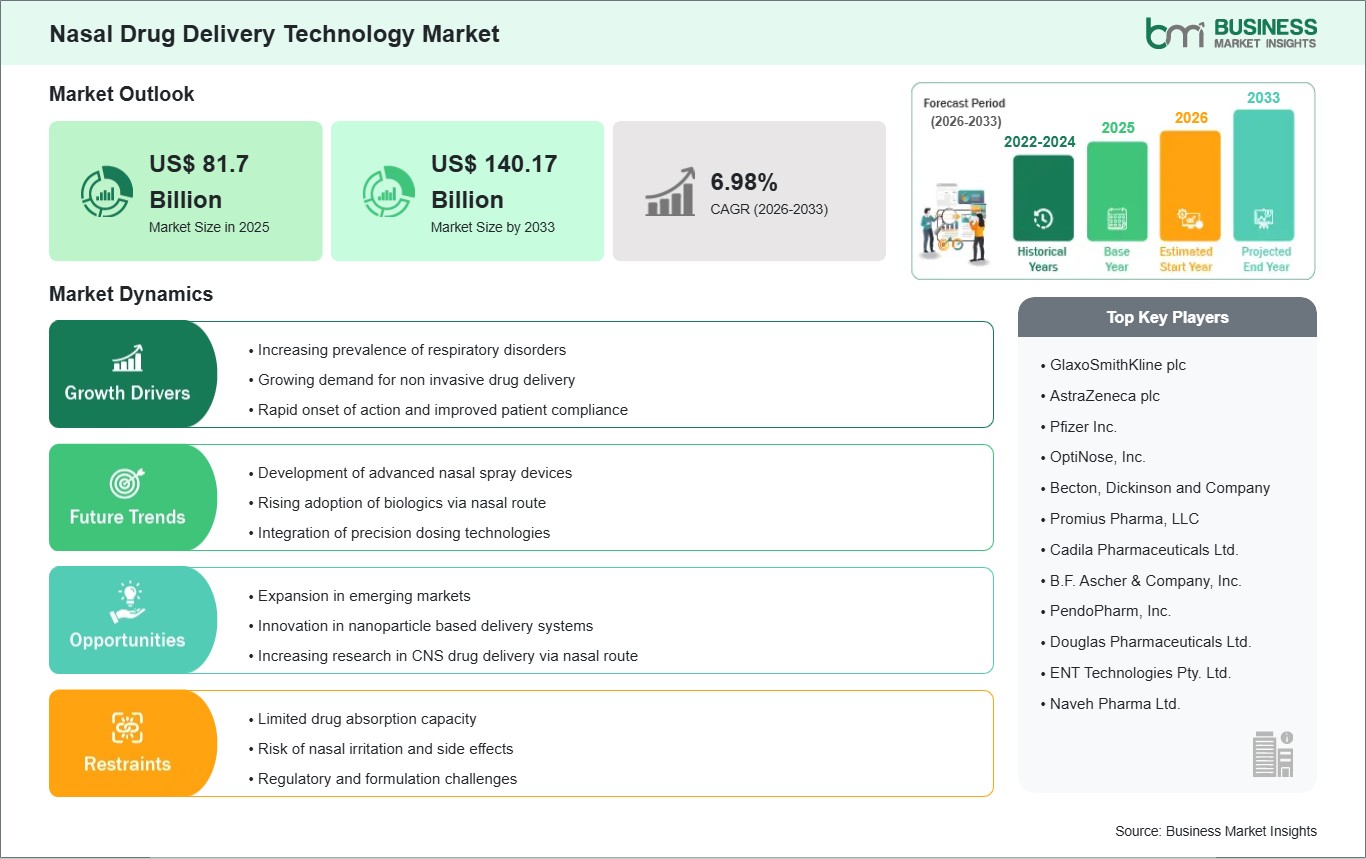
Nasal drug delivery technology refers to a specialized category of medical devices and pharmaceutical formulations designed to administer therapeutic agents into the systemic circulation or directly to the central nervous system through the nasal cavity. Market expansion is fundamentally driven by the rising global prevalence of chronic respiratory diseases, such as allergic rhinitis and sinusitis, as well as an increasing demand for needle-free emergency medications for conditions like anaphylaxis and migraine. Furthermore, the shift toward self-administration and the development of intranasal vaccines are enhancing patient compliance and expanding the reach of immunization programs in both developed and emerging economies.
However, several factors can restrain market growth. Variability in drug absorption, influenced by individual nasal physiology and common conditions like the cold or nasal polyps, can lead to inconsistent therapeutic outcomes. Stringent regulatory hurdles for drug-device combination products often extend the timeline for commercialization and increase research and development expenditures. Additionally, the industry faces constraints due to potential mucosal irritation and the biological limitations of the nasal cavity`s limited surface area, which can restrict the volume of medication administered in a single dose.
Despite these hurdles, the market holds significant opportunities in the formulation of large-molecule biologics and peptides for systemic delivery. The rise of smart nasal devices, equipped with sensors to track dosage and ensure proper administration technique, and the expansion of central nervous system (CNS) therapies for Alzheimer`s and Parkinson`s diseases are expected to support long-term development within the sector. Manufacturers are also exploring mucoadhesive polymers to increase the residence time of drugs in the nasal cavity, thereby improving bioavailability.
Segment Analysis
Nasal Drug Delivery Technology Market Segmentation
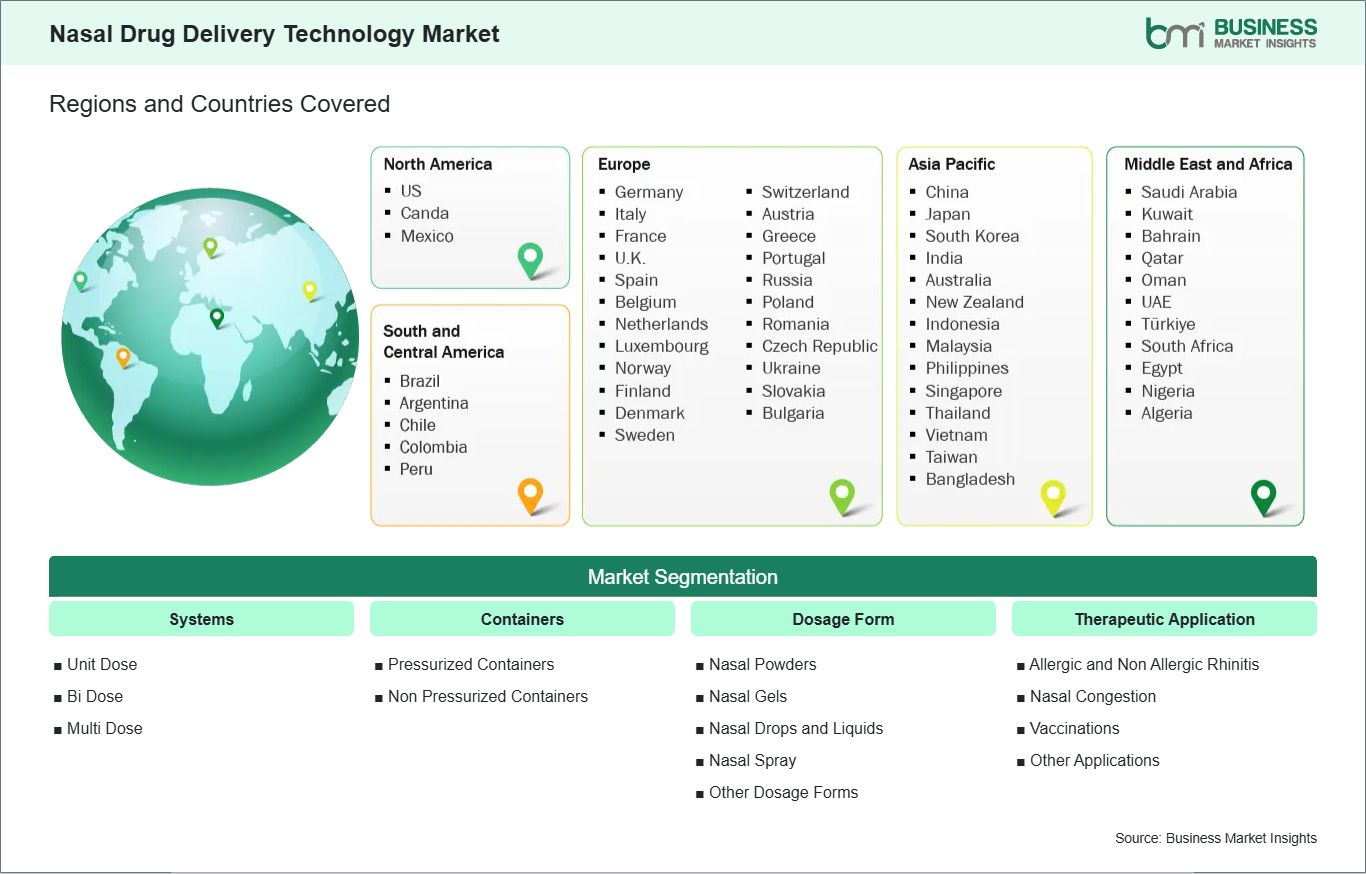
Key segments that contributed to the derivation of the Nasal Drug Delivery Technology market analysis are systems, containers, dosage form, and therapeutic application.
- By Systems, the market is segmented into Unit Dose, Bi‑Dose, and Multi Dose.
- By Containers, the market is divided into Pressurized Containers and Non‑Pressurized Containers.
- By Dosage Form, the market is categorized into Nasal Powders, Nasal Gels, Nasal Drops and Liquids, Nasal Spray, and Others.
- By Therapeutic Application, the market is segmented into Allergic and Non‑Allergic Rhinitis, Nasal Congestion, Vaccinations, and Other Applications.
Market Forces
Nasal Drug Delivery Technology Market Drivers and Opportunities
Expanding Biologic Pipelines and the Proliferation of Self-Administered Care
The primary driver for the Nasal Drug Delivery Technology Market is the systemic global increase in chronic conditions, including diabetes, cardiovascular disease, and central nervous system (CNS) disorders, necessitating user-friendly, non-invasive administration. The Rising Demand for Needle-Free Alternatives to Traditional Injections acts as a foundational catalyst, as patients and healthcare providers prioritize delivery methods that improve long-term adherence and minimize the procedural burden of parenteral therapy. This momentum is further propelled by the Strategic Development of Nose-to-Brain Pathways; by bypassing the blood-brain barrier via the olfactory and trigeminal nerves, nasal technology offers a unique frontier for treating neurodegenerative diseases like Alzheimer`s and Parkinson`s, where traditional systemic delivery often fails.
In the technological sphere, the Rapid Adoption of Single-Dose and Unit-Dose Spray Systems serves as a major driver, as these devices provide the high sterility and precise dosing required for emergency medications such as naloxone and midazolam. Furthermore, the Mainstreaming of Self-Administration in Home-Care Settings, accelerated by a global shift toward decentralized healthcare, is driving the development of intuitive, ready-to-use devices that require minimal training for patients and non-medical caregivers. Together, these factors, the biologic revolution, CNS-targeting, and patient centricity, ensure a high-growth and technologically sophisticated path for the global Nasal Drug Delivery Technology Market.
AI-Integrated Precision Dosing and the Rise of Nasal Vaccines
A significant high-value opportunity lies in the convergence of Nasal Drug Delivery with Smart Sensors and Digital Adherence Platforms. Next-generation smart sprays are being developed to utilize electronic dose counters and Bluetooth connectivity to transmit usage data directly to clinicians, ensuring that patients maintain their therapeutic regimens for chronic conditions like asthma and COPD. There is also a major growth frontier in the development of Dry Powder Nasal Formulations for Large-Molecule Biologics; as manufacturers seek to improve the stability and shelf-life of complex proteins and peptides, specialized powder-delivery devices offer a viable solution that eliminates the need for refrigeration and cold-chain logistics.
Furthermore, the expansion of Intranasal Immunization and Mucosal Vaccines presents a lucrative opportunity, as nasal sprays can induce both systemic and local mucosal immunity, potentially providing a more effective defense against respiratory pathogens while simplifying mass vaccination campaigns. Beyond hardware, the rise of Mucoadhesive and In-Situ Gelling Technologies offers a unique frontier, where formulations are engineered to prolong the residence time of the drug in the nasal cavity, thereby maximizing absorption and therapeutic efficacy. Manufacturers who focus on Ergonomic Soft-Mist Delivery Systems and those pioneering Brain-Targeted Oncological Therapies are positioned to lead the Nasal Drug Delivery Technology Market.
Size and Share Analysis
Nasal Drug Delivery Technology Market Size and Share Analysis
The Nasal Drug Delivery Technology market demonstrates steady growth, with size and share analysis revealing evolving trends and competitive positioning among key players. The report examines subsegments categorized within systems, containers, dosage form, and therapeutic applications, offering insights into their contribution to overall market performance.
Based on the dosage form, the Nasal Spray subsegment holds the primary market presence, representing the highest-volume format for both over-the-counter and prescription medications. A notable trend is the surge in the Nasal Powders and Nasal Gels subsegments, which are registering a higher pace of adoption. Nasal Powders are becoming essential for Stability-Driven Formulations, as the move toward dry-state delivery allows for the storage of temperature-sensitive vaccines and peptides without the need for extensive cold-chain infrastructure.
Report Coverage
Nasal Drug Delivery Technology Market Report Coverage and Deliverables
The "Nasal Drug Delivery Technology Market Size and Forecast (2022–2033)" report provides a detailed analysis of the market covering below areas:
- Nasal Drug Delivery Technology market size and forecast at global, regional, and country levels for all market segments covered under the scope
- Nasal Drug Delivery Technology market trends, as well as drivers, restraints, and opportunities
- Nasal Drug Delivery Technology market analysis covering key trends, global and regional framework, major players, regulations, and recent developments
- Industry landscape and competition analysis covering market concentration, heat map analysis, prominent players, and recent developments for the Nasal Drug Delivery Technology market
- Detailed company profiles, including SWOT analysis
Geographic Insights
Nasal Drug Delivery Technology Market Geographic Insights
The geographical scope of the Nasal Drug Delivery Technology market report is divided into five regions: North America, Asia Pacific, Europe, Middle East & Africa, and South & Central America.
North America maintains the leading market position, supported by a highly developed pharmaceutical sector, significant investment in biotechnology research, and a high prevalence of allergic rhinitis and chronic respiratory conditions. Europe represents a mature and technologically advanced market where growth is sustained by a robust framework for clinical trials and an increasing institutional shift toward non-invasive systemic drug delivery, particularly for central nervous system (CNS) therapies. Asia Pacific is identified as the most rapidly advancing region, propelled by accelerating healthcare modernization, rising disposable incomes, and the expansion of domestic pharmaceutical manufacturing capabilities in emerging economies.
The Asia-Pacific Nasal Drug Delivery Technology Market is segmented into China, Japan, South Korea, India, Australia, and the Rest of Asia Pacific. China serves as a central hub for regional expansion, driven by large-scale government initiatives to modernize healthcare infrastructure and a rising demand for self-administered respiratory treatments in urban centers. India is witnessing a notable transition as domestic pharmaceutical players increase their production of generic nasal sprays and pressurized containers to address the needs of a burgeoning middle-class demographic. Japan continues to prioritize high-precision instrumentation, focusing on the integration of smart, connected devices to improve medication adherence among its substantial geriatric population.
Industry Activity
Recent Developments
The Nasal Drug Delivery Technology market is evaluated by gathering qualitative and quantitative data post primary and secondary research, which includes important corporate publications, association data, and databases. A few of the key developments in the Nasal Drug Delivery Technology market are:
- In December 2025, Aptar Pharma announced its Bidose Nasal System now delivers CARDAMYST™ (etripamil), the first FDA-approved self-administered nasal spray for PSVT. The launch highlights the growing adoption of intranasal delivery platforms for cardiovascular therapies, expands Aptar`s proven drug delivery solutions, and reinforces the nasal drug delivery market.
- In October 2024, Aero Pump and Resyca launched the Ultra Soft Nasal Pump Spray, featuring advanced soft-mist nozzle technology for precise nasal drug delivery. Targeting nose-to-brain therapies, vaccination, and other multidose applications, the device is now available for licensing, highlighting growing innovation in nasal delivery platforms.
Trust & Transparency
Research Methodology
The market analysis combines proprietary research with secondary data from government agencies, company disclosures, regulatory filings, industry databases and expert interviews. Market estimates are validated through data triangulation, cross-market benchmarking and analyst
review.
View Full Research Methodology
Key Sources Referred:
World Bank – Global Trade Indicators World Trade Organization (WTO) (International Monetary Fund )IMF International Trade Administration (ITA) Company website Company annual reports Company investor presentations