
Injectable Drug Delivery Market Outlook (2022-2033)

Historic Data: 2022-2024   |   Base Year: 2025   |   Forecast Period: 2026-2033
Report Content: Market Scope, Market Segmentation, Market Dynamics, and Competitive Analysis

Report Coverage:
  • Device Type (Conventional Injection Devices, Prefilled Syringes, Auto Injectors, Wearable Injectors, Needle-Free Injectors, Injection Pens, and Others)
  • Packaging (Ampoules, Vials, Cartridges, Bottles, and Others)
  • Therapeutic Application (Diabetes / Hormonal Disorders, Autoimmune Disorders, Oncology, Vaccines, Cardiovascular Diseases, Pain Management, Others)
  • Route of Administration (Intravenous, Subcutaneous, Intramuscular, others)

No. of Pages: 400
Report Code: BMIPUB00033219
Category: Life Sciences
Injectable Drug Delivery Market

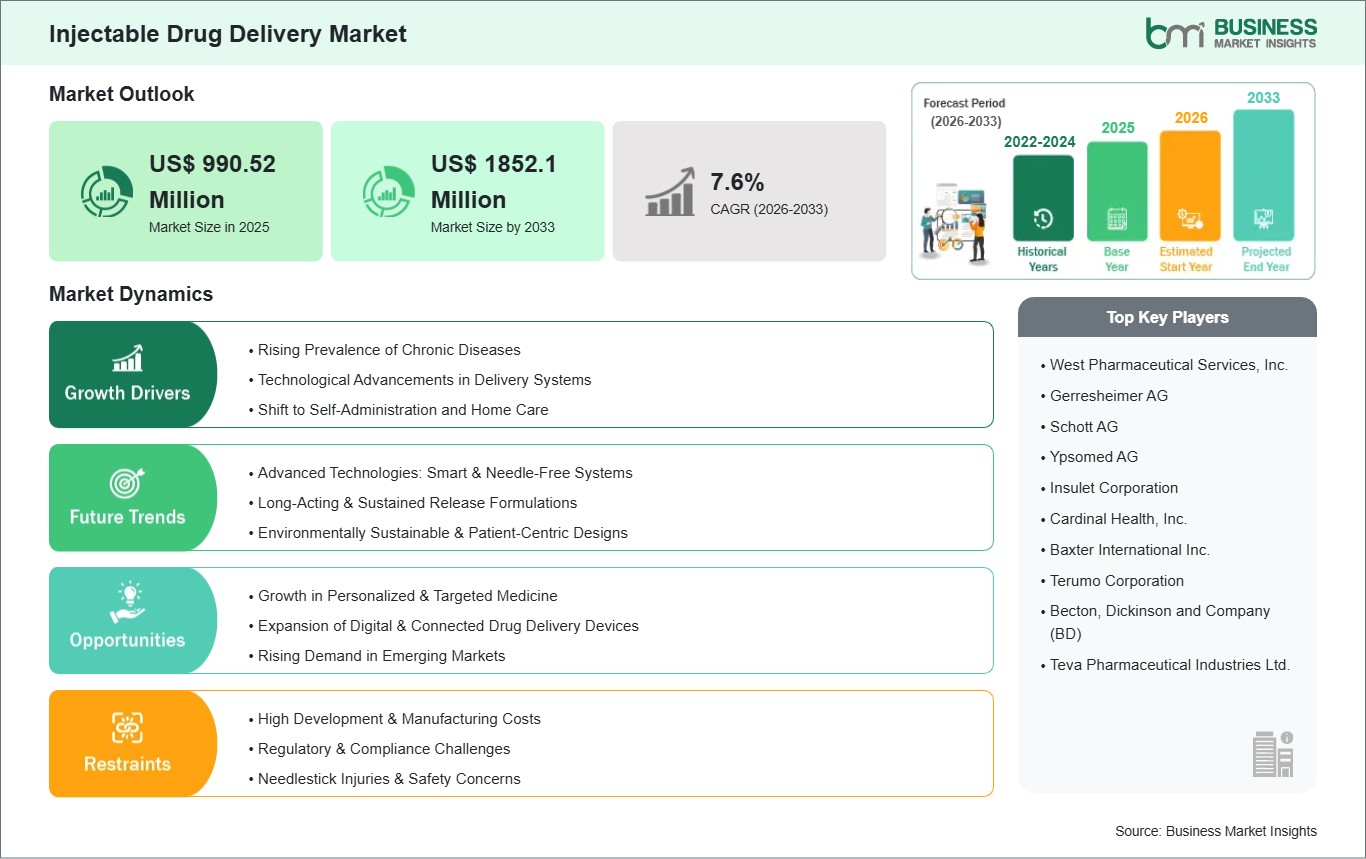
The Injectable Drug Delivery Market size is expected to reach US$ 1852.1 Million in 2033 from US$ 990.52 Million in 2025. The market is estimated to record a CAGR of 7.6% from 2026 to 2033.

Executive Summary and Global Market Analysis:

Injectable drug delivery market is driven by the increasing demand for fast-acting methods to deliver drugs and injectables. While injectable systems have traditionally been used for the delivery of biologics, vaccines, insulin, cancer medications, and emergency medicines, they have also been used because of their higher bioavailability and quick onset of action. Chronic illnesses such as diabetes, cancer, and autoimmune disorders have become more prevalent in recent years, which has resulted in an increased demand for long-term injection therapies. Additionally, the continued growth of the biological and biosimilar product pipeline, which is primarily administered through injection systems, is another major factor driving the overall growth of the injectable drug delivery market.

The market for injectable drug delivery has changed because of new developments in technology with rapid acceptance of prefilled syringes, auto-injectors, wearable injectors, and needle-free delivery methods. As a result, many patients can now use these new devices in their homes rather than having to go to a healthcare facility to do so. Currently, North America holds the largest market share due to its advanced healthcare infrastructure, increased use of drug-device combination products, and high levels of pharmaceutical manufacturing capabilities. Europe is the second largest region, where there is a push for greater regulatory support for the development of biologic drugs and more patient-focused methods of delivering biologic medications. Asia-Pacific is growing with the highest CAGR because of greater healthcare access and spending increases, as well as an increase in the amount of injectable generic drugs and biosimilars being manufactured there. The injectable drug delivery devices market is expected to continue growing as healthcare providers place more emphasis on providing better services to patients by using technology to provide the most accurate, safest, and most effective ways to deliver injectable medications.

Injectable Drug Delivery Market - Strategic Insights:

global-market-strategic-framework
Get more information on this report

Injectable Drug Delivery Market Segmentation Analysis:

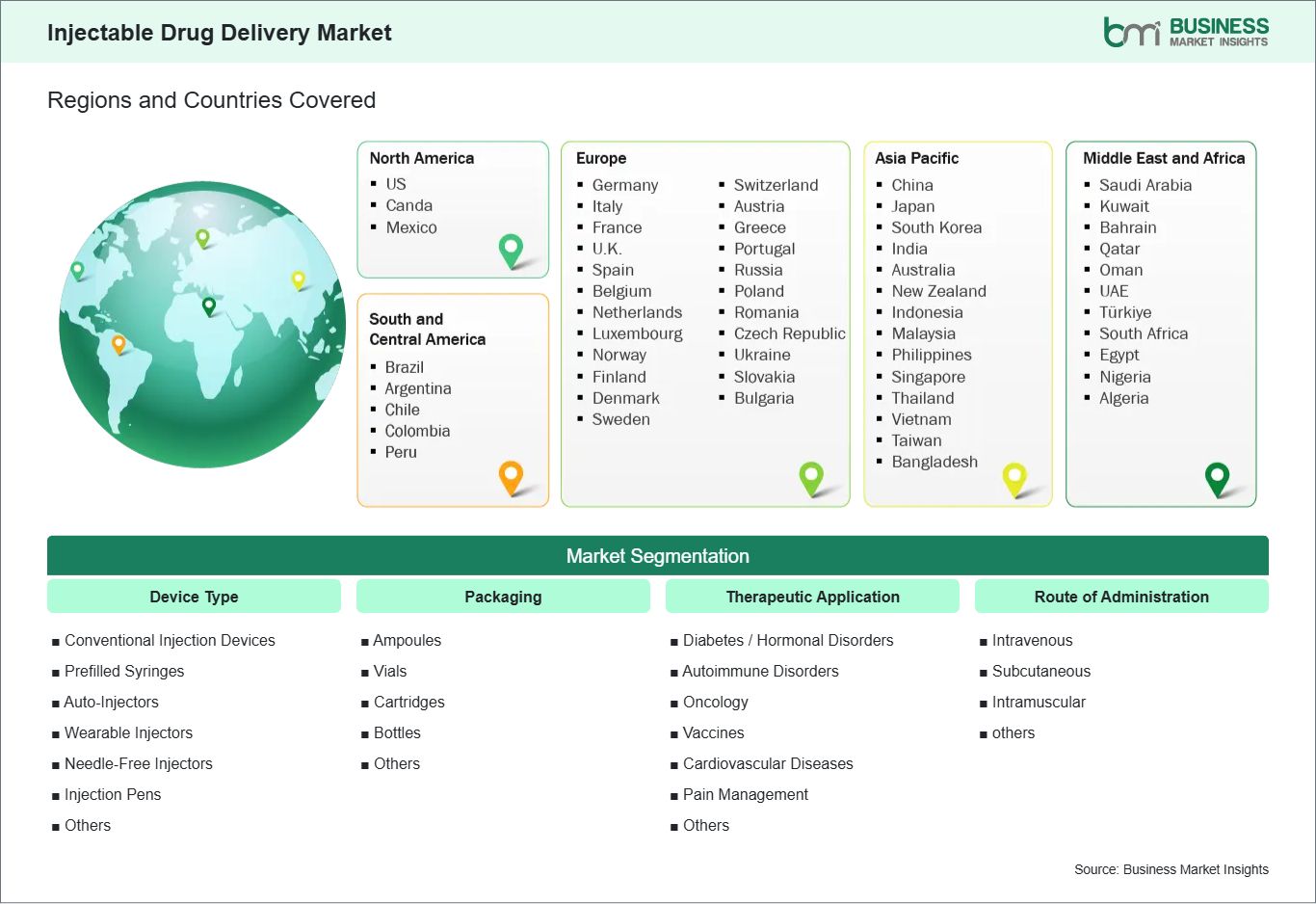
Key segments that contributed to the derivation of the Injectable Drug Delivery market analysis are device type, packaging, therapeutic application, route of administration, usability, and end user.

  • By device type, the injectable drug delivery market is segmented into conventional injection devices, prefilled syringes, auto‑injectors, wearable injectors, needle‑free injectors, injection pens, and others. The prefilled syringes segment dominated the market in 2024.
  • By packaging, the market is segmented into ampoules, vials, cartridges, bottles, and others. The vials segment held the largest share of the market in 2024.
  • By therapeutic application, the market is segmented into diabetes / hormonal disorders, autoimmune disorders, oncology, vaccines, cardiovascular diseases, pain management, others. The diabetes / hormonal disorders segment held the largest share of the market in 2024.
  • By route of administration, the injectable drug delivery market is segmented into intravenous, subcutaneous, intramuscular, others. The subcutaneous segment dominated the market in 2024.
  • By usability, the market is segmented into disposable injectors, reusable devices. The disposable injectors segment held the largest share of the market in 2024.
  • By end user, the market is segmented into hospitals & clinics, home care settings, pharmacies, ambulatory surgical centers, other end users. The hospitals & clinics segment held the largest share of the market in 2024.
Injectable Drug Delivery Market Drivers and Opportunities:

Growing Demand for Biologics and Chronic Disease Management

Injectable drug delivery market has been growing rapidly in recent years owing to the large rise in the number of injectable therapeutics being developed to treat chronic and complex diseases. Chronic diseases such as diabetes, cancer, autoimmune disorders, etc., require high bioavailability delivery of medications in precise doses that can't be achieved with an oral route of administration. Biologics, such as monoclonal antibodies, peptide therapies, and vaccines, are also incredibly sensitive to degradation when exposed to the oligosaccharides found in the GI tract; therefore, injectable route of administration is considered the most effective and reliable means of administering biologic therapies. As the global population ages and the number of people suffering from chronic illnesses continues to increase, so do the numbers of patients receiving long-term injectable therapies. Hospitals and clinics also utilize injectable drugs to treat patients in emergency situations, for critical care and for immunizations, emphasizing how critical these drug delivery methods are to the healthcare system. Healthcare professionals prefer injectable delivery methods because the medications take effect much quicker than oral preparations, the medications can be exactly dosed, and therapeutic effects are more predictable. The expansion of biosimilar products and cost-effective injectable generics are providing more patients access to injectable medications, especially in emerging markets, therefore, creating an ever-growing need for more innovative and advanced injectable drug delivery devices and systems in all healthcare environments globally.

Shift Toward Self-Administration and Advanced Drug–Device Combinations

One of the key opportunities in the injectable drug delivery market growth is the ever-growing trend to self-administer and develop patient-centric drug/device combination products. Many healthcare systems across the globe are taking necessary steps to provide "value-based care" with a focus on the ability to reduce costs, increase access, and ensure better patient compliance. As a result, pre-filled syringes, auto-injectors, wearable injectors, and needle-free delivery systems are becoming widely accepted for use in the outpatient and home care environments. These technologies simplify drug administration, can eliminate dosing errors, and significantly decrease "needle stick" injuries. Patients having chronic illnesses such as rheumatoid arthritis, diabetes, and multiple sclerosis now prefer to receive treatment from their homes, leading to further expansion of the market for these types of products. The need to provide continuous compliance monitoring, integrated drug/device platforms, and collaborate with device companies will allow pharmaceutical companies to differentiate their products and enhance lifecycle management. Emerging markets around the world present additional opportunities for premium products to achieve exponential growth, driven by the increase in healthcare awareness, the emergence of reimbursement systems that support biologic products, and the exponential growth of investment in manufacturing for biologic products. The rise in digital integration with connected injectors and adherence-monitoring capabilities provides yet another opportunity for innovation and value creation. This rapidly changing market landscape provides pharmaceutical companies focused on usability, safety, and smart delivery technologies with an excellent opportunity to build long-term competitive advantages and, therefore, to grow successfully.

Injectable Drug Delivery Market Size and Share Analysis:

By device type, the injectable drug delivery market is segmented into conventional injection devices, prefilled syringes, auto‑injectors, wearable injectors, needle‑free injectors, injection pens, and others. The prefilled syringes segment dominated the market in 2024. The growth is attributed to improved dosing accuracy and reduced contamination risk through technological advances as well as the increased acceptance of prefilled syringes in biopharmaceuticals and vaccines.

By packaging, the market is segmented into ampoules, vials, cartridges, bottles, and others. The vials segment held the largest share of the market in 2024. The growth of vials as packaging is associated with the large quantities of injectable therapies used in the hospital sectors.

By therapeutic application, the market is segmented into diabetes / hormonal disorders, autoimmune disorders, oncology, vaccines, cardiovascular diseases, pain management, others. The diabetes / hormonal disorders segment held the largest share of the market in 2024. There is an increased interest in using injectable insulin and hormones for the treatment of diabetes and other hormonal disorders, contributing to their widespread use in the treatment of diabetes and hormonal disorders.

By route of administration, the market is segmented into intravenous, subcutaneous, intramuscular, others. The subcutaneous segment held the largest share of the market in 2024. Self-administered injections via subcutaneous routes are more acceptable to patients, easier to self-administer and are beneficial for chronic disease patients.

By usability, the market is segmented into disposable injectors, reusable devices. The disposable injectors segment held the largest share of the market in 2024. The convenience of disposable injectors provides a significant benefit from infection control, provides ease of use, eliminates the need for cleaning and maintenance of a reusable device.

By end user, the market is segmented into hospitals & clinics, home care settings, pharmacies, ambulatory surgical centers, other end users. The hospitals & clinics segment held the largest share of the market in 2024. Hospitals and clinics have the largest volume of injectable medications dispensed and have complex systems in place to store, prepare and administer injectable medications.

Injectable Drug Delivery Market Report Highlights:

Report Attribute Details
Market size in 2025 US$ 990.52 Million
Market Size by 2033 US$ 1852.1 Million
Global CAGR (2026 - 2033)7.6%
Historical Data 2022-2024
Forecast period 2026-2033
Segments Covered By Device Type
  • Conventional Injection Devices
  • Prefilled Syringes
  • Auto Injectors
  • Wearable Injectors
  • Needle-Free Injectors
  • Injection Pens
  • Others
By Packaging
  • Ampoules
  • Vials
  • Cartridges
  • Bottles
  • Others
By Therapeutic Application
  • Diabetes / Hormonal Disorders
  • Autoimmune Disorders
  • Oncology
  • Vaccines
  • Cardiovascular Diseases
  • Pain Management
  • Others
By Route of Administration
  • Intravenous
  • Subcutaneous
  • Intramuscular
  • others
Regions and Countries Covered
North America US, Canada, Mexico
Europe Belgium, Austria, Finland, Denmark, Greece, Poland, Romania, Russia, Ukraine, Czech Republic, Slovakia, Bulgaria, Italy, Luxembourg, Germany, Switzerland, France, Netherlands, Norway, Portugal, Spain, Sweden, United Kingdom
Asia-Pacific Australia, China, India, Japan, South Korea, Indonesia, Malaysia, Philippines, Singapore, Thailand, Vietnam, Bangladesh, New Zealand, Taiwan
South and Central America Brazil, Argentina, Peru, Chile, Colombia
Middle East and Africa Bahrain, Kuwait, Oman, Qatar, Saudi Arabia, United Arab Emirates, Turkiye, South Africa, Egypt, Algeria, Nigeria
Market leaders and key company profiles
  • West Pharmaceutical Services, Inc.
  • Gerresheimer AG
  • Schott AG
  • Ypsomed AG
  • Insulet Corporation
  • Cardinal Health, Inc.
  • Baxter International Inc.
  • Terumo Corporation
  • Becton, Dickinson and Company (BD)
Get more information on this report

Injectable Drug Delivery Market Report Coverage and Deliverables:

The "Injectable Drug Delivery Market Size and Forecast (2022 - 2033)" report provides a detailed analysis of the market covering below areas:

  • Injectable Drug Delivery market size and forecast at global, regional, and country levels for all the key market segments covered under the scope
  • Injectable Drug Delivery market trends, as well as market dynamics such as drivers, restraints, and key opportunities
  • Injectable Drug Delivery market analysis covering key market trends, global and regional framework, major players, regulations, and recent market developments
  • Industry landscape and competition analysis covering market concentration, heat map analysis, prominent players, and recent developments for the Injectable Drug Delivery market
  • Detailed company profiles, including SWOT analysis

Injectable Drug Delivery Market Geographic Insights:

The geographical scope of the Injectable Drug Delivery market report is divided into five regions: North America, Asia Pacific, Europe, Middle East & Africa, and South & Central America. The Injectable Drug Delivery market in Asia Pacific is expected to grow significantly during the forecast period.

The Asia-Pacific Injectable Drug Delivery market is segmented into China, Japan, South Korea, India, Australia, New Zealand, Indonesia, Malaysia, the Philippines, Singapore, Thailand, Vietnam, Taiwan, Bangladesh, and the Rest of Asia. The Asia Pacific injectable drug delivery market has been growing significantly due to various factors including improvements in healthcare infrastructures around the region, increased expenditures on healthcare by many countries in the region, and demand for the most effective ways to treat chronic and infectious diseases. Specifically, countries such as China, India, Japan, South Korea, and Australia have seen increased burden of diabetes, cancer, cardiovascular disease, and autoimmune disease all dependent on injectable therapy in order to manage these conditions. In addition, as large-scale vaccination programs have started to be implemented as well as the continued growth in vaccine production in the area, the injectable drug delivery system continues to grow rapidly.

In addition to this growth, the area is benefiting from the growth of manufacturing capacity for biologics and biosimilar products, particularly in China, India, and South Korea, where government programs encourage domestic and international investment in these country-specific products due to lower-cost manufacturing capabilities, along with the implementation of government policies that support the continued growth of this industry. Along with this manufacturing base, technological adoption is increasing dramatically in the pharmaceutical sector due to an increasing number of prefilled syringes, auto-injectors, and pen injectors have provided more accurate dosing, greater safety for users, and increased compliance with medication regimens. Currently, although hospitals are still considered to be the primary end-users of injectable drug delivery systems, there is a growing number of patients now recognizing the convenience of using these types of delivery systems at home or self-administration settings due to an increase in the number of patients who prefer a convenient means of obtaining and using injectable drugs. In addition to government efforts to improve healthcare access, cold chain supply chain development, and local manufacturing of medical devices in the region, there is currently a large patient base, a growing pharmaceutical industry, and increasing use of advanced and patient-oriented drug delivery applications in the region.

global-market-geography
Get more information on this report

Injectable Drug Delivery Market Research Report Guidance:

  • The report includes qualitative and quantitative data in the Injectable Drug Delivery market across device type, packaging, therapeutic application, route of administration, usability, end user, and geography.
  • The report starts with the key takeaways (chapter 2), highlighting the key trends and outlook of the Injectable Drug Delivery market.
  • Chapter 3 includes the research methodology of the study.
  • Chapter 4 further includes ecosystem analysis.
  • Chapter 5 highlights the major industry dynamics in the Injectable Drug Delivery market, including factors that are driving the market, prevailing deterrents, potential opportunities, as well as future trends. Impact analysis of these drivers and restraints is also covered in this section.
  • Chapter 6 discusses the Injectable Drug Delivery market scenario, in terms of historical market revenues, and forecast till the year 2031.
  • Chapters 7 to 10 cover Injectable Drug Delivery market segments by device type, packaging, therapeutic application, route of administration, usability, end user, and geography across North America, Europe, Asia Pacific, Middle East and Africa, and South and Central America. They cover the market volume revenue forecast and factors driving the market.
  • Chapter 11 describes the competitive analysis along with the heat map analysis for the key players operating in the market.
  • Chapter 12 describes the industry landscape analysis. It provides detailed descriptions of business activities such as market initiatives, new developments, mergers, and joint ventures globally, along with a competitive landscape.
  • Chapter 13 provides detailed profiles of the major companies operating in the Injectable Drug Delivery market. Companies have been profiled on the basis of their key facts, business descriptions, products and services, financial overview, SWOT analysis, and key developments.
  • Chapter 14, i.e., the appendix is inclusive of a brief overview of the company, list of abbreviations, and disclaimer.

Injectable Drug Delivery Market News and Key Development:

The Injectable Drug Delivery market is evaluated by gathering qualitative and quantitative data post primary and secondary research, which includes important corporate publications, association data, and databases. A few of the key developments in the injectable drug delivery market are:

  • In October 2025, West Pharmaceutical Services, Inc. launched its West Synchrony Prefillable Syringe (PFS) System at CPHI Worldwide in Frankfurt, Germany. This innovative system marks a significant shift in drug delivery solutions by offering a fully verified platform from a single supplier that will be commercially available in January 2026.
  • In October 2025, SCHOTT Pharma introduced the first 5.5 ml prefillable staked-needle glass syringe to the market. As part of the company’s syriQ BioPure platform, this new large-volume syringe facilitates the shift towards large-volume drug delivery devices for biologic therapies administered at home.

Key Sources Referred:

  • World Bank Global Trade Indicators
  • World Trade Organization (WTO)
  • (International Monetary Fund )IMF
  • International Trade Administration (ITA)
  • Company website
  • Company annual reports
  • Company investor presentations
The List of Companies - Injectable Drug Delivery Market
  • West Pharmaceutical Services, Inc.
  • Gerresheimer AG
  • Schott AG
  • Ypsomed AG
  • Insulet Corporation
  • Cardinal Health, Inc.
  • Baxter International Inc.
  • Terumo Corporation
  • Becton, Dickinson and Company (BD)
  • Teva Pharmaceutical Industries Ltd.
Frequently Asked Questions
How big is the Injectable Drug Delivery Market?

The Injectable Drug Delivery Market is valued at US$ 990.52 Million in 2025, it is projected to reach US$ 1852.1 Million by 2033.

What is the CAGR for Injectable Drug Delivery Market by (2026 - 2033)?

As per our report Injectable Drug Delivery Market, the market size is valued at US$ 990.52 Million in 2025, projecting it to reach US$ 1852.1 Million by 2033. This translates to a CAGR of approximately 7.6% during the forecast period.

What segments are covered in this report?

The Injectable Drug Delivery Market report typically cover these key segments-

  • Device Type (Conventional Injection Devices, Prefilled Syringes, Auto Injectors, Wearable Injectors, Needle-Free Injectors, Injection Pens, and Others)
  • Packaging (Ampoules, Vials, Cartridges, Bottles, and Others)
  • Therapeutic Application (Diabetes / Hormonal Disorders, Autoimmune Disorders, Oncology, Vaccines, Cardiovascular Diseases, Pain Management, Others)
  • Route of Administration (Intravenous, Subcutaneous, Intramuscular, others)

What is the historic period, base year, and forecast period taken for Injectable Drug Delivery Market?

The historic period, base year, and forecast period can vary slightly depending on the specific market research report. However, for the Injectable Drug Delivery Market report:

  • Historic Period : 2022-2024
  • Base Year : 2025
  • Forecast Period : 2026-2033
  • Who are the major players in Injectable Drug Delivery Market?

    The Injectable Drug Delivery Market is populated by several key players, each contributing to its growth and innovation. Some of the major players include:

  • West Pharmaceutical Services, Inc.
  • Gerresheimer AG
  • Schott AG
  • Ypsomed AG
  • Insulet Corporation
  • Cardinal Health, Inc.
  • Baxter International Inc.
  • Terumo Corporation
  • Becton, Dickinson and Company (BD)
  • Teva Pharmaceutical Industries Ltd.
  • Who should buy this report?

    The Injectable Drug Delivery Market report is valuable for diverse stakeholders, including:

    • Investors: Provides insights for investment decisions pertaining to market growth, companies, or industry insights. Helps assess market attractiveness and potential returns.
    • Industry Players: Offers competitive intelligence, market sizing, and trend analysis to inform strategic planning, product development, and sales strategies.
    • Suppliers and Manufacturers: Helps understand market demand for components, materials, and services related to concerned industry.
    • Researchers and Consultants: Provides data and analysis for academic research, consulting projects, and market studies.
    • Financial Institutions: Helps assess risks and opportunities associated with financing or investing in the concerned market.

    Essentially, anyone involved in or considering involvement in the Injectable Drug Delivery Market value chain can benefit from the information contained in a comprehensive market report.

    Available Report Formats

    pdf-format excel-format pptx-format
    Buy Now
    Sales Assistance
    +1 646 791 7070 (US & UK)
    Customization Form

    Please tell us your area of interest
    (Market Segments/ Regions and Countries/ Companies)