Market Summary
Executive Summary and Global Market Analysis
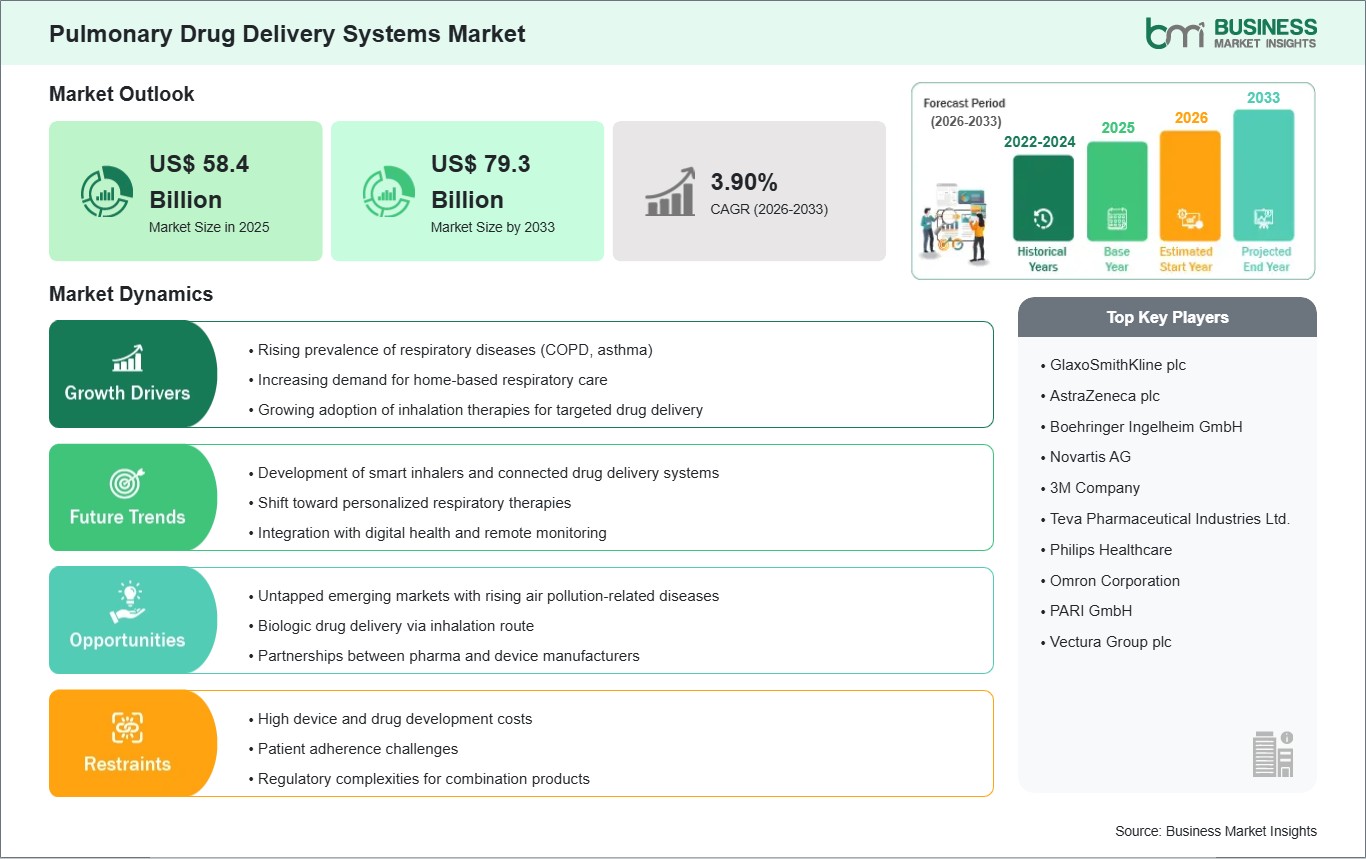
Pulmonary drug delivery systems refer to specialized pharmaceutical technologies and medical devices designed to administer therapeutic agents directly into the respiratory tract via inhalation. Market expansion is fundamentally driven by the rising global prevalence of respiratory disorders, often attributed to escalating air pollution levels and tobacco consumption, and the global aging population, who are more susceptible to chronic lung infections. Furthermore, the shift toward patient-centric self-administration and the integration of digital health technologies are improving medication adherence and allowing for real-time monitoring of patient technique.
However, several factors can restrain market growth. The high cost of advanced inhalation devices, particularly those incorporating electronic monitoring or smart features, can limit accessibility in price-sensitive regions. Technical challenges regarding formulation stability and the complex physics of ensuring consistent particle deposition in the deep lung remain significant hurdles for manufacturers. Additionally, the industry faces constraints due to stringent regulatory requirements for combination products (drug-device systems) and a lack of standardized training for patients, which often leads to improper device usage and suboptimal clinical outcomes.
Despite these hurdles, the market holds significant opportunities in the development of inhaled biologics and vaccines, offering a needle-free alternative for systemic therapy. The rise of triple-combination therapies in a single inhaler and the expansion of telehealth-integrated respiratory care are expected to support long-term development within the sector. Manufacturers are also exploring green propellant technologies to meet evolving environmental standards while maintaining device performance.
Segment Analysis
Pulmonary Drug Delivery Systems Market Segmentation
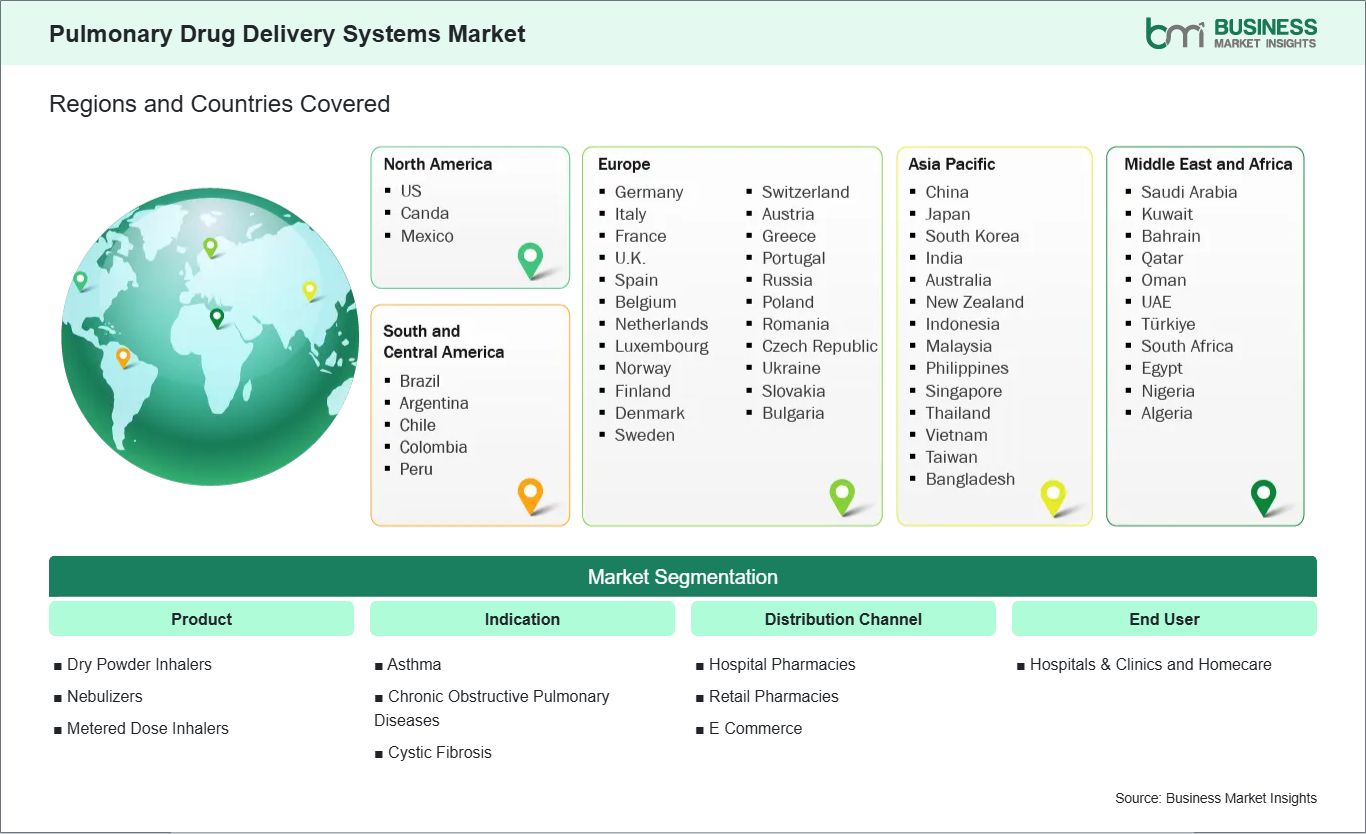
Key segments that contributed to the derivation of the Pulmonary Drug Delivery Systems market analysis are product, indication, distribution channel, and end user.
- By Product, the market is segmented into Dry Powder Inhalers, Nebulizers, and Metered Dose Inhalers.
- By Indication, the market is divided into Asthma, Chronic Obstructive Pulmonary Diseases, and Cystic Fibrosis.
- By Distribution Channel, the market is categorized into Hospital Pharmacies, Retail Pharmacies, and E‑Commerce.
- By End User, the market is segmented into Hospitals & Clinics and Homecare.
Market Forces
Pulmonary Drug Delivery Systems Market Drivers and Opportunities
Escalating Respiratory Burden and the Mainstreaming of Digital Adherence
The primary driver for the Pulmonary Drug Delivery Systems Market is the systemic global rise in chronic respiratory diseases, intensified by deteriorating air quality and demographic aging. The Growing Global Prevalence of Asthma and Chronic Obstructive Pulmonary Disease (COPD) acts as a foundational catalyst, as these conditions, now affecting hundreds of millions worldwide, require non-discretionary, long-term maintenance therapy. This momentum is further propelled by the Strategic Shift Toward Patient-Centric Self-Administration; as healthcare systems migrate toward home-based care, there is an intensified demand for portable, easy-to-use devices that empower patients to manage their conditions outside of acute settings. In the technological sphere, the Rapid Adoption of Smart and Connected Inhaler Systems serves as a critical driver, with integrated sensors providing data-driven insights that improve technique and reduce hospital exacerbations. Furthermore, Stringent Environmental Regulations and the Phase-Out of Traditional Propellants are compelling manufacturers to innovate in propellant-free DPIs and eco-friendly MDIs, ensuring that sustainability mandates drive hardware modernization. Together, these factors, disease incidence, the Hospital-at-Home trend, and digital accountability, ensure a robust and essential growth path for the global Pulmonary Drug Delivery Systems Market.
Inhaled Biologics and AI-Driven Therapeutic Personalization
A significant high-value opportunity lies in the convergence of Pulmonary Systems with Large-Molecule Biologic and Vaccine Delivery. Manufacturers are increasingly exploring the lungs as a non-invasive gateway for systemic therapies, including inhaled insulin and monoclonal antibodies, which could eliminate the need for frequent injections in chronic disease management. There is also a major growth frontier in the development of Nanotechnology-Based Formulations for Targeted Lung Therapy; by utilizing nanocarriers, companies can enhance drug bioavailability and achieve deep-lung penetration, offering new possibilities for treating pulmonary hypertension and lung malignancies. Furthermore, the expansion of AI-Enhanced Diagnostic and Device Matching Systems presents a lucrative opportunity, where algorithms analyze a patient`s inspiratory flow patterns to recommend the specific inhaler type, MDI, DPI, or nebulizer, that will maximize drug deposition. Beyond traditional hardware, the rise of Bioresorbable and Zero-Waste Inhalation Components offers a unique frontier, particularly in Europe and North America, where "green" medical procurement is becoming a competitive necessity. Manufacturers who focus on Low-Resistance Breath-Actuated Mechanisms and those pioneering Inhaled RNA and Gene Therapies are positioned to lead the most innovative and high-margin segments of the global Pulmonary Drug Delivery Systems Market.
Size and Share Analysis
Pulmonary Drug Delivery Systems Market Size and Share Analysis
The Pulmonary Drug Delivery Systems market demonstrates steady growth, with size and share analysis revealing evolving trends and competitive positioning among key players. The report examines subsegments categorized within product, indication, distribution channel, and end user, offering insights into their contribution to overall market performance.
Based on the product, the Metered Dose Inhalers subsegment holds the primary market presence, serving as the long-standing technological cornerstone of respiratory therapy. These systems maintain the largest market share as a result of their proven efficacy, portability, and relative affordability, which make them the primary choice for both rescue and maintenance treatments globally. While Nebulizers provide critical support for acute hospital-based care and specialized pediatric or geriatric populations, they hold a secondary position. However, a notable trend is the surge in the Dry Powder Inhalers subsegment, which is registering the highest pace of adoption. These devices are becoming essential for Coordination-Independent Administration, as they utilize the patient's own inspiratory flow to actuate the dose, effectively removing the need for hand-breath synchronization and holding a critical presence in the evolving chronic care vertical.
Report Coverage
Pulmonary Drug Delivery Systems Market Report Coverage and Deliverables
The "Pulmonary Drug Delivery Systems Market Size and Forecast (2022–2033)" report provides a detailed analysis of the market covering below areas:
- Pulmonary Drug Delivery Systems market size and forecast at global, regional, and country levels for all market segments covered under the scope
- Pulmonary Drug Delivery Systems market trends, as well as drivers, restraints, and opportunities
- Pulmonary Drug Delivery Systems market analysis covering key trends, global and regional framework, major players, regulations, and recent developments
- Industry landscape and competition analysis covering market concentration, heat map analysis, prominent players, and recent developments for the Pulmonary Drug Delivery Systems market
- Detailed company profiles, including SWOT analysis
Geographic Insights
Pulmonary Drug Delivery Systems Market Geographic Insights
The geographical scope of the Pulmonary Drug Delivery Systems market report is divided into five regions: North America, Asia Pacific, Europe, Middle East & Africa, and South & Central America.
North America maintains a commanding market presence, supported by a sophisticated regulatory framework that facilitates rapid approval of innovative inhalation therapies and a high prevalence of chronic respiratory conditions among the aging population. Europe represents a mature market characterized by stringent environmental regulations driving the transition toward propellant-free inhalers and a strong institutional emphasis on standardized asthma and COPD management protocols. Asia Pacific is identified as the most rapidly advancing region, propelled by accelerating urbanization, rising air pollution levels, and significant healthcare infrastructure investments across emerging economies to address increasing respiratory morbidity.
The Asia-Pacific Pulmonary Drug Delivery Systems Market is segmented into China, Japan, South Korea, India, Australia, and the Rest of Asia Pacific. China serves as a primary engine for regional growth, driven by an extensive patient base requiring localized treatment for obstructive lung diseases and government-led initiatives to improve access to essential inhaled medications. India is witnessing a notable surge in demand as domestic pharmaceutical manufacturers expand their portfolios of affordable metered-dose and dry-powder inhalers to serve a burgeoning middle-class demographic. Japan continues to lead in the adoption of high-specification nebulizers and smart inhaler technologies, focusing on improving treatment adherence among its substantial geriatric population.
Industry Activity
Recent Developments
The Pulmonary Drug Delivery Systems market is evaluated by gathering qualitative and quantitative data post primary and secondary research, which includes important corporate publications, association data, and databases. A few of the key developments in the Pulmonary Drug Delivery Systems market are:
- In September 2025, Biogen acquired Alcyone Therapeutics to expand its drug delivery solutions portfolio, including the investigational ThecaFlex DRx™ implantable device for intrathecal administration of antisense oligonucleotides. This acquisition strengthens Biogen`s capabilities in patient-centered delivery technologies, representing a significant development in the pulmonary and neurological drug delivery systems market.
- In March 2024, Lonza launched spray-drying services for protein-based biologics, oligonucleotides, and peptides for pulmonary delivery. The new offering from its Bend, US facility supports clinical and commercial-scale production of inhalable therapies, strengthening patient access and advancing the Pulmonary Drug Delivery Systems Market.
Trust & Transparency
Research Methodology
The market analysis combines proprietary research with secondary data from government agencies, company disclosures, regulatory filings, industry databases and expert interviews. Market estimates are validated through data triangulation, cross-market benchmarking and analyst
review.
View Full Research Methodology
Key Sources Referred:
World Bank – Global Trade IndicatorsWorld Trade Organization (WTO)(International Monetary Fund )IMFInternational Trade Administration (ITA)Company websiteCompany annual reportsCompany investor presentations