Market Summary
Executive Summary and Global Market Analysis
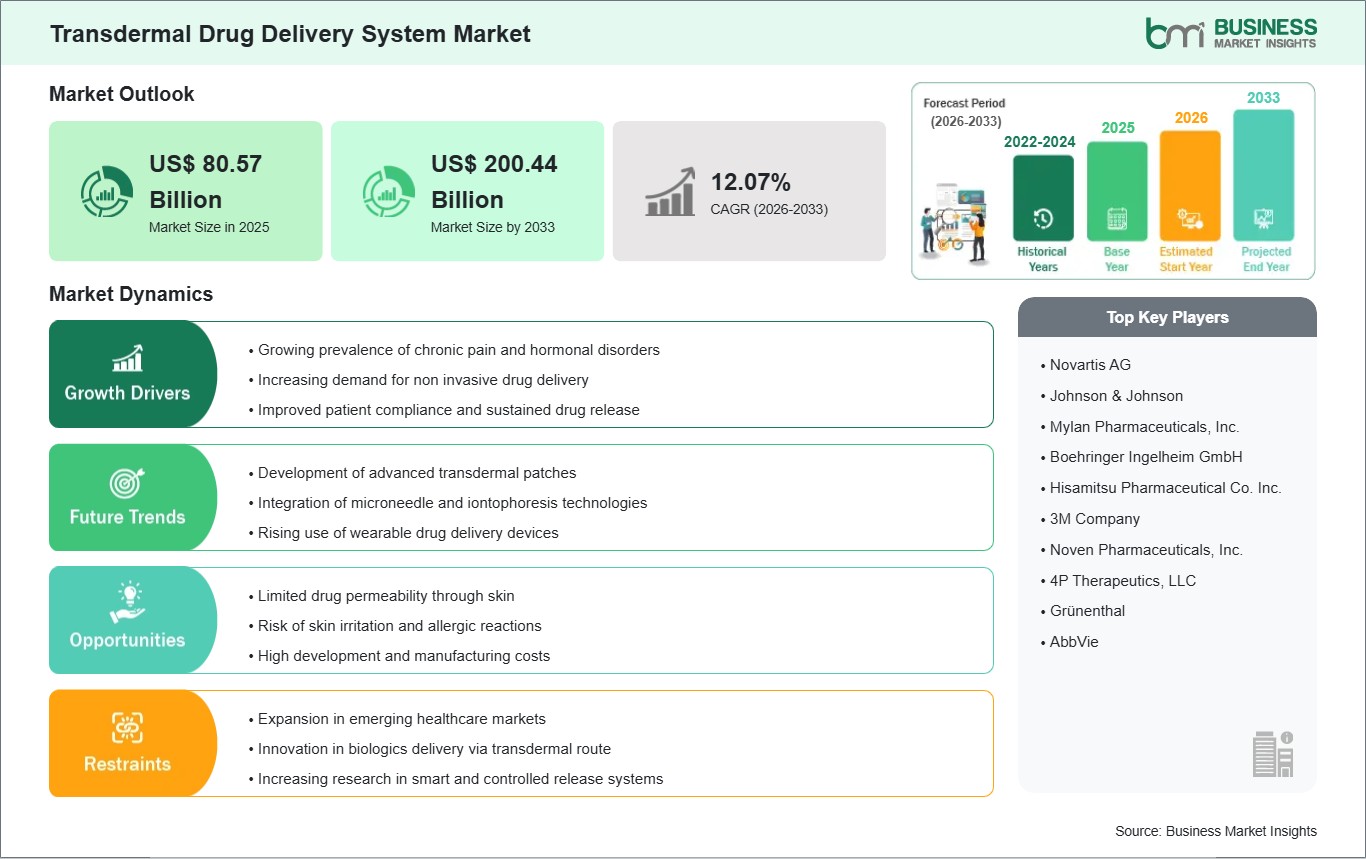
Transdermal drug delivery systems are pharmaceutical formulations designed to deliver a predetermined and controlled amount of therapeutic agents through the skin into the systemic circulation. Unlike traditional oral medications that are subject to first-pass metabolism in the liver or injectables that require invasive administration, these systems utilize adhesive patches, gels, or sprays to maintain a steady drug concentration in the bloodstream over an extended period.
Market expansion is fundamentally driven by the rising global demand for non-invasive therapeutic alternatives and the increasing prevalence of chronic illnesses requiring long-term, consistent medication. Furthermore, the shift toward patient-centric self-administration is improving medication adherence and reducing the frequency of hospital visits, particularly among the growing geriatric population who may face challenges with swallowing oral pills or administering frequent injections.
However, several factors can restrain market growth. Technical limitations regarding drug permeability remain a significant challenge, as many high-molecular-weight drugs and biologics cannot naturally penetrate the skin`s protective lipid barrier. The potential for skin irritation or localized allergic reactions at the application site can lead to patient discomfort and treatment discontinuation. Additionally, the industry faces constraints due to stringent regulatory approval cycles for combination products (drug-device systems) and the high costs associated with developing innovative penetration-enhancement technologies.
Despite these hurdles, the market finds immense opportunities in the integration of smart-patch technology, which can monitor physiological biomarkers and release drugs in response to real-time patient needs. The expansion of transdermal vaccine delivery, offering a needle-free solution for global immunization programs, and the development of biodegradable microneedles are expected to support long-term development within the sector.
Segment Analysis
Transdermal Drug Delivery System Market Segmentation
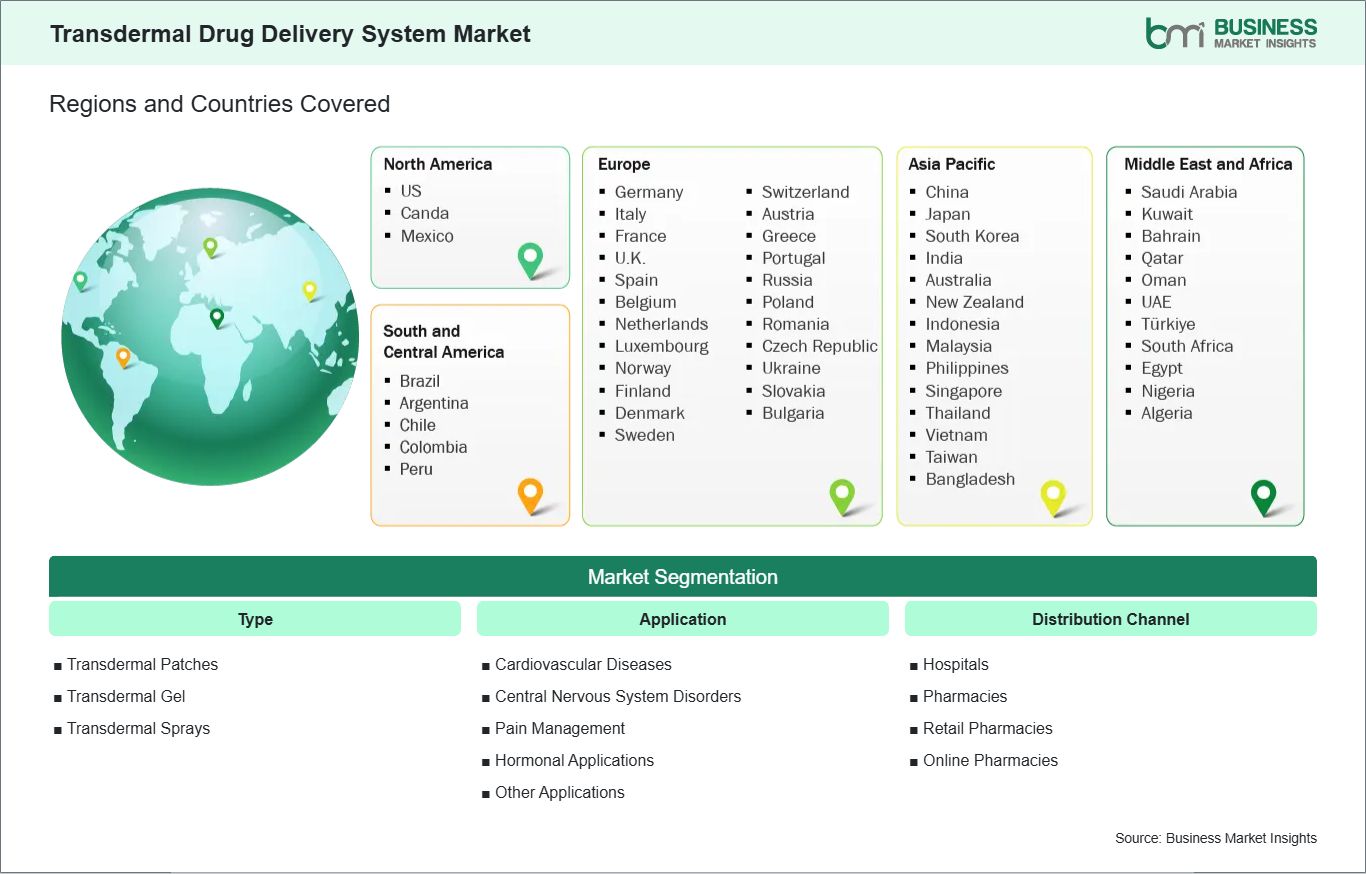
Key segments that contributed to the derivation of the Transdermal Drug Delivery System market analysis are type, application, and distribution channel.
- By Type, the market is segmented into Transdermal Patches, Transdermal Gel, and Transdermal Sprays.
- By Application, the market is divided into Cardiovascular Diseases, Central Nervous System Disorders, Pain Management, Hormonal Applications, and Other Applications.
- By Distribution Channel, the market is categorized into Hospitals, Pharmacies, Retail Pharmacies, and Online Pharmacies.
Market Forces
Transdermal Drug Delivery System Market Drivers and Opportunities
Chronic Disease Burden and the Mainstreaming of Self-Administered Care
The primary driver for the Transdermal Drug Delivery System Market is the systemic global increase in chronic ailments that require sustained, steady-state medication levels, such as cardiovascular disease, Alzheimer`s, and chronic pain. The Escalating Geriatric Population and the Rise of Polypharmacy act as a dominant catalyst, as older adults often struggle with oral pill burdens or the dexterity required for self-injections, making long-acting patches a preferred alternative. This momentum is further propelled by the Strategic Shift Toward Non-Invasive Vaccine and Biologic Delivery; the development of microneedle arrays is providing a pain-free, shelf-stable method for mass immunization, reducing the logistics and cold-chain requirements of traditional vaccines.
In the technology sphere, the Demand for Improved Bioavailability and Reduced Side Effects serves as a critical driver, as transdermal routes avoid gastrointestinal degradation and peak-to-trough fluctuations in plasma concentration. Furthermore, the Proliferation of Remote Patient Monitoring and Hospital-at-Home Models is driving the adoption of wearable transdermal systems that enable continuous therapy without professional supervision. Together, these factors, demographic aging, biologic innovation, and outpatient care trends, ensure a high-growth and technologically advanced path for the global drug delivery landscape.
AI-Integrated Smart Patches and Personalized Microneedle Fabrication
A significant high-value opportunity lies in the convergence of Transdermal Systems with Digital Health and Smart Sensors. Next-generation smart patches are being developed to integrate real-time biomarker monitoring, such as glucose-responsive insulin delivery, where the patch automatically adjusts the drug release rate based on the patient's physiological data. There is also a major growth frontier in the development of 3D-Printed, Personalized Transdermal Patches; by utilizing additive manufacturing, companies can customize drug dosages and release kinetics for individual patients, moving away from one-size-fits-all pharmacotherapy.
Furthermore, the expansion of Active Enhancement Technologies for Large-Molecule Biologics presents a lucrative opportunity, as iontophoresis and electroporation systems are refined to deliver complex proteins and nucleic acids that were previously restricted to intravenous administration. Beyond traditional pharmaceuticals, the rise of Transdermal Delivery in the Wellness and Aesthetic Sectors offers a unique frontier, where bioactive microneedles are used for targeted skin rejuvenation and hair growth treatments. Manufacturers who focus on Biodegradable Polymer-Based Dissolvable Microneedles and those pioneering Battery-Free, Heat-Activated Pump Systems are positioned to lead the most innovative and high-margin segments of the global pharmaceutical market.
Size and Share Analysis
Transdermal Drug Delivery System Market Size and Share Analysis
The Transdermal Drug Delivery System market demonstrates steady growth, with size and share analysis revealing evolving trends and competitive positioning among key players. The report examines subsegments categorized within type, application, and distribution channel, offering insights into their contribution to overall market performance.
Based on type, the Transdermal Patches, Transdermal Gel, and Transdermal Sprays subsegments hold the primary market presence, representing a range of delivery speeds and surface area applications. Transdermal Patches hold the largest market position and remain indispensable for the Sustained-Release vertical, offering zero-order delivery kinetics that ensure consistent therapeutic levels over several days. A notable trend is the surge in the Transdermal Gel and Spray subsegments, which are registering a higher pace of adoption for Acute and Flexible Dosing. These formats are becoming essential for Hormonal and Topical Pain applications, as they offer rapid absorption and the ability to adjust the dosage area, making them a preferred strategic alternative for patients who experience skin irritation from adhesive-based patch systems.
Report Coverage
Transdermal Drug Delivery System Market Report Coverage and Deliverables
The "Transdermal Drug Delivery System Market Size and Forecast (2022–2033)" report provides a detailed analysis of the market covering below areas:
- Transdermal Drug Delivery System market size and forecast at global, regional, and country levels for all market segments covered under the scope
- Transdermal Drug Delivery System market trends, as well as drivers, restraints, and opportunities
- Transdermal Drug Delivery System market analysis covering key trends, global and regional framework, major players, regulations, and recent developments
- Industry landscape and competition analysis covering market concentration, heat map analysis, prominent players, and recent developments for the Transdermal Drug Delivery System market
- Detailed company profiles, including SWOT analysis
Geographic Insights
Transdermal Drug Delivery System Market Geographic Insights
The geographical scope of the Transdermal Drug Delivery System market report is divided into five regions: North America, Asia Pacific, Europe, Middle East & Africa, and South & Central America.
North America maintains the primary market position, supported by a robust research and development ecosystem and the early clinical adoption of advanced patches for chronic pain management and hormone replacement therapies. Europe represents a sophisticated market segment characterized by stringent regulatory oversight and a growing institutional focus on the circular economy, which encourages the development of biodegradable film technologies. Asia Pacific is identified as the most rapidly advancing region, propelled by accelerating urbanization, an aging demographic requiring non-invasive treatment options, and significant investments in microneedle manufacturing hubs.
The Asia-Pacific Transdermal Drug Delivery System Market is segmented into China, Japan, South Korea, India, Australia, and the Rest of Asia Pacific. China serves as a central engine for regional growth, driven by extensive advancements in flexible electronics for smart patches and the increasing prevalence of cardiovascular disorders requiring long-term medication adherence. India is witnessing a transition toward specialized transdermal solutions as healthcare infrastructure modernizes and domestic pharmaceutical players expand their portfolios to include self-administered delivery formats. Japan and South Korea continue to lead in technological refinement, prioritizing the integration of miniaturized sensors and digital monitoring features within transdermal platforms to optimize outpatient care for chronic central nervous system (CNS) disorders.
Industry Activity
Recent Developments
The Transdermal Drug Delivery System market is evaluated by gathering qualitative and quantitative data post primary and secondary research, which includes important corporate publications, association data, and databases. A few of the key developments in the Transdermal Drug Delivery System market are:
- In May 2025, AMW and AdhexPharma completed the strategic transfer of transdermal delivery systems (TDS), including Rivastigmine and Buprenorphine patches, with AdhexPharma acquiring manufacturing equipment and IP. The partnership expands TDS production capacity and strengthens global patch manufacturing, supporting broader patient access and market growth.
- In March 2025, Aveva Drug Delivery Systems (DifGen) received FDA approval for its generic Lidocaine 1.8% transdermal patch for post-herpetic neuralgia, offering a non-invasive, localized, and cost-effective pain management option. This milestone strengthens Aveva`s TDS portfolio and enhances patient access to innovative topical therapies.
Trust & Transparency
Research Methodology
The market analysis combines proprietary research with secondary data from government agencies, company disclosures, regulatory filings, industry databases and expert interviews. Market estimates are validated through data triangulation, cross-market benchmarking and analyst
review.
View Full Research Methodology
Key Sources Referred:
World Bank – Global Trade Indicators World Trade Organization (WTO) (International Monetary Fund )IMF International Trade Administration (ITA) Company website Company annual reports Company investor presentations