Market Summary
Executive Summary and Global Market Analysis
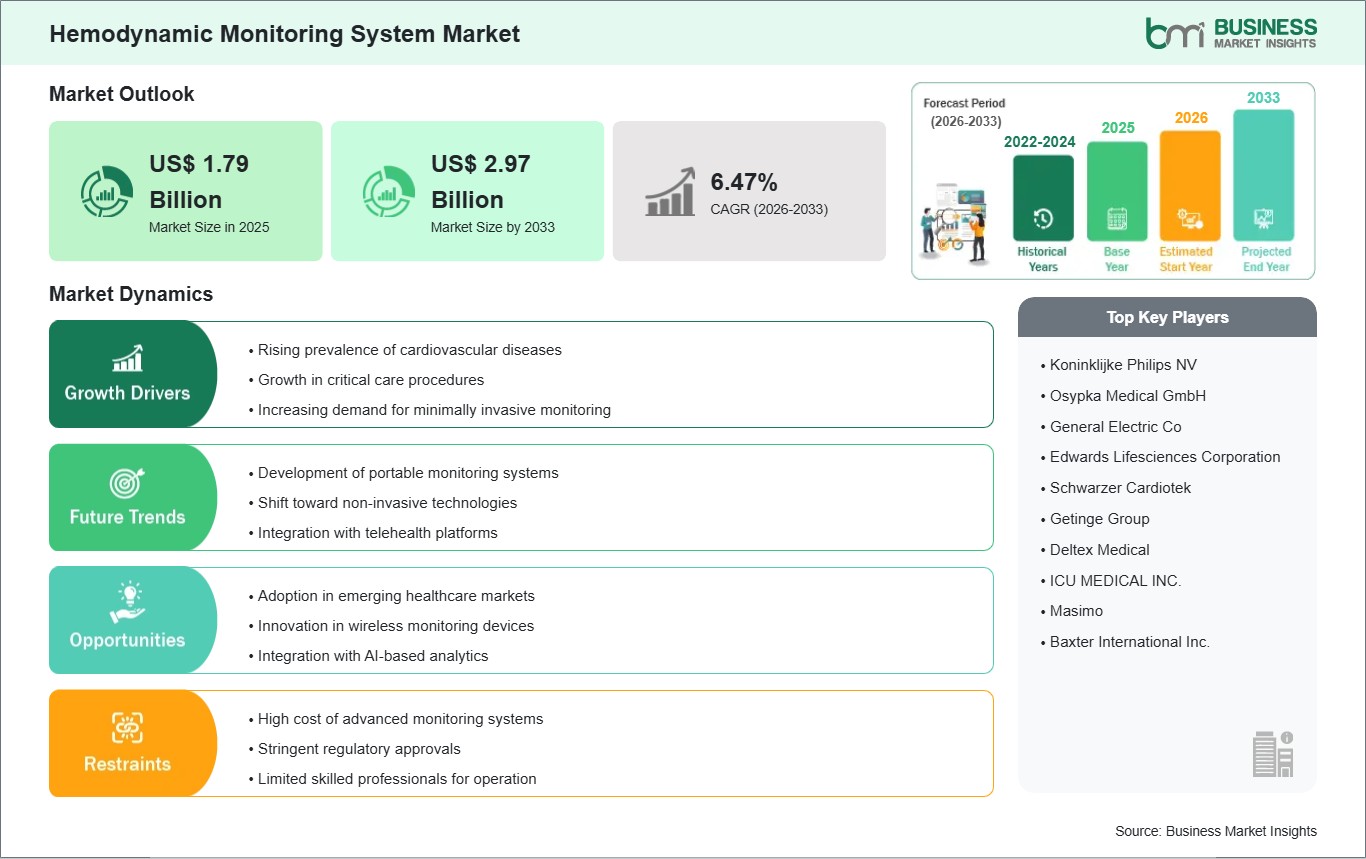
Hemodynamic monitoring systems play a critical role in the management of critically ill patients by providing real-time data on blood flow, cardiac output, and oxygen saturation. These systems are essential for clinical decision-making in environments such as Intensive Care Units (ICUs), operating rooms, and emergency departments. Monitoring techniques have evolved from traditional invasive pulmonary artery catheterization to modern minimally invasive and noninvasive sensors, which offer reduced risk of infection and faster recovery times. Increasing global prevalence of cardiovascular diseases (CVDs), a growing geriatric population more susceptible to heart failure, and the rising demand for sophisticated surgical procedures are fueling the market. Additionally, the integration of Artificial Intelligence (AI) for predictive hypotension alerts and the expansion of remote patient monitoring are enhancing clinical efficiency.
However, several challenges can restrain market growth, such as the high cost of advanced monitoring consoles, risks associated with invasive procedures (e.g., sepsis and thrombosis), and the requirement for highly skilled personnel to interpret complex data. The industry is also subject to rigorous regulatory approvals and occasional product recalls. Despite these hurdles, the market holds significant opportunities driven by the shift toward value-based care, the rise of home-based monitoring for chronic heart failure patients, and the rapid modernization of healthcare infrastructure in emerging economies.
Segment Analysis
Hemodynamic Monitoring System Market Segmentation
Key segments that contributed to the derivation of the Hemodynamic Monitoring System market analysis are type, product, and end user.
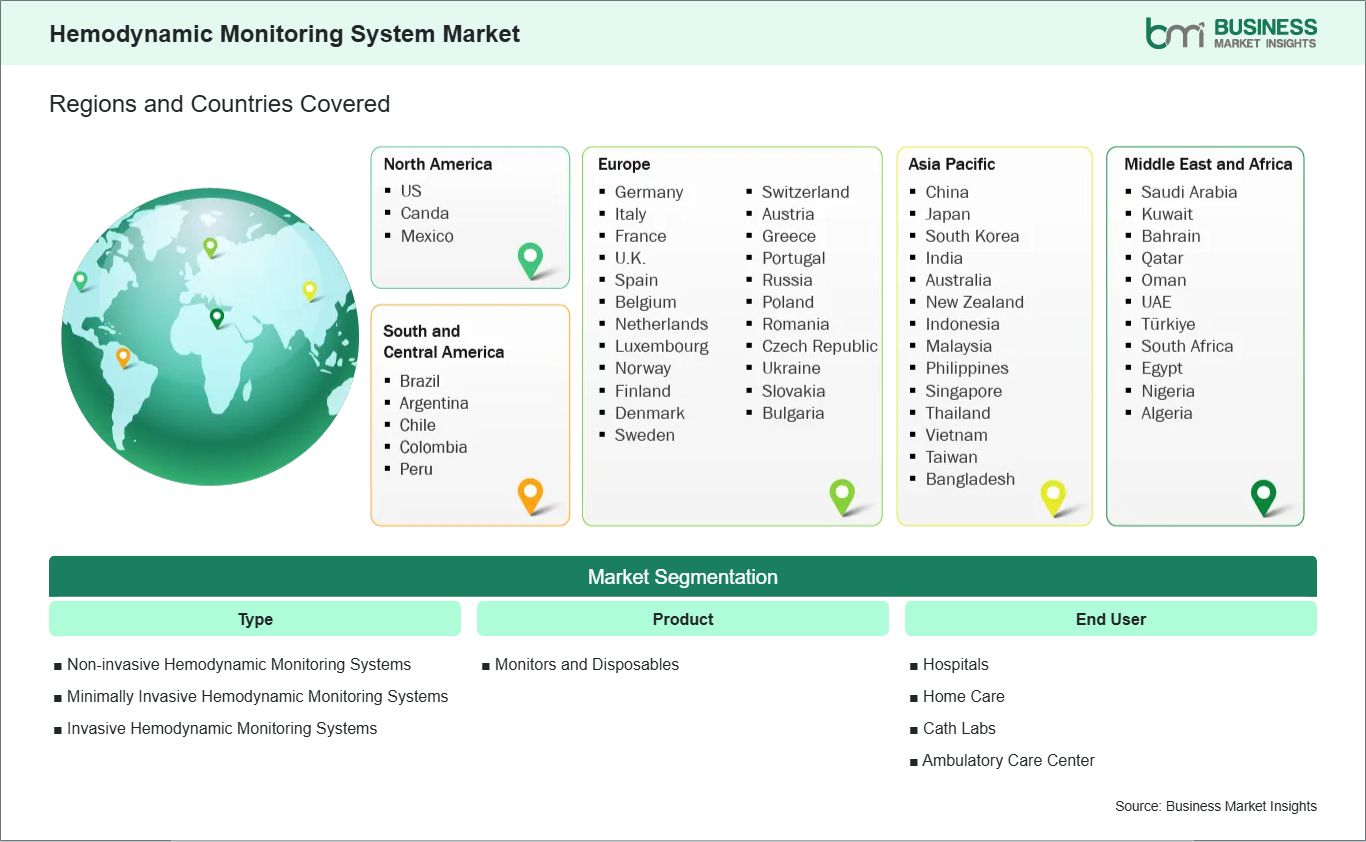
- By Type, the market is segmented into Non-invasive Hemodynamic Monitoring Systems, Minimally Invasive Hemodynamic Monitoring Systems, and Invasive Hemodynamic Monitoring Systems.
- By Product, the market is bifurcated into Monitors and Disposables.
- By End User, the market is segmented into Hospitals, Home Care, Cath Labs, and Ambulatory Care Center.
Market Forces
Hemodynamic Monitoring System Market Drivers and Opportunities
Rising Global Burden of Cardiovascular Diseases
The rising prevalence of chronic diseases such as hypertension, heart failure, and diabetes continues to be a key catalyst for growth in the hemodynamic monitoring market. These conditions significantly increase the risk of cardiovascular instability, creating an urgent need for continuous and precise monitoring across broader care environments. As a result, hemodynamic assessment is no longer confined to intensive care units; it is increasingly being adopted in general wards, emergency departments, ambulatory care centers, and even home-based monitoring programs. This shift reflects the growing emphasis on early risk detection and timely intervention to prevent deterioration.
Global health authorities, including the World Health Organization (WHO), consistently highlight cardiovascular diseases as the leading cause of mortality worldwide, underscoring the necessity for advanced diagnostic and monitoring technologies capable of evaluating blood flow, cardiac function, and tissue perfusion with high accuracy. Consequently, healthcare systems are investing in more sophisticated hemodynamic solutions to improve clinical outcomes and reduce the overall burden of cardiovascular complications.
Technological Integration of AI and Wireless Connectivity
Innovations in sensor technology and advanced data analytics are transforming the hemodynamic monitoring landscape, enabling healthcare providers to move from reactive to proactive patient management. The integration of AI-enabled platforms, most notably tools such as the Hypotension Prediction Index (HPI), is redefining clinical decision-making by allowing physicians to predict episodes of hemodynamic instability before they occur. This level of real-time, predictive insight significantly enhances patient safety, reduces complications, and supports more efficient use of critical care resources.
At the same time, the market is witnessing rapid advancements in wireless and wearable hemodynamic monitoring patches. These next-generation devices facilitate continuous, non-invasive monitoring outside traditional clinical settings, unlocking new possibilities in remote patient management and telehealth. By allowing clinicians to track high-risk patients after discharge, these technologies help reduce hospital readmissions, support early intervention, and improve long-term outcomes. Collectively, these innovations are shaping a more connected, data-driven future for cardiovascular and critical care management.
Size and Share Analysis
Hemodynamic Monitoring System Market Size and Share Analysis
The Hemodynamic Monitoring System market demonstrates steady growth, with size and share analysis revealing evolving trends and competitive positioning among key players. The report further examines subsegments categorized within type, product, and end user, offering insights into their contribution to overall market performance.
For instance, the noninvasive subsegment is estimated to record a high growth rate due to its lower risk profile and the increasing trend of monitoring in non-hospital settings. In terms of product, the monitors subsegment account for the larger revenue share, driven by the continuous replacement cycle of high-tech display units and the adoption of portable devices. Hospitals remain the dominant end user, accounting for over 60% of the market share, as they handle the majority of high-acuity cases and complex surgical procedures requiring sophisticated hemodynamic oversight.
Report Coverage
Hemodynamic Monitoring System Market Report Coverage and Deliverables
The "Hemodynamic Monitoring System Market Size and Forecast (2022 - 2033)" report provides a detailed analysis of the market covering below areas:
- Hemodynamic Monitoring System market size and forecast at global, regional, and country levels for all the key market segments covered under the scope
- Hemodynamic Monitoring System market trends, as well as market dynamics such as drivers, restraints, and key opportunities
- Hemodynamic Monitoring System market analysis covering key market trends, global and regional framework, major players, regulations, and recent market developments
- Industry landscape and competition analysis covering market concentration, heat map analysis, prominent players, and recent developments for the Hemodynamic Monitoring System market
- Detailed company profiles, including SWOT analysis
Geographic Insights
Hemodynamic Monitoring System Market Geographic Insights
The geographical scope of the Hemodynamic Monitoring System market report is divided into five regions: North America, Asia Pacific, Europe, the Middle East & Africa, and South & Central America.
North America accounts for a substantial global revenue, fueled by its advanced healthcare infrastructure and high adoption of AI-driven medical devices. Europe's growth is supported by strong government funding for patient safety and a well-established geriatric care system. The Asia-Pacific region is projected to register rapid growth, driven by the continuous expansion of private hospitals in China and India and a high incidence of diabetes-related cardiac complications. In the Middle East & Africa, market growth is tied to increasing investments in specialized cardiac centers and critical care capacity building in GCC countries. South & Central America are witnessing a steady rise in demand as countries like Brazil and Mexico modernize their surgical facilities and adopt minimally invasive monitoring standards.
Industry Activity
Recent Developments
The Hemodynamic Monitoring System market is evaluated by gathering qualitative and quantitative data post primary and secondary research, which includes important corporate publications, association data, and databases. A few of the key developments in the Hemodynamic Monitoring System market are:
- In April 2025, Becton, Dickinson and Company (BD), a leading global medical technology company, launched a new advanced hemodynamic monitoring platform with predictive, artificial intelligence (AI) based algorithms that can help clinicians proactively address blood pressure instability and optimize blood flow to help avoid potential life-threatening situations during procedures.
- In April 2025, Medtronic, a global leader in healthcare technology, entered into an agreement with Retia Medical, an innovative digital health company that develops advanced hemodynamic solutions, to distribute the Argos™ cardiac output monitor. The Argos™ monitor provides healthcare professionals with accurate hemodynamic data to support the treatment of high-risk surgical and critically ill patients.
Trust & Transparency
Research Methodology
The market analysis combines proprietary research with secondary data from government agencies, company disclosures, regulatory filings, industry databases and expert interviews. Market estimates are validated through data triangulation, cross-market benchmarking and analyst
review.
View Full Research Methodology
Key Sources Referred:
World Bank - Global Trade IndicatorsWorld Trade Organization (WTO)International Monetary Fund (IMF)International Trade Administration (ITA)Company WebsitesCompany Annual ReportsCompany Investor Presentations