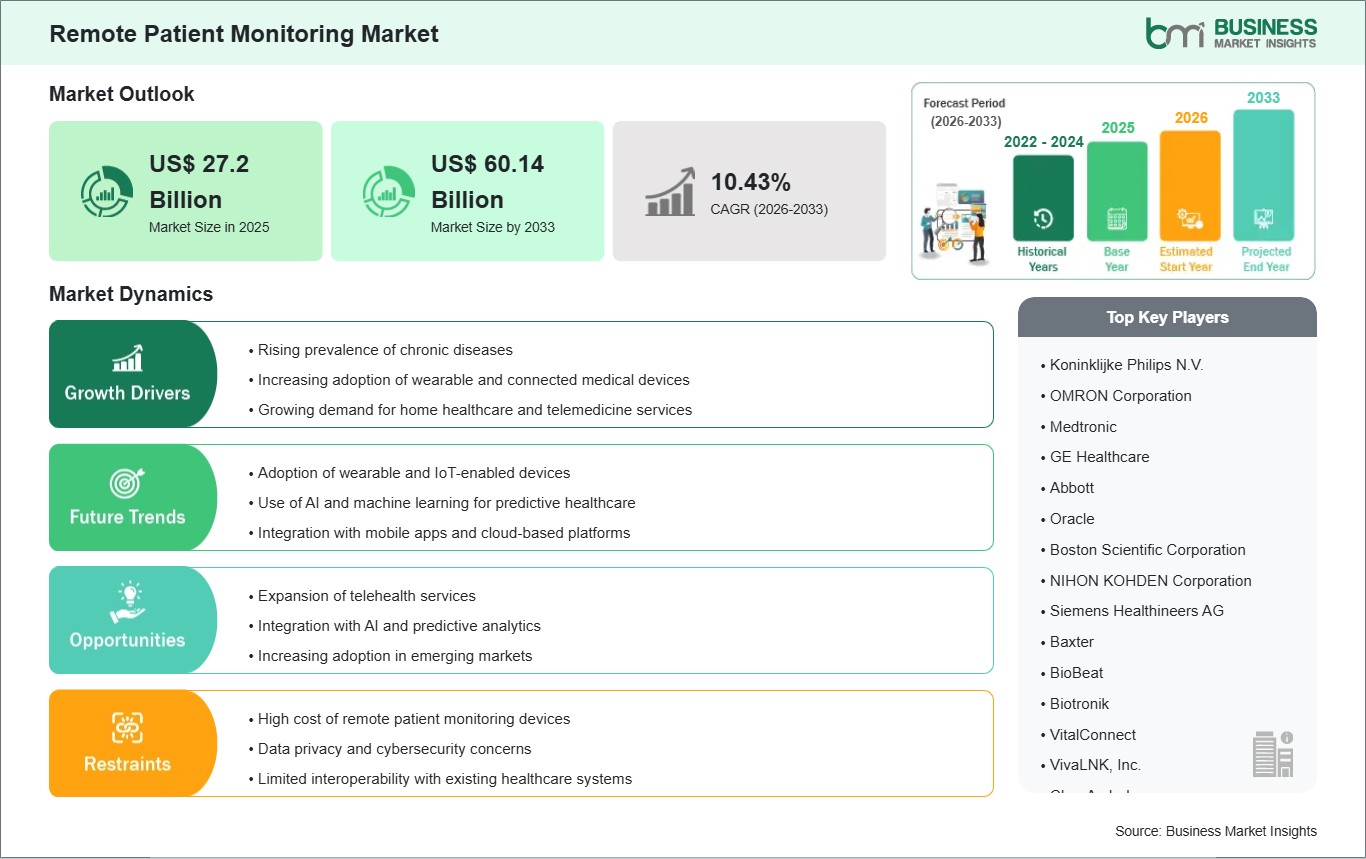
The Remote Patient Monitoring market size is expected to reach US$ 60.14 billion by 2033 from US$ 27.20 billion in 2025. The market is estimated to record a CAGR of 10.43% from 2026 to 2033
The RPM (remote patient monitoring) is a global market that has caught the attention of many because of its profitable advantages. Most of the people contributing to this market are those who demand better medical care and the upsurge of chronic diseases along with aging baby boomers. Large healthcare institutions and tech companies have identified the opportunity to improve patient outcomes and at the same time save on hospital costs by monitoring patients continuously via RPM. North America is the biggest market in this regard, mainly due to its sophisticated healthcare system, wide use of connected devices, and progressive insurance policies that get reimbursement from Medicare and private health insurances. Europe is next in line and it is mainly due to the aging population and the national health systems that are encouraging the use of digital health applications to effectively take care of chronic patients.
Although the Asia-Pacific is a latecomer, it is the fastest-growing market due to urbanization, popularity of smartphones, and the government's telemedicine expansion program in countries like India and China. On the other hand, Latin America and the Middle East and Africa have a huge and largely unexploited market potential due to accessibility to the internet, the rise of chronic diseases, and investments in digital health infrastructure. The most important factors pushing the market forward are the need to act promptly in cases of hypertension, diabetes, and heart attacks, plus the breakthroughs that have been made in wearable sensors, AI-based analytics, and cloud-based platforms boosting data accuracy and usability. The market that is continuously changing now has interoperability, data security, and patient engagement as its main themes and thus RPM is being positioned as the main provider of modern healthcare worldwide

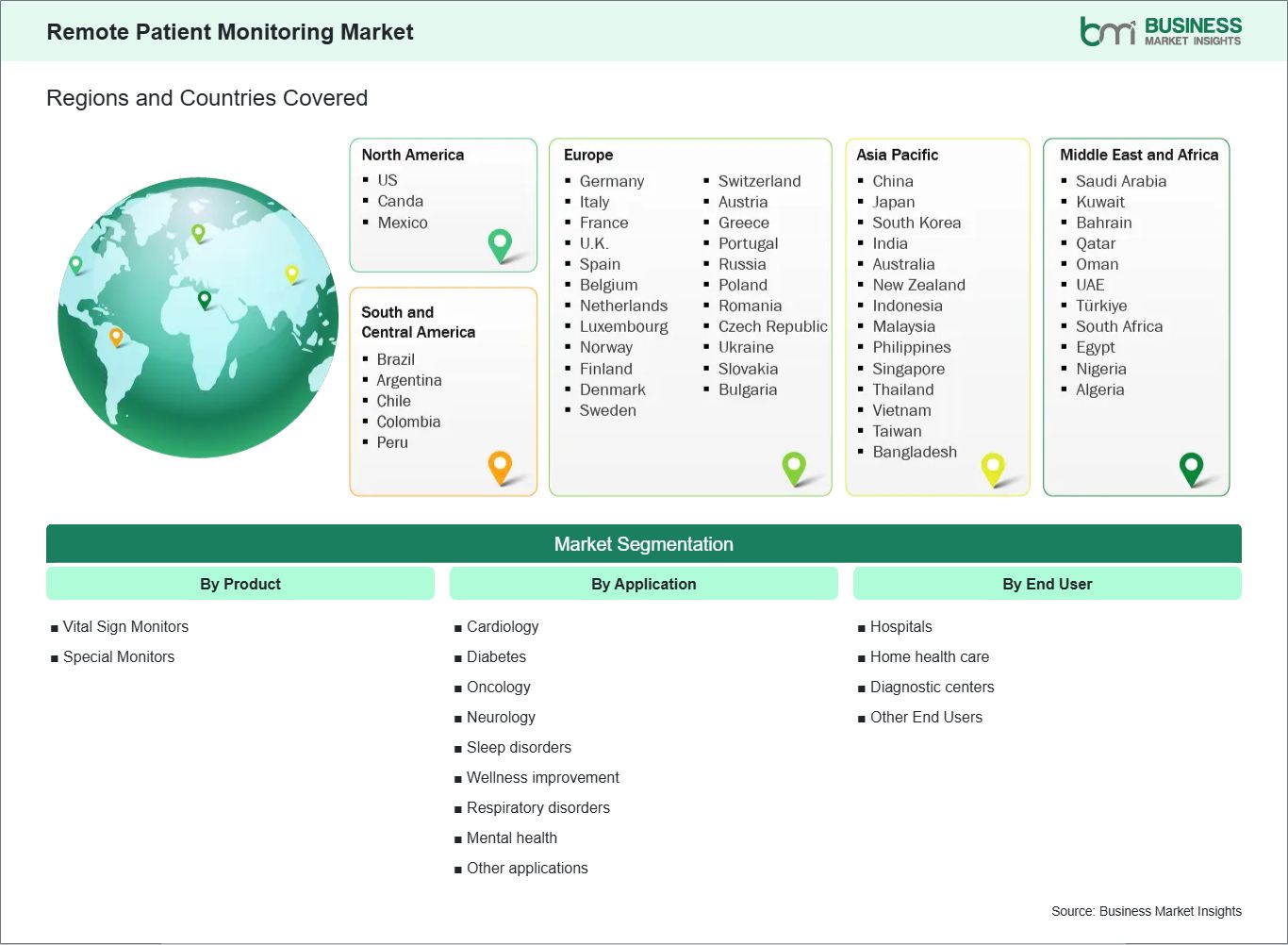
Key segments that contributed to the derivation of the Remote Patient Monitoring market analysis are product, application, and end user.
The escalating incidence of chronic diseases, like the ones that require continuously monitoring of people's vital parameters (hypertension, diabetes, etc.), is the main reason for the growth of the global remote patient monitoring (RPM) market. Also, the diseases would be less treated in the hospitals hence less hospitalized if the monitoring gets timely assistance to prevent complications. A recent report by the World Health Organization (WHO) predicts that in 2025 about one billion adults worldwide aged 30 to 79 years will suffer from hypertension, whereas 38% of the Eastern Mediterranean Region will be the main zone with the highest prevalence. The hypertension prevalence among adults in the United States from August 2021 to August 2023 was reported by the Centers for Disease Control and Prevention (CDC) at 47.7%, along with a constant low rate of control.
Moreover, among the WHO European Region data from 2023, the number of the hypertensive patients reached over 34% in some countries of central and eastern Europe. According to the International Diabetes Federation (IDF), there would be 537 million adults suffering from diabetes in 2021, and that number would go up to 589 million in 2025, with Asia Pacific and the Middle East carrying the heaviest brunt. The Global Burden of Disease Study has mentioned that the disease of heart failure was on the rise in aging populations while the other disorder of COPD was responsible for the deaths of 3.72 million people in 2021 as per WHO. These diseases will make the RPM essential for the monitoring of vital signs in real time, the adherence to medication and the providing of telehealth intervention that is all the more facilitated by essential clinical practice integration.
The global market for remote patient monitoring (RPM) is charging ahead towards a huge breakthrough, especially in the areas of toggling and merging health care services and getting new technologies into the hands of distant patients in regions where medical help is not readily available. The World Health Organization (WHO) has stated that in 2025 the number of adults between 30 and 79 years with high blood pressure will be up to 1.4 billion; the majority of this burden will be harshest in the LMICs in the Asia-Pacific and Africa region. The Indian government, through its Ministry of Health and Family Welfare, has been very active in screening people for chronic diseases; going through a total of over 5.82 crore beneficiaries (roughly 70 million) from 2020-2023, and discovering a lot of cases of diabetes and hypertension amongst those.
In Brazil, the Health Ministry forecasts that chronic disease-related admissions to hospitals will continue to climb in the year 2023. Among the major outputs of product development are the RPM devices that are deemed portable and WHO pre-qualified for use in community health programs of LMICs during the years 2023–2025. The Pan American Health Organization (PAHO) is also in the process of carrying out the project of integrating telehealth with RPM for both dengue and chronic care in Latin America during the period ranging from 2023 up to 2025. The initiatives promoting telehealth in the Asia-Pacific region, which were backed by the government in the field of digital health during the year 2025, have made it possible to conduct remote monitoring of the vital signs of people living in sparsely populated areas. All these developments are going to help people in such regions where access to health care has been very limited, they will also facilitate the management of chronic diseases and finally, they will complement the overall global health equity objectives in those areas where chronic diseases are become quite widespread, thus making it possible to implement decentralized care and timely interventions across various healthcare systems
By product, the Remote Patient Monitoring market is bifurcated into vital sign monitors and special monitors. The special monitors segment dominated the market in 2025. Special monitors dominated the Remote Patient Monitoring market in 2025 because they enable condition-specific, continuous monitoring for diseases such as diabetes, cardiac disorders, respiratory conditions, and sleep disorders. Their ability to deliver clinically actionable data, higher accuracy, and personalized insights made them more valuable than general vital sign monitors for chronic disease management.
By application, the market is divided into cardiology, diabetes, oncology, neurology, sleep disorders, wellness improvement, respiratory disorders, mental health, other applications. The cardiology segment held the largest share of the market in 2025. Cardiology monitors dominated in 2025 due to the high global prevalence of cardiovascular diseases, the need for continuous heart monitoring, and widespread adoption of remote ECG, blood pressure, and rhythm monitoring technologies for early detection and ongoing cardiac care.
By end user, the market is segmented into hospitals, home health care, diagnostic centers, other end users. The hospitals segment held the largest share of the market in 2025. Hospitals dominated the market in 2025 because they serve as primary centers for cardiology diagnosis and treatment, manage high patient volumes, and have the infrastructure to integrate remote patient monitoring into clinical workflows, enabling continuous monitoring, data analysis, and timely clinical intervention
| Report Attribute | Details |
|---|---|
| Market size in 2025 | US$ 27.2 Billion |
| Market Size by 2033 | US$ 60.14 Billion |
| Global CAGR (2026 - 2033) | 10.43% |
| Historical Data | 2022 - 2024 |
| Forecast period | 2026-2033 |
| Segments Covered | By By Product
|
| Regions and Countries Covered | North America
|
| Market leaders and key company profiles |
|
The Remote Patient Monitoring Market Size and Forecast (2025-2033) report provides a detailed analysis of the market covering below areas:
The geographical scope of the Remote Patient Monitoring market report is divided into five regions: North America, Asia Pacific, Europe, Middle East & Africa, and South & Central America. The Remote Patient Monitoring market in Asia Pacific is expected to grow significantly during the forecast period.
The Asia-Pacific Remote Patient Monitoring market is anticipated to achieve remarkable growth in the years to come, thanks to the increasing occurrence of chronic diseases, the growing number of aged people, and the acceptance of digital health technologies in a swift manner. The Asia-Pacific RPM market is categorized into different countries, namely, China, Japan, South Korea, India, Australia, New Zealand, Indonesia, Malaysia, the Philippines, Singapore, Thailand, Vietnam, Taiwan, Bangladesh, and the Rest of Asia. China, Japan, and India which are considered as some of the major regions are at the forefront of the adoption owing to the digitization of healthcare by the government, increased smartphone usage, and greater telemedicine infrastructure investment.
There is a huge crush for cardiology, diabetes, and respiratory care in the region through the use of connected medical devices, wearable sensors, and cloud-based monitoring platforms. The removal of barriers to healthcare access in the countryside, the existence of favorable regulations, and the establishment of partnerships between hospitals and digital health providers are the main factors that are propelling the growth of RPM. Moreover, the upsurge in healthcare costs, better internet connectivity, and the use of AI-powered analytics are making the Asia-Pacific region an important contributor to the global Remote Patient Monitoring market.

Chapter 14, i.e., the appendix is inclusive of a brief overview of the company, list of abbreviations, and disclaimer
The Remote Patient Monitoring market is evaluated by gathering qualitative and quantitative data post primary and secondary research, which includes important corporate publications, association data, and databases. A few of the key developments in the Remote Patient Monitoring market are:
The Remote Patient Monitoring Market is valued at US$ 27.2 Billion in 2025, it is projected to reach US$ 60.14 Billion by 2033.
As per our report Remote Patient Monitoring Market, the market size is valued at US$ 27.2 Billion in 2025, projecting it to reach US$ 60.14 Billion by 2033. This translates to a CAGR of approximately 10.43% during the forecast period.
The Remote Patient Monitoring Market report typically cover these key segments-
The historic period, base year, and forecast period can vary slightly depending on the specific market research report. However, for the Remote Patient Monitoring Market report:
The Remote Patient Monitoring Market is populated by several key players, each contributing to its growth and innovation. Some of the major players include:
The Remote Patient Monitoring Market report is valuable for diverse stakeholders, including:
Essentially, anyone involved in or considering involvement in the Remote Patient Monitoring Market value chain can benefit from the information contained in a comprehensive market report.
Please tell us your area of interest
(Market Segments/ Regions and Countries/ Companies)