The Therapeutic Drug Monitoring market size is expected to reach US$ 7.78 billion by 2033 from US$ 3.18 billion in 2024. The market is estimated to record a CAGR of 11.8% from 2025 to 2033.
Global demand for Therapeutic Drug Monitoring (TDM) is rapidly increasing due to the emphasis placed on Precision Medicine by North American Healthcare Systems as well as Improving Patient Safety through Optimal Treatment Options. TDM measures the exact amount of a drug's concentration present in a patient's blood in order to keep it as close to an Optimal Therapeutic Level as possible while minimising any Toxic Effects that may occur. The popularity of the TDM Market was primarily driven by increasing usage of the many medications available with very low Therapeutic Indices (TI), including Antiepileptics, Immunosuppressants, Antiobiotics, and Cancer Medications, with a high need for precise dosing with those medications. There is an increased prevalence of many chronic Diseases, such as Cancer, Chronic Organ Transplants, and Infectious Conditions, necessitating the need for Individualised Dosing Strategies, which are supported by the growth in the TDM Market. As more Precision Medicine options become available, so too will the demand for TDM increase accordingly. Advances made in various Analytical Techniques, such as Immunoassays, Chromatography, and Mass Spectrometry are offering all health care professionals accurate, sensitive, and expedited TDM. This will enable healthcare facilities to offer TDM routinely as part of their Clinical Workflow processes in order to Enhance Patient Care and Reduce Overall Healthcare Costs Relative to Adverse Drug Reactions. North America and Europe continue to be major markets at the regional level because of their sophisticated healthcare infrastructures and the strong focus on patient safety. In contrast, the Asia Pacific is rapidly transforming into an region with substantial growth potential that is largely attributable to increased healthcare access and awareness. The global therapeutic drug monitoring market is essentially set to experience gradual upward trends as instrument precision becomes a vital part of standard clinical practice.

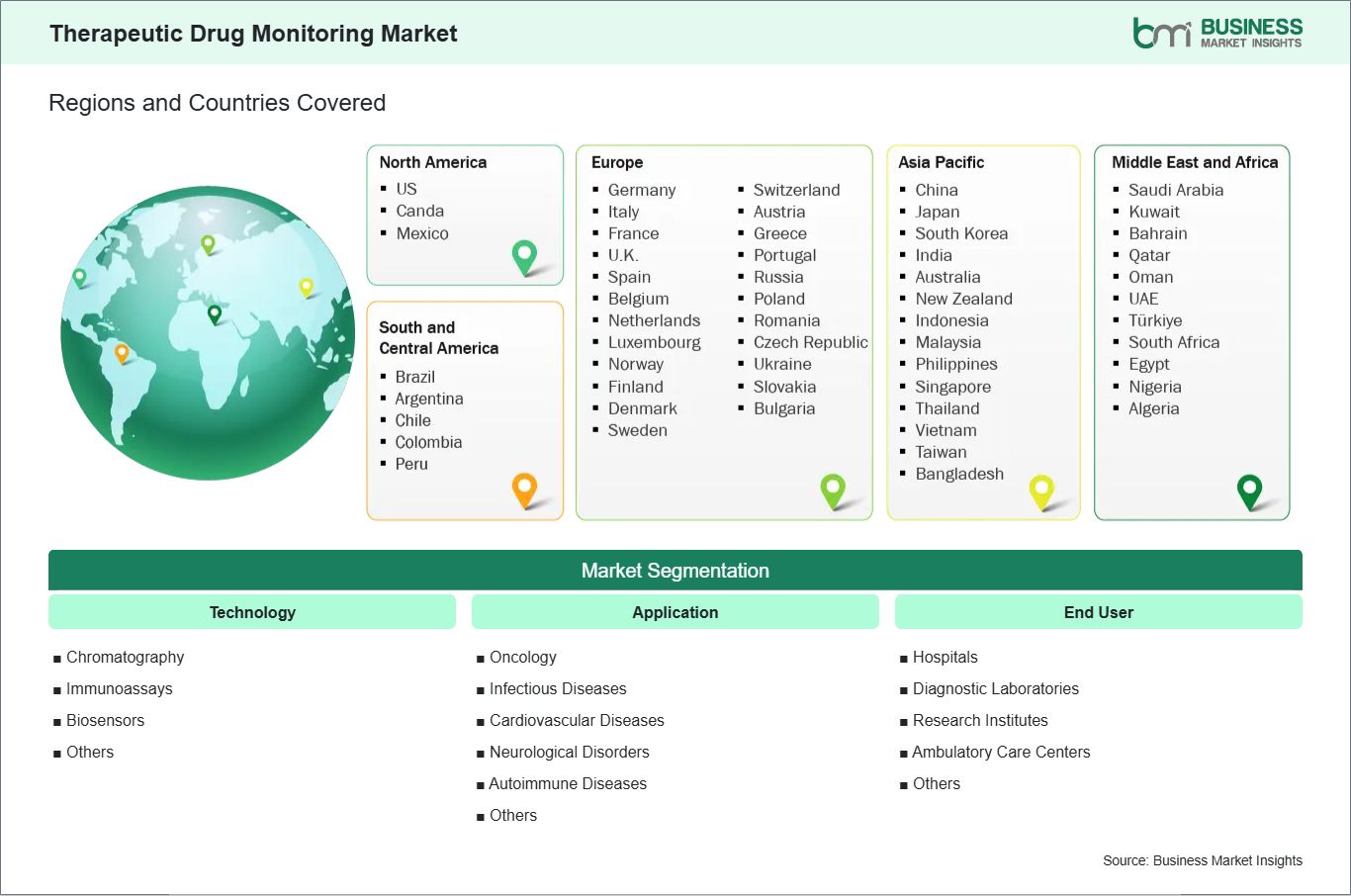
Key segments that contributed to the derivation of the Therapeutic Drug Monitoring market analysis are technology, application, and end user.
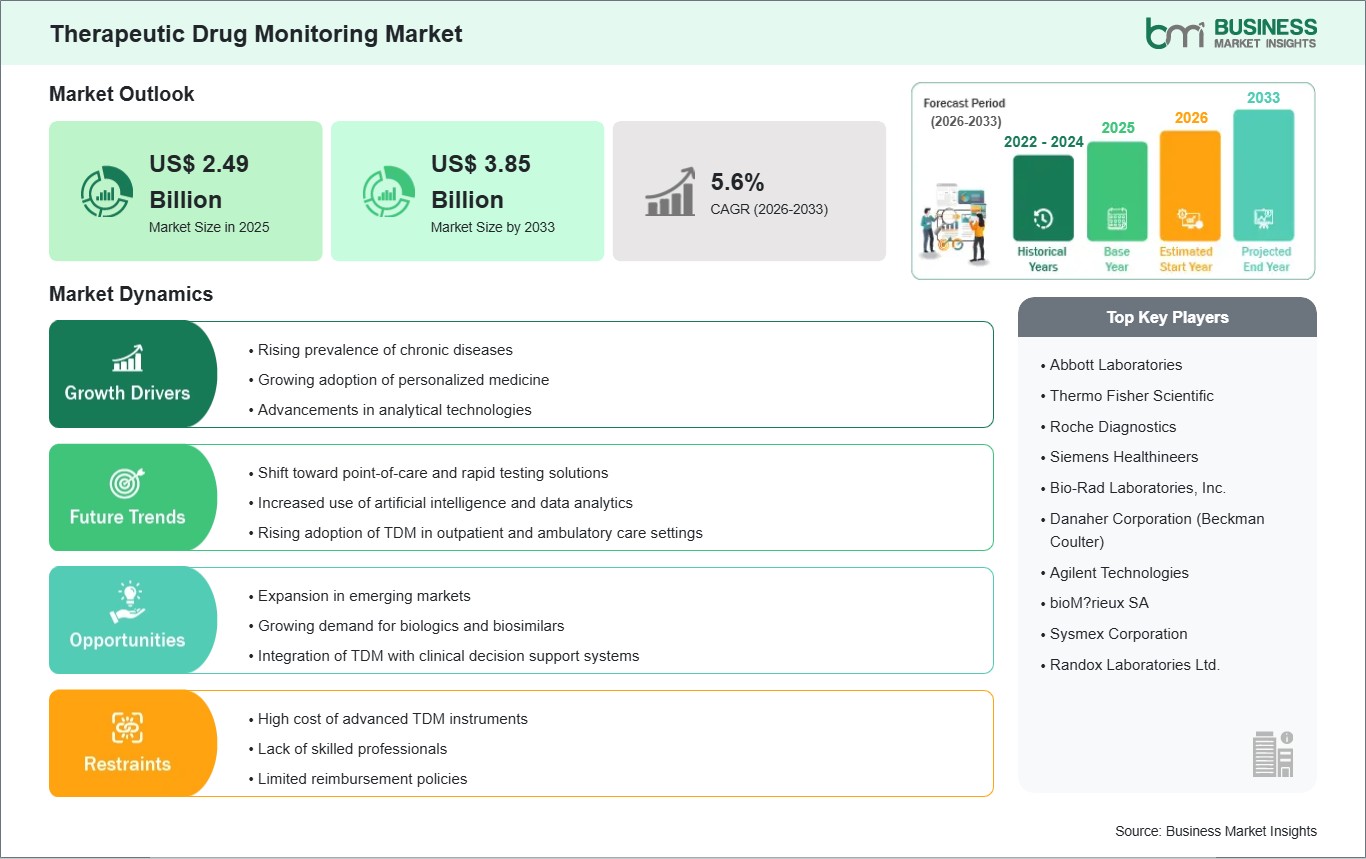
The therapeutic drug monitoring (TDM) market is primarily being driven by the increasing movement towards the personalised/precision medicine concept in the healthcare industry today. Many commonly prescribed medications such as immunosuppressants, antiepileptics, antibiotics, cardiovascular medications and oncology therapies all have a narrow therapeutic index. A small variation in dosage can result in either toxicity or inefficacy. Consequently, TDM is an important parameter used to optimise medication dosing by factoring in patient-specific variables such as age, genetics, organ functions, drug-drug interactions and disease states. Furthermore, there has been a continued increase in long-term and complex medication regimens due to the increasing burden of chronic conditions, the rising prevalence of cancer, organ transplants, and severe infections, making the requirement for accurate monitoring of these drug levels necessary for effective treatment. Additionally, there is growing emphasis from healthcare systems on reducing adverse drug reactions, hospital readmissions, and failure to achieve desired therapeutic outcomes, all of which can be managed through the routine monitoring of drug concentrations in patient's blood. Advances in analytical technologies, such as high sensitivity immunoassays and mass spectrometry, have provided major improvements to the overall reliability and speed of clinical adoption of TDM. Therefore, as patients and physicians seek out the safest and most effective therapies that take into account individual patient characteristics, the demand for TDM will be strong from hospitals and diagnostic laboratories.
Within the therapeutic drug monitoring segment of the overall healthcare market, the most attractive opportunity at this time is the continued growth and expansion of TDM into developing nations, as well as the development of point-of-care (POC) testing solutions. Within the geographic regions where developing healthcare systems have been observed over the last several years (Asia Pacific, Latin America, select countries within the region referred to as the Middle Eastern Region), the healthcare systems in these typical "emerging" economies are expanding rapidly. As these countries continue to build up their healthcare systems and the density of patients diagnosed with chronic diseases continues to increase, the trend toward increased access to sophisticated medical treatments, including oncology and transplant therapies with required close monitoring of drug levels, is occurring at an accelerated pace. However, TDM adoption remains at a relatively low level, providing a significant growth opportunity for TDM within these geographic regions as the level of TDM awareness and affordability increases.
The growth of compact, rapid, and user friendly POC TDM devices is another attractive growth opportunity. The development and availability of POC TDM devices will provide healthcare professionals with improved access to TDM testing, thus allowing for quicker clinical decisions during critical care situations or in emergency room environments, as well as in remote or resource-limited settings when a centralized laboratory may be less accessible. In addition, integrating TDM with digital health solutions and electronic medical records will increase the clinical value of TDM by allowing healthcare professionals to adjust doses in real-time and optimize patient treatment. Companies that invest in developing cost-effective methods of providing TDM testing, as well as companies that develop portable technology, and establish strategic partnerships with their commercial counterparts in healthcare, will be well positioned to take advantage of this enormous opportunity for the global expansion of treatment drug monitoring.

By technology, the therapeutic drug monitoring market is segmented into chromatography, immunoassays, biosensors, others. The immunoassays segment dominated the market in 2024. Immunoassays continue to lead primarily due to their ability to process a large number of samples in a short period, their convenient automation, and the fact that they are readily compatible with the existing laboratory setup. These features make them the preferred instruments for routine TDM execution.
By application, the market is segmented into oncology, infectious diseases, cardiovascular diseases, neurological disorders, autoimmune diseases, others. The oncology segment held the largest share of the market in 2024. The demand for therapeutic drug monitoring in oncology is mainly propelled by the escalating global cancer incidence and the extensive application of targeted and combination therapies.
By end user, the market is segmented hospitals, diagnostic laboratories, research institutes, ambulatory care centers, others. The hospitals segment held the largest share of the market in 2024. Expanded patient admissions, greater usage of high, risk drugs, and a strong focus on patient safety as well as treatment optimization are some of the factors that have led to the adoption of TDM solutions in hospitals.
| Report Attribute | Details |
|---|---|
| Market size in 2025 | US$ 2.49 Billion |
| Market Size by 2033 | US$ 3.85 Billion |
| Global CAGR (2026 - 2033) | 5.6% |
| Historical Data | 2022 - 2024 |
| Forecast period | 2026-2033 |
| Segments Covered | By Technology
|
| Regions and Countries Covered | North America
|
| Market leaders and key company profiles |
|
The "Therapeutic Drug Monitoring Market Size and Forecast (2022–2033)" report provides a detailed analysis of the market covering below areas:
The geographical scope of the Therapeutic Drug Monitoring market report is divided into five regions: North America, Asia Pacific, Europe, Middle East and Africa, and South and Central America. The Therapeutic Drug Monitoring market in Asia Pacific is expected to grow significantly during the forecast period.
The Asia-Pacific Therapeutic Drug Monitoring market is segmented into China, Japan, South Korea, India, Australia, New Zealand, Indonesia, Malaysia, the Philippines, Singapore, Thailand, Vietnam, Taiwan, Bangladesh, and the Rest of Asia. The Asia Pacific TDM Market is growing consistently with the growth of the healthcare infrastructure, the increase of the disease burden and growth of the personalised medicine market within this region. Countries such as China, India, Japan, South Korea and Australia are also being/have played a large role in expanding the market due to the improvement of the hospitals' facilities, diagnostic laboratories, and the availability of advanced drug therapies. In Relation to the increases in chronic diseases, (cancer, infectious diseases), and organ transplants, the need for accurate dosing and monitoring to ensure that treatments are safe and effective is also greater than it was before. Government initiatives to improve the healthcare system, patient safety and the practice of using evidence-based medicine will also aid in the growing use of TDM within the region. Furthermore, with the increased awareness among clinicians regarding adverse drug reactions and treatment failures will drive the continued growth of incorporating drug monitoring into everyday clinical practice/workflow. technology advances in the development of immunoassays/tests and mass spectrometry will aid in increasing the accuracy and turnaround time of tests. private diagnostic laboratories and tertiary care hospitals are investing in the latest analytical platforms available in order to better support complex therapies that are becoming increasingly commonplace.

The Therapeutic Drug Monitoring market is evaluated by gathering qualitative and quantitative data post primary and secondary research, which includes important corporate publications, association data, and databases. A few of the key developments in the therapeutic drug monitoring market are:
The Therapeutic Drug Monitoring Market is valued at US$ 2.49 Billion in 2025, it is projected to reach US$ 3.85 Billion by 2033.
As per our report Therapeutic Drug Monitoring Market, the market size is valued at US$ 2.49 Billion in 2025, projecting it to reach US$ 3.85 Billion by 2033. This translates to a CAGR of approximately 5.6% during the forecast period.
The Therapeutic Drug Monitoring Market report typically cover these key segments-
The historic period, base year, and forecast period can vary slightly depending on the specific market research report. However, for the Therapeutic Drug Monitoring Market report:
The Therapeutic Drug Monitoring Market is populated by several key players, each contributing to its growth and innovation. Some of the major players include:
The Therapeutic Drug Monitoring Market report is valuable for diverse stakeholders, including:
Essentially, anyone involved in or considering involvement in the Therapeutic Drug Monitoring Market value chain can benefit from the information contained in a comprehensive market report.
Please tell us your area of interest
(Market Segments/ Regions and Countries/ Companies)