Controlled Release Drug Delivery Market Outlook (2022-2033)

Historic Data: 2022 - 2024   |   Base Year: 2025   |   Forecast Period: 2026-2033
Report Content: Market Scope, Market Segmentation, Market Dynamics, and Competitive Analysis

Report Coverage:
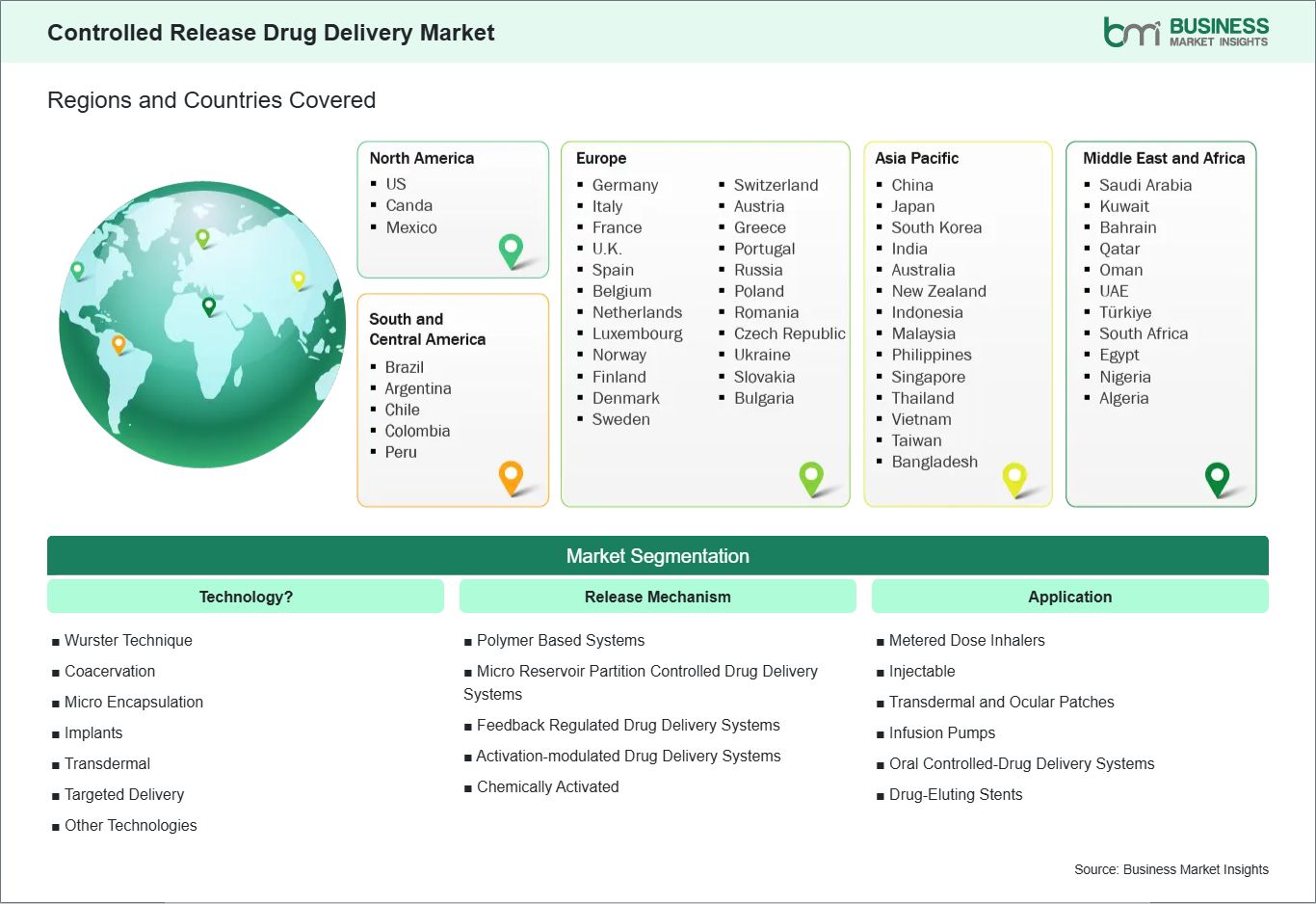
  • Technology (Wurster Technique, Coacervation, Micro Encapsulation, Implants, Transdermal, Targeted Delivery, Other Technologies)
  • Release Mechanism (Polymer Based Systems, Micro Reservoir Partition Controlled Drug Delivery Systems, Feedback Regulated Drug Delivery Systems, Activation-modulated Drug Delivery Systems, Chemically Activated)
  • Application (Metered Dose Inhalers, Injectable, Transdermal and Ocular Patches, Infusion Pumps, Oral Controlled-Drug Delivery Systems, and Drug-Eluting Stents)

No. of Pages: 400
Report Code: BMIPUB00032512
Category: Life Sciences
Controlled Release Drug Delivery Market
Buy Now

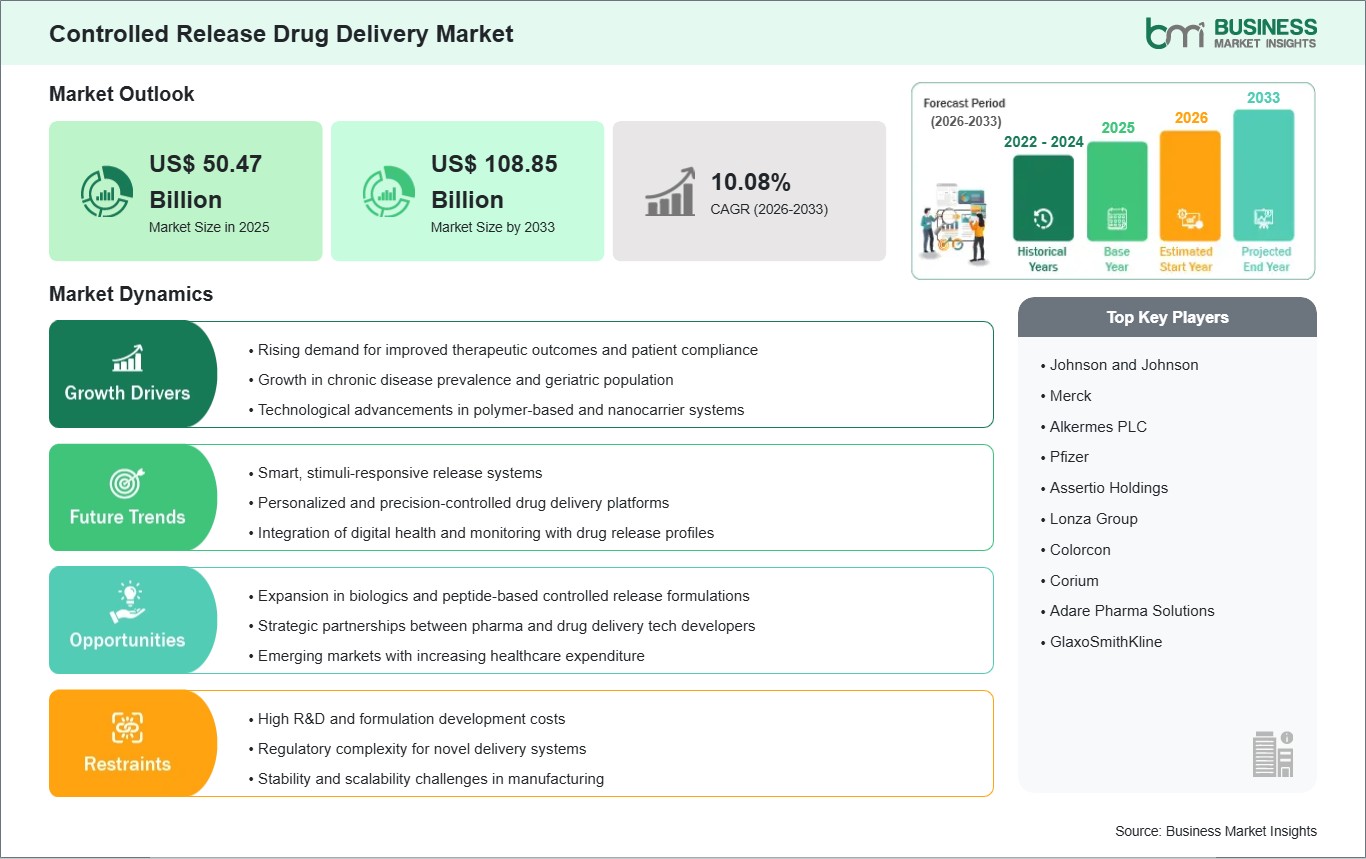
The Controlled Release Drug Delivery market size is expected to reach US$ 108.85 billion by 2033 from US$ 50.47 billion in 2025. The market is estimated to record a CAGR of 10.08% from 2026 to 2033

Executive Summary and Global Market Analysis:

In the medical field worldwide, controlled release drug delivery systems have become a part and parcel of modern therapeutics considering that governments and health authorities are focusing on better management of chronic diseases and patient adherence. Health authorities point out that the aforementioned drug delivery technologies which are capable of releasing the drugs at predetermined rates so as to keep the therapeutic levels are indispensable for treatment of chronic ailments such as diabetes, heart and brain diseases, etc., besides improving drug availability and patient compliance over the situation of traditional method of dosing. Researchers and clinical study centers like the U.S. National Institutes of Health (NIH) are supporting a large number of clinical trials and R&D projects on controlled-released formulations and advanced delivery mechanisms and the projections show continued research investment to the year 2025.

As per the Journal of Controlled Release, the peer-reviewed research work has been very continuous and energetic in the area of drug delivery system from 2025 to 2025 which shows the scientific community's high level of participation. Also, the regulatory agencies are showing the same signal: the reports of yearly new drug therapy approvals from the U.S. Food and Drug Administration (FDA) for the years 2025 and 2023 indicate a large amount of new therapies (including long-acting and extended-release formulations) coming into the market which points to the fact that regulators are focusing on advanced delivery methods to improve patients' needs. These official and clinical sources when taken together indicate that controlled release drug delivery technologies have been in the forefront and changing rapidly during the period 2025-2025 with the integration of such techniques into treatment regimes and the continued support of health authorities through innovation.

Controlled Release Drug Delivery Market - Strategic Insights:

global-market-strategic-framework
Get more information on this report

Controlled Release Drug Delivery Market Segmentation Analysis:

Key segments that contributed to the derivation of the Controlled Release Drug Delivery market analysis are type, destination, and end user.

  • By Technology, the Controlled Release Drug Delivery market is divided into Wurster Technique, Coacervation, Micro Encapsulation, Implants, Transdermal, Targeted Delivery, Other Technologies. The Targeted Delivery segment dominated the market in 2025.
  • By Release Mechanism, the market is segmented into Polymer Based Systems, Micro Reservoir Partition Controlled Drug Delivery Systems, Feedback Regulated Drug Delivery Systems, Activation-modulated Drug Delivery Systems, Chemically Activated. The Feedback Regulated Drug Delivery Systems segment held the largest share of the market in 2025. The activation-modulated drug delivery systems segment is further subsegmental as osmotic pressure activated, hydrodynamic pressure activated, vapor pressure activated, mechanically activated, magnetically activated. Similarly, the chemically activated segment further sub divided into pH activated, hydrolysis activated, enzyme activated.

•              By Application, the market is segmented into metered dose inhalers, injectable, transdermal and ocular patches, infusion pumps, oral controlled-drug delivery systems, and drug-eluting stents. The oral controlled-drug delivery systems segment held the largest share of the market in 2025

Controlled Release Drug Delivery Market Drivers and Opportunities:

Demand for Precision and High-Throughput in Lab Workflows  

Liquid handling systems have gained a major driver for their adoption with the growing need for precision, efficiency, and high-throughput laboratory workflows in public health, clinical diagnostics, and scientific research institutions. Government-backed laboratory automation projects and reports are indicating that the use of liquid handling robots in laboratory automation systems is going to become a standard in modern workflows that will minimize human errors and improve reproducibility. To illustrate, the global market for lab automation systems (including liquid handlers) was valued at about US-$6.7-billion in 2025, which was totally a result of the very high demands imposed on the drug discovery and clinical diagnostics workflow areas. This demand trend for liquid handlers continued into 2023 and 2025 due to the fact that laboratories around the world were increasingly adopting robotics and automation to perform such tasks as PCR setup, ELISA, and next-generation sequencing workflows with much higher accuracy and lower manual variability. Moreover, this trend was facilitated by the availability of official funding for research infrastructure, especially from the NIH, as well as other national R&D funding streams that prioritize automated laboratory platforms for the handling of complex biological assays that are impractical or prone to errors when done manually. Furthermore, reports from reliable sources indicate that in 2023 there were, worldwide, large installations of automated liquid handling units, with many labs transforming into, digital systems that are scalable and support reproducible analysis and remote monitoring—an evolution that was dramatically increased by the pandemic era's pressure of having to safely handle large sample volumes.

Laboratory stakeholders are increasingly investing in liquid handling to support precision public health testing and research workflows. This is driven not only by new product developments, such as: AI-integrated pipetting platforms, cloud-enabled automation controls, modular robotic workstations, and acoustic dispensing systems that were launched between 2023-2025.

Personalized Medicine and Genomics Workflows  

Liquid handling systems are presented a significant chance above all within the personalized medicine, genomics, and complex biopharma applications that continue to expand. Officially, laboratories' automation market insights indicate that institutions around the globe are investing more in technologies like ultra-low volume dispensers, complex sample preparation, and high-throughput genomic analysis which mainly the growing demand for individualized treatment protocols and population-level disease surveillance is responsible for this trend. In the year 2025 the wider laboratory automation systems industry was already billion dollars worth and one of the factors for this situation was the need for high-precision liquid handling in genomic and proteomic assays. The number of automated liquid handling units that were installed across pharmaceutical research, diagnostics, and academic labs was over 82,000 in the year 2023. The modular and scalable systems that support various workflows like single-cell analysis and precision oncology sample prep attracted strong demand. This trend of adoption continued in 2025 as laboratories were demanding more and more flexible platforms that could work with micro- and nanoliter volumes for personalized drug screening, biomarker discovery, and clinical assay development. Moreover, the product developments that are on the verge of being introduced bolster this opportunity: for example, AI-assisted liquid handling workflow optimization, acoustic or piezoelectric low-volume dispensing, IoT-enabled remote control, and enhanced contamination control were the concepts presented by leading manufacturers during the period of 2023-2025. This technology helps in the fast and reliable processing of difficult sample types and is also very suitable for the high-precision and flexible requisites of the advanced genomics and cell-based workflows.

The demand created by the government-supported precision medicine initiatives (e.g., national genomic projects and public health laboratory upgrades) is further stimulating the market, thus opening a door for the vendors to come up with solutions that are specifically designed for the clinical and research environments where both performance and regulatory compliance are required.

Controlled Release Drug Delivery Market Size and Share Analysis:

By Technology, the Controlled Release Drug Delivery market is divided into Wurster Technique, Coacervation, Micro Encapsulation, Implants, Transdermal, Targeted Delivery, Other Technologies. The Targeted Delivery segment dominated the market in 2025. Automated systems streamline drug formulation, dosing, and delivery with precision, enhancing safety, efficiency, and patient adherence, making them a crucial segment in controlled release drug delivery.

By Release Mechanism, the market is segmented into Polymer Based Systems, Micro Reservoir Partition Controlled Drug Delivery Systems, Feedback Regulated Drug Delivery Systems, Activation-modulated Drug Delivery Systems, Chemically Activated. The Feedback Regulated Drug Delivery Systems segment held the largest share of the market in 2025. The activation-modulated drug delivery systems segment is further subsegmental as osmotic pressure activated, hydrodynamic pressure activated, vapor pressure activated, mechanically activated, magnetically activated. Similarly, the chemically activated segment further sub divided into pH activated, hydrolysis activated, enzyme activated. Automated feedback-regulated systems adjust drug release in real-time based on patient conditions, improving therapeutic outcomes, minimizing side effects, and driving their dominance in controlled release drug delivery.

By Application, the market is segmented into metered dose inhalers, injectable, transdermal and ocular patches, infusion pumps, oral controlled-drug delivery systems, and drug-eluting stents. The oral controlled-drug delivery systems segment held the largest share of the market in 2025.   Automated oral controlled-drug delivery systems ensure precise, consistent dosing, improve patient adherence, reduce errors, and support chronic disease management, making them a dominant market segment

Controlled Release Drug Delivery Market Report Highlights:

Report Attribute Details
Market size in 2025 US$ 50.47 Billion
Market Size by 2033 US$ 108.85 Billion
Global CAGR (2026 - 2033)10.08%
Historical Data 2022 - 2024
Forecast period 2026-2033
Segments Covered By Technology
  • Wurster Technique
  • Coacervation
  • Micro Encapsulation
  • Implants
  • Transdermal
  • Targeted Delivery
  • Other Technologies
By Release Mechanism
  • Polymer Based Systems
  • Micro Reservoir Partition Controlled Drug Delivery Systems
  • Feedback Regulated Drug Delivery Systems
  • Activation-modulated Drug Delivery Systems
  • Chemically Activated
By Application
  • Metered Dose Inhalers
  • Injectable
  • Transdermal and Ocular Patches
  • Infusion Pumps
  • Oral Controlled-Drug Delivery Systems
  • Drug-Eluting Stents
Regions and Countries Covered North America
  • US
  • Canada
  • Mexico
Europe
  • Belgium
  • Austria
  • Finland
  • Denmark
  • Greece
  • Poland
  • Romania
  • Russia
  • Ukraine
  • Czech Republic
  • Slovakia
  • Bulgaria
  • Italy
  • Luxembourg
  • Germany
  • Switzerland
  • France
  • Netherlands
  • Norway
  • Portugal
  • Spain
  • Sweden
  • United Kingdom
Asia-Pacific
  • Australia
  • China
  • India
  • Japan
  • South Korea
  • Indonesia
  • Malaysia
  • Philippines
  • Singapore
  • Thailand
  • Vietnam
  • Bangladesh
  • New Zealand
  • Taiwan
South and Central America
  • Brazil
  • Argentina
  • Peru
  • Chile
  • Colombia
Middle East and Africa
  • Bahrain
  • Kuwait
  • Oman
  • Qatar
  • Saudi Arabia
  • United Arab Emirates
  • Turkiye
  • South Africa
  • Egypt
  • Algeria
  • Nigeria
Market leaders and key company profiles
  • Johnson & Johnson
  • Pfizer Inc.
  • Merck & Co., Inc.
  • AbbVie Inc.
  • Novartis AG
  • Bayer AG
  • AstraZeneca plc
  • Corium International, Inc.
  • Alkermes plc
Get more information on this report

Controlled Release Drug Delivery Market Report Coverage and Deliverables:

The Controlled Release Drug Delivery Market Size and Forecast (2025-2033) report provides a detailed analysis of the market covering below areas:

  • Controlled Release Drug Delivery market size and forecast at global, regional, and country levels for all the key market segments covered under the scope
  • Controlled Release Drug Delivery market trends, as well as market dynamics such as drivers, restraints, and key opportunities
  • Controlled Release Drug Delivery market analysis covering key market trends, global and regional framework, major players, regulations, and recent market developments
  • Industry landscape and competition analysis covering market concentration, heat map analysis, prominent players, and recent developments for the Controlled Release Drug Delivery market
  • Detailed company profiles, including SWOT analysis

Controlled Release Drug Delivery Market Geographic Insights:

The geographical scope of the Controlled Release Drug Delivery market report is divided into five regions: North America, Asia Pacific, Europe, Middle East & Africa, and South & Central America. The Controlled Release Drug Delivery market in Asia Pacific is expected to grow significantly during the forecast period.

The controlled release drug delivery market reflects global health priorities, with country and regional trends highlighting both disease prevalence and regulatory innovation. In India, the Indian Council of Medical Research (ICMR) reported that chronic non-communicable diseases accounted for 64% of total deaths in 2025, rising to 66% in 2023 and 68% in 2025, driving demand for long-acting formulations to improve patient adherence. In the United States, the FDA’s Center for Drug Evaluation and Research (CDER) approved 55 novel drugs in 2023 and 50 in 2025, including several controlled release formulations for oncology and neurology, reflecting regulatory support for sustained-release technologies. In Europe, the European Medicines Agency (EMA) recommended 114 medicines for approval in 2025, of which 46 contained new active substances, including controlled release antibiotics and therapies for chronic conditions. Globally, the United Nations Office on Drugs and Crime (UNODC) noted in its 2025 World Drug Report that prescription drug demand continues to rise, particularly for formulations that reduce misuse risk through controlled release mechanisms. Together, these prevalence statistics and regulatory milestones demonstrate how chronic disease burdens and official approvals are shaping regional adoption of controlled release drug delivery systems

global-market-geography
Get more information on this report

Controlled Release Drug Delivery Market Research Report Guidance:

  • The report includes qualitative and quantitative data in the Controlled Release Drug Delivery market across type, destination, and end user, and geography.
  • The report starts with the key takeaways (chapter 2), highlighting the key trends and outlook of the Controlled Release Drug Delivery market.
  • Chapter 3 includes the research methodology of the study.
  • Chapter 4 further includes ecosystem analysis.
  • Chapter 5 highlights the major industry dynamics in the Controlled Release Drug Delivery market, including factors that are driving the market, prevailing deterrents, potential opportunities, as well as future trends. Impact analysis of these drivers and restraints is also covered in this section.
  • Chapter 6 discusses the Controlled Release Drug Delivery market scenario, in terms of historical market revenues, and forecast till the year 2031.
  • Chapters 7 to 10 cover Controlled Release Drug Delivery market segments by type, destination, and end user, and geography across North America, Europe, Asia Pacific, Middle East and Africa, and South and Central America. They cover the market volume revenue forecast and factors driving the market.
  • Chapter 11 describes the competitive analysis along with the heat map analysis for the key players operating in the market.
  • Chapter 12 describes the industry landscape analysis. It provides detailed descriptions of business activities such as market initiatives, new developments, mergers, and joint ventures globally, along with a competitive landscape.
  • Chapter 13 provides detailed profiles of the major companies operating in the Controlled Release Drug Delivery market. Companies have been profiled on the basis of their key facts, business descriptions, products and services, financial overview, SWOT analysis, and key developments.

Chapter 14, i.e., the appendix is inclusive of a brief overview of the company, list of abbreviations, and disclaimer

Controlled Release Drug Delivery Market News and Key Development:

The Controlled Release Drug Delivery market is evaluated by gathering qualitative and quantitative data post primary and secondary research, which includes important corporate publications, association data, and databases. A few of the key developments in the Controlled Release Drug Delivery market are:

  • In November 2025, Biogen Inc. has completed the acquisition of Alcyone Therapeutics, a clinical-stage biotechnology company known for its innovative CNS therapy delivery solutions, such as the ThecaFlex DRx™ drug delivery system.
  • In November 2025, Halozyme Therapeutics, Inc. announced the successful completion of its acquisition of Elektrofi, Inc., a biopharmaceutical company with a proprietary ultra-high concentration microparticle formulation technology for biologics, branded Hypercon.

In December 2025, Halozyme Therapeutics, Inc announced that Johnson & Johnson has received approval from the U.S. Food and Drug Administration (FDA) for RYBREVANT FASPRO™ (amivantamab and hyaluronidase-lpuj), which is co-formulated with ENHANZE® for patients with epidermal growth factor receptor (EGFR)-mutated locally advanced or metastatic non-small cell lung cancer (NSCLC).1 RYBREVANT FASPRO™ is approved across all indications of RYBREVANT® (amivantamab-vmjw) and represents the first and only subcutaneously (SC) administered targeted therapy for patients with EGFR+ mNSCLC

Key Sources Referred:

  • World Bank – Global Trade Indicators
  • European Chemicals Agency
  • International Council of Chemical Associations
  • (International Monetary Fund )IMF
  • World Trade Organization (WTO)
  • International Trade Administration (ITA)
  • Company website
  • Company annual reports
  • Company investor presentations

The List of Companies - Controlled Release Drug Delivery Market

  • Johnson & Johnson
  • Pfizer Inc.
  • Merck & Co., Inc.
  • AbbVie Inc.
  • Novartis AG
  • Bayer AG
  • AstraZeneca plc
  • Corium International, Inc.
  • Alkermes plc
  • Amneal Pharmaceuticals
Frequently Asked Questions
How big is the Controlled Release Drug Delivery Market?

The Controlled Release Drug Delivery Market is valued at US$ 50.47 Billion in 2025, it is projected to reach US$ 108.85 Billion by 2033.

What is the CAGR for Controlled Release Drug Delivery Market by (2026 - 2033)?

As per our report Controlled Release Drug Delivery Market, the market size is valued at US$ 50.47 Billion in 2025, projecting it to reach US$ 108.85 Billion by 2033. This translates to a CAGR of approximately 10.08% during the forecast period.

What segments are covered in this report?

The Controlled Release Drug Delivery Market report typically cover these key segments-

  • Technology (Wurster Technique, Coacervation, Micro Encapsulation, Implants, Transdermal, Targeted Delivery, Other Technologies)
  • Release Mechanism (Polymer Based Systems, Micro Reservoir Partition Controlled Drug Delivery Systems, Feedback Regulated Drug Delivery Systems, Activation-modulated Drug Delivery Systems, Chemically Activated)
  • Application (Metered Dose Inhalers, Injectable, Transdermal and Ocular Patches, Infusion Pumps, Oral Controlled-Drug Delivery Systems, and Drug-Eluting Stents)

What is the historic period, base year, and forecast period taken for Controlled Release Drug Delivery Market?

The historic period, base year, and forecast period can vary slightly depending on the specific market research report. However, for the Controlled Release Drug Delivery Market report:

  • Historic Period : 2022 - 2024
  • Base Year : 2025
  • Forecast Period : 2026-2033
  • Who are the major players in Controlled Release Drug Delivery Market?

    The Controlled Release Drug Delivery Market is populated by several key players, each contributing to its growth and innovation. Some of the major players include:

  • Johnson & Johnson
  • Pfizer Inc.
  • Merck & Co., Inc.
  • AbbVie Inc.
  • Novartis AG
  • Bayer AG
  • AstraZeneca plc
  • Corium International, Inc.
  • Alkermes plc
  • Amneal Pharmaceuticals
  • Who should buy this report?

    The Controlled Release Drug Delivery Market report is valuable for diverse stakeholders, including:

    • Investors: Provides insights for investment decisions pertaining to market growth, companies, or industry insights. Helps assess market attractiveness and potential returns.
    • Industry Players: Offers competitive intelligence, market sizing, and trend analysis to inform strategic planning, product development, and sales strategies.
    • Suppliers and Manufacturers: Helps understand market demand for components, materials, and services related to concerned industry.
    • Researchers and Consultants: Provides data and analysis for academic research, consulting projects, and market studies.
    • Financial Institutions: Helps assess risks and opportunities associated with financing or investing in the concerned market.

    Essentially, anyone involved in or considering involvement in the Controlled Release Drug Delivery Market value chain can benefit from the information contained in a comprehensive market report.

    Available Report Formats

    pdf-format excel-format pptx-format
    Buy Now

    Customization Form

    Please tell us your area of interest
    (Market Segments/ Regions and Countries/ Companies)