
Dynamic Random Access Memory (DRAM) Market Outlook: Size, Share, Trends, Growth Analysis, Competitive Landscape & Forecast, 2026-2033

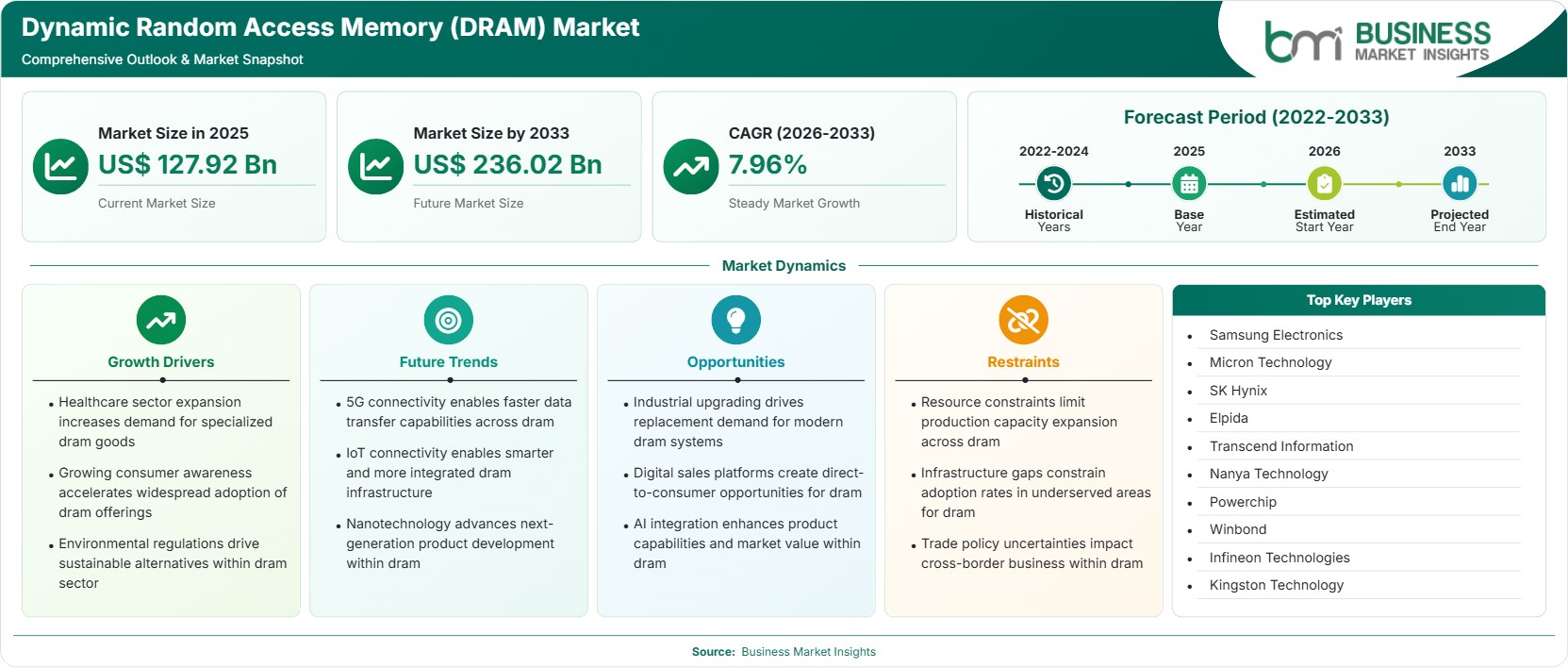
The DRAM Market size was valued at US$ 127.92 Billion in 2025 and is projected to reach US$ 236.02 Billion by 2033, growing at a CAGR of 7.96% during 2026–2033. Rising AI server deployments, high-performance computing demand, advanced automotive electronics, and increasing memory requirements across edge devices are accelerating investment, while next-generation DDR5 adoption and semiconductor manufacturing expansion continue creating attractive long-term opportunities.

Report Coverage
  • Type: Double Data Rate SDRAM, Rambus DRAM, Fast Page Mode DRAM, Extended Data Out DRAM, Others
  • Technology: DDR4, DDR5, Others
  • Application: Gaming Console, PCs/Laptops, Automotive, Mobile Phones, Others
US$ 127.92 Bn Market size in 2025
US$ 236.02 Bn Market Size by 2033
7.96% CAGR, 2026 - 2033
2026-2033 Forecast Period

01 AI Overview

Dynamic Random Access Memory (DRAM) Market Summary

  • North America Region: North America holds a 30%–33% share in 2025, expanding at a 7.3%–7.8% CAGR during 2026–2033. Strong cloud infrastructure investments, AI server deployment, advanced semiconductor design capabilities, and enterprise digital transformation continue supporting production expansion and long-term technology commercialization opportunities.
    U.S. Market: The U.S. leads regional innovation through hyperscale data center investments, AI accelerator adoption, and semiconductor ecosystem expansion, advancing at an estimated 7.4%–7.9% CAGR through 2033.
  • Fastest Growing Region: Asia Pacific accounts for 28%–31% of the market in 2025 and is expected to expand at a 8.8%–9.4% CAGR during 2026–2033. Government-backed semiconductor investments, expanding fabrication capacity, AI hardware manufacturing, consumer electronics production, and automotive digitalization continue strengthening long-term regional competitiveness and export opportunities.
  • Leading Segment: DDR4 represents 46%–49% of revenue in 2025 and is projected to grow at a 6.8%–7.3% CAGR through 2033. Widespread compatibility, mature manufacturing processes, cost efficiency, enterprise computing demand, and industrial equipment upgrades continue supporting substantial shipment volumes across multiple application environments globally.
  • High Growth Segment: DDR5 captures 23%–26% market share in 2025 while advancing at a 10.8%–11.6% CAGR through 2033. Higher bandwidth, lower power consumption, AI computing workloads, cloud infrastructure modernization, and premium computing platforms continue driving accelerated technology adoption worldwide.
  • Key Market Opportunity: Accelerating deployment of AI infrastructure, high-bandwidth memory integration, autonomous vehicle electronics, and edge computing platforms is creating sustained investment opportunities for advanced memory manufacturing, packaging innovation, and long-term semiconductor ecosystem expansion.
  • Major Market Players: Samsung Electronics Co., Ltd., Micron Technology, Inc., SK hynix Inc., Elpida Memory, Inc., Transcend Information, Inc., Nanya Technology Corporation, Powerchip Semiconductor Manufacturing Corporation, Winbond Electronics Corporation, Infineon Technologies AG, and Kingston Technology Corporation.
02 Strategic Insights

Dynamic Random Access Memory (DRAM) Market: Strategic Insights

Dynamic Random Access Memory (DRAM) Market Strategic Framework
FREE PDF
Request your free sample
Request free sample
03 Stakeholder View

Key Takeaways

  • The industry's value chain is becoming increasingly integrated, with wafer fabrication, advanced packaging, testing, and system integration strengthening supply resilience while improving production efficiency for global semiconductor manufacturers.
  • AI servers, cloud data centers, automotive electronics, and premium computing platforms present the strongest commercial opportunities as higher memory bandwidth and capacity requirements continue expanding addressable demand across multiple industries.
  • Technology innovation is shifting toward DDR5 adoption, advanced lithography, power-efficient architectures, and heterogeneous memory integration that enhance computing performance while supporting increasingly complex AI and high-performance workloads.
  • Asia Pacific remains the most attractive manufacturing investment destination, while North America continues leading semiconductor design, cloud infrastructure deployment, and research activities supporting next-generation memory technologies and commercialization.
  • Strategic partnerships, long-term supply agreements, manufacturing capacity expansion, and government-backed semiconductor incentives continue driving capital investment as producers strengthen resilience against future supply-demand volatility.
  • Sustainability initiatives, including lower-power memory technologies, manufacturing process optimization, water recycling, and energy-efficient fabrication facilities, are becoming increasingly important competitive differentiators across the global semiconductor ecosystem.
04 Geographic Outlook

Dynamic Random Access Memory (DRAM) Market Regional Highlights

North America DRAM Market

North America accounted for 30%–33% of global revenue in 2025 and is projected to expand at a 7.3%–7.8% CAGR through 2033. Strong hyperscale cloud investments, AI accelerator deployments, and high-performance computing infrastructure continue driving regional demand. Advanced semiconductor R&D, favorable government incentives, and increasing enterprise digital transformation strengthen long-term competitiveness. The DRAM Market share in North America also benefits from growing automotive electronics integration and expanding edge AI deployments, supporting resilient demand despite periodic semiconductor pricing fluctuations.

  • AI servers and hyperscale cloud infrastructure continue generating sustained demand for high-capacity DDR5 memory modules, encouraging long-term procurement agreements and increasing investments in advanced semiconductor packaging technologies across major manufacturing ecosystems.
  • The U.S. remains the leading semiconductor innovation center with extensive investments in advanced chip design, memory controller development, and next-generation computing platforms supporting enterprise AI and high-performance workloads.
  • Government-backed semiconductor manufacturing initiatives encourage domestic fabrication expansion, reducing supply chain concentration risks while strengthening regional production resilience and technology leadership in advanced memory products.
  • Automotive electronics, industrial automation, and aerospace computing applications increasingly require reliable high-bandwidth memory, creating diversified revenue opportunities beyond traditional consumer electronics demand.
  • Strong collaboration between semiconductor manufacturers, cloud service providers, and research institutions accelerates commercialization of advanced memory technologies while supporting sustainable manufacturing improvements.

US DRAM Market

The United States represents 78%–82% of North American DRAM Market revenue and is expected to register a 7.4%–7.9% CAGR during 2026–2033. Robust investments in AI infrastructure, semiconductor fabrication, defense electronics, and cloud computing continue supporting advanced memory demand. Large-scale enterprise modernization, expanding digital services, and increasing data center construction strengthen long-term consumption across commercial and industrial applications.

  • Major hyperscale operators continue expanding AI data centers, significantly increasing procurement of high-bandwidth memory solutions required for large language model training and inference infrastructure.
  • The CHIPS-related semiconductor investment ecosystem continues attracting fabrication capacity, advanced packaging facilities, and collaborative research supporting long-term technology competitiveness.
  • Enterprise adoption of AI-enabled computing platforms continues driving upgrades across servers, networking equipment, and storage systems requiring higher-performance memory architectures.
  • Automotive innovation, autonomous driving research, and advanced industrial automation create diversified opportunities for premium memory technologies across multiple industries.

Europe DRAM Market

Europe contributes 21%–24% of global DRAM Market revenue in 2025 while advancing at a 7.0%–7.5% CAGR through 2033. The region benefits from growing automotive semiconductor demand, industrial digitalization, and expanding investments in advanced manufacturing. Germany remains the largest regional market, while France and the Netherlands strengthen semiconductor ecosystem investments. Ireland and Poland emerge among the fastest-growing destinations, supported by technology investments and digital infrastructure expansion.

  • Germany leads regional consumption through automotive electronics, industrial automation, and advanced manufacturing applications requiring reliable memory technologies for intelligent production systems.
  • France continues strengthening semiconductor research collaborations supporting innovation in AI computing, telecommunications infrastructure, and secure embedded electronic systems.
  • Ireland records one of the fastest growth rates owing to cloud infrastructure expansion, multinational technology investments, and increasing semiconductor supply chain activities.
  • European Union semiconductor policies encourage regional manufacturing resilience while improving long-term investment attractiveness across fabrication, packaging, and research facilities.
  • Sustainability initiatives encourage energy-efficient semiconductor manufacturing processes, supporting the adoption of lower-power memory technologies across commercial computing environments.

Asia Pacific DRAM Market

Asia Pacific represents 28%–31% of global DRAM Market revenue in 2025 and is forecast to expand at a 8.8%–9.4% CAGR through 2033, making it the fastest-growing regional market. Strong semiconductor manufacturing capabilities, expanding consumer electronics production, and increasing AI hardware investments continue driving demand. South Korea leads advanced memory manufacturing, while China and Taiwan maintain substantial production capacity. India demonstrates the fastest regional expansion through semiconductor policy support and electronics manufacturing growth.

  • South Korea maintains global leadership in advanced memory production through continuous investments in fabrication technology, process innovation, and next-generation memory commercialization.
  • Taiwan strengthens regional competitiveness through advanced semiconductor manufacturing ecosystems supporting global computing, networking, and embedded electronics industries.
  • China continues expanding domestic semiconductor capabilities while increasing investments in AI infrastructure, automotive electronics, and high-performance computing applications.
  • India experiences rapid expansion supported by semiconductor incentive programs, electronics manufacturing initiatives, and increasing digital infrastructure investments attracting international technology companies.
  • Rising gaming, smartphone, and enterprise server demand strengthens long-term regional production capacity while supporting sustained export opportunities.

Rest of World DRAM Market

The Rest of World region accounts for 16%–19% of global DRAM Market revenue in 2025 and is projected to grow at a 7.5%–8.1% CAGR through 2033. South & Central America benefit from expanding investments in enterprise digitalization and telecommunications, while the Middle East & Africa experience growing demand driven by smart city initiatives, cloud infrastructure, and industrial automation. Brazil leads South & Central America, whereas the UAE demonstrates the strongest regional growth supported by digital economy strategies.

  • Brazil remains the largest regional market through expanding enterprise IT modernization, financial services digitalization, and increasing investments in advanced computing infrastructure.
  • Mexico strengthens semiconductor supply chain participation through electronics manufacturing expansion and cross-border technology partnerships supporting industrial production.
  • The United Arab Emirates experiences strong demand driven by smart city programs, AI infrastructure development, and cloud computing investments supporting digital transformation initiatives.
  • Saudi Arabia increases technology investments through economic diversification strategies encouraging advanced digital infrastructure and enterprise modernization projects.
  • Growing telecommunications infrastructure, industrial automation, and digital government programs continue expanding long-term demand across emerging economies.
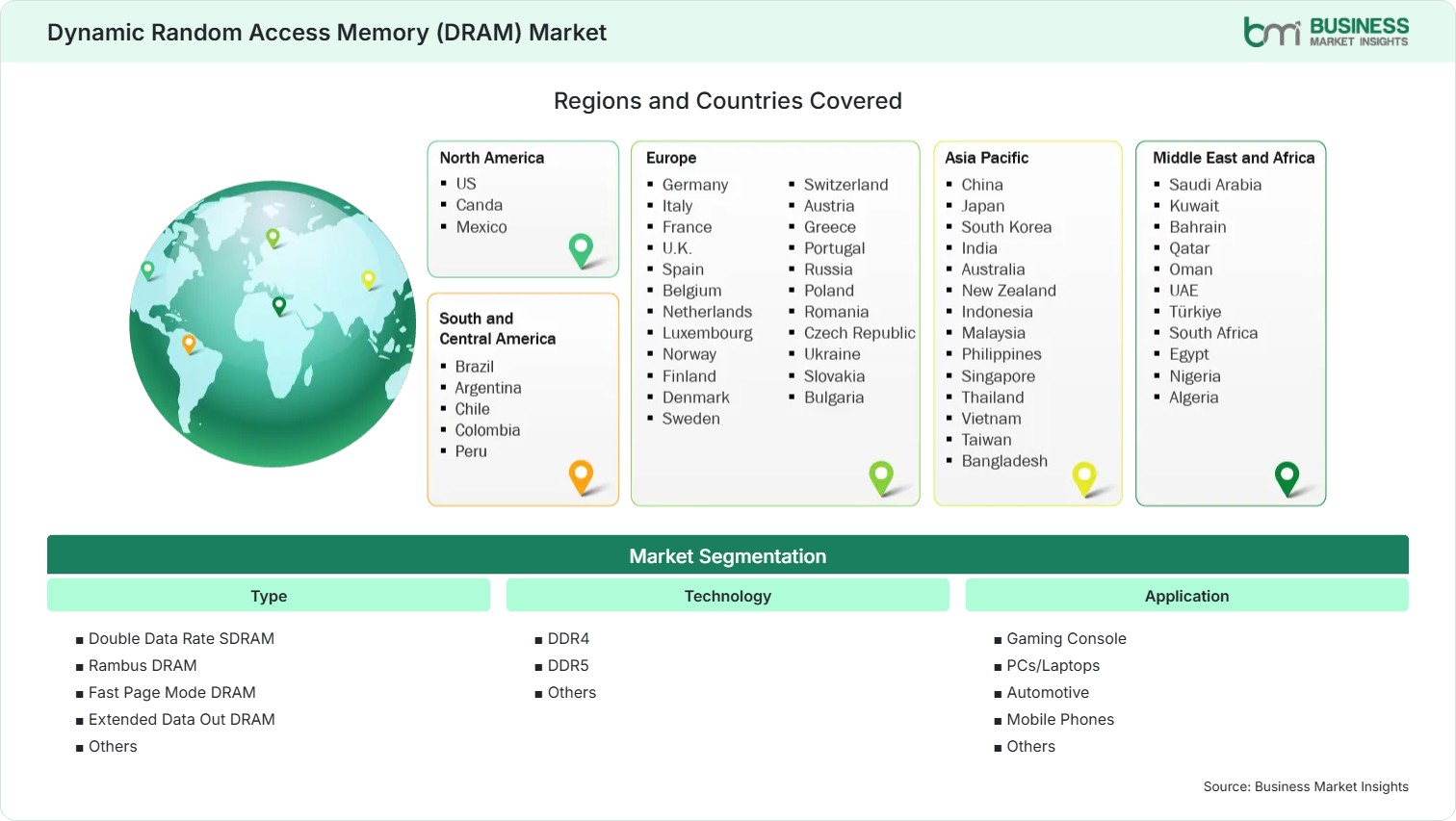
Global Market Geography
FREE PDF
Request your free sample
Request free sample
05 Segment Analysis

Dynamic Random Access Memory (DRAM) Market Segmentation

Type

The Type segment accounted for approximately 100% of the market, with Double Data Rate SDRAM remaining dominant. The segment is expected to expand at a 7.6%–8.1% CAGR through 2033 as higher bandwidth, improved efficiency, and broad application compatibility support sustained adoption. The DRAM Market scope continues expanding through innovation across enterprise computing, automotive electronics, and AI-enabled platforms.

  • Double Data Rate SDRAM: Dominates industry adoption owing to superior bandwidth, extensive compatibility with modern computing systems, and continuous deployment across servers, gaming platforms, enterprise storage, and consumer electronics.
  • Rambus DRAM: Continues serving specialized high-performance applications requiring extremely fast data transfer capabilities, particularly within networking equipment, graphics processing, and selected enterprise computing environments.
  • Fast Page Mode DRAM: Maintains limited utilization across legacy industrial equipment, embedded electronics, and specialized systems requiring compatibility with existing hardware architectures despite declining commercial demand.
  • Extended Data Out DRAM: Supports legacy computing environments where extended compatibility remains essential for industrial automation equipment, older networking hardware, and maintenance of established embedded systems.

Technology

The Technology segment reflects rapid evolution toward higher-performance memory architectures. DDR4 accounts for approximately 46%–49% DRAM Market share in 2025 while advancing at a 6.8%–7.3% CAGR, whereas newer technologies continue accelerating adoption across AI computing and cloud infrastructure. Technology migration remains a primary competitive differentiator among leading semiconductor manufacturers.

  • DDR4: Continues dominating shipments through mature manufacturing capabilities, broad compatibility, stable pricing, and widespread deployment across enterprise servers, desktops, notebooks, industrial systems, and embedded applications.
  • DDR5: Gains rapid commercial adoption through substantially improved bandwidth, enhanced power efficiency, greater memory density, and growing implementation across AI servers, cloud computing platforms, premium PCs, and advanced workstations.

Application

The Application segment continues to diversify as advanced computing expands across consumer and enterprise environments. Mobile Phones account for 34%–37% market share during 2025 and are expected to grow at a 7.8%–8.4% CAGR, supported by increasing AI-enabled mobile processors, premium smartphones, and higher memory configurations across flagship and mid-range devices.

  • Gaming Console: Increasing graphics performance requirements, immersive gaming experiences, and higher processing capabilities continue driving adoption of advanced memory technologies supporting next-generation gaming hardware.
  • PCs/Laptops: Enterprise upgrades, hybrid work environments, AI-enabled computing, and content creation workloads continue strengthening demand for higher-capacity, energy-efficient memory modules across commercial and consumer systems.
  • Automotive: Advanced driver assistance systems, connected vehicles, digital cockpits, and autonomous driving technologies continue increasing demand for reliable, high-performance memory solutions within modern transportation platforms.
  • Mobile Phones: Premium smartphones increasingly integrate higher-capacity memory supporting AI applications, advanced imaging, gaming, multitasking, and next-generation mobile computing experiences across global consumer markets.
06 Market Forces

Dynamic Random Access Memory (DRAM) Market Dynamics

Key Market Drivers

Accelerating AI Infrastructure and Hyperscale Data Center Expansion

The adoption of artificial intelligence is fundamentally reshaping memory demand across hyperscale cloud environments. Training and execution of AI models need servers that have more memory bandwidth and higher memory capacity compared to ordinary enterprise servers, thus creating a need for enhanced DRAMs. Global investments in data centers are expected to increase, together with the expansion of AI infrastructure, in addition to the capacity of servers to support generative AI applications. The DRAM Market growth is increasingly linked to high-bandwidth computing architectures, DDR5 adoption, and memory-intensive accelerator platforms. Semiconductor manufacturers are therefore prioritizing advanced process nodes, higher-density memory modules, and improved power efficiency to address growing enterprise computing requirements while strengthening long-term supply capabilities.

Growing Automotive Electronics and Intelligent Mobility

Modern vehicles increasingly depend on advanced memory technologies to support digital cockpits, advanced driver assistance systems (ADAS), infotainment platforms, autonomous driving functions, and vehicle connectivity. According to industry associations, semiconductor content per vehicle is on the rise, with the adoption of software-based vehicle architecture becoming prevalent. High-speed memory supports quick analysis of sensors, navigation, machine learning, and critical decision-making. Electrification trends further increase electronic system complexity, driving demand for reliable, automotive-grade memory solutions. The continued integration of AI processors and centralized computing platforms within vehicles is expected to sustain long-term consumption of advanced DRAM products across passenger vehicles, commercial fleets, and next-generation autonomous transportation ecosystems.

Enterprise Digital Transformation and High-Performance Computing

Companies across the world are moving towards upgrading their IT infrastructures by implementing cloud technology, virtualization, edge computing, and AI analytics platforms. This leads to increased requirements for larger memory and better processing capabilities on servers, resulting in an increasing need for next-generation DRAM solutions. Scientific computing, financial modeling, medical analysis, weather forecasting, and industrial simulations all need intensive memory processing. The DRAM Market trends indicate sustained investments in enterprise computing modernization as organizations deploy increasingly sophisticated workloads requiring improved bandwidth and lower latency. Continued adoption of virtualization technologies, enterprise AI applications, and hybrid cloud environments supports consistent memory upgrades across both public and private infrastructure deployments.

Key Market Opportunities

Expansion of DDR5 and Next-Generation Memory Technologies

DDR5 commercialization represents one of the strongest long-term investment opportunities for memory manufacturers and technology suppliers. Higher bandwidth, lower operating voltage, improved efficiency, and greater memory density make DDR5 increasingly attractive for AI servers, enterprise computing, gaming systems, and premium consumer electronics. The DRAM Market Forecasts continue benefiting from technology migration as enterprises replace aging computing infrastructure with next-generation platforms capable of supporting memory-intensive workloads. With investments made into new technologies in manufacturing, packaging, and larger module sizes, manufacturers are able to become more competitive and meet the increasing demands of hyperscale cloud service providers, industrial computer firms, and automotive semiconductor buyers around the globe.

Emerging Semiconductor Manufacturing Investments

Governments across Asia, North America, and Europe continue introducing semiconductor incentive programs designed to strengthen domestic manufacturing capacity and reduce supply chain concentration risks. Public-private partnership initiatives, investment initiatives, and high fabrication initiatives play an important role in the establishment of wafer fabrication fabs, packaging fabs, and semiconductor R&D centers. These initiatives provide excellent opportunities for equipment suppliers, materials suppliers, technology suppliers, and memory suppliers. The increased production capacity in the region not only ensures greater supply reliability but also plays an important role in innovation in advanced memory technology in the future. Organizations with diversified manufacturing capabilities are bound to benefit a lot in the future.

AI at the Edge and Industrial Digitalization

Edge AI applications are creating substantial opportunities for advanced memory deployment across manufacturing, healthcare, telecommunications, retail, logistics, and smart infrastructure. Smart edge devices become more demanding when it comes to faster local processing power without depending completely on cloud-based connections. High-performance memory is needed in industrial automation, robotic systems, machine vision systems, and predictive maintenance systems as well. The further growth of Industry 4.0 projects, connected manufacturing sites, and smart infrastructure systems will create many future business prospects for semiconductor suppliers who can provide the right memory products designed specifically for edge computing.

Market Restraints and Challenges

Memory Price Volatility and Supply-Demand Imbalances

Factor: The memory industry remains highly cyclical because production capacity expansions often outpace short-term demand growth, leading to fluctuations in average selling prices. Inventory corrections, changing consumer electronics demand, and macroeconomic uncertainty can amplify pricing volatility throughout the semiconductor value chain.

Impact: These fluctuations directly influence manufacturer profitability, investment planning, and capital allocation decisions. Pricing environments that are lower could lead to delays in expansion plans for fabrication processes, thin operating margins, and research budgets, despite future requirements of technological innovations being positive. Businesses are increasingly implementing production strategies that include diversification of customers and long-term agreements in order to avoid pricing cycles.

Escalating Manufacturing Complexity and Capital Requirements

Factor: Advanced DRAM production requires increasingly sophisticated lithography equipment, process technologies, cleanroom infrastructure, and research investments. Transitioning toward smaller semiconductor nodes significantly increases manufacturing complexity and capital expenditure requirements for leading producers.

Impact: High investment barriers restrict DRAM Market entry for new participants while increasing financial pressure on existing manufacturers during periods of slower demand. Timelines associated with equipment acquisitions, lack of expertise, and technological qualifications could result in delayed expansions. Therefore, firms need to make sure that they are making efforts towards being innovative without going into unnecessary expenses and ensuring efficiency of operation amid the highly technology-driven semiconductor industry.

07 Company Analysis

Competitive Landscape

The DRAM Market analysis indicates a highly consolidated competitive environment where leading manufacturers compete through advanced process technologies, higher-density memory products, AI-optimized memory solutions, and long-term supply agreements with hyperscale cloud providers and automotive OEMs. Continuous investment in DDR5, LPDDR5X, HBM, and next-generation fabrication technologies remains the primary differentiator as AI-driven computing reshapes global memory demand.

Company Name

Overview

Products and Services Relevant to this Market

Samsung Electronics Co., Ltd.

Global semiconductor leader with extensive DRAM manufacturing capabilities, advanced fabrication technologies, and broad customer relationships across enterprise, mobile, and automotive sectors.

DDR4, DDR5, LPDDR5X, HBM, server memory, mobile memory, automotive memory, semiconductor manufacturing and packaging solutions.

Micron Technology, Inc.

Leading U.S.-based memory manufacturer focused on AI infrastructure, enterprise computing, automotive electronics, and advanced storage technologies.

DDR4, DDR5, LPDDR5X, HBM, enterprise memory modules, automotive DRAM, embedded memory, AI memory solutions.

SK hynix Inc.

Major global DRAM producer recognized for leadership in high-bandwidth memory and advanced AI-focused semiconductor innovation.

DDR4, DDR5, HBM3E, LPDDR5X, server memory, mobile memory, enterprise memory, automotive semiconductor solutions.

Elpida Memory, Inc.

Established DRAM developer whose technology portfolio continues contributing to legacy and specialized memory applications through industry integration.

DRAM technologies, specialty memory products, mobile DRAM technologies, embedded memory solutions.

Transcend Information, Inc.

Memory products manufacturer serving industrial, embedded, commercial, and consumer computing markets through diversified memory solutions.

DRAM modules, industrial memory, embedded memory products, enterprise memory upgrades, storage and memory accessories.

Nanya Technology Corporation

Taiwanese DRAM manufacturer emphasizing advanced process technology and reliable memory products for industrial and enterprise customers.

DDR4, DDR5, specialty DRAM, industrial memory, consumer memory modules, semiconductor manufacturing services.

Powerchip Semiconductor Manufacturing Corporation

Semiconductor manufacturer providing specialty memory production and foundry services supporting global electronics manufacturers.

DRAM manufacturing, specialty memory fabrication, semiconductor foundry services, integrated circuit manufacturing.

Winbond Electronics Corporation

Semiconductor company specializing in specialty memory technologies for automotive, industrial, networking, and embedded applications.

Specialty DRAM, mobile DRAM, automotive memory, embedded memory, industrial semiconductor products.

Infineon Technologies AG

Global semiconductor supplier supporting automotive, industrial automation, and embedded computing with advanced semiconductor technologies.

Automotive memory interfaces, embedded semiconductor solutions, industrial electronics, intelligent system components.

Kingston Technology Corporation

Leading independent memory supplier serving enterprise, consumer, gaming, and industrial computing markets worldwide.

DRAM modules, server memory, gaming memory, notebook memory, enterprise memory upgrades, embedded memory products.

10 Trust & Transparency

Research Methodology

The market analysis combines proprietary research with secondary data from government agencies, company disclosures, regulatory filings, industry databases and expert interviews. Market estimates are validated through data triangulation, cross-market benchmarking and analyst review.

View Full Research Methodology

11 Questions Answered

Frequently Asked Questions

What challenges affect the industry?

The market faces cyclical pricing volatility, high capital investment requirements, complex semiconductor manufacturing processes, geopolitical supply chain risks, and increasing technology development costs associated with advanced fabrication nodes.

Who are the leading companies in the DRAM Market Report?

Major participants include Samsung Electronics Co., Ltd., Micron Technology, Inc., SK hynix Inc., Nanya Technology Corporation, Winbond Electronics Corporation, Kingston Technology Corporation, and several other established memory manufacturers.

Which technology segment is growing the fastest?

DDR5 represents the fastest-growing technology segment because of its higher bandwidth, lower power consumption, and suitability for AI servers, advanced workstations, and next-generation enterprise computing.

Which region dominates the market?

North America currently holds the largest regional share due to strong investments in AI data centers, semiconductor innovation, cloud infrastructure, and advanced enterprise computing technologies.

What is driving the growth of the DRAM Market?

Growth is primarily supported by AI infrastructure expansion, hyperscale cloud computing, DDR5 adoption, automotive electronics, high-performance computing, and increasing enterprise digital transformation requiring higher-capacity memory solutions.

Access the Full Dynamic Random Access Memory (DRAM) Market Report

Get segment-level forecasts, regional estimates, competitive benchmarking, company profiles and downloadable Excel datasets.

Access the full Dynamic Random Access Memory (DRAM) Market Report
350 pages PDF & Excel | 2026-08-18